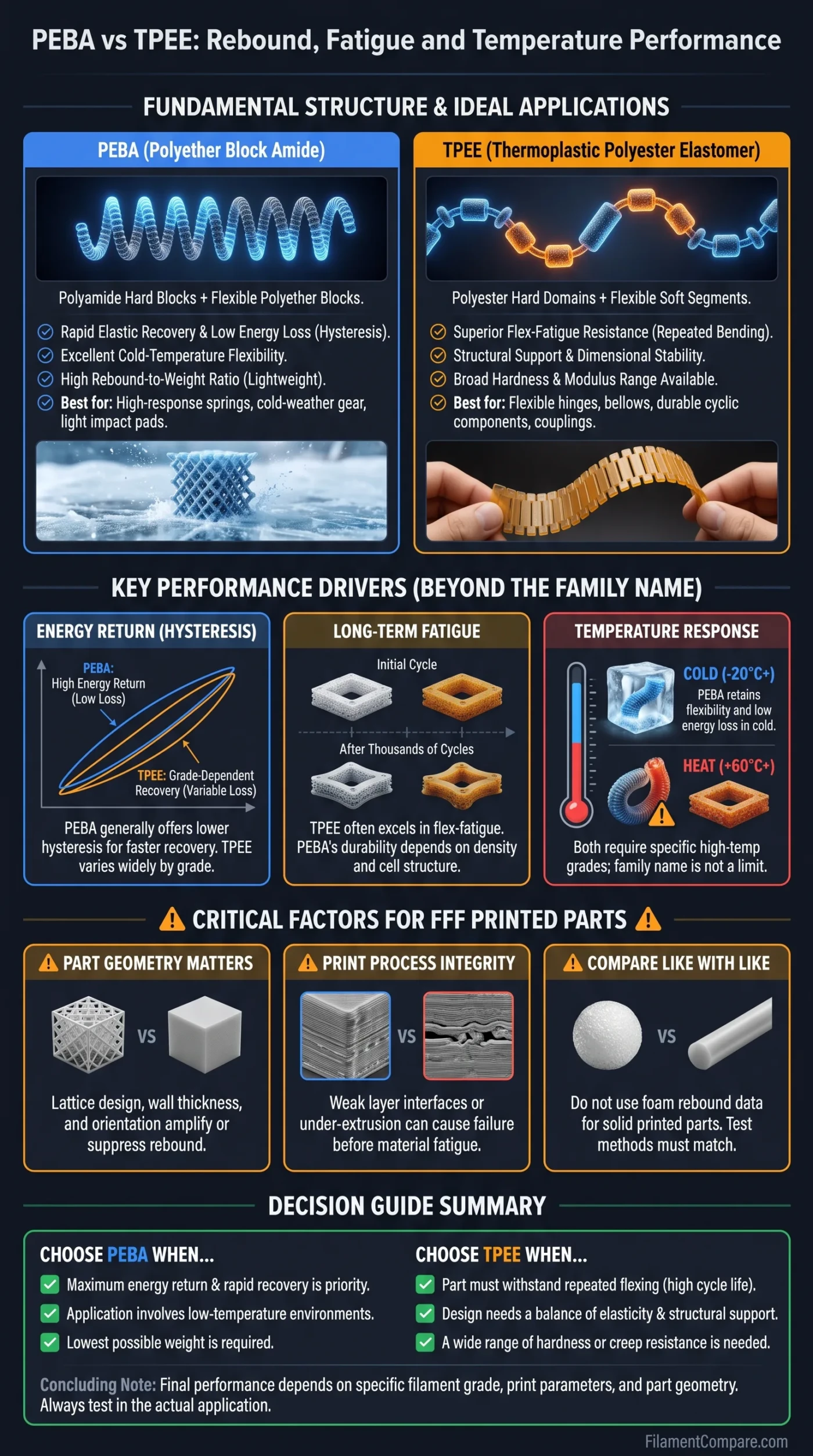
PEBA and TPEE can both produce elastic parts with fast recovery, but they reach that behavior through different block-copolymer structures. PEBA is usually the stronger candidate when low hysteresis, low mass and cold-temperature elasticity dominate the requirement, while TPEE becomes especially attractive when repeated flexing, dimensional support and a broad mechanical operating window matter. For a printed part, however, polymer family alone does not determine the result: grade, hardness, print orientation, wall geometry and whether the material is solid or foamed can change the ranking.
Choose PEBA when the part depends on low energy loss, rapid elastic recovery, low-temperature flexibility or a high rebound-to-weight ratio. Choose TPEE when the design combines elasticity with repeated flexing, creep control, shape stability or exposure to a wider range of mechanical conditions. Neither choice should be made from a generic rebound percentage: a soft expanded PEBA, a dense PEBA filament, a low-hardness TPEE and a high-hardness TPEE can behave like very different materials.
| Decision Point | PEBA | TPEE |
|---|---|---|
| Polymer structure | Polyamide hard blocks with flexible polyether blocks | Thermoplastic polyester hard domains combined with flexible soft segments |
| Rebound potential | Usually very high in grades designed for dynamic response | High to very high in suitable grades and engineered foam structures |
| Hysteresis | Low energy loss is a defining strength of performance PEBA grades | Can also provide low hysteresis and spring-like recovery; result depends strongly on grade |
| Low-temperature response | One of PEBA’s strongest areas, especially where cold stiffening must be limited | Good low-temperature flexibility is available, but the useful range is grade-dependent |
| Repeated flexing | Well suited to dynamic deformation, but fatigue life still depends on grade and part structure | Flex-fatigue resistance is a major reason TPEE is used in repeatedly moving engineering components |
| Compression fatigue | Strong potential, though low-density or cellular structures can accumulate permanent damage | Strong potential when cell stability, hardness and dimensional recovery are controlled |
| Shape support | Ranges from very soft to comparatively rigid depending on grade | Available across a broad hardness and modulus range, including grades that combine elasticity with more structural support |
| Foam sensitivity | Density, cell walls and bead bonding can materially change rebound retention | Cell morphology and post-foaming shrinkage can materially change resilience and compression behavior |
| FFF behavior | Filament formulation and hardness must be checked individually; PEBA is not one universal print profile | Also highly product-specific; TPEE family data should not be substituted for the filament supplier’s print settings |
| Best fit | Light, energetic, cold-flexible parts where elastic recovery is prioritized | Repeatedly flexed parts that need elasticity together with mechanical and dimensional support |
| Main limitation of a family-level comparison | A foamed sports grade and a solid extrusion grade may have little practical resemblance | Hard-segment content and formulation can shift stiffness, thermal behavior and rebound considerably |
The Block Structure Changes How Energy Is Stored and Released
Both PEBA and TPEE are segmented thermoplastic elastomers, so neither behaves like a simple homogeneous rubber. Their harder domains provide physical restraint while softer segments supply much of the reversible deformation. The chemistry of those regions, their proportion and the way they separate into microscopic phases influence stiffness, recovery speed and energy dissipation.
PEBA
Polyamide domains: provide harder, more ordered regions that help hold the polymer network together.
Polyether regions: provide flexible molecular motion and contribute to elastic response.
The low glass-transition behavior of the polyether phase is one reason performance PEBA grades can retain flexibility and low energy loss in cold conditions.[a]
TPEE
Polyester hard domains: contribute stiffness, strength and dimensional restraint.
Flexible soft segments: permit repeated deformation and recovery.
Commercial TPEE families can span very different hardness and modulus levels, so the acronym TPEE does not describe one fixed mechanical response. Celanese describes its Hytrel TPC family as combining low hysteresis, spring-like recovery and high flex-fatigue resistance.[b]
This distinction matters for filament selection because hardness alone does not describe rebound. Two filaments with similar Shore hardness can dissipate different amounts of energy during loading and unloading, and two grades from the same polymer family can have different hard-to-soft segment ratios. The material name defines a family of possible behavior, not one fixed spring response.
Rebound Is Really a Question of Hysteresis
A part that compresses easily is not necessarily a high-rebound part. Rebound depends on how much of the mechanical energy introduced during deformation is recovered when the load is removed. The energy that does not return is dissipated through mechanisms such as internal friction, viscoelastic movement and local structural deformation.
Loading and unloading are not the same path
Input energy is applied while the part is compressed, bent or stretched.
Returned energy is recovered as the material moves back toward its original shape.
Hysteresis loss is the difference between those two portions of the loading cycle.
PEBA is closely associated with low hysteresis because high-performance grades can return a large fraction of stored deformation energy during repeated motion. Arkema specifically identifies efficient energy return and low hysteresis as characteristic behavior of its Pebax elastomer family.[c] This is one reason PEBA is attractive for spring elements, cushioning structures and other parts where a soft material must recover quickly rather than merely absorb deformation.
TPEE should not be reduced to a lower-rebound alternative. Its elastic response can also be fast, and recent work on microcellular TPEE shows that microphase structure and foam morphology can be adjusted to alter mechanical recovery. A 2025 Chemical Engineering Journal study found that changing hard-segment content altered cell morphology, dimensional shrinkage and mechanical behavior in TPEE foams.[d] That finding does not provide a universal TPEE-versus-PEBA ranking, but it shows why a polymer-family label is too broad for predicting rebound.
Fatigue Can Reverse the Day-One Result
Initial rebound describes a fresh specimen. A hinge, spring element, flexible coupler, lattice or impact pad may instead be loaded thousands of times, making retained rebound and permanent set more useful than the first cycle.
Repeated deformation can produce stress softening, residual strain and local damage even when the material still returns close to its original shape. In printed parts, fatigue can also develop at layer interfaces, sharp transitions and thin walls. That means polymer fatigue resistance and print design must be considered together.
PEBA Can Lose Performance Without Looking Permanently Crushed
PEBA’s low hysteresis does not make it immune to cyclic damage. Research published in the International Journal of Fatigue in 2025 examined bead-welded PEBA foam under cyclic compression and reported both short- and long-duration fatigue behavior. The study also found different fatigue performance between foam densities, reinforcing that cellular structure and density affect durability rather than simply changing weight.[e]
For filament users, the important boundary is that a bead foam is not an FFF print. The study is useful for understanding PEBA’s cellular fatigue mechanisms, but its cycle life or density result should not be copied onto a printed PEBA lattice. An extrusion-printed part adds raster direction, layer bonding, wall thickness and toolpath geometry to the fatigue problem.
TPEE’s Flex-Fatigue Reputation Matters Most in Moving Parts
TPEE has a long engineering-material role in components that bend repeatedly. Commercial TPEE documentation emphasizes flex-fatigue resistance, recovery and creep resistance, making the family attractive for bellows, flexible covers, spring-like components and other repeatedly moving parts.[f]
That does not mean every TPEE filament will outlast every PEBA filament. A very soft grade may deform differently from a harder TPEE, and printing a flexure across weak layer interfaces can erase much of the material-level advantage. For cyclic parts, the useful comparison is therefore property retention in the actual geometry, not a generic statement that one polymer is more durable.
| Measurement | What It Reveals | Why It Matters |
|---|---|---|
| Initial rebound | Response of a new specimen | Useful baseline but says little about long-duration retention |
| Hysteresis after conditioning | Whether energy loss rises after early cycling | Separates a stable elastic response from a material that changes quickly |
| Permanent set | Residual deformation after unloading | Shows whether repeated compression is changing the resting geometry |
| Stiffness retention | Change in load needed to reach the same displacement | Detects softening or structural damage even when the part still looks intact |
| Rebound after extended cycling | How much dynamic response remains | More relevant than day-one rebound for springs, pads and flexures |
| Recovery after rest | How much deformation disappears after unloading for an extended period | Helps separate temporary viscoelastic set from lasting damage |
Cold and Heat Do Not Affect PEBA and TPEE in the Same Way
Temperature changes molecular mobility, so a filament that feels lively at room temperature may become stiffer in the cold or softer under sustained heat. For rebound-sensitive parts, the useful question is not simply whether the polymer survives a temperature. It is whether modulus, hysteresis and recovery remain acceptable at that temperature.
Cold Conditions Favor PEBA’s Low-Temperature Elasticity
Cold performance is one of the clearest reasons to consider PEBA. Arkema attributes the behavior of its Pebax grades to the low glass-transition temperature of the polyether phase and reports that energy loss remains low in sub-zero conditions while elastic modulus changes much less than in materials that undergo pronounced cold stiffening.[g]
For a printed bumper, flexible clip, footwear component or spring element used outdoors, this can matter more than the room-temperature rebound ranking. A material that begins with slightly less rebound but retains its flexibility as temperature falls may perform better than a nominally softer material that stiffens rapidly.
TPEE Offers a Broad Thermal Design Space, but Grade Choice Matters
TPEE grades are offered across a wide hardness and thermal-property range, including heat-stabilized formulations. This makes TPEE useful when elasticity must coexist with mechanical support at elevated temperatures. It would still be incorrect to assign one service-temperature limit to all TPEE: hard-segment content, stabilization package and formulation change the result.
The same caution applies to PEBA. The family contains grades spanning very different hardness levels and formulations, so cold flexibility does not justify assuming identical high-temperature behavior across all PEBA filaments. For a functional print, the filament manufacturer’s TDS should take priority over a general family description.
A Printed Lattice Can Change the PEBA–TPEE Ranking
Material comparisons are often made on standardized specimens, while flexible printed parts commonly depend on geometry to create their spring response. A hollow rib, gyroid structure, thin flexure or cellular pad can store energy by bending its walls as well as by deforming the polymer itself. This creates an important distinction for FFF users: part architecture can amplify or suppress the polymer’s natural rebound behavior.
A dense PEBA specimen may exhibit very low hysteresis, yet a poorly designed PEBA lattice can buckle and retain deformation. A TPEE lattice with thicker load paths may appear more energetic simply because its geometry remains stable. Reverse the wall thickness or relative density and the order may change again.
When Geometry Favors Elastic Recovery
- Smooth load paths instead of sharp strain concentrations
- Wall thickness that avoids immediate local buckling
- Layer orientation aligned with the primary repeated deformation
- Enough recovery space to prevent early densification
- Consistent extrusion without weak or under-filled interfaces
When Geometry Hides the Material Advantage
- Thin hinges loaded repeatedly across weak layer boundaries
- Structures that bottom out before the material can recover elastically
- Very low relative-density lattices that collapse locally
- Sharp corners carrying most of the cyclic strain
- Comparisons where PEBA and TPEE specimens use different geometry
This is also why published foam data should be treated carefully. Expanded bead foams and supercritical-fluid foams have gas-filled cells created during manufacturing; an FFF lattice has designed voids created by toolpaths. Both can be lightweight and compliant, but their damage mechanisms and load paths are not interchangeable.
Foam Research Shows Why Density Alone Cannot Predict Rebound
PEBA and TPEE are both used in cellular materials, and foam studies expose variables that are easy to miss when comparing material names. Cell size, cell-wall thickness, closed-cell content, expansion ratio, bead bonding and post-foaming shrinkage all affect how a cellular elastomer stores and loses mechanical energy.
For PEBA, lowering density reduces mass but also changes the amount of polymer available to carry load. The 2025 cyclic-compression research on bead-welded PEBA found better fatigue behavior in the tested 0.13 g/cm³ foam than in the tested 0.10 g/cm³ foam.[h] That result is valuable precisely because it contradicts the assumption that the lightest version of a high-rebound polymer automatically provides the best long-term mechanical response.
TPEE presents a different cellular-design challenge: shrinkage after foaming can alter dimensions, density and mechanical recovery. Current research is therefore focused not only on making TPEE lighter but also on stabilizing its cell structure. A 2026 review of thermoplastic-elastomer foams describes shrinkage control as a central design problem for obtaining dimensionally stable lightweight elastomeric foams.[i]
For filament users, the practical lesson is narrower: do not transfer a foam rebound number to a solid printed filament. Foam research is useful for understanding how density and structure interact with polymer chemistry, but the actual print should be tested in its intended geometry.
A Useful PEBA vs TPEE Test Needs More Than One Compression
A fair functional comparison can be built without specialized marketing metrics. The aim is to test whether the part returns energy, keeps its geometry and remains consistent as cycles and temperature change.
1. Establish the Baseline
Print specimens with matched geometry, wall count, layer orientation and relative density. Record mass, thickness and the force needed to reach a fixed deformation.
2. Measure Loading and Recovery
Use the same displacement and loading rate for both materials. Compare the loading and unloading response rather than recording only maximum force.
3. Cycle the Part
Repeat the deformation and periodically remeasure thickness, stiffness and recovery. This reveals whether the material is softening or accumulating permanent set.
4. Change Temperature
Condition matched specimens at the temperatures relevant to the application, then repeat the same mechanical test. Do not change deformation or test speed between materials.
5. Test Recovery After Rest
Allow fatigued specimens to recover unloaded, then measure them again. Partial recovery indicates a different failure mode from permanent structural damage.
Where the Decision Lands for Functional Prints
- Choose PEBA when low hysteresis is the main target: especially for light elastic parts where rapid recovery and energy return matter more than maximum structural support.
- Choose PEBA when the part must stay flexible in cold conditions: low-temperature dynamic behavior is one of the family’s clearest advantages.
- Choose TPEE when the part repeatedly bends while still carrying shape: the family is particularly well suited to flex-fatigue applications where elasticity must coexist with engineering-plastic behavior.
- Choose TPEE when a broad selection of hardness and mechanically supportive grades is useful: the polyester-elastomer family covers very different stiffness levels.
- Either material can work for rebound-oriented lattices: geometry, hardness, relative density and print orientation can outweigh a small difference between the base polymers.
- Either material requires grade-level data for elevated-temperature use: family names do not provide a reliable service-temperature or compression-set limit.
- Neither material should be selected from one rebound percentage: test method, specimen type and conditioning must match before percentages can be compared.
- Test the actual printed geometry when fatigue matters: standardized resin or foam data cannot predict layer-interface damage or lattice buckling with enough precision for a cyclic part.
For a part designed primarily as a light elastic spring, impact-return element or cold-weather flex component, PEBA has a persuasive material-level profile because low hysteresis and cold flexibility are closely associated with the family. TPEE becomes more compelling as the requirement shifts toward repeated flexing combined with dimensional restraint, creep resistance and a broader selection of mechanically supportive grades.
The closest comparisons are decided below the polymer-family level. A well-matched PEBA grade can outperform one TPEE grade while losing to another TPEE formulation under a different temperature, density or fatigue condition. For functional 3D printing, the useful specification is therefore not simply PEBA or TPEE; it is the exact filament grade, printed architecture and mechanical condition the finished part must survive.
Technical Sources and Documentation
- [a] Key Properties of Pebax® Elastomers — Arkema High Performance Polymers (Used for PEBA block behavior and low-temperature energy-loss information.)
- [b] Hytrel® TPC — Celanese (Used for TPEE resilience, low-hysteresis and flex-fatigue characteristics.)
- [c] Key Properties of Pebax® Elastomers — Arkema High Performance Polymers (Used for PEBA energy-return and hysteresis behavior.)
- [d] Thermoplastic polyester elastomer foams with tailored morphology and mechanical performance achieved by manipulating microphase-separated structure (Chemical Engineering Journal, 2025; used for the relationship between TPEE microphase structure, foam morphology and mechanical behavior.)
- [e] Fatigue behaviors and cellular damages of bead-welded foam of poly(ether-b-amide) under cyclic compression (International Journal of Fatigue, 2025; used for cyclic-compression fatigue behavior of PEBA bead foam.)
- [f] Thermoplastic Elastomer Portfolio — Celanese (Used for Hytrel TPC flex-fatigue, recovery and creep characteristics.)
- [g] Key Properties of Pebax® Elastomers — Arkema High Performance Polymers (Used for low-temperature modulus and energy-loss behavior.)
- [h] Fatigue behaviors and cellular damages of bead-welded foam of poly(ether-b-amide) under cyclic compression (Used for the reported density-dependent PEBA foam fatigue result.)
- [i] Thermoplastic elastomer foams: Anti-shrinkage strategies toward dimensionally stable lightweight materials (Composites Part B: Engineering, 2026; used for current elastomer-foam shrinkage and dimensional-stability context.)
