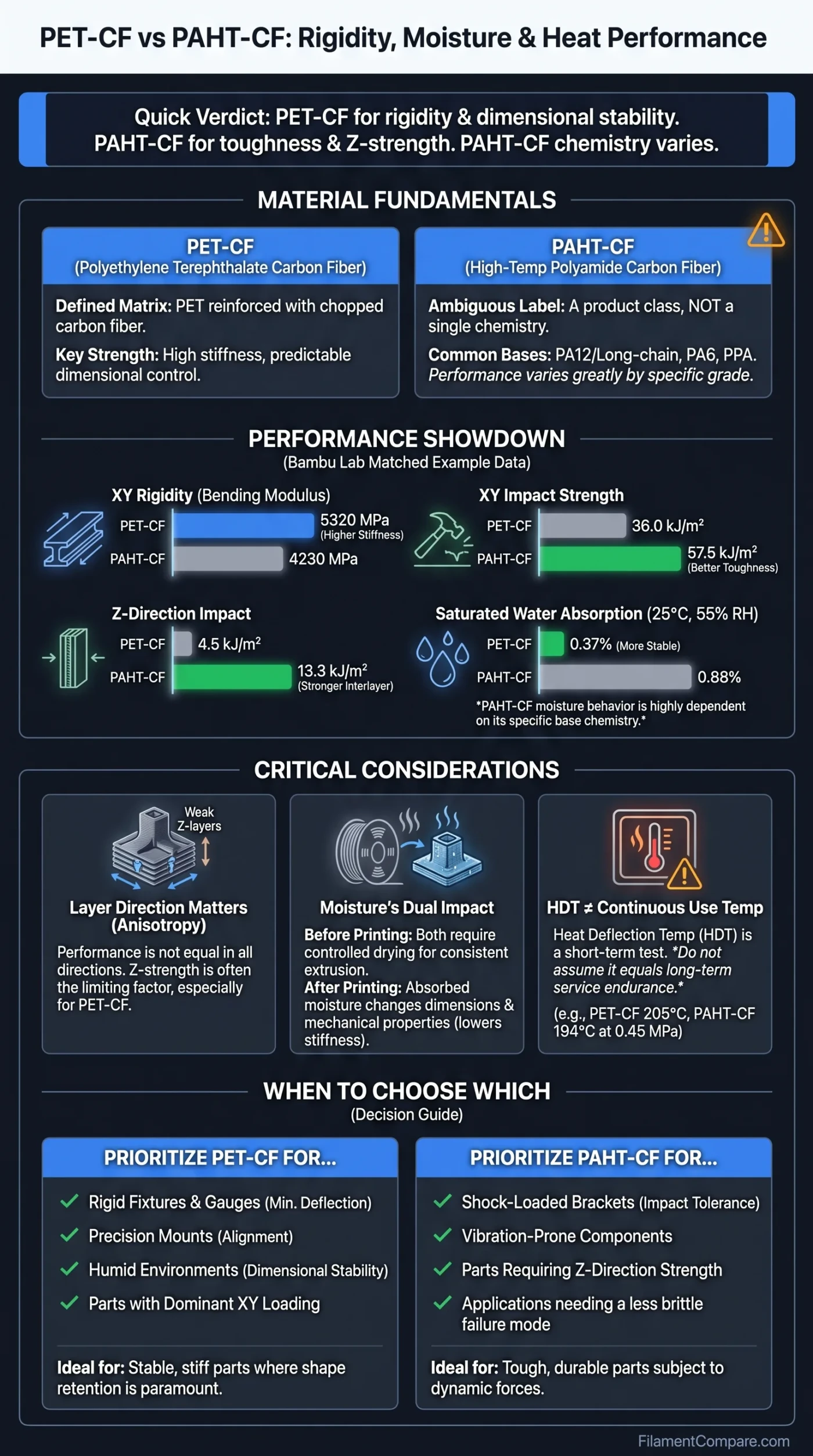
PET-CF generally favors higher rigidity, lower moisture uptake and tighter dimensional control, while PAHT-CF can trade some stiffness for better impact behavior and stronger layer-to-layer performance. The choice becomes less obvious once heat, humidity and sustained loading occur together. PAHT-CF also needs an extra qualification: the name does not define one universal polymer formulation.
For a matched product example, Bambu Lab lists PET-CF at a higher XY bending modulus and lower saturated water absorption than its PAHT-CF, while the PAHT-CF shows higher XY impact strength and much higher Z-direction impact performance. In the same comparison, both sit in a high-HDT class, with PET-CF listed at 205°C and PAHT-CF at 194°C under a 0.45 MPa HDT condition.[a] These numbers are useful because the materials were compared within one manufacturer data system; they should not be treated as universal values for every PET-CF or PAHT-CF spool.
The Better Fit by Priority
Choose PET-CF first when the part must resist bending, hold dimensions closely, or remain predictable after prolonged exposure to humid conditions.
Choose PAHT-CF first when impact tolerance, Z-direction bonding, vibration or a less brittle failure mode matters more than maximum stiffness.
Compare the exact grades rather than the names when heat resistance is the deciding requirement. PAHT-CF chemistry, conditioning and post-processing can change the result enough to overturn a category-level assumption.
| Decision Point | PET-CF | PAHT-CF |
|---|---|---|
| Base polymer | PET reinforced with chopped carbon fiber | High-temperature polyamide category; the actual PA chemistry varies by product |
| Rigidity | Usually the stronger choice when minimum flex is the priority | High, but many grades favor a better stiffness-to-toughness balance |
| Impact behavior | More rigid behavior can come with lower impact tolerance | Often better suited to shock, repeated handling and vibration |
| Layer-to-layer behavior | Can become the limiting direction in heavily loaded FDM parts | Often offers stronger Z-direction performance in comparable grades |
| Moisture uptake | Generally lower and more favorable for dimensional consistency | Lower than conventional nylon in some formulations, but still grade-dependent |
| Dimensional stability in humidity | A strong fit for precision fixtures and parts that should remain geometrically stable | Can be very good, but moisture conditioning of the exact PA grade matters |
| Heat deflection behavior | Very high in engineering PET-CF grades | Very high in suitable PAHT-CF grades; formulation and annealing can alter the result |
| Matched Bambu HDT example | 205°C at 0.45 MPa | 194°C at 0.45 MPa |
| Matched Bambu saturated water absorption | 0.37% at 25°C, 55% RH | 0.88% at 25°C, 55% RH |
| Matched Bambu nozzle range | 260–290°C | 260–290°C |
| Drying requirement | Dry before printing; Bambu specifies 80°C for 8–12 hours in its comparison | Dry before printing; Bambu specifies the same 80°C for 8–12 hours in its comparison |
| Nozzle wear | Carbon fiber is abrasive; wear-resistant hardware is appropriate | Carbon fiber is abrasive; wear-resistant hardware is appropriate |
| Main limitation | Higher rigidity does not guarantee better impact or Z-layer performance | The PAHT-CF label alone does not reveal moisture, stiffness or heat behavior |
The PAHT-CF Label Can Hide a Different Nylon Chemistry
PET-CF is comparatively straightforward at the family level: the matrix is PET and the reinforcement is carbon fiber. PAHT-CF is less specific. The label describes a high-temperature carbon-fiber-reinforced polyamide product class, but it does not reliably identify the underlying nylon chemistry.
Bambu Lab describes its PAHT-CF as a composite based on PA12 and other long-chain polyamides with carbon fiber.[b] That chemistry helps explain why its moisture behavior is much better than a conventional PA6-CF while still retaining the toughness associated with a polyamide matrix.
The same PAHT-CF name has been used for materially different products. eSUN identifies its discontinued ePAHT-CF grade as PA6 reinforced with 15% high-rigidity carbon fiber, together with a 190°C HDT at 0.45 MPa in the product data.[c] Siraya Tech, meanwhile, publishes a Fibreheart PAHT-CF technical sheet based on PPA with 15% carbon fiber.[d]
PAHT-CF is not a sufficiently precise material specification by itself. A PA6-based grade, PA12/long-chain PA grade and PPA-based grade can have different moisture uptake, modulus, heat response, drying conditions and annealing behavior. Compare the polymer base and the test conditions before transferring a number from one brand to another.
This distinction matters most when a project requirement is expressed as a number. A requirement such as “the part must remain stiff near 120°C” cannot be answered from the PAHT-CF name alone. The exact grade, conditioning state, print orientation and post-processing method become part of the material specification.
Rigidity Is About Deflection, Not Just the Highest Strength Number
A bracket that must hold a sensor in alignment has a different requirement from a clip that must survive repeated impacts. For the bracket, bending modulus is often more informative than headline tensile strength because the design problem is how much the part moves under load, not merely the load at which it finally fails.
In Bambu Lab’s matched comparison, PET-CF is listed with an XY bending modulus of 5320 MPa versus 4230 MPa for PAHT-CF. The same dataset moves in the opposite direction for impact behavior: XY impact strength is listed at 36.0 kJ/m² for PET-CF and 57.5 kJ/m² for PAHT-CF. The contrast becomes stronger in the Z direction, where the listed impact values are 4.5 kJ/m² for PET-CF and 13.3 kJ/m² for PAHT-CF.
Rigid Fixture or Gauge
PET-CF usually fits better. Lower bending deflection and stronger dimensional stability are more useful here than additional impact compliance.
Shock-Loaded Bracket
PAHT-CF often fits better. A part that is struck, flexed or vibrated may benefit more from impact tolerance and layer toughness than maximum modulus.
Mixed Structural Loading
Geometry and orientation can decide it. A high XY modulus cannot compensate for a design that repeatedly tries to separate layers in Z.
This is why describing either material simply as “stronger” is not useful. PET-CF can be the stiffer material while PAHT-CF is simultaneously the tougher material. Both statements can be true because stiffness, bending strength, impact resistance and interlayer behavior measure different failure modes.
Moisture Changes the Filament Before Printing and the Part After Printing
Moisture creates two separate engineering problems. Moist filament affects the extrusion process. Water in the feedstock can contribute to unstable extrusion, rough surfaces, bubbles, stringing and weaker bonding. Moisture absorbed by a finished part is a service-condition problem that can change dimensions and mechanical behavior after an otherwise successful print.
Before Printing
The question is whether the filament entering the hotend is dry enough to extrude consistently. Both PET-CF and PAHT-CF should be treated as materials that benefit from controlled drying and dry storage rather than assuming PET-CF can be left exposed because its finished-part water uptake is comparatively low.
After Printing
The question becomes how much environmental moisture the polymer matrix absorbs and how that conditioning changes stiffness, dimensions and long-term behavior. This is where PET-CF often gains a practical advantage over polyamide-based alternatives.
The Bambu comparison illustrates the scale of that difference within one product family: saturated water absorption is listed at 0.37% for PET-CF and 0.88% for PAHT-CF under the stated 25°C, 55% RH condition. That does not make the PAHT-CF unusually moisture-sensitive for a nylon; in fact, the same manufacturer positions it as a lower-absorption alternative to conventional PA-CF. It does mean that PET-CF starts with a useful advantage when geometric stability in humidity is the main requirement.
Bambu’s PAHT-CF data also shows why “nylon gets wet” is too crude a description. Its listed XY bending modulus changes from 4230 MPa in the dry condition to 3640 MPa after the specified wet conditioning, while the manufacturer’s conventional PA-CF comparison drops much more sharply. A well-formulated PAHT-CF can therefore retain useful mechanical properties after moisture exposure, even though its behavior still changes more than a low-absorption PET-CF.
Low moisture absorption is not the same as a liquid-tight printed part. Layer interfaces, porosity, wall thickness, print parameters, chemical exposure and pressure can still determine whether a component leaks or survives long-term fluid contact. PET-CF’s moisture advantage should be interpreted as a material-stability benefit, not as an automatic waterproofing claim.
For a 100.00 mm fixture dimension, the useful question is therefore not only which filament prints closest to 100.00 mm on day one. It is which part remains closest to that target after days or weeks in the environment where the fixture will actually operate.
HDT Does Not Set the Continuous Service Temperature
The 205°C PET-CF and 194°C PAHT-CF HDT figures in the matched Bambu example can make PET-CF look like an automatic heat winner. The numbers do show excellent resistance to deflection in that particular test, but an HDT value is not a promise that a printed component can carry its working load continuously at the same temperature.
ISO 75-1 defines the test around deflection under flexural load while temperature rises under specified conditions. The current ISO 75-1:2020 standard also states that the results do not necessarily represent maximum applicable temperatures and are not intended to predict actual end-use endurance at elevated temperature.[e]
HDT ≠ continuous-use temperature. A part surviving a standardized short-duration deflection test is different from a bracket carrying load for months near a hot motor, enclosure or process line. Time, stress, geometry, orientation and environmental conditioning all matter.
Annealing adds another complication. Siraya Tech’s PPA-based PAHT-CF data illustrates how much post-processing can alter a heat result: its published HDT Method B value at 0.45 MPa is 84.5°C unannealed and 192°C after annealing. The same sheet lists an HDT Method A result at 1.80 MPa of 82.5°C unannealed and 119°C annealed. Those are results for that specific PPA-based product, not general PAHT-CF values, but they demonstrate why test load and annealing condition cannot be omitted from a serious comparison.
A fair heat comparison therefore requires more than placing two HDT numbers next to each other. Check whether both specimens were dry or conditioned, annealed or as-printed, tested under the same load and produced in a comparable orientation. An annealed specimen should not be used to claim superiority over an as-printed competitor without making the condition visible.
For real parts, temperature and load duration should be considered together. A fixture exposed to 150°C for a few minutes during a process step poses a different problem from a bracket that must hold a constant load at 110°C for thousands of hours. Creep and stress relaxation can become more important than the headline HDT once the exposure is sustained.
Layer Direction Can Reverse a Datasheet Advantage
Short carbon fibers tend to align with material flow during extrusion, while FDM parts still contain interfaces between deposited roads and layers. The printed component is therefore anisotropic: an XY property cannot be assumed to describe the same behavior in Z.
This matters directly in PET-CF versus PAHT-CF. In Bambu Lab’s comparison, PET-CF carries the higher XY bending modulus, yet PAHT-CF has the much higher listed Z-direction impact strength. A stiff PET-CF bracket loaded mostly within the layer plane can perform very differently from the same geometry rotated so that the load tries to separate layers.
Print orientation is part of the material choice. Before choosing a filament from an XY modulus or strength number, identify the dominant load path in the actual model. If the load opens layer interfaces, Z-direction data and geometry may matter more than the highest XY value on the datasheet.
| Part or Environment | Better Starting Point | Why | What Still Needs Checking |
|---|---|---|---|
| Precision machining fixture | PET-CF | High rigidity and low moisture-driven dimensional change favor stable references and locating features. | Creep under the actual clamping load and temperature. |
| Camera, sensor or optical mount | PET-CF | Small deflections can matter more than impact toughness when alignment must remain fixed. | Layer direction around screw bosses and cantilevered arms. |
| Humid equipment enclosure bracket | PET-CF | Lower moisture uptake reduces one source of dimensional drift. | Actual UV, chemical and temperature exposure if the part is outdoors. |
| Vibration-loaded machine bracket | Often PAHT-CF | Higher toughness and stronger layer performance may be more useful than maximum stiffness. | Exact PAHT chemistry, fatigue behavior and print orientation. |
| Impact-prone functional component | Often PAHT-CF | A less brittle response can be preferable when the part is struck or repeatedly flexed. | Whether added compliance creates unacceptable movement. |
| Hot, dimension-sensitive fixture | Grade-dependent | PET-CF combines low moisture uptake with high HDT, but some PAHT-CF chemistries can deliver very strong thermal performance. | Matched HDT method, continuous load, annealing and service duration. |
| Long-term wet or splash-exposed structural part | Often PET-CF | Lower water uptake is favorable when dimensional consistency is more important than maximum impact toughness. | Fluid chemistry, sealing, layer porosity and any pressure requirement. |
| Gear or sliding mechanism | No automatic winner | Polyamide behavior may be attractive for moving parts, but carbon fiber is abrasive and the mating system matters. | Wear testing, lubrication, surface finish, backlash and mating material. |
Orientation can also affect how heat and creep appear in practice. A ribbed PET-CF component with its primary load carried along the extrusion direction may outperform a nominally tougher material in a stiffness-driven design, while a PAHT-CF component with better Z bonding may survive a load case that causes the PET-CF part to fracture between layers. The useful comparison is therefore material + orientation + environment, not material name alone.
Choosing by the Part Requirement
Choose PET-CF When
- The part should deflect as little as practical under load.
- Tight dimensional control matters over weeks or months.
- Humidity or intermittent water exposure is part of the service environment.
- The design is a rigid frame, fixture, gauge, mount or structural support rather than an impact-absorbing component.
- The load path can be kept primarily within strong printed directions.
- You have verified that the selected grade’s heat data matches the real operating temperature and load duration.
Choose PAHT-CF When
- Impact resistance matters more than obtaining the highest possible modulus.
- The component will see vibration, repeated handling or occasional shock.
- Z-direction bonding is a major part of the structural design.
- A small amount of compliance is preferable to a more brittle failure mode.
- You can identify the actual PA chemistry rather than buying from the PAHT-CF label alone.
- The grade’s moisture and annealing requirements fit your production workflow.
Where the Decision Lands
PET-CF is the stronger starting point for rigidity and environmental dimensional stability. It is especially compelling for fixtures, frames and alignment-sensitive parts where a small change in shape is itself a failure.
PAHT-CF is the stronger starting point for toughness and layer-sensitive mechanical loading. It becomes more attractive when impact, vibration or Z-direction stress can punish a very stiff but more brittle part.
Either can work for high-temperature engineering parts when the actual grade has been verified under comparable test conditions and the service temperature remains comfortably inside a validated design envelope.
Neither material name solves the entire engineering problem. Sustained load, creep, chemical exposure, fatigue, outdoor exposure, fluid sealing and print orientation may require their own validation before a functional component is put into service.
Technical Sources and Documentation
- [a] PET-CF | Bambu Lab US Store (Used for the matched PET-CF versus PAHT-CF stiffness, toughness, layer adhesion, HDT, water absorption and printing-condition comparison.)
- [b] PAHT-CF | Bambu Lab US Store (Used for PA12/long-chain PA composition, wet-condition mechanical data and PAHT-CF moisture behavior.)
- [c] ePAHT-CF eSUN 3D Printer Filament (Used to document a PA6-based, 15% carbon-fiber PAHT-CF formulation and its published material data; the page identifies this grade as discontinued.)
- [d] Siraya Tech Fibreheart PPA-CF TDS (Used for the PPA-based PAHT-CF example, 15% carbon-fiber composition and annealed versus unannealed thermal data.)
- [e] ISO 75-1:2020 — Plastics — Determination of Temperature of Deflection Under Load — Part 1: General Test Method (Used for the interpretation and limitations of HDT data.)
