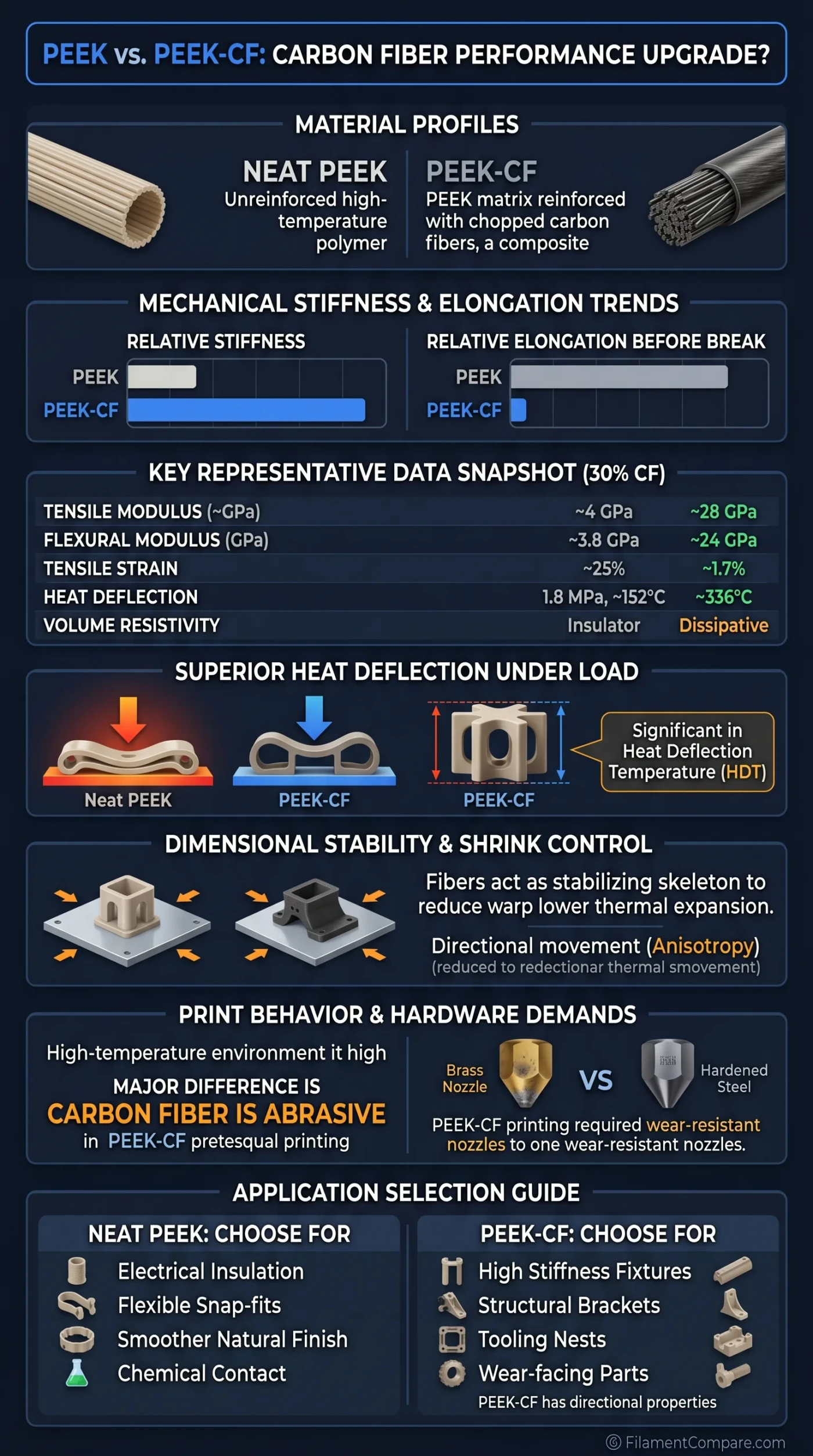
PEEK-CF can improve PEEK performance, but the improvement is not one single thing. The clearest gains are stiffness, shape stability under heat and load, lower thermal expansion, and better resistance to dimensional drift. Neat PEEK still has a strong place when a printed part needs more elongation, cleaner electrical insulation, or a little more flex before failure.
| Property | PEEK [a] | PEEK-CF [b] | Meaning for Printed Parts |
|---|---|---|---|
| Material Type | Unreinforced semi-crystalline polyetheretherketone | PEEK matrix reinforced with chopped carbon fiber; 30% carbon fiber in the reference resin grade | PEEK-CF behaves more like a stiff composite; PEEK behaves more like a tough high-temperature polymer. |
| Density | 1.30 g/cm³ | 1.40 g/cm³ | PEEK-CF may add a little mass, though the stronger stiffness-to-weight feel can still suit brackets, jigs, and load-bearing housings. |
| Tensile Modulus at 23°C | 4,000 MPa | 28,000 MPa | Carbon fiber raises stiffness sharply in molded data; printed values depend on fiber loading, toolpath, chamber temperature, and annealing. |
| Reported Tensile Stress | 98 MPa at yield | 265 MPa at break | PEEK-CF can carry higher tensile stress in the fiber-aligned direction, while neat PEEK gives more stretch before rupture. |
| Tensile Strain at Break | 25% | 1.7% | PEEK favors ductile movement; PEEK-CF favors rigidity and low deflection. |
| Flexural Modulus at 23°C | 3,800 MPa | 24,000 MPa | PEEK-CF is much harder to bend, which matters for arms, fixtures, plates, and thin structural ribs. |
| Heat Deflection Under Load, 1.8 MPa | 152°C, unannealed | 336°C, unannealed | Carbon fiber improves shape retention under load at elevated temperature; this is one of the largest practical differences. |
| Glass Transition Temperature | 143°C onset; 150°C midpoint | 143°C onset; 150°C midpoint | The polymer phase is still PEEK, so carbon fiber does not turn the base resin into a new polymer. |
| Melting Temperature | 343°C | 343°C | Both need true high-temperature equipment. A regular desktop hotend and open build volume are not a realistic match. |
| CLTE Below Tg, Flow Direction | 45 ppm/K | 5 ppm/K | PEEK-CF expands less along fiber alignment, which helps reduce shrink-driven movement when the thermal path is controlled. |
| Electrical Behavior at 23°C | Volume resistivity around 1.0E+16 ohms·cm | Volume resistivity around 1.0E+5 ohms·cm | Neat PEEK is the clearer choice for electrical insulation; PEEK-CF can be more dissipative depending on fiber loading and part geometry. |
The PEEK and PEEK-CF values above come from manufacturer datasheets and standards-based references; they show material trends, while real printed results change with fiber percentage, extrusion path, annealing, crystallinity, and printer thermal control.
- PEEK: more elongation
- PEEK-CF: higher stiffness
- Both: high-temperature polymers
- Printed parts: orientation-sensitive
- Main variable: crystallinity
Does Carbon Fiber Improve PEEK?
Yes, carbon fiber usually improves PEEK when the word “performance” means stiffness, creep resistance, dimensional stability, lower thermal expansion, heat-loaded rigidity, or wear-oriented behavior. It gives the polymer matrix a stiff internal reinforcement, so the part bends less under the same load. That is the main story.
It is not a universal upgrade. For snap-fit tabs, parts that need visible flex, electrical insulation, transparent or natural-colored material, and smoother tool wear conditions, neat PEEK may fit the design more cleanly. Carbon fiber changes the trade-off: it trades elongation and some electrical insulation for a more rigid, fiber-reinforced response.
Plain Answer for Material Selection
Choose PEEK-CF when the printed part must stay straighter, bend less, and hold shape near heat. Choose PEEK when the part needs more ductility, cleaner dielectric behavior, or a less abrasive printing path. Short answer. Real answer: the part geometry decides a lot.
What Carbon Fiber Changes Inside PEEK
PEEK is a semi-crystalline high-performance thermoplastic. In a PEEK-CF filament, chopped carbon fibers sit inside the PEEK matrix and act as a reinforcement phase. The polymer still melts and crystallizes as PEEK, while the fibers carry part of the mechanical load and restrict movement of the resin around them.
That restriction is why PEEK-CF often shows higher modulus and lower shrink movement. In simple terms, the carbon fibers behave like tiny stiff rods inside a high-temperature polymer. They do not make every direction stronger by the same amount, because FFF/FDM printing tends to align chopped fibers along the extrusion path.
This is where many short comparisons blur the picture: PEEK-CF is anisotropic. Along the bead direction it can be very stiff. Across beads, through layers, or around sharp notches, the result depends heavily on layer bonding, voids, crystallinity, and fiber distribution. Same material name. Different part behavior.
Mechanical Performance: Stiffness, Strength, and Strain
The largest mechanical change is stiffness. Neat PEEK already sits far above common materials such as PLA, PETG, ABS, ASA, and many nylons in heat capability, but it still behaves like an unfilled polymer. Add carbon fiber and the modulus can jump, especially in molded test specimens or well-aligned printed beads.
Relative Stiffness Trend
Relative Elongation Trend
Tensile Behavior
In tensile loading, carbon fiber helps most when the load follows the direction of the fibers. For printed filament, that usually means the direction of the extrusion road. This is why two PEEK-CF samples printed from the same spool can behave differently if one is loaded along the bead direction and the other is loaded across layer lines.
PEEK-CF often feels much more rigid in the hand. It also reaches lower elongation before break, so it is less forgiving in flex-heavy features. Neat PEEK can stretch more before it fails, which can suit living-hinge-like movement, clips with controlled flex, and parts where stress needs to spread through the polymer rather than stay concentrated around fibers.
Flexural Behavior
Flexural modulus matters when a part acts like a beam, bracket, cover, tool nest, or support plate. Carbon fiber gives PEEK-CF a strong advantage here, because bending puts one side of the part in tension and the other in compression, and the stiff fibers resist that deformation.
In FFF/FDM, perimeter direction and raster angle matter. A PEEK-CF bracket can be very stiff in a load path that follows continuous extruded roads, then less impressive when force tries to peel or split layers. The material improves the part, but it does not erase layer mechanics.
Why Datasheet Numbers Can Look Far Apart
PEEK-CF values vary by fiber content, fiber length, base resin grade, processing method, and specimen shape. For example, a molded 30% carbon-fiber PEEK resin can show far higher modulus than a machined stock-shape datasheet that uses different test geometry and processing history; one TECAPEEK CF30 stock-shape listing reports 6,000 MPa tensile modulus, 112 MPa tensile strength, and 10% elongation at break under DIN EN ISO 527-2 conditions.[c]
This does not make the data conflict by default. It means form matters. Resin pellets, extruded rod, compression-molded plate, and 3D printed filament are not identical test worlds.
Heat Behavior Under Load
Carbon fiber does not meaningfully change the identity of PEEK. The glass transition and melting point stay close because the polymer matrix is still PEEK. The big improvement is seen when heat and load act together.
Heat deflection temperature is often the most useful thermal comparison for structural parts. It describes when a standard specimen reaches a defined deformation under load, not when the polymer melts. ASTM D648 covers deflection temperature of plastics under flexural load in specified conditions.[f]
That distinction matters. A neat PEEK part may remain chemically stable at high temperature, but it can lose stiffness as it moves through and above its glass-transition region. Carbon fiber helps the part resist that softening-driven shape change, so PEEK-CF can keep geometry steadier when a load is present.
HDT is not melting temperature. A material can have a melting point near 343°C and still show a much lower or higher heat-deflection value depending on load, reinforcement, crystallinity, specimen thickness, and test method.
Dimensional Stability, Shrink, and Warp
PEEK printing has a thermal challenge: the material needs a high melt temperature, then cools through a crystallization zone where shrinkage and stress can build. Neat PEEK can print accurately on suitable equipment, but it asks for a well-controlled thermal environment.
PEEK-CF often helps by lowering thermal expansion and restricting resin movement. The fibers act like a stabilizing skeleton inside the polymer. This is why PEEK-CF is commonly chosen for parts that need flatness, tight geometry, or reduced movement during cooling.
There is a catch, and it is an engineering catch rather than a warning label: carbon fibers mostly help where they are aligned. A printed plate may show lower shrink along the bead direction than across the bead direction. That means PEEK-CF can still show directional movement, especially in wide, thin, or unevenly cooled parts.
Annealing is another part of the story. In 3D printed CF/PEEK research, low-pressure annealing improved interlaminar shear strength by up to 55.4%, with the improvement linked to higher crystallinity, lower porosity, and a better fiber–resin interface.[h] The practical meaning is simple: thermal history is part of the material, not a footnote.
Print Behavior and Machine Demands
Both materials sit in the high-temperature end of filament printing. They need a hot nozzle, a heated bed, and a chamber that can hold enough heat to reduce thermal gradients. The exact values depend on the filament brand and printer, but the machine class is not casual desktop territory.
PEEK-CF can reduce some shrink-related movement, yet it introduces its own hardware consideration: carbon fiber is abrasive. A standard brass nozzle can wear faster, which changes extrusion width over time and can affect dimensional accuracy. Hardened steel, ruby, tungsten carbide, or similar wear-resistant nozzles are common pairings for carbon-fiber-filled filaments.
Neat PEEK does not contain abrasive fiber, so the nozzle wear side is simpler. It may also give a smoother natural finish and better translucency in thin sections. PEEK-CF usually prints with a matte black surface, a more technical texture, and a stiffer feel right off the bed.
| Printing Area | PEEK | PEEK-CF | Practical Reading |
|---|---|---|---|
| Shrink Control | Strongly affected by chamber temperature and crystallization control | Usually improved by carbon-fiber reinforcement | PEEK-CF can be easier to keep dimensionally calm, but machine heat still matters. |
| Nozzle Wear | Lower abrasive wear | Higher abrasive wear from carbon fiber | Wear-resistant nozzles are a normal part of PEEK-CF printing. |
| Layer Bonding | Depends on melt temperature, chamber heat, and crystallinity | Also depends on fiber content and fiber–resin interface | PEEK-CF does not remove Z-axis limits; it changes the balance of stiffness and bonding. |
| Surface Appearance | Natural to beige, often smoother | Black, matte, more textured | Appearance can matter for visible prototypes, fixtures, and inspection parts. |
| Post-Processing Response | Annealing can tune crystallinity and heat behavior | Annealing can also improve interlayer and fiber–matrix behavior | Thermal treatment must match the material supplier’s data and part geometry. |
Wear, Friction, and Surface Load
Carbon-fiber-reinforced PEEK is often selected for sliding, bearing-adjacent, and wear-related components because the stiff filler helps the surface hold shape under pressure. The polymer matrix already has strong chemical and thermal behavior; the carbon fiber adds a harder internal phase and lower movement under load.
Still, wear is a system result. Counterface material, contact pressure, surface finish, lubrication, temperature, and fiber exposure all matter. A printed PEEK-CF bushing does not behave exactly like an injection-molded or machined engineering part, because porosity and bead boundaries can influence the contact surface.
For printed parts, PEEK-CF usually suits stiff sliding supports, inspection nests, high-temperature fixtures, and low-deflection tooling. Neat PEEK suits parts that need chemical resistance, heat capability, and a polymer surface without exposed fiber ends.
Electrical and Thermal Conductivity Differences
Neat PEEK is a strong electrical insulator. Carbon fiber changes that. Depending on fiber loading, fiber contact paths, and geometry, PEEK-CF can move toward static-dissipative or more conductive behavior. It should not be treated as automatically conductive in every design, but it is no longer the same dielectric material as neat PEEK.
This difference can be useful in fixtures where static management matters. It can also be a reason to choose neat PEEK for electrical separators, insulators, sensor housings, or parts where stable dielectric behavior is more important than stiffness.
Carbon fiber can also raise thermal conductivity in preferred directions. That may help a part spread heat more evenly, though printed bead orientation again matters. Directional material, directional result.
Where PEEK-CF Usually Makes More Sense
PEEK-CF tends to be the stronger fit when the part needs high stiffness, low deflection, and stable geometry. It is especially relevant when the load path is known and the print orientation can place fibers in useful directions.
- High-temperature fixtures that need to stay flat and resist bending.
- Structural brackets where stiffness matters more than elongation.
- Tooling nests and inspection aids that benefit from dimensional stability.
- Wear-facing parts where lower movement under pressure is helpful.
- Thin ribs or plates where neat PEEK may deflect more than desired.
- Parts exposed to repeated thermal cycles where lower expansion can protect alignment.
Where Neat PEEK Usually Makes More Sense
Neat PEEK is not the “weaker choice.” It is the more ductile version of the same high-end polymer family, and that can be exactly what a part needs. More movement before break can protect clips, flexible tabs, small hooks, and geometries that concentrate stress.
- Electrical insulation parts that should keep high resistivity.
- Flexible or snap-fit features where elongation is part of the design.
- Chemical-contact parts where exposed fiber is not desired at the surface.
- Parts needing a smoother natural finish or a lighter material color.
- Small detailed features where fiber-filled flow or nozzle wear may affect edges.
- Designs loaded in many directions where fiber alignment is hard to use predictably.
Test Terms That Matter
Material datasheets can look simple, but each number carries a test method behind it. Comparing PEEK to PEEK-CF is much safer when the same property, specimen type, and standard are being compared.
| Term | What It Describes | Why It Matters in PEEK vs PEEK-CF |
|---|---|---|
| Tensile Modulus | Resistance to stretching in the early, mostly elastic part of a tensile test; ISO 527 defines general tensile testing principles for plastics and plastic composites.[d] | PEEK-CF usually rises strongly here, so the part feels much stiffer. |
| Tensile Strength | Stress level during pulling, often reported at yield or break; ASTM D638 is used to produce tensile property data for plastics under specified conditions.[e] | Comparisons need care because PEEK may yield while PEEK-CF may break with less elongation. |
| Flexural Modulus | Resistance to bending; ASTM D790 uses a three-point loading setup for unreinforced and reinforced plastics.[g] | This is one of the most useful values for brackets, covers, arms, and fixture plates. |
| HDT or DTUL | Temperature where a loaded specimen reaches a defined deflection. | PEEK-CF can show a large advantage because fibers support the polymer under heat and bending stress. |
| CLTE | Coefficient of linear thermal expansion. | Lower CLTE means less size change per degree of temperature change, especially along fiber alignment. |
| Crystallinity | The ordered fraction of the semi-crystalline PEEK matrix. | Crystallinity affects stiffness, heat behavior, shrinkage, chemical response, and layer bonding. |
The 3D Printing Reality: Fiber Direction Rules the Part
In molded PEEK-CF, fibers may be distributed through a mold flow pattern. In FFF/FDM, the nozzle lays down fiber-filled roads. The fibers tend to follow that road, so the part becomes direction-sensitive.
This can be used well. A printed PEEK-CF beam can be oriented so its main roads follow the load path. A flat plate can be rastered to reduce deflection in chosen directions. A ring, clip, or multi-axis bracket may need more thought because the fiber direction changes from region to region.
The Z direction deserves special attention. Carbon fiber improves the filament strand, but layers still join through polymer diffusion, heat, pressure, and time at temperature. If the chamber is too cool or the part cools unevenly, PEEK-CF may keep high in-plane stiffness while the layer interface becomes the limiting area.
Does PEEK-CF Need Annealing More Than PEEK?
Both materials can be affected by annealing because PEEK is semi-crystalline. Annealing can raise crystallinity and reduce internal stress, but it may also change dimensions. For PEEK-CF, carbon fiber can help hold shape during thermal treatment, while the polymer matrix still responds to heat history.
The safest way to read annealing data is as a material-and-process pair. A temperature that works for one filament, printer, part thickness, and chamber profile may not transfer cleanly to another. Thin coupons, thick blocks, and wide plates can all respond differently.
Useful Design Reading
PEEK-CF improves stiffness first. Heat-loaded shape retention comes next. Strength may improve in well-aligned directions, but the printed part still depends on layer bonding, void content, crystallinity, and the orientation of each road.
PEEK-CF vs PEEK by Application Goal
| Application Goal | More Natural Fit | Reason |
|---|---|---|
| Lowest deflection under load | PEEK-CF | Carbon fiber raises stiffness and flexural rigidity. |
| Higher elongation before failure | PEEK | Unfilled PEEK offers more ductile movement. |
| Higher shape stability near heat | PEEK-CF | Carbon fiber supports the matrix under thermal and mechanical load. |
| Electrical insulation | PEEK | Neat PEEK has much higher resistivity in typical datasheet values. |
| Reduced thermal expansion | PEEK-CF | Fibers reduce expansion most clearly along their alignment. |
| Less abrasive printing path | PEEK | No carbon fiber means less nozzle wear from reinforcement. |
| Matte black technical finish | PEEK-CF | Carbon fiber filled grades usually print black with a more textured surface. |
| Natural polymer finish | PEEK | Unfilled PEEK is often natural or beige, depending on grade. |
Common Misreadings in PEEK-CF Comparisons
“Carbon Fiber Makes PEEK Stronger in Every Direction”
Carbon fiber can raise strength and stiffness, but direction matters. In printed PEEK-CF, the strongest behavior often appears along the extrusion path. Across layers, geometry and bonding can matter more than the fiber content on the label.
“Higher HDT Means Higher Melting Point”
PEEK and PEEK-CF can share a similar melting temperature while showing very different heat deflection values. HDT is a loaded deformation test, not a melt test. The carbon fiber helps support the shape before the polymer reaches melt.
“All PEEK-CF Filaments Are the Same”
They are not. A 10% carbon-fiber PEEK filament and a 30% carbon-fiber PEEK compound can behave very differently. Fiber length, fiber treatment, base resin viscosity, moisture control, and extrusion quality also change the final printed part.
“Datasheet Strength Equals Printed Part Strength”
Datasheets are reference points, not finished-part guarantees. A printed part adds bead bonding, porosity, fiber orientation, cooling rate, annealing response, and surface quality to the material equation. This is why a printed coupon and a molded specimen can tell different stories while both are valid in their own setting.
Frequently Asked Questions
- Does carbon fiber make PEEK stronger?
- Often, yes, especially in stiffness and fiber-aligned tensile or flexural loading. The improvement is strongest when the print orientation matches the load path. For strain before break, neat PEEK usually has the advantage.
- Is PEEK-CF always better than PEEK?
- No. PEEK-CF is more suitable for stiff, stable, heat-loaded parts. Neat PEEK can be more suitable for ductility, electrical insulation, smoother polymer surfaces, and designs that need controlled flex.
- Does PEEK-CF print easier than PEEK?
- PEEK-CF can reduce shrink and warping trends, but it is abrasive and still needs a high-temperature printer. It may feel easier in dimensional stability, while neat PEEK is easier on nozzle wear.
- Does carbon fiber raise PEEK’s melting point?
- Not in a major way. PEEK-CF still uses a PEEK matrix, so melting temperature stays near the PEEK range. The larger change is heat deflection under load, not polymer melting.
- Is PEEK-CF electrically conductive?
- It can be more conductive or static-dissipative than neat PEEK, depending on fiber content and fiber network. It should not be assumed to behave like metal, and it should not be used as a dielectric substitute for neat PEEK without testing.
- Which material is better for high-temperature brackets?
- PEEK-CF is usually the more natural fit when the bracket must resist bending and keep shape under heat. Neat PEEK remains useful when the bracket needs more flex or electrical insulation.
Resources Used
- [a] VICTREX™ PEEK POLYMER 450G™ datasheet
- [b] VICTREX™ PEEK POLYMER 450CA30 datasheet
- [c] Ensinger TECAPEEK CF30 black technical data
- [d] ISO 527-1:2019 plastics tensile properties
- [e] ASTM D638 tensile properties of plastics
- [f] ASTM D648 deflection temperature under load
- [g] ASTM D790 flexural properties of plastics
- [h] Effects of low-pressure annealing on 3D printed CF/PEEK composites
