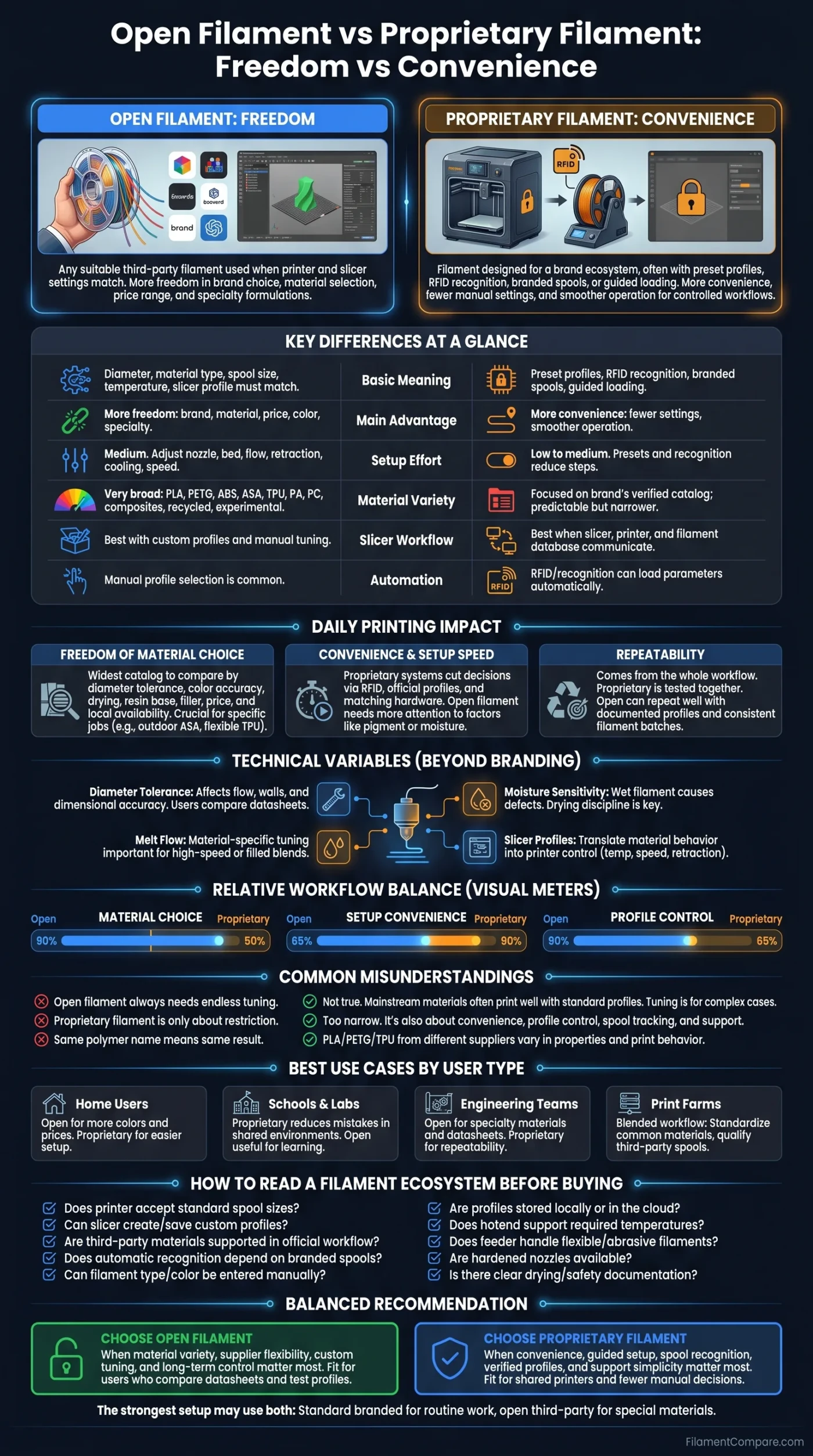
| Comparison Point | Open Filament | Proprietary Filament |
|---|---|---|
| Basic Meaning | Any suitable third-party filament can be used when the diameter, material type, spool size, temperature range, and slicer profile match the printer. | Filament is designed to work inside a defined brand ecosystem, often with preset profiles, RFID recognition, branded spools, or guided loading. |
| Main Advantage | More freedom in brand choice, material selection, price range, color range, and specialty formulations. | More convenience, fewer manual settings, and smoother operation for users who prefer a controlled workflow. |
| Setup Effort | Medium. Users may adjust nozzle temperature, bed temperature, flow rate, retraction, cooling, drying, and speed. | Low to medium. Presets and automatic recognition can reduce setup steps, especially with matching hardware. |
| Material Variety | Very broad: PLA, PETG, ABS, ASA, TPU, PA, PC, filled composites, recycled blends, ESD-safe grades, flame-retardant grades, and experimental blends. | Usually focused on the brand’s verified material catalog, with more predictable profiles but a narrower supply path. |
| Common Diameter | Most desktop FDM/FFF printers use 1.75 mm; some machines use 2.85 mm. Tolerance varies by manufacturer. | Usually matched to the printer ecosystem; some branded filaments publish tighter diameter control, such as 1.75 ± 0.02 mm for Prusament PLA.[a] |
| Slicer Workflow | Works best when the slicer allows custom filament profiles and manual tuning. | Works best when the slicer, printer, and filament database are built to communicate with each other. |
| Automation | Manual profile selection is common, although open profile libraries and third-party material marketplaces can reduce trial work. | RFID or branded material recognition can load material type, color, and print parameters automatically on supported systems.[b] |
| Best Fit | Users who want control, broad material access, supplier flexibility, and custom tuning. | Users who value repeatability, guided setup, brand-tested profiles, and simpler daily operation. |
This comparison treats open filament and proprietary filament as material-system models, using manufacturer datasheets, slicer documentation, and industry terminology sources; real print results still change with printer hardware, nozzle condition, moisture level, slicer settings, and part geometry.
Open filament and proprietary filament are not only about spool branding. They describe two different ways of managing FDM/FFF printing: one gives the user more control over material choice, while the other bundles filament, profiles, and hardware behavior into a more guided workflow. Both approaches can produce accurate, clean, strong parts when the material is matched to the machine.
The useful question is not “which one is better?” A better question is: which system gives the right balance of freedom, convenience, reliability, and material access for the prints being made? For a school lab, print farm, engineering desk, maker space, or home workshop, that answer may be different.
- Open choice
- Brand profiles
- RFID workflow
- Third-party materials
- Slicer tuning
- Spool compatibility
What Open Filament Means
Open filament means the printer can accept suitable filament from many brands, not only the printer manufacturer’s own material line. In practice, the printer still has limits. The filament must match the correct diameter, melting behavior, spool path, feed system, hotend capacity, bed surface, and chamber environment.
Open does not mean “anything works.” It means the user is allowed to choose. A PLA spool from one brand, a PETG-CF spool from another, and a TPU spool from a smaller specialty supplier may all be usable if the printer can physically feed the filament and the slicer settings are correct.
Open Filament Usually Depends on These Variables
- Diameter: 1.75 mm and 2.85 mm are the common desktop filament formats.
- Thermal range: nozzle temperature, bed temperature, chamber temperature, and cooling must match the polymer.
- Mechanical feeding: soft TPU, brittle composites, cardboard spools, and rough fiber-filled filament may need different handling.
- Slicer profile: flow rate, pressure advance, retraction, volumetric speed, fan curve, and first-layer settings affect the result.
- Moisture control: nylon, PC, TPU, PVA, and many composites benefit from controlled drying and storage.
Open filament is common in machines and slicers influenced by the RepRap-style ecosystem. PrusaSlicer, for example, is described by Prusa as free and open-source, runs locally, and is built for broad 3D printing use rather than one closed material path.[c] That kind of software environment makes custom filament profiles a normal part of the workflow.
What Proprietary Filament Means
Proprietary filament is filament made to work inside a specific brand’s printer ecosystem. The material itself may still be PLA, PETG, ABS, ASA, TPU, PA, or PC. The difference is the system around it: spool design, RFID tags, material recognition, preset profiles, refill structure, support database, and brand-tested recommendations.
This approach can feel easier because fewer settings need to be chosen by hand. The printer may identify the material type or color, the slicer may load a matching profile, and the brand may publish a narrow set of known-good settings. Less guessing. Less tuning.
Proprietary does not automatically mean closed in every detail. Some systems are only partly proprietary. For example, a printer may accept third-party filament, while branded spools unlock automatic recognition, remaining-filament estimates, or simplified multi-material setup.
Bambu Lab’s AMS documentation, for instance, describes official filament rolls with RFID tags that allow the system to read filament information in supported workflows.[b] This is a convenience layer over the material path, not a change in the chemistry of PLA or PETG itself.
Open Filament vs Proprietary Filament in Daily Printing
Freedom of Material Choice
Open filament gives the widest material catalog. A user can compare brands by diameter tolerance, color accuracy, drying recommendations, resin base, filler content, datasheet testing, sustainability claims, price per kilogram, and local availability.
This matters most when the print has a specific job. A decorative PLA model, an outdoor ASA bracket, a flexible TPU gasket, a nylon gear, and a carbon-fiber reinforced PETG fixture do not ask for the same material behavior. An open system makes it easier to choose from many suppliers.
Proprietary filament narrows the path. That can be useful. When a school, office, or small print farm wants stable repeat printing, a smaller verified catalog may reduce profile drift and user error. The trade is simple: fewer choices, fewer variables.
Convenience and Setup Speed
Proprietary filament is strongest when the user wants the machine to handle more of the setup. RFID recognition, official slicer profiles, matching spool geometry, and branded material settings can cut down the number of decisions before printing.
Open filament asks for more attention. The label may say PLA, but one PLA can behave differently from another due to pigment, plasticizer package, crystallinity, filler, recycled content, moisture level, and melt flow. The first print may need a temperature tower or flow check. Not always. Often enough.
Repeatability
Repeatability comes from the whole workflow, not the word “open” or “proprietary.” A proprietary material profile can repeat well because the printer, slicer, and filament are tested together. An open setup can also repeat well when the user builds a careful profile and sticks with the same filament batch or supplier.
The most stable open workflows are documented. They record nozzle size, layer height, extrusion multiplier, pressure advance, fan speed, drying time, spool age, and enclosure state. Once those values are known, open filament can become very predictable.
Technical Differences That Matter More Than Branding
| Technical Variable | Why It Matters | Open Filament Impact | Proprietary Filament Impact |
|---|---|---|---|
| Diameter Tolerance | Diameter variation changes volumetric flow and can affect walls, top layers, and dimensional accuracy. | Users compare datasheets across brands; tolerance may range from tight to basic depending on supplier. | Often documented as part of the brand’s quality system; Prusament PLA lists 1.75 ± 0.02 mm.[a] |
| Melt Flow | Higher-flow filaments can support faster printing when the hotend can melt enough polymer. | Material-specific tuning is more important, especially for high-speed PLA, PETG-HF, or filled blends. | Profiles may already limit speed and temperature to match the branded filament. |
| Spool Geometry | Spool width, flange shape, weight, and center hole affect AMS units, dry boxes, and spool holders. | More variation; adapters or respooling may be needed for some multi-material systems. | Usually designed for the brand’s feeder, storage, or multi-spool hardware. |
| Moisture Sensitivity | Wet filament can cause bubbles, stringing, weaker layers, and rough surfaces. | Drying recommendations must be checked by material family and supplier. | Branded guidance may be easier to follow, especially when the slicer suggests drying or profile limits. |
| Slicer Profiles | Profiles translate material behavior into nozzle temperature, cooling, speed, retraction, and extrusion control. | Manual profiles, community profiles, and manufacturer profiles may all be used. | Profiles are commonly preloaded or tightly connected to the brand ecosystem. |
Material Extrusion Context
Most filament printing belongs to material extrusion, the additive manufacturing process where material is selectively dispensed through a nozzle or orifice. ISO/ASTM terminology places material extrusion among the recognized additive manufacturing process categories.[d]
That definition is useful because it keeps the comparison grounded. Whether a spool is open or proprietary, the printer still pushes thermoplastic through a heated nozzle, lays down roads of polymer, and relies on cooling, pressure, adhesion, and layer bonding. The brand system changes workflow. The physics stays the same.
Where Open Filament Works Well
Broader Material Access
Open filament is a strong fit when the print requires a very specific material property. Examples include high-temperature resistance, outdoor UV stability, chemical resistance, flexibility, low friction, electrical behavior, flame rating, or fiber reinforcement.
Open choice also helps when a user needs a local supplier, a rare color, a recycled blend, a certified engineering material, or a filament that matches a customer’s documentation needs. Some professional workflows rely on supplier datasheets, safety sheets, and batch information more than brand presets.
Lower Supply Dependency
An open filament workflow can reduce dependence on one store, one spool format, or one product line. If a material is unavailable, the user can test a similar grade from another supplier. This flexibility matters for labs, print farms, schools, and repair workflows that need continuity.
There is still a cost: every substitute material should be tested before being used for important parts. Same polymer name does not always mean same print behavior.
Better for Learning Material Behavior
Open filament teaches the relationship between polymer behavior and slicer settings. Users see how temperature, speed, cooling, retraction, and moisture change extrusion. This is useful knowledge for anyone moving from PLA into PETG, ASA, TPU, nylon, or PC.
- Good Match for Open Filament
- Users who like testing, documenting profiles, comparing datasheets, and choosing materials by application rather than by printer brand.
- Main Skill Needed
- Basic slicer tuning: temperature, flow, retraction, cooling, volumetric speed, first layer, and drying discipline.
- Practical Limit
- The printer’s hotend, feeder, bed surface, chamber, and spool path still define what can be used safely and reliably.
Where Proprietary Filament Works Well
Fewer Manual Decisions
Proprietary filament works well when users want a shorter path from loading to printing. A branded spool can connect material type, color, and profile selection in a way that is easier for mixed-skill environments.
That can be valuable in classrooms, offices, shared labs, and print farms where many people use the same machines. A guided workflow can reduce accidental use of the wrong profile, wrong temperature, or wrong material slot.
Profile and Hardware Alignment
When the printer maker also controls the filament profile, the system can be tuned around known values: temperature range, cooling behavior, speed limits, wipe behavior, purge volume, spool friction, and multi-material handling. UltiMaker’s material ecosystem is a useful example of this middle ground: it supports third-party filament through marketplace profiles developed with material suppliers, rather than relying only on manual user tuning.[e]
This supplier-profile model blends convenience with openness. The user still gains access to advanced materials, while the slicer receives a tested profile path.
Cleaner Multi-Material Operation
Multi-material systems add more variables than single-spool printing. The machine needs to know which spool is loaded, how much material remains, what temperature each material needs, and how much purge is required during color or material changes.
In that setting, proprietary filament can feel easier because the system may recognize the spool automatically. Open filament can still work, but the user may need to enter material type, color, remaining amount, and profile information manually.
Good Match for Proprietary Filament
- Shared printers where simple loading matters.
- Multi-spool systems that benefit from automatic material recognition.
- Users who print mostly common materials such as PLA, PETG, ABS, ASA, TPU, and support materials.
- Workflows where repeat settings are more valuable than supplier variety.
- Situations where support documentation and official profiles save time.
Cost and Availability
Open filament usually gives a wider price range. Budget PLA, premium matte PLA, engineering PETG, specialty nylon, PC blends, fiber-filled filaments, and recycled spools can all be compared by cost per kilogram. This makes open systems attractive for users who print large volumes.
Proprietary filament may cost more per spool in some ecosystems, but the extra cost can be balanced by fewer setup mistakes, less failed tuning, and smoother support. For a business or school, staff time can matter as much as spool price.
The cleanest comparison is not only “price per kilogram.” It is usable printed output per kilogram. A cheaper spool that needs hours of tuning may not be cheaper for every user. A branded spool that prints reliably may be worth the premium in a busy shared environment.
Software Profiles and Slicer Control
Slicer control is where open filament becomes practical. A slicer that supports custom filament profiles lets the user save settings for each material and reuse them later. PrusaSlicer’s GitHub documentation describes compatibility with modern printers based on the RepRap toolchain and lists features such as fine-grained control of speed, extrusion width, cooling logic, and post-processing scripts.[f]
This matters because many filament problems are profile problems. Stringing may need retraction and drying changes. Poor layer bonding may need temperature, speed, or fan changes. Rough top layers may need flow correction. Open filament is easier when those controls are visible.
Proprietary systems can hide some of that complexity. That is pleasant for common prints. For unusual materials or special part requirements, advanced users may still want access to the underlying profile values.
Spools, Refills, RFID, and Physical Fit
Filament compatibility is not only chemistry. A spool can be the right polymer and still create friction in an automatic material system if the flange shape, width, cardboard edge, or weight distribution does not feed smoothly.
Open filament users often check spool dimensions and surface finish. Some systems work well with cardboard spools; others prefer plastic spools, adapter rings, or respooling. Dry boxes add another layer because the spool must rotate freely inside the container.
Proprietary filament often has the advantage here because the spool is designed for the brand’s feeding hardware. RFID can add another convenience layer by identifying official spools and synchronizing information with the slicer or printer interface.[b]
Performance Is Still Material-Specific
Open vs proprietary does not decide heat resistance, tensile strength, stiffness, impact behavior, or outdoor life. The polymer family and formulation do.
| Material Family | Typical Strengths | Profile Sensitivity | Open vs Proprietary Note |
|---|---|---|---|
| PLA | Easy printing, crisp detail, low warp, broad color selection. | Low to medium. | Both systems work well; open PLA offers the widest color and finish range. |
| PETG | Good toughness, layer bonding, chemical resistance, practical daily-use parts. | Medium. | Open PETG may need tuning for stringing; proprietary profiles can simplify first setup. |
| ABS / ASA | Higher heat resistance than PLA, useful for enclosed-printer workflows. | Medium to high. | Printer enclosure and ventilation planning matter more than branding. |
| TPU | Flexibility, grip, vibration damping, soft functional parts. | High. | Feeder path and shore hardness are more important than brand category. |
| PA / Nylon | Toughness, wear resistance, engineering use, good fatigue behavior. | High. | Drying and storage discipline matter in both open and proprietary workflows. |
| Fiber-Filled Composites | Higher stiffness, reduced shrinkage in some blends, technical surface finish. | High. | Hardened nozzles, flow limits, and abrasion planning are needed in either system. |
A proprietary PLA will not behave like nylon just because the profile is convenient. An open ASA will not become easy like PLA just because the user has profile control. The material family sets the baseline; the ecosystem only changes how easily the user reaches a stable setup.
Reliability and Support
Proprietary filament can simplify support because the printer maker knows the tested material, profile, spool, and hardware combination. When troubleshooting, there are fewer unknowns. That is helpful for warranty conversations, classroom support, and repeat office printing.
Open filament support depends more on documentation. A good supplier datasheet can be better than a vague branded label. Look for recommended temperatures, drying guidance, density, mechanical test methods, diameter tolerance, safety data sheets, and storage notes.
Datasheets are not perfect promises. They are tested under specific conditions. Prusament’s PLA datasheet, for example, lists test settings and notes that results depend on print settings, geometry, and test conditions.[a] That same idea applies across filament brands.
Open Filament and Proprietary Filament in Print Farms
Print farms care about throughput, downtime, staff training, inventory, and repeatability. Open filament can reduce material cost and improve supply flexibility. Proprietary filament can reduce operator decisions and keep profiles aligned across machines.
A mixed approach is common. A farm might use proprietary PLA for standard customer colors, open PETG for a specific supplier’s strength profile, and verified third-party ASA for outdoor parts. The best workflow is often not pure open or pure proprietary. It is controlled choice.
A practical print farm policy is to qualify each material once, save the profile, label the spool path, and keep a small test part for comparison. This keeps open filament from becoming random filament.
Decision Matrix: Which One Fits Better?
| User Priority | Usually Better Fit | Reason |
|---|---|---|
| Lowest material cost across many brands | Open filament | More suppliers and price tiers can be compared. |
| Simple loading with fewer manual settings | Proprietary filament | Brand profiles and recognition features reduce setup steps. |
| Rare engineering materials | Open filament | Specialty suppliers often offer broader formulations. |
| Shared classroom or office printers | Proprietary filament | A guided workflow can reduce user confusion. |
| Advanced tuning and experiments | Open filament | Custom profiles and material swaps are easier to manage. |
| Automatic multi-spool recognition | Proprietary filament | RFID and ecosystem features can simplify spool tracking. |
| Supplier backup options | Open filament | Alternative brands can be tested when one material is unavailable. |
| Fast onboarding for new users | Proprietary filament | Preset profiles shorten the learning curve. |
Relative Workflow Balance
Material Choice
Setup Convenience
Profile Control
Common Misunderstandings
“Open Filament Always Needs Endless Tuning”
Not true. Many mainstream PLA and PETG spools print well with standard profiles. Tuning becomes more important with high-speed printing, flexible filament, fiber-filled blends, wet materials, unusual pigments, and engineering polymers.
“Proprietary Filament Is Only About Restriction”
That is too narrow. Proprietary filament is also about convenience, profile control, spool tracking, and support. Some users value that because it turns the printer into a more appliance-like tool.
“Same Polymer Means Same Result”
PLA from two suppliers can differ in melt flow, pigment load, surface finish, brittleness, and heat behavior. PETG can differ in stringing and clarity. TPU can differ widely by shore hardness. Brand category is only one layer of the story.
Best Use Cases by User Type
Home Users
Open filament offers more colors, finishes, and price points. Proprietary filament helps when the user wants easier setup and does not want to build profiles from scratch.
Schools and Shared Labs
Proprietary filament can reduce mistakes when many users share the same printers. Open filament is still useful for lessons about materials, engineering behavior, and slicer tuning.
Engineering and Product Teams
Open filament gives access to specialty materials and supplier datasheets. Proprietary filament helps when repeatability and operator simplicity matter more than material range.
Print Farms
A blended workflow often works best: standardize common materials, qualify third-party spools carefully, and keep profiles versioned by printer model and nozzle size.
How to Read a Filament Ecosystem Before Buying
Before choosing a printer or material path, read the ecosystem rather than only the spec sheet. The important questions are practical:
- Does the printer accept standard spool sizes?
- Can the slicer create and save custom filament profiles?
- Are third-party materials supported in the official workflow?
- Does automatic recognition depend on branded spools?
- Can filament type and color be entered manually?
- Are profiles stored locally, in the cloud, or both?
- Does the hotend support the temperatures required for the target materials?
- Does the feeder handle flexible or abrasive filaments?
- Are hardened nozzles available for filled materials?
- Is there clear documentation for drying, storage, and safety data?
These questions reveal the real difference between freedom and convenience. A printer may be open in filament choice but limited by hotend temperature. Another may be proprietary in automation but still allow manual third-party profiles. The details matter.
Balanced Recommendation
Choose open filament when material variety, supplier flexibility, custom tuning, and long-term control matter most. It is the stronger fit for users who compare datasheets, test profiles, and want access to the widest range of polymers and specialty blends.
Choose proprietary filament when convenience, guided setup, spool recognition, verified profiles, and support simplicity matter most. It is the smoother fit for shared printers, multi-spool workflows, and users who want fewer manual decisions.
The strongest setup may use both. Standard branded filament for routine work. Open third-party filament for special materials. A printer that allows this mixed approach gives users convenience without giving up practical material freedom.
Resources Used
- [a] Prusament PLA Technical Data Sheet, Prusa Polymers: Prusament PLA TDS
- [b] Bambu Lab Wiki, AMS Function Introduction: Bambu Lab AMS Function Introduction
- [c] PrusaSlicer Product Page, Prusa Research: PrusaSlicer
- [d] ISO/ASTM 52900 Additive Manufacturing Vocabulary, ISO: ISO/ASTM 52900:2021
- [e] UltiMaker Marketplace and Material Profiles: UltiMaker Marketplace
- [f] PrusaSlicer GitHub Repository: PrusaSlicer on GitHub
