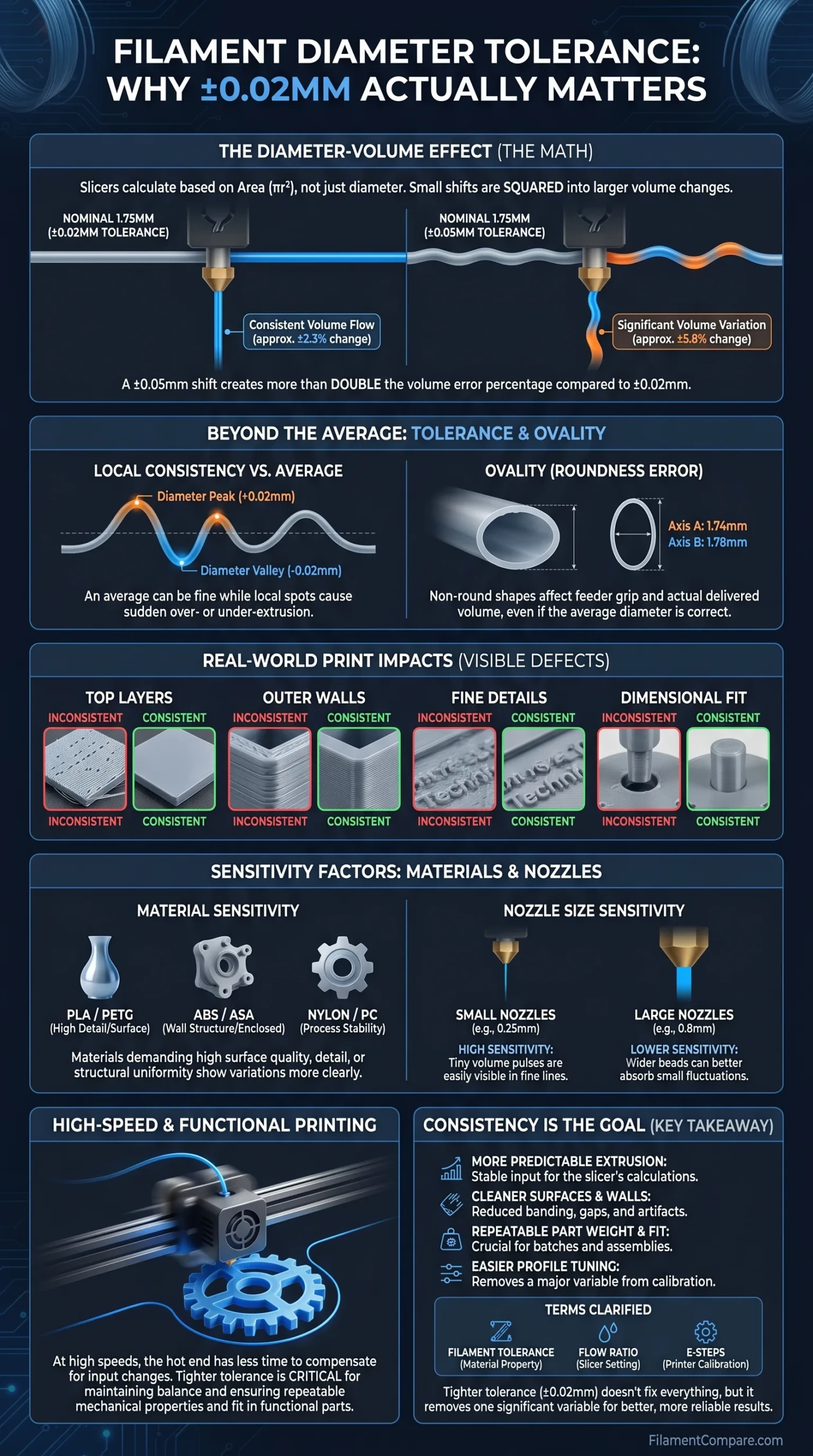
Filament diameter tolerance looks tiny on a spool label, yet it directly changes the amount of plastic a printer receives. A 1.75 mm filament with ±0.02 mm tolerance is not just “a little more accurate” than ±0.05 mm. Because filament volume is based on cross-sectional area, a small diameter change becomes a larger extrusion flow difference inside the slicer and hot end.
| Nominal Filament Size | Diameter Tolerance | Possible Diameter Range | Approx. Area / Flow Change | What It Means in Printing |
|---|---|---|---|---|
| 1.75 mm | ±0.02 mm | 1.73–1.77 mm | About -2.27% to +2.30% | Usually easier to tune for steady extrusion, cleaner walls, and repeatable part weight. |
| 1.75 mm | ±0.03 mm | 1.72–1.78 mm | About -3.40% to +3.46% | Still usable for many materials, but flow variation becomes more visible on fine details. |
| 1.75 mm | ±0.05 mm | 1.70–1.80 mm | About -5.63% to +5.80% | Can produce more visible changes in line width, top layers, seams, and small features. |
| 2.85 mm | ±0.02 mm | 2.83–2.87 mm | About -1.40% to +1.41% | The same absolute tolerance creates a smaller percentage change than on 1.75 mm filament. |
| 2.85 mm | ±0.05 mm | 2.80–2.90 mm | About -3.48% to +3.54% | Often less dramatic than ±0.05 mm on 1.75 mm, but still relevant for repeatable output. |
These values compare the nominal filament diameter with the largest allowed diameter swing. Real print results also depend on ovality, moisture, melt flow, feeder grip, hot-end capacity, nozzle size, slicer settings, and spool-to-spool consistency.
- Diameter: 1.75 mm or 2.85 mm
- Tolerance: allowed size deviation
- Ovality: roundness error
- Flow: delivered plastic volume
- Slicer diameter setting: volume assumption
Why Filament Diameter Tolerance Changes Flow
A slicer does not see every microscopic part of a filament spool. It works from the filament diameter value stored in the material profile, then calculates how much filament length should be pushed to create a target bead volume. Firmware can also calculate extrusion from diameter in volumetric extrusion mode, where E values are treated as cubic millimeters and the firmware uses the filament diameter to determine filament length.[a]
The math is simple, but it is easy to underestimate. A filament strand is close to a cylinder, so its cross-sectional area follows πr². Diameter changes radius. Radius changes area. Area changes volume.
That is why ±0.02 mm matters more than the label suggests. On 1.75 mm filament, the full high-side change from 1.75 mm to 1.77 mm is about 2.30% more cross-sectional area. A shift to 1.80 mm is about 5.80% more. The printer may still push the same commanded filament length, but the hot end receives a different amount of plastic.
The Diameter Error Is Squared
Diameter tolerance is not a straight “two-hundredths of a millimeter” story. Since the printer is using a round strand, the extrusion volume effect scales with the area of the filament, not only the visible width of the raw plastic.
| Actual Diameter | Difference from 1.75 mm | Approx. Flow Effect | Likely Visible Clue |
|---|---|---|---|
| 1.73 mm | -0.02 mm | About 2.27% less plastic | Fine gaps, lighter top surfaces, slightly thinner walls. |
| 1.77 mm | +0.02 mm | About 2.30% more plastic | Fuller top layers, wider lines, small seam swell. |
| 1.70 mm | -0.05 mm | About 5.63% less plastic | More visible under-extrusion on solid infill and perimeters. |
| 1.80 mm | +0.05 mm | About 5.80% more plastic | More visible over-extrusion, rough top skin, crowded corners. |
What ±0.02 mm Actually Means on a Spool
A ±0.02 mm diameter tolerance claim means the filament should stay within 0.04 mm total diameter spread around the nominal size. For 1.75 mm filament, that means 1.73 mm to 1.77 mm. For 2.85 mm filament, it means 2.83 mm to 2.87 mm.
Some manufacturers publish tighter diameter controls and measurement methods. Prusament states that most of its materials are held to ±0.02 mm precision, with diameter measured in both axes several times per second; it also provides spool-level diameter data, maximum deviation, standard deviation, and ovality for inspection.[b] Polymaker also states that its filaments have ±0.02 mm dimensional accuracy on its material information page.[c]
That does not mean every print will become perfect. It means the material gives the printer a more consistent input. The rest still comes from the printer, slicer, hot end, storage, and print profile.
Tolerance Is Not the Same as Average Diameter
A spool can average 1.75 mm and still have sections that swing wider or thinner. The average may look fine, while local diameter peaks create short bursts of extra extrusion. The reverse also happens: thin spots can create short under-filled areas.
This matters most on prints where surface continuity is easy to see. Thin walls. Small text. Threads. Top surfaces. Multi-part assemblies. A few short sections of diameter drift may not ruin a decorative print, yet the same drift can show up clearly on a tight mechanical fit.
Ovality Adds Another Layer
Ovality means the filament is not perfectly round. One axis may measure 1.74 mm while the other measures 1.78 mm. The average diameter may look acceptable, but the feeder and filament path experience a shape that is not fully round.
Good diameter control should include roundness consistency, not just one caliper reading. That is why two-axis or laser-based monitoring is useful in filament production. A single measurement direction can miss a flattened or egg-shaped section.
Where Diameter Tolerance Shows Up in Real Prints
Diameter tolerance usually appears as an extrusion consistency issue rather than a single obvious “diameter problem.” The print may still finish. The difference is in the texture, wall regularity, weight, line width, and fit.
Common Print Areas Affected by Diameter Variation
- Top layers: thin filament sections can leave faint gaps; thicker sections can create a slightly raised, crowded surface.
- Outer walls: flow swings may show as subtle vertical bands or uneven gloss.
- Small features: embossed letters, clips, pins, and thin ribs reveal tiny flow changes faster than large smooth shapes.
- Dimensional fit: holes, tabs, threads, and snap features can feel different across spools if flow changes.
- Part weight: repeated production parts may vary more when the input filament diameter moves around.
Research on fused filament fabrication has also treated filament diameter tolerance as an indicator of print quality. One study notes that irregular diameter affects flow rate during extrusion and may lead to poor surface quality, extruder jams, gaps between extrusions, or excessive overlap.[d] The point is practical: material shape affects material delivery.
Surface Finish and Line Width
When actual filament diameter grows above the slicer’s assumption, the same extruder movement pushes more plastic than expected. The nozzle then has to place that extra material somewhere. It can widen the bead, lift the surface slightly, or make corners look fuller.
When actual diameter falls below the slicer’s assumption, the opposite happens. The hot end receives less material. That can show as micro-gaps, weaker-looking top infill, or walls that seem slightly lean. Small difference. Visible result.
Layer Adhesion and Internal Fill
Layer adhesion is affected by temperature, polymer type, cooling, speed, line width, and pressure in the nozzle. Diameter tolerance does not replace those variables. It feeds into them.
A stable filament diameter helps the extrusion system maintain a steadier bead. That can support more predictable contact between neighboring lines and layers. For functional PLA, PETG, ABS, ASA, nylon, PC, and filled composites, repeatable volume is especially useful because users often tune profiles around part strength, dimensional fit, and surface quality.
High-Speed Printing Makes Tolerance More Noticeable
At slow speeds, a hot end has more time to melt and place material. At higher flow rates, small changes in incoming filament volume can interact with pressure advance, maximum volumetric speed, nozzle temperature, and cooling.
For high-speed PLA or PETG profiles, a tight tolerance does not automatically allow faster printing, yet it reduces one source of variation. The printer is already balancing melt rate, motion, and cooling. A steadier filament cross-section keeps that balance easier to maintain.
1.75 mm vs 2.85 mm: Why the Same Tolerance Feels Different
The same absolute tolerance has a larger percentage effect on smaller filament. That is why ±0.02 mm on 1.75 mm matters more than ±0.02 mm on 2.85 mm when viewed as a percentage of cross-sectional area.
UltiMaker notes that 2.85 mm filament can offer more control during travel in some setups, while 1.75 mm can be easier to control in direct-drive or very small print situations.[e] In practice, both sizes can print accurately when the printer and profile are matched to the material.
- 1.75 mm filament
- More sensitive to the same absolute diameter error. A ±0.05 mm tolerance creates a larger percentage flow swing than it does on 2.85 mm filament.
- 2.85 mm filament
- Less sensitive to the same absolute diameter error as a percentage of area, but still affected by ovality, feeder grip, and slicer diameter settings.
- Practical meaning
- Tolerance should be read together with printer design, filament path, material type, and the quality target of the printed part.
Why ±0.02 mm Matters More for Some Materials
Every FDM/FFF filament benefits from consistent diameter, but the effect is easier to notice in some materials. The reason is not that one material “needs perfection.” It is that each polymer behaves differently under heat, pressure, cooling, and feeder load.
| Filament Type | Why Diameter Consistency Helps | Typical Print Clues |
|---|---|---|
| PLA / PLA+ | Shows surface and top-layer flow changes clearly because it often prints with sharp detail and strong cooling. | Top-skin smoothness, lettering, seam size, fine edges. |
| PETG | Extra material can make PETG look glossy, raised, or slightly stringier because it tends to flow and stick strongly. | Ridges, nozzle drag, crowded corners, glossy blobs. |
| ABS / ASA | Stable flow helps maintain wall regularity during enclosed printing and shrinkage-sensitive parts. | Wall consistency, dimensional repeatability, corner shape. |
| Nylon | Moisture and flexibility already affect extrusion behavior, so diameter stability removes one more variable. | Surface texture, line regularity, part weight consistency. |
| PC and High-Temperature Filaments | These materials often run at higher nozzle temperatures and demand steadier melt delivery. | Layer bonding regularity, wall accuracy, internal fill consistency. |
| Carbon-Fiber or Glass-Fiber Filled Filaments | Filled materials are more abrasive and may have different flow behavior; steady diameter helps the feeder and hot end stay predictable. | Line width, nozzle pressure stability, dimensional repeatability. |
| TPU / Flexible Filaments | Flexible filament compresses in the feed path. A tighter, rounder strand can help the feeder maintain steadier grip. | Extrusion pulses, inconsistent walls, soft material feed marks. |
Diameter Tolerance, Flow Ratio, and E-Steps Are Different Things
It is easy to mix these terms because they all affect extrusion. They are related, but they are not the same.
Diameter Tolerance
Diameter tolerance belongs to the filament. It describes how far the filament is allowed to move away from its nominal diameter. A good spool stays close to its stated diameter through the usable length, not only at a few checked points.
Flow Ratio or Extrusion Multiplier
Flow ratio belongs to the slicer profile. It adjusts the amount of plastic the slicer asks the printer to extrude. If the filament is consistently 1.73 mm and the profile assumes 1.75 mm, a calibrated flow profile may compensate for the average. It cannot fully erase fast local swings along the spool.
E-Steps or Rotation Distance
E-steps, steps/mm, or rotation distance belongs to the extruder motion system. It defines how much filament length the drive gear moves for a given motor command. This should describe the machine’s mechanical feed behavior, not be used as a catch-all correction for every spool.
A well-tuned printer can still show extrusion variation if the filament diameter changes along the spool. A tight diameter tolerance reduces how much the material itself fights the profile.
The Hidden Difference Between Tolerance and Consistency
A tolerance claim tells you the allowed limit. Consistency tells you how the spool behaves inside that limit. Two filaments can both claim ±0.03 mm, but one may stay close to 1.75 mm most of the time while the other moves back and forth more often.
For print quality, the pattern matters. A slow, even shift can often be handled by an average diameter value or flow calibration. A frequent up-and-down pattern can create visible bands because the printer receives alternating more plastic and less plastic over short distances.
Maximum Deviation
Maximum deviation is the largest measured difference from nominal diameter. It helps identify the worst spot measured on that spool or sample. It is useful, but it does not tell the whole story by itself.
Standard Deviation
Standard deviation describes how tightly the measurements cluster around the average. A low value means the filament is more stable across many measurements. For repeat printing, this can be more informative than a single maximum reading.
Ovality
Ovality describes how far the filament shape is from round. A filament can pass a diameter check in one direction and still be less round in another. This is why two-axis diameter measurement is more meaningful than one random caliper reading.
When ±0.02 mm Matters Most
Not every print needs the tightest filament on the shelf. A decorative vase, a large draft prototype, or a simple bracket may print well with a wider tolerance if the material is dry and the printer is tuned. The value of ±0.02 mm rises when the print has less room to hide flow variation.
Print Types That Benefit Most from Tight Diameter Control
- Mechanical assemblies: clips, hinges, sliding parts, press-fit features, threads, and mating surfaces.
- Thin-wall parts: single-wall or two-wall sections where line width changes are easy to see.
- Fine cosmetic surfaces: smooth outer walls, display parts, text, logos, and visible top layers.
- Batch printing: repeated parts where weight, fit, and surface finish need to stay close from one print to the next.
- High-flow profiles: fast prints, larger nozzles, and thicker layers that run closer to hot-end melt limits.
For a single casual print, a few percent flow difference may be acceptable. For repeated parts or fine details, that same difference can become the line between a print that fits and a print that needs profile adjustment.
Reading Filament Tolerance Claims Without Guesswork
A good tolerance statement should be specific. “1.75 mm filament” is not enough. Look for the allowed diameter range, measurement method, and whether the brand discusses roundness or ovality. If the spool provides batch data, that is even more useful.
| Specification Element | Clear Version | Less Clear Version | Why It Matters |
|---|---|---|---|
| Nominal Diameter | 1.75 mm or 2.85 mm | “Standard size” | The slicer needs the correct diameter assumption. |
| Tolerance | ±0.02 mm, ±0.03 mm, ±0.05 mm | “High precision” | The number lets users estimate possible flow swing. |
| Measurement Direction | Two-axis or multi-axis measurement | One unspecified reading | Ovality can hide in a single-axis check. |
| Batch Data | Spool graph, average, deviation, ovality | No lot-level data | Batch data gives a better picture of real spool behavior. |
| Material-Specific Note | Separate tolerance for blends or filled materials | One generic claim for all products | Blends, fibers, and specialty additives can change extrusion control. |
Diameter Tolerance and Nozzle Size
Nozzle size changes how easily diameter variation appears. A 0.8 mm nozzle laying thick lines may visually hide small fluctuations better than a 0.25 mm nozzle printing fine detail. The flow difference still exists, but the print may show it differently.
Small nozzles and thin layers have less margin. A tiny over-extrusion pulse can crowd a narrow line. A tiny under-extrusion pulse can leave a gap. With larger nozzles, the bead is wider and the print may absorb small changes more quietly, though part weight and internal pressure can still shift.
Fine Nozzles
For 0.2 mm and 0.25 mm nozzles, diameter consistency supports cleaner micro-features and steadier thin walls. Any flow swing is spread across a smaller extrusion path, so visual clues can appear faster.
Standard 0.4 mm Nozzles
The common 0.4 mm nozzle is flexible enough for many materials. It can print well with a range of filament tolerances, but ±0.02 mm filament can make profile tuning more repeatable, especially for smooth walls and tight fits.
Large Nozzles
With 0.6 mm, 0.8 mm, or larger nozzles, diameter tolerance works together with melt capacity. The nozzle needs a steady material supply, and the hot end must melt that material fast enough. A tight tolerance supports steadier input, while hot-end capacity decides how much output is realistic.
Moisture, Temperature, and Tolerance Should Not Be Confused
Diameter tolerance is only one part of filament quality. Moisture can cause bubbles, rough texture, and inconsistent extrusion pressure. Temperature can change viscosity and layer bonding. A worn nozzle can change line shape. Feeder tension can mark or slip on the filament.
A tight-tolerance spool that has absorbed moisture may still print with rough surfaces. A dry spool with wider tolerance may print acceptably on a forgiving part. The best reading is not “tolerance fixes everything.” It is more accurate to say tolerance removes one important variable.
Why Manufacturers Measure Filament Continuously
Filament extrusion is a controlled manufacturing process. Polymer pellets are melted, shaped, pulled, cooled, measured, and wound. Pull speed, melt temperature, cooling rate, material blend, and line control all affect final diameter.
NIST describes polymer additive manufacturing as an area where metrology tools and measurement standards support understanding of material characteristics and behavior.[f] In filament production, that measurement mindset matters because the product is not just “plastic on a spool.” It is a feedstock for a volume-controlled manufacturing process.
Continuous monitoring can catch diameter drift before a full spool is wound. It can also reveal patterns: a slow upward trend, a sudden narrow section, or ovality caused by cooling and pulling behavior. Those details are more useful than a single check at the start of the spool.
What the ±0.02 mm Label Can and Cannot Promise
A ±0.02 mm filament tolerance can support better flow consistency. It can make calibration more stable. It can help repeated prints behave more alike. It can reduce one cause of surface bands, top-layer variation, and dimensional drift.
It cannot promise perfect dimensional accuracy by itself. Printed part accuracy also depends on shrinkage, slicer compensation, material stiffness, thermal contraction, cooling, belt tension, pressure advance, extrusion temperature, layer height, and the geometry of the model.
Relative Flow Sensitivity on 1.75 mm Filament
Practical Meaning for Filament Selection
For most 1.75 mm FDM printers, ±0.02 mm tolerance is a strong diameter-control target. ±0.03 mm can still be suitable for many materials and print types. ±0.05 mm is common, but it allows a wider flow window, especially on 1.75 mm filament.
The best choice depends on the print. If the goal is a display model, a draft prototype, or a large low-detail object, the difference may be modest. If the goal is repeatable parts, clean surfaces, fine nozzles, small features, or high-speed extrusion, tighter diameter control becomes more valuable.
For material comparison, tolerance should sit beside other specs: melt flow behavior, tensile properties, heat deflection temperature, moisture sensitivity, spool winding, colorant consistency, ovality, and print profile support. One number cannot describe the entire filament. It can still tell you a lot.
Terms Related to Filament Diameter Tolerance
- Nominal Diameter
- The intended filament size, usually 1.75 mm or 2.85 mm.
- Diameter Tolerance
- The allowed deviation from the nominal diameter, often written as ±0.02 mm, ±0.03 mm, or ±0.05 mm.
- Cross-Sectional Area
- The circular area of the filament strand. This determines how much plastic volume is delivered for each millimeter of filament length.
- Ovality
- The difference between diameter measurements taken in different directions across the same filament section.
- Volumetric Flow
- The amount of melted plastic delivered per second, often expressed in mm³/s.
- Extrusion Multiplier / Flow Ratio
- A slicer setting that adjusts requested extrusion volume to match a specific printer, material, and profile.
- Spool-Level Traceability
- Batch or spool data that may include measured diameter, deviation, weight, length, and production details.
Resources Used
- [a] Marlin Firmware: M200 Volumetric Extrusion Diameter
- [b] Prusament: The Story Behind Prusament
- [c] Polymaker: PLA Pro Material Information
- [d] Indiana University Journal of Undergraduate Research: Effects of Filament Diameter Tolerances in Fused Filament Fabrication
- [e] UltiMaker: 3D Printing Schooling
- [f] NIST: Additive Manufacturing of Polymers
