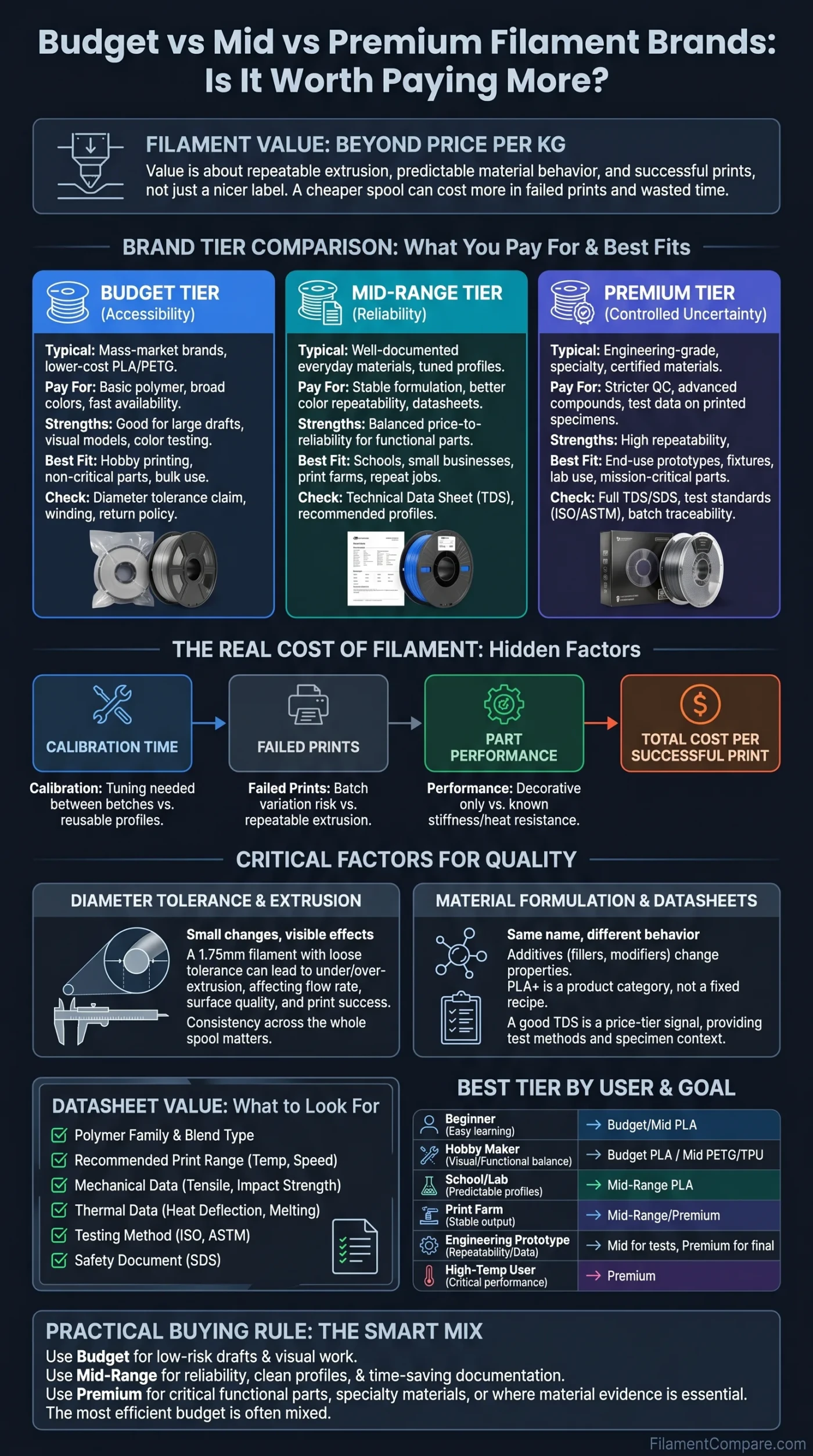
Paying more for filament is worth it when the print depends on repeatable extrusion, documented material behavior, color consistency, clean winding, or a specialty compound such as carbon fiber, ESD-safe PLA, flame-retardant PETG, nylon, PC, ASA, PEEK, PEI, PPS, or PEKK. For simple PLA display models, many budget spools print very well. For functional parts, customer work, school labs, print farms, and engineering prototypes, mid-range or premium filament often saves time because fewer unknowns need to be tuned out.
| Category | Typical Market Position | What You Usually Pay For | Common Strengths | Best Fit | Where to Check Before Buying |
|---|---|---|---|---|---|
| Budget filament | Lower-cost PLA, PETG, TPU, ABS, ASA, and decorative spools from mass-market brands | Basic polymer blend, broad color choice, everyday packaging, fast availability | Good value for prototypes, toys, simple brackets, large drafts, and color testing | Hobby printing, early prototypes, non-critical parts, bulk PLA use | Diameter tolerance claim, recent user batch feedback, spool winding, moisture packaging, return policy |
| Mid-range filament | Well-documented everyday materials from brands that publish more print and material data | More stable formulation, better color repeatability, datasheets, wider material families, tuned profiles | Balanced price-to-reliability ratio for PLA, PLA+, PETG, ASA, ABS, PC blend, and nylon variants | Functional prototypes, schools, small businesses, repeat print jobs, mixed printer fleets | Technical data sheet, recommended print profile, drying notes, test method, material family consistency |
| Premium filament | Engineering-grade, specialty, certified, or tightly controlled materials | Stricter QC, advanced compounds, test data, traceability, specialty additives, documented use cases | Better repeatability for demanding prints, high-temperature materials, carbon fiber grades, ESD-safe materials, flame-retardant lines | End-use prototypes, fixtures, jigs, print farms, lab use, high-temp parts, controlled material selection | Full TDS/SDS, test specimen method, tolerance, batch traceability, drying protocol, certification or compliance note |
Filament value is not only the price per kilogram. A spool that costs less can still become expensive if it needs repeated calibration, extra drying, failed reprints, or post-processing time. A higher-priced spool earns its place when the brand gives predictable material behavior, not just a nicer label.
What “Budget,” “Mid,” and “Premium” Mean in Filament Buying
There is no universal price line that separates budget, mid, and premium filament. The same brand may sell an affordable PLA, a mid-range PETG, and a premium carbon fiber nylon. A better way to compare brands is to look at manufacturing control, published test data, material range, support quality, and how often the same spool behaves the same way across different printers.
Budget Filament Brands
Budget filament focuses on accessibility. It is often the right choice for large visual prints, color experiments, draft prototypes, school projects, cosplay parts, organizers, toys, and early design testing. PLA and PETG are the safest bets in this tier because both materials have broad print windows and many printer profiles already handle them well.
- Best value when the model is not heat-loaded, load-bearing, or dimension-critical.
- Useful when color variety matters more than a detailed datasheet.
- Works well for bulk printing after one good temperature and flow calibration.
- Worth checking for vacuum sealing, spool winding, and stated diameter tolerance.
Budget does not mean low quality. It means fewer guarantees. The buyer usually carries more of the tuning work.
Mid-Range Filament Brands
Mid-range filament is often the most practical choice for regular users. These brands usually provide better print profile consistency, clearer material families, and more useful datasheets. Polymaker’s PolyLite PLA page, for example, lists physical properties, print settings, and testing methods such as ISO 1183 for density and ISO 527 for tensile testing.[a]
This tier is a good match when a print is still hobby-friendly but failure has a cost: parts for a school lab, repeat products for a small shop, printer farm jobs, assembly prototypes, brackets, enclosures, jigs, or customer-facing models.
Premium Filament Brands
Premium filament is less about luxury and more about controlled uncertainty. Premium brands tend to publish more complete TDS and SDS documents, offer engineering compounds, and test printed specimens rather than only quoting raw resin data. 3DXTECH, for instance, states that its technical data is generated on actual 3D printed ISO specimens for comparing material grades.[b]
Premium pricing makes the most sense for carbon fiber nylon, glass fiber reinforced materials, ESD-safe PLA or PETG, PC blends, PPS, PEI, PEEK, PEKK, flame-retardant materials, or prints that must be repeated with low variation. The spool is only part of the cost. The risk of failed time matters too.
The Real Cost Is Not Price per Spool
A lower price per kilogram looks attractive, but FDM and FFF printing turn material into value slowly. A 12-hour print that fails near the end can use a small amount of filament and still waste a full work cycle. That is why serious buyers compare cost per successful print, not only cost per spool.
| Cost Area | Budget Filament Impact | Mid or Premium Filament Impact | Why It Matters |
|---|---|---|---|
| Calibration time | May need more flow, temperature, retraction, and pressure advance checks between colors or batches | Often easier to reuse profiles across spools from the same product line | Less tuning time improves print farm and workshop output |
| Failed prints | Usually acceptable for simple parts, but batch variation can show up on long jobs | More repeatable extrusion can reduce surprise failures | Long prints make reliability more valuable than small material savings |
| Part performance | Fine for decorative and low-load models | Better fit when the part needs known stiffness, impact behavior, or heat resistance | Functional prints need predictable material behavior |
| Documentation | Sometimes limited to nozzle and bed temperature | More likely to include TDS, SDS, test standards, density, strength, elongation, and thermal notes | Datasheets help compare materials without guessing |
| Color repeatability | Good for many casual prints, but repeat orders may vary | Often better when the same color must match across batches | Brand color control matters for product parts and multi-piece sets |
Diameter Tolerance: Small Numbers, Visible Effects
Filament diameter affects extrusion volume. A 1.75 mm filament that becomes slightly thicker or thinner changes the amount of plastic pushed into the hotend. Research on fused filament fabrication notes that irregular filament diameter can affect flow rate and lead to surface quality issues, gaps, overlap, jams, or failed prints.[c]
Premium brands often emphasize tight dimensional control. Prusament PLA, for example, lists 1.75 ± 0.02 mm for standard PLA in its technical datasheet.[d] Some other brands publish ±0.03 mm or similar values. The number alone is not everything; the brand also needs roundness control, clean winding, dry packaging, and batch consistency.
Why Tolerance Changes Extrusion
A filament’s cross-sectional area changes faster than many users expect because area is based on radius squared. A slightly thicker filament can feed more plastic than the slicer expects; a slightly thinner one can feed less. On small decorative models, this may be barely visible. On tall walls, tight tolerances, glossy surfaces, or transparent PETG, it can show.
| Measured Diameter | Approximate Area Change vs 1.75 mm | Possible Print Effect |
|---|---|---|
| 1.73 mm | About 2.3% lower | Slight under-extrusion risk if the slicer still assumes 1.75 mm |
| 1.75 mm | Baseline | Expected flow when slicer and measured filament match |
| 1.77 mm | About 2.3% higher | Slight over-extrusion risk on tuned profiles |
| 1.80 mm | About 5.8% higher | More visible over-extrusion, dimensional shift, or extra pressure in the hotend |
The practical lesson is simple: a tight tolerance claim is useful, but consistent tolerance across the whole spool matters more than one polished number on the box.
Material Formulation: Same Plastic Name, Different Behavior
Two spools can both say PLA and still print differently. The base polymer may be blended with impact modifiers, pigments, fillers, plasticizers, matting agents, sparkle additives, carbon fiber, glass fiber, recycled content, or flow modifiers. That is why brand tier often matters more with PLA+, PETG-CF, ASA, nylon, PC, and high-temperature polymers than with plain PLA.
Plain PLA vs PLA+
Standard PLA is valued for stiffness, easy printing, and clean detail. PLA+ is usually modified for improved toughness or layer bonding, but there is no single global recipe for PLA+. eSUN’s PLA+ datasheet describes it as a modified PLA material intended to improve toughness and layer adhesion while keeping easy printing behavior.[e]
This is where paying more can be sensible. A branded PLA+ line with published test data is easier to compare than a vague “strong PLA” label. Look for tensile strength, elongation at break, impact strength, and the test method behind those numbers.
PETG, ASA, ABS, and PC Blends
PETG is forgiving, but it is sensitive to moisture, stringing, and surface finish. ASA and ABS add enclosure needs and higher shrink behavior. PC blends need more heat control. In these materials, mid-range and premium brands can justify a higher price through clearer drying instructions, more stable print windows, and better profile support.
Nylon, Carbon Fiber, and High-Temperature Filaments
With nylon, PA-CF, PC-CF, PPS, PEI, PEEK, and PEKK, the material itself is only one part of the decision. Drying, storage, hotend capability, nozzle material, chamber temperature, bed adhesion, annealing behavior, and part orientation all shape the final result. Here, premium brands often give more useful information because the target user needs it.
Datasheets Are a Price-Tier Signal
A serious filament brand does not need to publish every internal formulation detail, but it should provide enough information to make rational material choices. A good datasheet turns a spool from a guess into a material candidate.
- Polymer family: PLA, PETG, ASA, ABS, PA6, PA12, PC, TPU, PPS, PEI, PEEK, PEKK, or blend type.
- Recommended print range: nozzle temperature, bed temperature, fan, speed, enclosure note, and drying guidance.
- Mechanical data: tensile strength, tensile modulus, elongation, flexural strength, impact strength.
- Thermal data: glass transition, heat deflection temperature, melting behavior, Vicat softening point, or annealing notes.
- Testing method: ISO, ASTM, GB/T, or another named standard.
- Safety document: SDS for handling, storage, and material composition context.
NIST’s report on polymer additive manufacturing standards discusses the role of existing ASTM and ISO test methods for mechanical properties and failure in polymer AM parts.[f] For buyers, the useful point is direct: numbers are more meaningful when the test method and specimen context are visible.
When Budget Filament Is Enough
Budget filament is often the smart buy for everyday PLA printing. A decorative model, draft prototype, vase mode print, fixture mockup, or classroom project usually does not need premium-grade documentation. If the spool is dry, round, cleanly wound, and close to its stated diameter, it can produce excellent results.
| Use Case | Why Budget Filament Can Work Well | Material Notes |
|---|---|---|
| Decorative PLA models | Surface appearance matters more than mechanical test data | PLA, matte PLA, silk PLA, marble PLA, wood-filled PLA |
| Large draft prototypes | The model is printed to check shape, size, or fit before final material selection | PLA or PETG depending on part size and bed adhesion |
| Learning and school use | Cost per student print matters, and PLA is easy to manage | Plain PLA with simple temperature range |
| Color testing | Many colors may be needed for visual evaluation | PLA gives the widest low-cost color range |
| Non-critical organizers | Low stress, indoor use, and simple geometry reduce material demands | PLA, PETG, or recycled PLA lines |
One caveat: cheap specialty filaments can be harder to judge than cheap plain PLA. Silk, matte, glow, wood, stone, metal-filled, and high-speed blends use additives that can change flow, brittleness, abrasion, and layer bonding. Plain is easier.
When Mid-Range Filament Usually Gives the Best Value
Mid-range filament is the safe center for many users because it offers better repeatability without engineering-grade prices. It is often the most sensible tier for PETG, ASA, PLA+, PC blends, TPU, and nylon variants that are not used in extreme service conditions.
- Repeated parts printed from the same profile.
- Functional prototypes that need better layer behavior than decorative PLA.
- Small business prints where appearance and reliability both matter.
- Mixed printer setups using tuned profiles across multiple machines.
- Parts where a datasheet is useful, but full traceability is not needed.
For many print farms, mid-range PLA or PETG is the true value tier. The spool price is not the lowest, yet the successful output per hour can be better.
When Premium Filament Is Worth Paying For
Premium filament becomes easier to justify when the part has a clear job. Heat exposure, load, chemical contact, electrical behavior, repeated use, dimensional accuracy, or customer delivery all raise the value of documented material control.
Engineering Materials
Materials such as PA12-CF, PA6-CF, PC-CF, PPS, PEI, PEEK, and PEKK are rarely bought only for color. They are selected for stiffness, thermal behavior, creep resistance, chemical compatibility, or dimensional stability. A premium brand that supplies drying instructions, test data, and known processing ranges helps reduce expensive trial-and-error.
Certified or Tested Printer-Material Combinations
For indoor environments, published emissions testing can matter. UL states that GREENGUARD Certification for 3D printers is awarded to printers and printing materials that demonstrate emissions below the limits in UL 2904.[g] This is not a generic claim that every spool is equal; it usually applies to a tested printer-material combination.
Repeat Production
When a part is printed again and again, material variation becomes visible. A premium spool can be worth more because it reduces profile changes, color mismatch, moisture surprises, and dimensional drift. For a one-off shelf ornament, that may not matter. For 200 identical brackets, it does.
Brand Tier by Material Type
The best tier depends strongly on material. Paying premium prices for simple PLA may not be necessary, while buying the cheapest high-temperature filament can make setup harder than it needs to be.
| Material Family | Budget Tier | Mid Tier | Premium Tier | Value Notes |
|---|---|---|---|---|
| PLA | Often enough for decorative and draft prints | Good for repeat work and better documentation | Useful for exact color control, specialty blends, or tested systems | Plain PLA has the widest safe budget range |
| PLA+ | Can work well, but formulas vary | Usually a strong value point | Useful when test data and consistency matter | Compare datasheets because PLA+ is not a single standard formula |
| PETG | Good for simple parts after drying and tuning | Often the best balance | Useful for clear, low-odor, carbon fiber, or tested lines | Moisture control and stringing behavior affect real value |
| ABS / ASA | Usable with enclosure and tuning | Good for more predictable shrink and finish | Useful for repeat parts and specialty grades | Warp control, batch consistency, and color stability matter |
| TPU | Fine for casual flexible prints | Better for predictable shore hardness and flow | Useful for repeat functional flexible parts | Spool winding and diameter consistency affect feeding |
| Nylon | Can be harder to manage without clear drying data | Good entry point for functional parts | Often worth it for PA-CF, PA-GF, and repeat use | Drying protocol is part of the material system |
| PC, PPS, PEI, PEEK, PEKK | Rarely the best place to cut cost | Useful for PC blends and early engineering tests | Often the safest choice for demanding prints | Printer capability and datasheet quality matter as much as spool price |
Color, Pigments, and Finish Can Change Print Behavior
Color is not only visual. Pigments and effect additives can change heat absorption, flow, brittleness, surface texture, and extrusion smoothness. A black PLA, a white PLA, a silk PLA, and a matte PLA from the same brand may not behave exactly the same. The difference is often small, but it can matter in tuned profiles.
Premium brands may charge more for color repeatability and quality control. That matters when printing product sets, replacement parts, branded colors, or multi-part assemblies where one slightly different shade would stand out. For casual prints, visual match tolerance is usually more forgiving.
Winding, Spool Design, and Packaging
Good filament is not only chemistry. A cleanly wound spool prevents feed interruptions. A strong spool avoids wobble. Vacuum sealing and desiccant help, although some materials still need drying before use. Cardboard spools reduce plastic waste but may produce dust on some spool holders; plastic spools can roll smoothly but add more packaging material. Neither is automatically better in every setup.
- Clean winding: reduces snags and uneven feeding.
- Sealed packaging: helps protect hygroscopic materials before opening.
- Batch labels: help repeat a successful setup later.
- Spool dimensions: matter for AMS systems, dry boxes, and enclosed spool holders.
- Material labels: reduce mix-ups between PLA, PETG, ABS, ASA, PC, TPU, and nylon.
A budget spool with clean winding can be better than a fancy spool that feeds poorly. Always judge the full system.
Printer Profiles Can Make a Brand Feel Better Than It Is
Some filament brands feel easier because slicers already include tuned profiles for them. Bambu Lab, Prusa, UltiMaker, Polymaker, and other established ecosystems benefit from ready-made settings on many machines. A budget spool may match the same quality after manual tuning, but the user must do the work.
That difference matters in business and education. A teacher, lab manager, or print farm operator may prefer a filament that works with existing profiles because it reduces setup friction. A hobby user may enjoy tuning cheaper spools manually. Both choices can be rational.
Moisture Sensitivity Changes the Value Equation
PLA can absorb moisture slowly enough that many users print it without much trouble. PETG, TPU, nylon, PC, and high-temperature polymers need more care. Once moisture enters a hygroscopic filament, surface finish, stringing, layer bonding, and extrusion stability can change.
This is where premium and mid-range brands can add value with clear drying instructions. A spool that states drying temperature, drying time, and storage advice is easier to manage than one with only a generic print temperature. For nylon and PC, drying guidance can be more useful than a small price saving.
Specialty Filaments: Where Premium Pricing Makes the Most Sense
Specialty filaments often justify higher prices because the formulation is harder to control and the printing window is narrower. Additives can improve one property while changing another. A carbon fiber nylon may be stiffer than standard nylon, yet it also needs an abrasion-resistant nozzle and careful drying. A flame-retardant PETG may have certification-related context that plain PETG does not provide.
| Specialty Type | What the Buyer Needs to Know | Why a Higher Tier May Help |
|---|---|---|
| Carbon fiber filled | Fiber percentage, base polymer, nozzle wear, stiffness, heat behavior | Better datasheets help compare CF-PLA, CF-PETG, CF-PA, CF-PC, and CF-PEEK |
| Glass fiber filled | Dimensional stability, abrasion, layer bonding, surface finish | Material data helps choose between stiffness and toughness needs |
| ESD-safe | Surface resistivity range, humidity sensitivity, base polymer | Published electrical data is more useful than a broad “anti-static” label |
| Flame-retardant | Rating method, material thickness, test standard, processing notes | Clear documentation prevents confusing marketing claims with tested behavior |
| High-temperature polymers | Drying, chamber temperature, crystallinity, annealing, bed adhesion | Premium datasheets reduce trial-and-error on expensive materials |
| Filled visual filaments | Particle content, nozzle wear, flow behavior, brittleness | Better product notes help avoid clogs and inconsistent surface finish |
Brand Reputation vs Real Material Evidence
Brand reputation is useful, but it should not replace evidence. The strongest buying signals are practical and verifiable: published TDS, SDS, clear print settings, honest material naming, batch traceability, stable availability, and support that understands the material.
A premium name without useful data is less valuable than a mid-range brand that clearly documents its material. A budget brand with consistent spools can be a smart bulk option. The best choice is not the most expensive spool; it is the least uncertain spool for the job.
How to Compare Filament Brands Without Guesswork
Use the same comparison logic for every tier. This keeps buying decisions fair and avoids judging a spool only by price, packaging, or social media popularity.
| Evaluation Area | What to Look For | Why It Matters |
|---|---|---|
| Diameter control | Published tolerance, roundness, real user measurements, stable extrusion | Flow consistency affects walls, dimensions, and surface finish |
| Documentation | TDS, SDS, test methods, recommended print range, drying notes | Good data reduces material selection risk |
| Material honesty | Clear base polymer and additive description | “PLA+” or “engineering grade” needs context |
| Batch repeatability | Batch code, consistent color, stable print behavior between orders | Repeat prints depend on repeatable material |
| Packaging | Dry sealing, desiccant, spool strength, clean winding | Feed reliability starts before the filament reaches the hotend |
| Profile support | Slicer profiles, printer ecosystem compatibility, AMS spool fit | Less setup time can be worth more than a lower spool price |
| Availability | Stable stock, repeat colors, reliable product names | A good filament is less useful if it cannot be reordered |
Material Extrusion Standards and Why They Matter
FDM and FFF printing sit inside the broader additive manufacturing category often called material extrusion. ISO/ASTM 52900 defines additive manufacturing terminology and describes the principle of creating 3D geometries by adding material layer by layer.[h] This matters because serious filament comparison should use the language of material behavior, not only brand labels.
Standards do not make every printed part identical. Print orientation, infill, shell count, nozzle temperature, cooling, humidity, speed, and annealing can all change results. A datasheet is still valuable because it gives a controlled reference point. It is a map, not a guarantee.
Common Price-Tier Mistakes
Many buying mistakes come from comparing the wrong things. A cheap PLA should not be judged like a carbon fiber nylon. A premium spool should not be bought just because the label looks technical. The print job decides the tier.
- Buying premium PLA for every simple model: useful sometimes, but plain budget or mid PLA can be enough for decorative prints.
- Buying the cheapest nylon without drying plans: nylon performance depends heavily on moisture control.
- Trusting only tensile strength: elongation, modulus, impact strength, heat behavior, and layer adhesion also matter.
- Ignoring color and additive effects: matte, silk, white, transparent, and filled filaments may need different settings.
- Comparing raw resin data to printed part data: printed specimen data is usually more relevant to FDM users.
- Assuming all PLA+ is the same: PLA+ is a product category, not one fixed material recipe.
Best Tier by User Type
| User Type | Best Starting Tier | Why |
|---|---|---|
| Beginner | Budget or mid-range PLA | Easy printing, low tuning burden, low cost for learning |
| Hobby maker | Budget PLA for visual prints; mid-range PETG or TPU for functional prints | Good balance between cost and print reliability |
| School or library lab | Mid-range PLA | Predictable profiles reduce support time and failed prints |
| Print farm | Mid-range or premium depending on job repeatability | Stable spools protect machine time |
| Engineering prototype user | Mid-range for early tests; premium for final material trials | Datasheets and repeatability matter as the part gets closer to use |
| High-temperature material user | Premium | Printer capability, drying data, and material documentation become central |
A Practical Buying Rule
Use budget filament when the print is low-risk and easy to repeat. Use mid-range filament when repeatability, clean profiles, and documentation save time. Use premium filament when the material has to do a job beyond looking good.
The most efficient filament budget is usually mixed. Keep affordable PLA for drafts and visual work. Keep trusted mid-range PETG, ASA, TPU, or PLA+ for regular functional parts. Reserve premium grades for prints where material evidence, specialty formulation, heat resistance, stiffness, electrical behavior, emissions testing, or repeat production justifies the price.
Resources Used
- [a] Polymaker PolyLite PLA Technical Data Sheet
- [b] 3DXTECH Technical and Safety Data Sheets
- [c] Effects of Filament Diameter Tolerances in Fused Filament Fabrication
- [d] Prusament PLA Technical Data Sheet
- [e] eSUN PLA+ Filament Technical Data Sheet
- [f] NISTIR 8059: Materials Testing Standards for Additive Manufacturing of Polymer Materials
- [g] UL GREENGUARD Certification for 3D Printers
- [h] ISO/ASTM 52900 Additive Manufacturing Terminology
