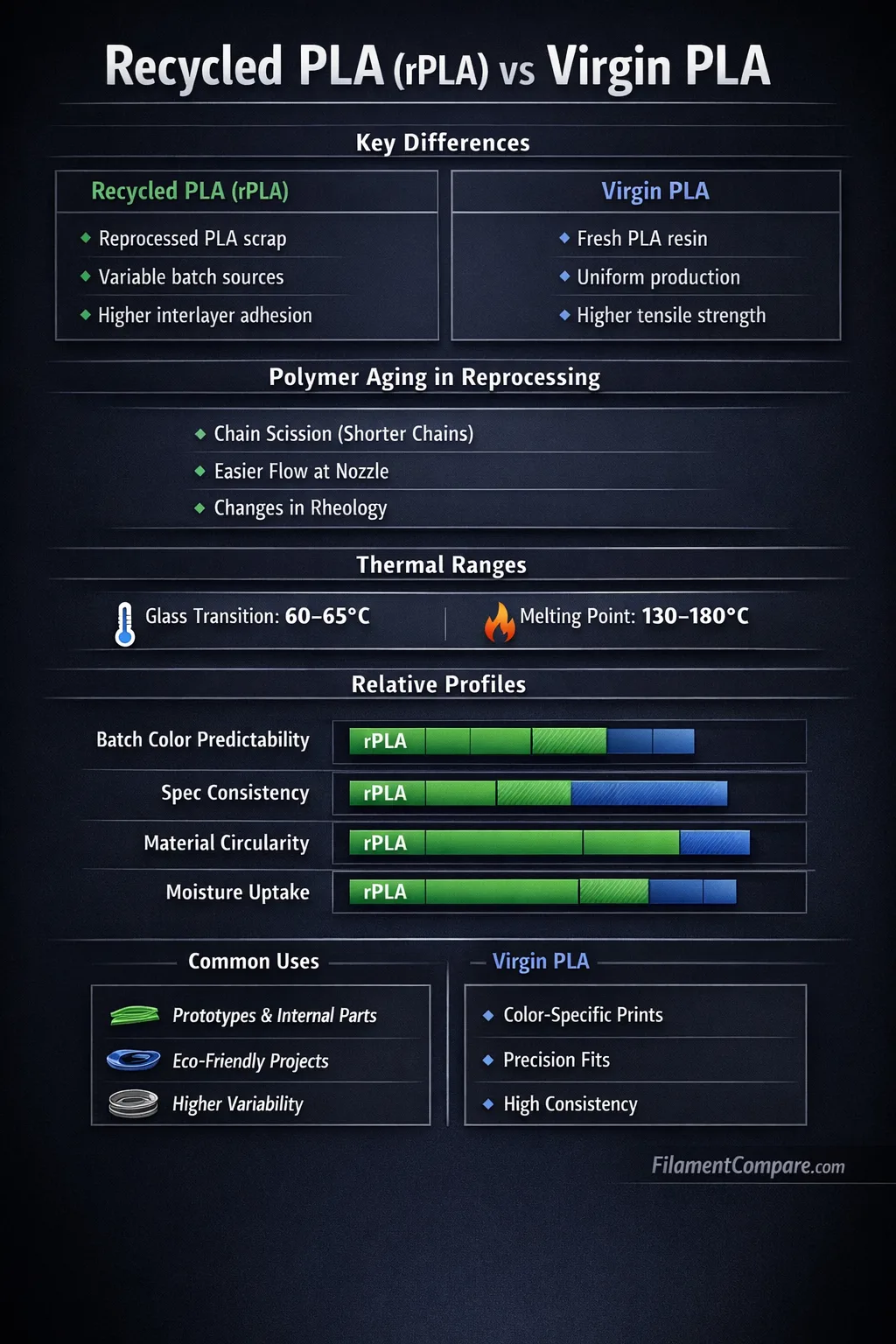
Recycled PLA (rPLA) contains material that has already passed through at least one manufacturing or use cycle before being processed into filament. Well-controlled rPLA can print much like standard PLA, while virgin PLA usually offers more predictable color, formulation, and batch-to-batch behavior. Choose according to the part’s reliability requirements, not the recycled label alone.
Choose rPLA for prototypes, visual models, educational prints, organizers, fixtures, and high-volume test pieces when using recovered feedstock is a main priority and modest batch variation is acceptable.
Choose virgin PLA for repeat production, matched colors, documented mechanical targets, long print runs, customer-facing parts, and designs where the same settings must work across several purchased batches.
Neither label guarantees better filament. A tightly sorted post-industrial rPLA can be more dependable than an unverified virgin PLA, while poorly sorted recycled feedstock can introduce color, flow, or strength variation.
Lower Use of New Resin
rPLA uses recovered PLA as part or all of its feedstock. Check the stated recycled percentage and waste source.
Color Repeatability
Virgin PLA is usually easier to reorder in a closely matched shade, especially for branded or multi-part products.
Prototype Iterations
rPLA is a practical fit for fit checks, draft models, workshop aids, and non-critical revisions.
Production Consistency
Virgin PLA usually has the advantage when several spools must behave alike with one validated profile.
Low-Warp Printing
Both are generally easy to print without an enclosure when the formulation and filament diameter are controlled.
Mechanical Documentation
Virgin PLA offers a wider selection of grades with published property data and stable formulation control.
Mixed or Muted Colors
rPLA often suits products where natural batch variation, neutral shades, or mixed colors are acceptable.
Fine Visual Detail
Both can produce clean small features, although a uniform virgin grade is easier to qualify for repeated detail work.
| Decision Area | Recycled PLA (rPLA) | Virgin PLA | More Suitable Option |
|---|---|---|---|
| Material family | PLA made partly or fully from recovered PLA feedstock | PLA made from newly produced resin | Same polymer family |
| Feedstock history | At least one prior processing or product cycle | No previous mechanical recycling cycle | Depends on priority |
| Waste stream | Post-industrial, post-consumer, or a controlled blend; brand-dependent | New resin with additives, pigments, and modifiers | Different supply routes |
| Print difficulty | Usually easy; may need a fresh temperature or flow check | Usually easy and widely supported by slicer profiles | Virgin PLA for repeatability |
| Typical nozzle temperature | Often about 190–220°C, but formulation-specific[a] | Often about 200–220°C for standard desktop grades[d] | Similar range |
| Typical bed temperature | Usually 40–60°C; some products allow an unheated bed | Usually 40–60°C; a heated bed is often optional | Similar range |
| Enclosure need | Normally not required | Normally not required | Tie |
| Warping | Generally low when diameter and formulation are controlled | Generally low | Usually similar |
| Heat resistance | Usually close to the source PLA; standard grades remain unsuitable for sustained high heat | Low for standard PLA; heat-modified or annealable grades differ | Grade-dependent |
| Stiffness | Often PLA-like, though recycling history and additives can shift the result | Usually stiff, with broader grade-level documentation | Virgin PLA for specified targets |
| Toughness | Can match ordinary PLA in controlled products, but some recycled formulations are more brittle | Standard PLA is also relatively brittle; tough grades are separate products | Product-dependent |
| Layer adhesion | Usually good after temperature and moisture are tuned | Usually good with established profiles | Virgin PLA for easier qualification |
| Moisture behavior | Some grades are more moisture-sensitive because of processing history or added fillers | Still benefits from dry storage, though behavior is often more predictable | Virgin PLA |
| Diameter consistency | Manufacturer quality control matters more than the recycled label | Often tightly controlled by established brands | Virgin PLA on average |
| Color consistency | Mixed-color grades may change between production runs[b] | Usually easier to match across repeat orders | Virgin PLA |
| Surface finish | Can be smooth, matte, speckled, or muted depending on the recycled stream and additives | Wider choice of controlled gloss, silk, matte, translucent, and solid-color grades | Virgin PLA for exact finish |
| Outdoor suitability | Limited for standard grades; recycled content does not add weather resistance | Limited for standard grades; UV-stabilized alternatives should be considered | Tie |
| Typical uses | Drafts, models, organizers, décor, teaching parts, non-critical fixtures | Models, prototypes, jigs, housings, repeat products, detailed visual parts | Use-case based |
| Main limitation | Recycled percentage, source purity, color, and property consistency vary by product | Relies more heavily on newly produced resin and does not reuse existing PLA waste | Different trade-offs |
Material Profiles and Printer Needs
Recycled PLA Profile
- Polymer type: Mechanically recycled PLA, sometimes blended with virgin PLA or modifiers
- Common source: Clean post-industrial extrusion waste, sorted failed prints, or post-consumer PLA
- Print difficulty: Beginner-friendly when produced under controlled conditions
- Nozzle range: Commonly within the normal PLA window
- Bed range: Usually 40–60°C
- Enclosure: Normally unnecessary
- Drying need: Check for brittleness, popping, rough extrusion, or excessive stringing before printing
- Typical behavior: Low warp, stiff feel, good detail, with possible batch or shade variation
- Best uses: Prototypes, visual parts, organizers, educational models, workshop aids
Virgin PLA Profile
- Polymer type: Newly produced PLA resin with grade-specific pigments and modifiers
- Common source: Commercial PLA resin manufactured for extrusion or 3D-printing compounds
- Print difficulty: Beginner-friendly with broad printer and slicer support
- Nozzle range: Commonly around 190–220°C for standard grades
- Bed range: Usually 40–60°C
- Enclosure: Normally unnecessary
- Drying need: Dry storage is still useful, especially after long exposure to humid air
- Typical behavior: Low warp, stiff parts, clean details, and more repeatable production settings
- Best uses: Repeat products, dimension-sensitive models, matched-color assemblies, qualified prototypes
Relative Printing and Use Indicators
The meters are relative printing-use indicators rather than laboratory ratings. Brand formulation, recycled percentage, waste-stream purity, additives, color, moisture, print direction, wall count, cooling, and slicer settings can move each result.
What the rPLA Label Should Tell You
Recycled PLA is not one fixed formulation. One spool may contain clean post-industrial scraps collected during filament extrusion, while another may use sorted failed prints, sheet offcuts, packaging waste, or a mixture of recovered and virgin resin. These routes do not carry the same contamination risk or property history.
Post-Industrial rPLA
Waste is collected before reaching an end user. The material source is often easier to identify, separate by polymer, and keep free from foreign plastics.
Post-Consumer rPLA
Material has completed a product-use cycle. Sorting, cleaning, labels, coatings, mixed polymers, and unknown heat history require closer process control.
Blended rPLA
Recovered PLA is mixed with virgin resin, chain extenders, pigments, fillers, or other modifiers to improve processing or target a chosen property.
A useful product listing should disclose the recycled content percentage, source category, diameter tolerance, recommended settings, and available technical data. “Recycled” by itself does not reveal whether the filament contains 20% or 100% recovered material, whether the stream is post-industrial or post-consumer, or whether each color uses the same formulation.
Controlled production waste can be highly uniform. FormFutura, for example, describes one rPLA line as being made from post-industrial waste generated during extrusion of its own PLA filament; it also notes that mixed-color collection can change color intensity between compound runs. That is a feedstock-management issue rather than an automatic printing defect.
Reprocessing History and Mechanical Behavior
Mechanical recycling normally includes sorting, shredding, drying, melting, filtering, pelletizing or direct extrusion, and filament production. Every heat cycle gives moisture, residence time, shear, and temperature another chance to shorten PLA polymer chains. The effect may be small in a clean, carefully dried industrial stream, or more visible when the waste has unknown age, contamination, hydrolysis, or repeated melt history.
This does not mean rPLA is always weaker. Mechanical results depend on the source material, number of cycles, drying, additives, extrusion control, specimen geometry, raster direction, walls, infill, and test method. A 2024 controlled comparison found that its fully recycled PLA prints had tensile and flexural strength more than 15% below the virgin reference under that study’s production and testing conditions[f]. The result is useful evidence of possible degradation, not a universal deduction for every commercial spool.
2026 Research Update: Closed-Loop PLA Recycling
A 2026 University of Montréal study examined a different side of recycled PLA: whether failed prints and local PLA waste can be collected and returned to filament production inside the same institutional system. The work followed waste through shredding, filament extrusion, and thermal and mechanical characterization rather than treating recycled feedstock as an anonymous commercial input.[i]
Closed-Loop Process Studied
- Collect PLA waste: failed prints and other suitable PLA material are kept as a known recycling stream.
- Shred the material: larger printed parts are reduced to feedstock that can enter the extrusion process.
- Extrude new filament: the shredded PLA is remelted and formed into filament for another printing cycle.
- Characterize the recycled material: thermal and mechanical testing checks how the material changes after reprocessing.
- Return material to local use: the process is evaluated as part of a campus-scale closed-loop filament system.
The campus approach is useful because source control begins before shredding. Failed prints from a known PLA stream are easier to separate from ABS, PETG, TPU, support material, labels, adhesives, and other contaminants than mixed plastic collected after disposal. That does not remove the effects of another melt cycle, but it gives recycling a cleaner starting point.
The study also fits the distinction between commercial rPLA and local recycling. A purchased rPLA spool may combine material from an industrial waste stream that the printer user never sees. A closed-loop system instead links printing waste, material preparation, filament extrusion, testing, and reuse in one traceable sequence. For universities, makerspaces, print labs, and other sites generating repeated PLA waste, that model can keep failed prints within a controlled material stream rather than treating them only as disposal waste.
Closed-loop recycling does not mean PLA can be remelted indefinitely without changes. Drying, contamination control, extrusion temperature, residence time, filament diameter, and previous thermal history still matter. Thermal and mechanical characterization remains part of the process for that reason: the new filament has to be checked as a material, not assumed to match virgin PLA simply because it started as PLA.
What Matters More Than the Label
- Known PLA-only waste rather than mixed unidentified plastics
- Dry feedstock before compounding and filament extrusion
- Stable diameter and ovality across the spool
- Controlled filtration without unmelted particles
- Declared recycled percentage and batch identification
- A technical data sheet for the actual color or grade
- Mechanical tests performed on printed parts, not resin alone
Virgin PLA remains easier to specify because the resin begins with a known molecular and additive history. It also gives compounders more freedom to design high-flow, high-speed, impact-modified, crystallizing, or heat-resistant grades. NatureWorks lists separate virgin PLA grades for faster printing, lower warping, higher impact performance, and improved heat behavior[e], showing why “virgin PLA” is also a broad category rather than one exact property set.
Color, Finish, and Batch Matching
Color control is one of the most visible differences. If multiple colors of extrusion scrap are combined, the resulting rPLA may settle into gray, brown, green, or another muted shade. A later production run can look lighter or darker because the incoming color mixture changes. Black and white may be more stable when waste streams are collected separately.
This variation can be useful for stone-like models, planters, organizers, workshop tools, décor, and products where a mixed tone is part of the design. It is less convenient for replacement components, serialized products, branded colors, or large assemblies built from spools bought months apart.
rPLA Finish Advantages
- Muted and mixed colors can hide minor layer lines
- Speckled or natural-looking surfaces suit decorative prints
- Small shade changes may not matter for prototypes
- Recovered colors can reduce the need for fresh pigment
Virgin PLA Finish Advantages
- Better chance of matching a catalog color later
- More transparent, silk, gloss, and specialty choices
- Easier visual approval for customer-facing production
- More stable appearance across multi-spool assemblies
Printability, Moisture, and Profile Tuning
Commercial rPLA from a controlled stream normally stays within standard PLA printer requirements: an open printer, strong part cooling, a clean PEI or similar build surface, and a nozzle near the ordinary PLA range. Some products can use the same slicer profile as virgin PLA. Others respond better to a small nozzle-temperature increase, slower outer walls, or a flow recalibration.
Moisture deserves attention because PLA can hydrolyze during hot processing when water is present. A recycled grade has already experienced at least one melt history, so careless storage and wet re-extrusion can compound the issue. Prusament describes one rPLA formulation as slightly more brittle and more hygroscopic than its regular PLA[c]. That observation applies to the named product, not every recycled PLA.
Recalibrate the Spool When You Notice
- Popping, hissing, steam, or a rough extruded line
- Filament snapping while sitting in the feed path
- Unexpected stringing compared with the previous PLA spool
- Under-extrusion that remains after checking the nozzle and drive gears
- Layer bonding that improves clearly at a slightly higher nozzle temperature
- Gloss changes or uneven flow across long walls
Dry according to the filament maker’s instructions. Excess heat can deform filament on the spool or accelerate PLA aging, so a generic high-temperature drying profile is not appropriate.
Environmental Claims Need Product-Level Evidence
rPLA directly reuses an existing PLA stream and can reduce demand for newly produced resin for that spool. That is the clearest claim that can be made from recycled content alone. It does not automatically prove a lower carbon footprint, lower total energy use, or a better end-of-life outcome.
The result changes with collection distance, sorting loss, washing, drying, extrusion energy, rejected material, added virgin resin, packaging, spool type, and how long the printed part remains useful. A review of rPLA research found that environmental work receives far more attention than economic and social assessment, and that recycled PLA performance depends on suitable control or modification[g].
The 2026 University of Montréal work adds another useful distinction: where recycling happens matters. A campus or makerspace that collects its own failed PLA prints can maintain a more controlled input stream and reduce the distance between waste generation and filament production. That does not by itself establish a lower full-life-cycle footprint, since shredding, drying, extrusion, rejected material, and equipment use still consume resources.
PLA also should not be placed in a household recycling bin unless the local program specifically accepts and sorts it. Collection and processing infrastructure are location-dependent; even technically sortable PLA requires a real recovery route[h]. Industrial composting claims, where applicable to a certified formulation and article, are separate from recycled-content claims and do not describe normal home or outdoor breakdown.
| Use Case | More Suitable Material | Reason |
|---|---|---|
| Early concept models | rPLA | Recovered feedstock works well when geometry and fit matter more than exact color matching. |
| School and workshop projects | rPLA | Suitable for many low-heat models, organizers, teaching aids, and iterative parts. |
| Failed-print recycling in a controlled lab | Locally recycled PLA | Known PLA waste can be collected, shredded, re-extruded, characterized, and returned to printing within a controlled loop. |
| Miniatures and visual models | Either | Both can hold fine detail; choose by finish, color, and spool quality. |
| Large decorative prints | Either | Both usually warp little. rPLA is attractive when mixed or muted color is acceptable. |
| Color-matched product sets | Virgin PLA | Catalog shades and repeat orders are normally easier to match. |
| Long multi-spool production | Virgin PLA | More predictable lot behavior reduces profile changes and visual mismatch risk. |
| Mechanical test coupons | Virgin PLA | A declared resin grade and stable batch make results easier to compare and repeat. |
| Non-critical jigs and fixtures | rPLA | A good use for recovered material when temperature and load remain modest. |
| Snap-fit parts | Virgin PLA | Repeatable ductility and a documented tough-PLA grade are safer choices than unknown recycled blends. |
| Parts near warm equipment | Neither standard grade | Standard rPLA and virgin PLA both soften under sustained warmth; consider a heat-focused grade or another polymer. |
| Outdoor parts | Neither standard grade | Recycled content does not provide UV or weather resistance. ASA or a tested stabilized grade is usually more suitable. |
| Replacement parts sold later | Virgin PLA | Future shade, formulation, and profile matching are usually easier. |
| Experimental surface finishes | rPLA | Mixed colors and recycled-stream character can create useful visual variation. |
| Certified or regulated products | Documented grade | Choose the material with the required declarations and traceability, regardless of recycled or virgin origin. |
Where Each Material Fits Better
Choose rPLA When
- The part is a prototype, model, organizer, display piece, or low-load fixture
- The manufacturer discloses the recycled percentage and source stream
- Minor color variation will not affect the project
- You are willing to run a temperature tower or flow check for a new batch
- The spool has stable diameter, clean extrusion, and suitable technical documentation
- Using recovered PLA is more important than exact catalog-color repeatability
rPLA Is Less Suitable When
- The material source and recycled content are not disclosed
- Several production lots must meet one mechanical target without requalification
- Exact shade matching is part of the product specification
- The part depends on predictable flex fatigue, impact behavior, or snap-fit life
- The application involves sustained heat, weather exposure, or regulated contact requirements
Choose Virgin PLA When
- You need stable color and formulation over repeat purchases
- A published technical data sheet is needed for the actual grade
- Several printers must share one qualified material profile
- The design uses tight visual tolerances or large multi-part assemblies
- You need a defined tough, high-speed, high-flow, heat-focused, or specialty formulation
- Mechanical comparison and process repeatability matter more than recycled content
Virgin PLA Is Less Suitable When
- A suitable verified rPLA can meet the same non-critical part requirements
- The print is a disposable draft or short-life iteration that could use recovered feedstock
- The only reason for choosing it is the assumption that all recycled PLA has lower quality
- The project’s purchasing policy requires a declared minimum recycled percentage
Material Selection Matrix
Choose rPLA when the spool comes from a disclosed and controlled waste stream, the part is not mechanically critical, color variation is acceptable, and using recovered material adds real value to the project.
Choose virgin PLA when repeated batches must match, the profile cannot be retuned often, the finish has to stay consistent, or the design needs a named grade with published mechanical and thermal properties.
Choose neither standard PLA option for sustained heat, demanding outdoor exposure, high-impact service, long-term flexing, or safety-regulated use unless a specific tested grade is documented for that condition.
The better purchase is the spool with clear feedstock information, tight diameter control, suitable test data, and reliable production quality. Recycled and virgin PLA do not replace each other in every workflow, but they overlap across a large share of ordinary desktop printing.
Common rPLA and Virgin PLA Questions
Is rPLA Always Weaker Than Virgin PLA?
No. Some controlled rPLA products perform close to standard virgin PLA, while other recycled batches lose tensile, flexural, or impact performance. Feedstock source, moisture, reprocessing count, additives, extrusion control, and print orientation all affect the result.
Can Failed PLA Prints Be Recycled Into New Filament?
Yes. Failed PLA prints can serve as feedstock when the waste is correctly identified, kept separate from incompatible materials, shredded, prepared for extrusion, and processed into new filament. The 2026 University of Montréal work examined that sequence together with thermal and mechanical characterization in a campus-scale closed-loop system. The recycled filament still needs process and material checks because another melt cycle can change PLA behavior.
Can rPLA Use a Normal PLA Slicer Profile?
Often yes. Start with the manufacturer’s profile, then check first-layer flow, temperature, stringing, and layer bonding. A different batch may need a small adjustment even when the previous spool worked with a standard PLA preset.
Does rPLA Clog Nozzles More Often?
Not when the feedstock is clean, filtered, and extruded to a stable diameter. Clog risk rises when recycled material contains foreign polymers, large particles, fillers, or uneven diameter. Filled matte or organic rPLA may also be more abrasive than unfilled PLA.
Why Does Recycled PLA Change Color Between Batches?
Mixed production scraps carry different pigments. When the color ratio changes, the blended shade changes too. Manufacturers can reduce this by separating black, white, and other waste streams or adding controlled pigment.
Is rPLA Automatically the Greener Choice?
It clearly uses recovered material, but a full environmental comparison needs product-level data. Recycled percentage, transport, sorting, drying energy, production yield, additives, packaging, and useful part life all influence the result.
Can rPLA and Virgin PLA Be Mixed in One Print?
Usually, provided both are ordinary compatible PLA formulations and their temperature ranges overlap. Test layer bonding first. Specialty PLA blends, filled rPLA, high-temperature PLA, silk PLA, and flexible PLA may behave differently despite sharing the PLA name.
Technical References and Product Documentation
- [a] ReForm – rPLA (Manufacturer product page used for post-industrial feedstock description, color-run variation, and typical nozzle, bed, fan, and enclosure guidance.)
- [b] Prusament PLA Recycled (Manufacturer page used for the disclosed 100% recycled PLA content, batch-dependent color, printability, and material limitations.)
- [c] Prusament rPLA (Manufacturer page used for the named natural-pigment rPLA grade’s printing requirements and its stated brittleness and moisture behavior.)
- [d] Prusament PLA (Manufacturer material page used for ordinary PLA printer requirements, low-warp behavior, and low temperature resistance.)
- [e] 3D Series for 3D Printing (Resin producer overview used to show that virgin PLA grades can be formulated for different speed, warping, toughness, and heat targets.)
- [f] A Comparative Study of 3D Printing With Virgin and Recycled Polylactic Acid Filaments (Peer-reviewed study used for the controlled comparison of filament extrusion, dimensional behavior, tensile strength, and flexural strength.)
- [g] Potential of Recycled PLA in 3D Printing: A Review (Peer-reviewed review used for recycling-property variability, improvement methods, and limits in current sustainability assessment.)
- [h] Recycling (PLA resin producer page used for the role of collection, sorting technology, local processing, and recovery infrastructure.)
- [i] Université de Montréal — 2026 research on closed-loop recycling of failed PLA prints and local PLA waste through shredding, filament extrusion, and thermal and mechanical characterization.
