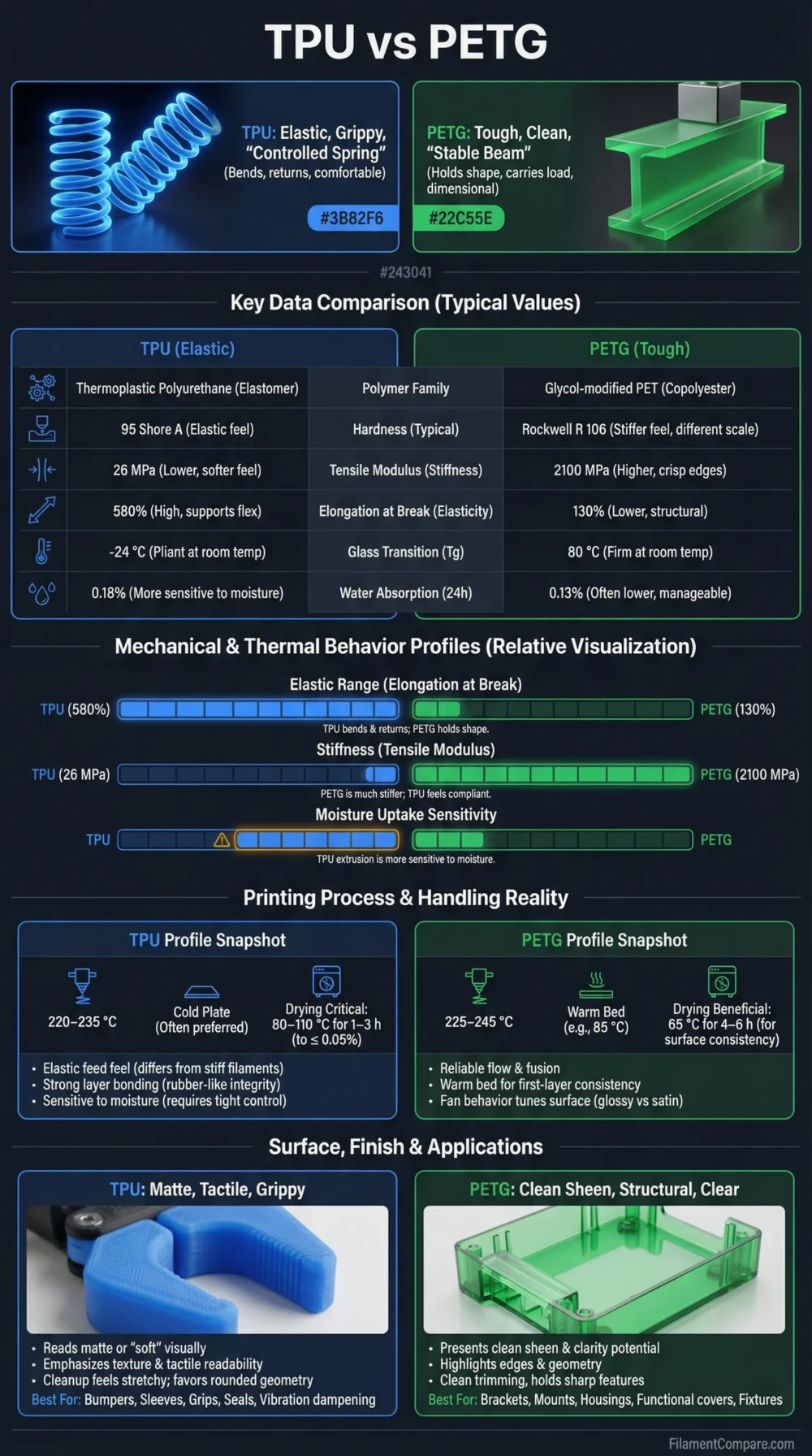
TPU is flexible and impact-absorbing, while PETG is stiffer, easier to dimension, and better for semi-rigid functional parts. PETG usually fits brackets, housings, clips, mounts, and everyday mechanical prints. TPU fits parts that need bend, grip, damping, or rubber-like behavior. The right choice depends less on raw strength and more on whether the part should hold shape or deform safely under load.
Choose PETG when you need a semi-rigid part with better dimensional control, easier tuning, cleaner edges, and practical heat resistance for normal indoor use. It is usually the safer default for functional printer parts, brackets, containers, clips, and general workshop prints.
Choose TPU when the part must flex, compress, absorb impact, resist abrasion, or provide grip. It is the better material for gaskets, feet, bumpers, cable protectors, soft mounts, wear pads, flexible hinges, and shock-absorbing parts.
Best for Beginners
PETG is easier to feed, retract, and print at normal speeds than most flexible TPU grades.
Better Flexibility
TPU is the clear fit for bendable, rubber-like parts.
Better for Rigid Functional Parts
PETG keeps shape better under normal handling and assembly loads.
Better Impact Absorption
TPU absorbs shock and vibration better because it can deform without cracking.
Better Surface Definition
PETG usually produces sharper edges and more predictable hole geometry than TPU.
Better Wear Pads and Feet
TPU works well for non-slip pads, soft contact surfaces, and abrasion-prone parts.
Better for Fast Printing
PETG is normally more forgiving at moderate speeds, while TPU often needs slower extrusion.
Better for Tight Tolerances
PETG is more suitable when holes, slots, and mating features must stay consistent.
| Category | TPU | PETG | Better Choice |
|---|---|---|---|
| Material Family | Thermoplastic polyurethane, part of the wider thermoplastic elastomer group | Polyethylene terephthalate glycol-modified copolyester | Use-case based |
| Print Difficulty | Medium to high; softer grades are more tuning-sensitive | Easy to medium; stringing control is the main tuning point | PETG |
| Typical Nozzle Temperature | Usually about 210–245 °C, grade-dependent[a] | Usually about 230–250 °C, brand-dependent[b] | Similar range |
| Typical Bed Temperature | Often 40–75 °C depending on hardness, printer, and part size | Usually around 70–90 °C depending on surface and formulation | Printer-dependent |
| Enclosure Requirement | Usually not required for common 95A TPU, though drafts can affect large parts | Usually not required, but stable room temperature helps large parts | Similar |
| Heat Resistance | Grade-dependent; some TPU grades can handle moderate warmth, but softness changes under load | Moderate; better than PLA for many warm indoor uses, but not a high-temperature engineering plastic | Depends on load and grade |
| Toughness | Excellent impact absorption and tear-resistant behavior in suitable grades | Good toughness for semi-rigid functional parts | TPU for impact absorption |
| Stiffness | Low; designed to flex | Medium; semi-rigid and shape-holding | PETG |
| Layer Adhesion | Often strong, but print speed and moisture matter | Usually strong and reliable when temperature is tuned | Both can be strong |
| Moisture Sensitivity | Can be moisture-sensitive; some modern TPU grades absorb less than older flexible materials | Moderate; wet PETG can string, pop, and lose surface quality | Both need dry storage |
| Surface Finish | Satin to rubber-like; fine detail can look soft | Glossy to semi-gloss; sharper edges than TPU | PETG |
| Outdoor Suitability | Good for bumpers and flexible contact parts, but UV stability varies by grade | Suitable for mild outdoor use better than PLA, but not the same as ASA or UV-stabilized grades | Grade-dependent |
| Typical Uses | Gaskets, bumpers, feet, grips, tires, seals, cable protectors, soft mounts | Brackets, containers, printer parts, tool holders, clips, housings, jigs | Use-case based |
| Main Limitation | Slow printing, flexible filament feeding, stringing, support removal | Stringing, strong bed adhesion, less stiffness than PLA or filled materials | Different limits |
This TPU and PETG comparison is based on manufacturer material guides and datasheet trends; real results change with brand, hardness grade, moisture level, additives, color, print orientation, and slicer settings.
TPU Material Profile
- Polymer type: Thermoplastic polyurethane elastomer
- Print difficulty: Medium to high, especially below 95A hardness
- Nozzle range: Usually 210–245 °C depending on grade and brand
- Bed range: Often 40–75 °C
- Enclosure: Usually not required for common desktop TPU
- Drying need: Recommended when stringing, bubbles, or weak surface texture appear
- Typical behavior: Flexible, grippy, impact-absorbing, slower to print
- Best use cases: Bumpers, feet, seals, soft mounts, wear pads, cable strain relief
PETG Material Profile
- Polymer type: Glycol-modified copolyester
- Print difficulty: Easy to medium
- Nozzle range: Usually 230–250 °C depending on material profile
- Bed range: Usually 70–90 °C
- Enclosure: Usually not needed
- Drying need: Useful for reducing stringing, popping, and rough extrusion
- Typical behavior: Semi-rigid, tough, slightly flexible, glossy, stringing-prone
- Best use cases: Brackets, housings, containers, printer parts, clips, jigs, workshop tools
These bars are relative print-use indicators, not lab ratings. Brand, hardness, moisture, additives, color, part orientation, flow calibration, and slicer settings can shift the result.
Printability and Tuning Behavior
PETG is usually the easier material to start with because it feeds like a normal semi-rigid filament. The main tuning work is controlling stringing, bed adhesion, cooling, and first-layer squish. PETG likes a heated bed, and it can bond too strongly to some smooth PEI surfaces if no separator is used. That is a build-plate issue, not a material failure.
TPU asks more from the extruder path. A direct-drive extruder, clean filament path, low print speed, controlled retraction, and dry spool make a larger difference than they do with PETG. Softer TPU can buckle or compress inside the feed path. A 95A TPU is much easier than very soft grades, but it still benefits from slower speeds and gentle retraction.
Practical tuning note: PETG is often tuned by reducing stringing and managing bed adhesion. TPU is often tuned by slowing the print, reducing feed resistance, and preventing the filament from stretching, buckling, or absorbing moisture.
Mechanical Behavior: Flexible Strength vs Shape-Holding Strength
TPU and PETG are both useful for functional printing, but they solve different mechanical problems. TPU handles impact by bending and recovering. PETG handles many workshop loads by staying semi-rigid while still offering better toughness than brittle materials.
A PETG bracket can hold a fixed geometry better than TPU. A TPU bumper can survive repeated knocks better than a rigid PETG bumper because the TPU part does not need to resist all the force in a stiff shape. This is why “stronger” is not enough as a decision word. For TPU vs PETG, ask whether the part must stay accurate or deform safely.
Heat Resistance and Shape Retention
PETG is generally more shape-stable than TPU in rigid assemblies, but it is not a high-temperature material. Manufacturer data for one Prusament PETG V0 grade lists heat deflection values in the upper double-digit Celsius range depending on load and test condition[c]. That does not mean every PETG print is safe for hot car interiors, enclosed electronics, or load-bearing warm environments.
TPU heat behavior is more complicated because softness, hardness grade, and load matter. A TPU may keep flexibility across a wide temperature range, yet still deform under pressure. BASF’s Ultrafuse TPU 95A datasheet lists Shore A hardness, Vicat, glass transition, and print parameters for one 95A grade[d]. Treat those values as grade-specific, not universal for every TPU spool.
Moisture, Stringing, and Surface Quality
Both materials should be stored dry. Wet PETG often shows extra stringing, popping, inconsistent gloss, and rougher walls. Wet TPU can show stringing, bubbles, weak surface texture, and less predictable feeding.
PETG normally produces sharper part edges than TPU. It is better for holes, slots, covers, containers, and assemblies where parts meet other printed or metal components. TPU can look clean when tuned well, but its flexible extrusion makes small text, tiny holes, thin walls, and sharp corners less predictable.
Where PETG Feels Easier
- More predictable extrusion at normal desktop speeds
- Better hole accuracy after flow calibration
- Cleaner corners on boxes and brackets
- Easier support removal than TPU in many cases
Where TPU Feels Different
- Excellent grip and soft contact behavior
- Better damping for vibration-prone parts
- Less useful for sharp rigid geometry
- Often slower and more sensitive to extruder setup
Outdoor, Wear, and Contact Surfaces
PETG is often chosen for mild outdoor prints because it is tougher and more temperature-tolerant than PLA in many common uses. Long-term UV exposure is still a separate issue. For demanding outdoor parts, ASA or a UV-stabilized material may fit better than standard PETG.
TPU is strong in a different way. It is useful where the printed part touches another surface repeatedly. Feet, pads, cable protectors, tool grips, and bump stops are natural TPU uses. Prusament’s TPU 95A material page describes applications such as O-rings, spacers, rugged housings, sports equipment parts, edge covers, cable protectors, and tires[e].
Printer Requirements and Hardware Fit
PETG works on most printers with an all-metal or PTFE-lined hotend rated for PETG temperatures, a heated bed, and a suitable build surface. It does not usually require an enclosure. Cooling should be balanced: enough fan for detail, not so much that layer bonding becomes weaker.
TPU is more hardware-sensitive. Direct drive is preferred, but some Bowden printers can handle firmer 95A TPU with slow speeds and a constrained filament path. Very soft TPU is less suitable for long Bowden tubes. Retraction should be conservative because flexible filament can stretch rather than retract cleanly.
Important: Carbon fiber, glass fiber, high-speed, matte, recycled, transparent, and specialty blends can behave differently from standard TPU or PETG. Use the brand profile as the starting point, then tune from a small calibration part.
| Use Case | Better Material | Reason |
|---|---|---|
| Beginner functional prints | PETG | Easier feeding, more predictable dimensions, and faster normal print speeds. |
| Flexible gaskets | TPU | Can compress and seal better than semi-rigid PETG. |
| Printer brackets and mounts | PETG | Keeps shape better under normal assembly loads. |
| Anti-vibration feet | TPU | Absorbs vibration and grips the surface. |
| Storage boxes and containers | PETG | Better wall stiffness and cleaner lid fit. |
| Cable strain relief | TPU | Bends repeatedly without behaving like a brittle hinge. |
| Snap-fit clips | Depends on design | PETG fits semi-rigid snap features; TPU fits soft retention or flexible straps. |
| Outdoor utility parts | Depends on exposure | PETG is more shape-holding; TPU is better for soft contact. UV-stabilized grades matter. |
| Miniatures and fine detail | PETG | Neither is ideal compared with PLA or resin, but PETG holds detail better than TPU. |
| Phone cases and protective covers | TPU | Flexible edges and impact absorption are more useful than stiffness. |
| Jigs and fixtures | PETG | Better for maintaining alignment, hole spacing, and flat surfaces. |
| Wear pads and bump stops | TPU | Handles rubbing, compression, and impact better in many contact applications. |
Choose TPU When
- The part must bend, stretch, compress, or absorb shock.
- You need grip, friction, cushioning, or vibration damping.
- The part touches another surface repeatedly.
- A rigid part would crack, rattle, slide, or damage the surface it contacts.
- You can print slower and tune the extruder path carefully.
TPU Is Less Suitable When
- You need sharp small details, threaded features, or crisp text.
- The part must hold tight tolerances under load.
- Your printer has a long Bowden path and the TPU grade is very soft.
- You need easy support removal or fast production printing.
Choose PETG When
- The part should be tough but still semi-rigid.
- You need brackets, cases, containers, clips, jigs, or printer parts.
- Dimensional consistency matters more than flexibility.
- You want a practical everyday material beyond PLA.
- You need better heat tolerance than PLA without moving to ABS, ASA, nylon, or PC.
PETG Is Less Suitable When
- The part needs rubber-like bend or compression.
- You need non-slip feet, soft bumpers, or elastic straps.
- Stringing cannot be accepted and you do not want to tune temperature, drying, and retraction.
- The part will face demanding UV, chemical, or high-temperature conditions without a suitable grade.
Material Selection Matrix
Choose PETG if the part must be semi-rigid, dimensionally predictable, easier to assemble, and suitable for general functional printing. It is the better default when the part should hold a shape.
Choose TPU if the part must flex, grip, damp vibration, absorb impact, or contact another surface without acting like a hard plastic part. It is the better material when controlled deformation is the design feature.
Neither material replaces the other. PETG is a tough copolyester for shape-holding parts. TPU is a flexible elastomer for soft, durable, and impact-friendly parts.
Common TPU and PETG Questions
Is TPU stronger than PETG?
TPU is usually better for impact absorption, stretching, and repeated bending. PETG is usually better for stiffness, shape retention, and dimensioned functional parts. The stronger choice depends on the load type.
Is PETG easier to print than TPU?
Yes, in most desktop printer setups. PETG behaves more like a standard rigid filament, while TPU needs slower speed, a controlled filament path, and careful retraction.
Can TPU replace PETG for functional parts?
Only when flexibility helps the design. TPU is not a good replacement for PETG brackets, boxes, jigs, or mounts that need stable geometry.
Can PETG replace TPU for flexible parts?
No. PETG has some give, but it is not a rubber-like material. For gaskets, soft feet, bumpers, grips, and flexible covers, TPU is the better fit.
Do TPU and PETG need drying?
Both benefit from dry storage. Drying is especially useful when TPU or PETG starts showing stringing, bubbles, popping, inconsistent extrusion, or rough surface texture.
Which is better for outdoor parts?
PETG is often the better semi-rigid choice for mild outdoor utility parts, while TPU is better for flexible outdoor contact parts. For long UV exposure, check UV-stabilized grades or consider ASA where rigidity is needed.
Resources Used
- [a] Flexible materials – Prusa Knowledge Base (Used for flexible filament printing behavior, general TPU/TPE print temperature ranges, bed temperature ranges, layer adhesion, warping, stringing, and print difficulty notes.)
- [b] PETG – Prusa Knowledge Base (Used for PETG print behavior, heated bed guidance, stringing tendencies, cooling notes, surface preparation, and common PETG use cases.)
- [c] Prusament PETG V0 by Prusa Polymers – Technical datasheet (Used as a manufacturer datasheet example for PETG print settings, density, heat deflection values, tensile data, impact data, and moisture absorption values.)
- [d] Ultrafuse TPU 95A Technical Data Sheet (Used for TPU 95A print parameters, drying recommendation, Shore hardness, Vicat, glass transition, melting temperature, abrasion, and impact-related datasheet values.)
- [e] Prusament TPU 95A – Prusament (Used for TPU 95A application examples, printer requirements, enclosure note, hardness, heat resistance note, wear resistance, and moisture behavior claims for that specific grade.)
