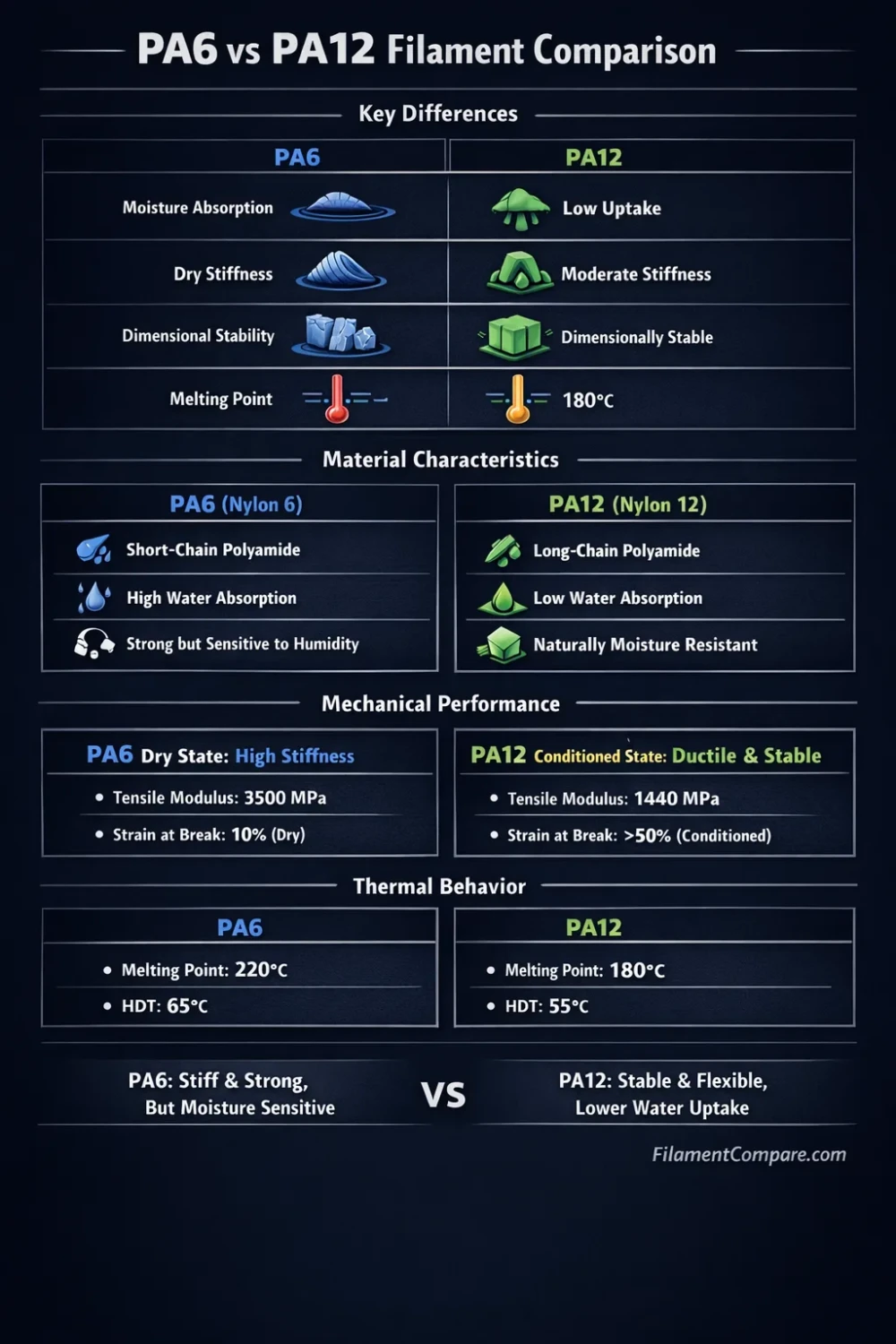
PA6 usually provides higher dry-state stiffness and greater heat potential, while PA12 absorbs less moisture and holds dimensions more consistently in changing humidity. PA6 is often the stronger choice for rigid, heat-loaded parts printed and used in controlled conditions. PA12 is usually the more practical option for snap-fits, lightweight housings, chemically exposed parts, and components that must stay predictable outside a dry workshop.
The Practical Choice
Choose PA6 when dry-state rigidity, load-bearing performance, wear resistance, and higher-temperature service matter more than moisture stability or easy processing.
Choose PA12 when lower moisture uptake, reduced warping, flexible toughness, chemical resistance, and repeatable dimensions across humid and dry conditions are higher priorities.
Neither material replaces the other. The correct choice depends on the part’s load, environment, geometry, and the exact filament formulation.
Higher Dry-State Stiffness
PA6
Commonly better for rigid brackets, fixtures, gears, and parts that should resist elastic deflection.
Better Humidity Stability
PA12
Lower moisture uptake generally produces smaller changes in dimensions and mechanical behavior.
Lower-Warp Nylon Printing
PA12
Usually more forgiving for broad bases, thin walls, and geometries that accumulate cooling stress.
Higher Heat Potential
PA6
Often favored for warm fixtures and mechanical parts, provided the selected grade has verified heat data.
Snap-Fits and Living Flex
PA12
Its lower modulus and higher elongation are often useful for clips, covers, and impact-absorbing features.
Rigid Wear Parts
PA6
A strong fit for dry-running guides, bushings, gears, and tooling when geometry and lubrication are suitable.
Tight Tolerances in Humidity
PA12
More consistent moisture behavior can reduce post-print swelling and fit changes.
Broader Filament Selection
PA6
PA6, PA6-CF, and PA6-GF options are widely offered, though availability varies by market.
| Decision Area | PA6 | PA12 | Better Fit |
|---|---|---|---|
| Polymer family | Short-chain aliphatic polyamide, also called Nylon 6 | Long-chain aliphatic polyamide, also called Nylon 12 | Application-dependent |
| Print difficulty | Advanced; often more sensitive to moisture, shrinkage, and chamber conditions | Advanced, but usually more forgiving than standard PA6 | PA12 |
| Typical nozzle temperature | Usually about 250–285°C; grade-dependent | Usually about 255–280°C; grade-dependent | Similar hardware class |
| Typical bed temperature | Commonly 70–110°C | Commonly 90–110°C | Check the spool profile |
| Enclosure need | Recommended for standard grades and larger parts; some low-warp grades differ | Recommended for dependable large parts, though small prints may be easier | PA12 |
| Dry-state stiffness | Usually higher | Usually lower and more compliant | PA6 |
| Impact and flex behavior | Tough, with behavior strongly affected by moisture and grade | Usually more flexible with better low-temperature impact retention | PA12 |
| Heat resistance | Often higher potential, especially in engineered or reinforced grades | Good, but exact ranking changes with grade, load, conditioning, and test method | PA6, after datasheet review |
| Layer adhesion | Very good when printed hot and dry | Very good when dry and correctly enclosed | Both |
| Moisture sensitivity | High; dry-box printing is strongly preferred | Lower than PA6, but still hygroscopic and still benefits from drying | PA12 |
| Dimensional stability | Good when dry and controlled; more likely to shift after conditioning | Usually more stable across humidity changes | PA12 |
| Warping tendency | Moderate to high for standard unfilled grades | Usually lower, not zero | PA12 |
| Chemical exposure | Good resistance to many oils and lubricants; compatibility remains chemical-specific | Usually better resistance to fuels, hydraulic fluids, oils, and several solvents | PA12 |
| Surface finish | Functional semi-matte finish; moisture can create rough extrusion | Often smoother and more even because shrinkage is easier to manage | PA12 |
| Typical uses | Rigid fixtures, gears, brackets, tooling, machine components, wear parts | Clips, housings, tubing-related parts, chemical-contact fixtures, flexible mechanical parts | Use-case based |
| Main limitation | Moisture uptake, warping, and performance changes after conditioning | Higher price, lower dry stiffness, and less universal availability | Different trade-offs |
Material Profiles
PA6 Material Profile
- Polymer type: Semi-crystalline polyamide 6
- Print level: Advanced
- Nozzle range: Commonly 250–285°C
- Bed range: Commonly 70–110°C
- Enclosure: Usually recommended, especially for large or flat parts
- Drying need: High; drying and dry-box feeding are preferred
- Typical behavior: Stiff when dry, strong layer bonding, wear resistant, more shrinkage-sensitive
- Best uses: Rigid fixtures, gears, structural brackets, jigs, guides, and machine parts
PA12 Material Profile
- Polymer type: Semi-crystalline polyamide 12
- Print level: Advanced, usually easier than standard PA6
- Nozzle range: Commonly 255–280°C
- Bed range: Commonly 90–110°C
- Enclosure: Recommended for consistent geometry and larger parts
- Drying need: Required when wet; dry-box feeding still improves consistency
- Typical behavior: Lower moisture uptake, lower density, more flexibility, reduced warping
- Best uses: Snap-fits, housings, impact parts, chemical-contact fixtures, and dimension-sensitive components
Relative Printing and Service Performance
PA6
PA12
Why Moisture Changes More Than Print Quality
Both materials absorb water from the air, but PA6 is normally much more moisture-sensitive. Wet filament may pop at the nozzle, string, ooze, form a rough surface, and produce inconsistent extrusion. Those symptoms matter during printing, yet moisture continues to matter after the part leaves the build plate.
Absorbed water plasticizes a polyamide. The part can become less stiff, more flexible, and slightly larger. BASF’s polyamide documentation separates dry and conditioned data because ambient moisture can materially alter modulus and other mechanical values[d]. A PA6 gear, press-fit, bearing seat, or measurement fixture may therefore behave differently after days or weeks in a humid room.
PA12 also needs sensible storage and drying, but its lower uptake gives it a wider environmental comfort zone. Arkema identifies lower water absorption and better dimensional stability as direct PA12 advantages over PA6[c]. This is why PA12 often makes more sense for calibration fixtures, covers with close-fitting clips, parts near fluids, and components moving between air-conditioned and humid spaces.
Stiffness, Toughness, and Creep Under Load
PA6 is commonly chosen when the part should feel rigid. Its dry-state modulus is generally higher, so a PA6 bracket, lever, or gear tooth often deflects less under the same load. That does not mean every PA6 filament has higher tensile strength than every PA12 filament. Test method, specimen conditioning, print direction, layer bonding, and additives can change the ranking.
PA12 usually trades some rigidity for greater elastic compliance and impact tolerance. That behavior is useful in clips, protective shells, cable guides, snap joints, and parts that must bend without immediately cracking. It may be less suitable for a long cantilever arm or a fixture that must resist small deflections under constant load.
Creep deserves separate attention. A part can survive a short tensile test yet slowly deform under a lower continuous force. Use thicker load paths, ribs, shorter unsupported spans, generous fillets, and mechanical fasteners where possible. For long-term clamping, bearing preload, or elevated-temperature loading, compare grade-specific creep curves rather than relying only on tensile strength.
Representative Datasheet Numbers
A neat STYX PA6 sheet reports 2,900 MPa tensile modulus, 50 MPa tensile strength, 3.0% moisture absorption at 23°C and 50% relative humidity, and a 185°C melting temperature[a]. A Fiberlogy PA12 sheet reports 1,400 MPa tensile modulus, 45 MPa tensile strength at yield, elongation at break above 50%, density of 1.01 g/cm³, and a 178°C melting temperature[b].
These figures illustrate the usual dry-stiffness and flexibility split, but they are not a universal PA6-versus-PA12 laboratory contest. They come from two commercial formulations, and the sheets may use material specimens or preparation conditions that do not match a finished FFF part. Printed-wall orientation can outweigh a modest resin-level difference.
Heat Ratings Need the Load and Test Method
PA6 is often described as the higher-heat choice because many PA6 grades have higher melting temperatures and strong dry-state performance. That is a useful starting point, not a safe design limit. Melting temperature, glass transition, Vicat softening, heat deflection temperature, and continuous-use temperature measure different behavior.
Heat deflection temperature changes with the applied stress. The same PA12 sheet can list a much higher HDT at 0.45 MPa than at 1.8 MPa. A lightly loaded cover and a tightly bolted bracket therefore cannot use the same temperature claim. Annealing, moisture, wall orientation, crystallinity, and fastener pressure also affect shape retention.
Use Heat Data Correctly
- Match the HDT load and test standard before comparing two grades.
- Separate short exposure from continuous service.
- Check whether the specimen was dry, conditioned, annealed, or reinforced.
- Reduce the target temperature when the part carries constant stress.
- Test the printed orientation and fastener design, not only the raw polymer.
Printability, Warping, and Dry-Box Workflow
Standard PA6 normally asks more from the printer. A high-temperature all-metal hot end, dependable bed heating, a stable build surface, low part cooling, and an enclosure are the usual starting points. FormFutura gives 255–285°C nozzle and 90–110°C bed guidance for its low-warp STYX PA6 grade[e]. Other PA6 products may use a cooler bed or require a warmer chamber, so the spool profile remains the controlling instruction.
PA12 generally shrinks less aggressively and often releases less internal stress during cooling. It can therefore be easier for tall shells, broad bases, and parts with thin-to-thick transitions. Fiberlogy still recommends a closed, heated chamber for its PA12 to manage shrinkage and dimensional quality[f]. Easier does not mean enclosure-free for every geometry.
PA6 Printing Priorities
- Dry the spool before calibration.
- Feed directly from a dry box during long prints.
- Use an enclosure for large, flat, or dense parts.
- Keep cooling low unless bridges require more airflow.
- Use a suitable nylon adhesive or verified build surface.
- Add fillets and reduce abrupt cross-section changes.
PA12 Printing Priorities
- Dry even when the filament looks visually normal.
- Use a hot, stable bed and a clean adhesion surface.
- Enclose production parts for repeatable dimensions.
- Tune retraction only after moisture is controlled.
- Allow the part to cool gradually before removal.
- Measure critical fits after environmental conditioning.
Popping, hissing, heavy stringing, foamy extrusion, rough walls, and uneven flow are common wet-filament indicators[h]. Retraction tuning cannot correct steam forming inside the nozzle. Dry first, then tune temperature, flow, and travel settings.
Chemical Exposure, Outdoor Use, and UV
PA12 is usually the safer starting point for parts near fuels, oils, hydraulic fluids, greases, salt water, and several solvents. Compatibility is still chemical-specific. Concentration, temperature, stress, contact time, cleaning agents, and additives all matter, and strong acids or bases can be unsuitable for many polyamides.
Lower moisture uptake also gives PA12 an advantage outdoors or in wet workshops, but neither generic material should be labeled weatherproof. UV stability depends heavily on pigments and stabilizers. Black or UV-stabilized grades may retain properties better than natural or bright colors, yet an exposed production part still needs a manufacturer weathering statement or direct testing.
Neat, Carbon-Fiber, and Glass-Fiber Grades Are Separate Choices
The base-polymer comparison above describes unfilled or lightly modified PA6 and PA12. Carbon fiber and glass fiber change stiffness, shrinkage, surface texture, impact behavior, nozzle wear, and minimum feature size. A PA12-CF filament can be stiffer than a neat PA6 filament, while a tuned PA6-CF grade may warp less than an older unfilled PA12.
Specialty chemistry can also narrow the moisture gap. One unreinforced PA6 product, LUVOCOM 3F PAHT 9936, is marketed with reduced water uptake, no enclosure requirement, and its own 255–275°C processing window[g]. That does not redefine all PA6; it shows why a verified product sheet should overrule a generic family rule.
Neat Nylon
Better ductility and smoother small features. Standard brass nozzles are normally acceptable unless the product contains abrasive additives.
Carbon-Fiber Nylon
Higher stiffness, lower shrinkage, matte texture, lower elongation, and abrasive wear. Use a hardened or similarly wear-resistant nozzle.
Glass-Fiber Nylon
High stiffness and dimensional control with a rougher finish. It is also abrasive and may retain more impact tolerance than some CF grades.
Use-Case Recommendations
| Use Case | More Suitable Material | Reason |
|---|---|---|
| Rigid machine bracket | PA6 | Higher dry-state stiffness can reduce bending when the environment remains controlled. |
| Humidity-exposed inspection fixture | PA12 | Lower moisture uptake usually keeps locating surfaces and hole spacing more stable. |
| Snap-fit enclosure | PA12 | Greater flexibility and elongation are better suited to repeated clip deflection. |
| Warm production jig | PA6 | Often offers higher heat potential, but the exact grade needs matching HDT and creep data. |
| Large flat cover | PA12 | Lower warping tendency improves the chance of holding a broad, flat footprint. |
| Rigid gear or guide | PA6 | Stiffness and wear behavior are useful when moisture and lubrication are controlled. |
| Flexible cable clip | PA12 | More compliant behavior helps the clip open and recover without excessive stress concentration. |
| Oil or fuel-area fixture | PA12 | Usually offers the better chemical-resistance profile, subject to exact-fluid verification. |
| Tight press-fit component | PA12 | Lower humidity-driven dimensional change makes fit behavior easier to predict. |
| Low-cost nylon prototype | PA6 | PA6 is often easier to source in more brands and reinforced variants. |
| Cold-impact housing | PA12 | PA12 generally retains impact tolerance and flexibility better at low temperatures. |
| Maximum-stiffness composite part | Compare PA6-CF and PA12-CF datasheets | Fiber percentage and grade design can matter more than the neat-polymer ranking. |
Where Each Material Fits Better
Choose PA6 When
- The part needs high dry-state rigidity.
- The operating environment is controlled and reasonably dry.
- Heat resistance is a main requirement and the grade has verified data.
- The design is a rigid gear, jig, fixture, guide, or structural bracket.
- A broad range of CF, GF, or specialty grades is useful.
PA6 Is Less Suitable When
- The part must hold tight dimensions across large humidity swings.
- The printer lacks reliable drying, enclosure, or bed adhesion.
- The geometry has a broad flat base and little tolerance for warp.
- Repeated flexing is more important than rigidity.
- Long chemical exposure has not been checked against the exact grade.
Choose PA12 When
- Humidity stability and repeatable dimensions matter.
- The design includes clips, covers, hinges, or impact-absorbing walls.
- Lower warping is more valuable than maximum dry stiffness.
- The part may contact oils, fuels, greases, or hydraulic fluids.
- A lighter, more compliant nylon part is preferred.
PA12 Is Less Suitable When
- The part must resist small deflections under constant load.
- The budget favors a widely available standard nylon.
- The application needs the highest verified heat rating in the chosen product range.
- The design expects neat PA12 to behave like a fiber-filled engineering composite.
- Local supply and color choice are limited.
Material Selection Matrix
Best Choice by Priority
Choose PA6 if the part is a rigid mechanical component, the spool can be kept dry, the print environment is controlled, and grade-specific heat or stiffness data supports the load case.
Choose PA12 if the part must tolerate humidity, impact, repeated flexing, chemical contact, or dimensional checks across changing environments.
Compare reinforced grades separately if maximum stiffness, low shrinkage, or production tooling is the target. PA6-CF versus PA12-CF is not the same decision as neat PA6 versus neat PA12.
For a typical enclosed engineering printer, PA12 is the easier general-purpose nylon. PA6 remains the stronger candidate for dry, rigid, and heat-focused mechanical work.
Common PA6 and PA12 Questions
Is PA12 stronger than PA6?
Not in one universal sense. PA6 is usually stiffer when dry, while PA12 is often more flexible, impact-tolerant, and stable after humidity exposure. Tensile strength, layer strength, toughness, and creep must be compared separately.
Does PA12 need drying?
Yes. PA12 absorbs less moisture than PA6, but wet PA12 can still string, pop, extrude unevenly, and lose surface quality. Follow the exact spool’s drying temperature because the polymer, spool material, and additives may limit safe heating.
Can PA6 and PA12 use the same printer?
Usually, provided the machine has an all-metal hot end, suitable bed temperature, controlled filament drying, and preferably an enclosure. The build surface, chamber need, cooling, and adhesive may still differ by brand.
Which material is better for outdoor parts?
PA12 is generally the better starting point because of lower moisture uptake and better environmental stability. Long-term sunlight exposure still requires a UV-stabilized grade or direct weathering data; generic PA12 is not automatically weatherproof.
Is PA6-CF automatically better than PA12?
No. PA6-CF can deliver much higher stiffness and lower shrinkage than neat PA6, but it remains a different material from unfilled PA12. Compare it with PA12-CF or another reinforced grade when the project needs composite-level rigidity.
Technical References
- [a] Technical Data Sheet — STYX PA6 (Used for representative PA6 moisture absorption, modulus, tensile strength, melting temperature, storage, and dry-box guidance. Values describe this commercial grade rather than every PA6 filament.)
- [b] Technical Data Sheet — Fiberlogy Nylon PA12 (Used for representative PA12 density, tensile values, elongation, thermal values, and printing temperatures. Its figures should be read with the listed ISO methods and test loads.)
- [c] Rilsamid® Polyamide 12 (Nylon 12) Material (Supports the lower-water-absorption, dimensional-stability, chemical-resistance, flexibility, and impact comparison between PA12 and PA6.)
- [d] Ultramid® (PA) Product Brochure (Used for the effect of conditioning and moisture on polyamide mechanical properties, including why dry and conditioned datasets should not be mixed.)
- [e] STYX PA6 (Provides manufacturer printing ranges and notes for a low-warp PA6 filament. It also demonstrates that modified PA6 grades may print more easily than generic PA6 expectations suggest.)
- [f] Nylon PA12 Filament — Fiberlogy (Used for PA12 chemical-contact examples, functional-part uses, post-processing notes, and the recommendation for closed-chamber printing.)
- [g] LUVOCOM 3F PAHT 9936 (Shows how a specialty unreinforced PA6 formulation can use its own moisture, heat, drying, and enclosure recommendations rather than generic family settings.)
- [h] How to Dry 3D Printing Filament (Used for practical moisture symptoms such as popping, hissing, rough surfaces, stringing, and inconsistent extrusion.)
