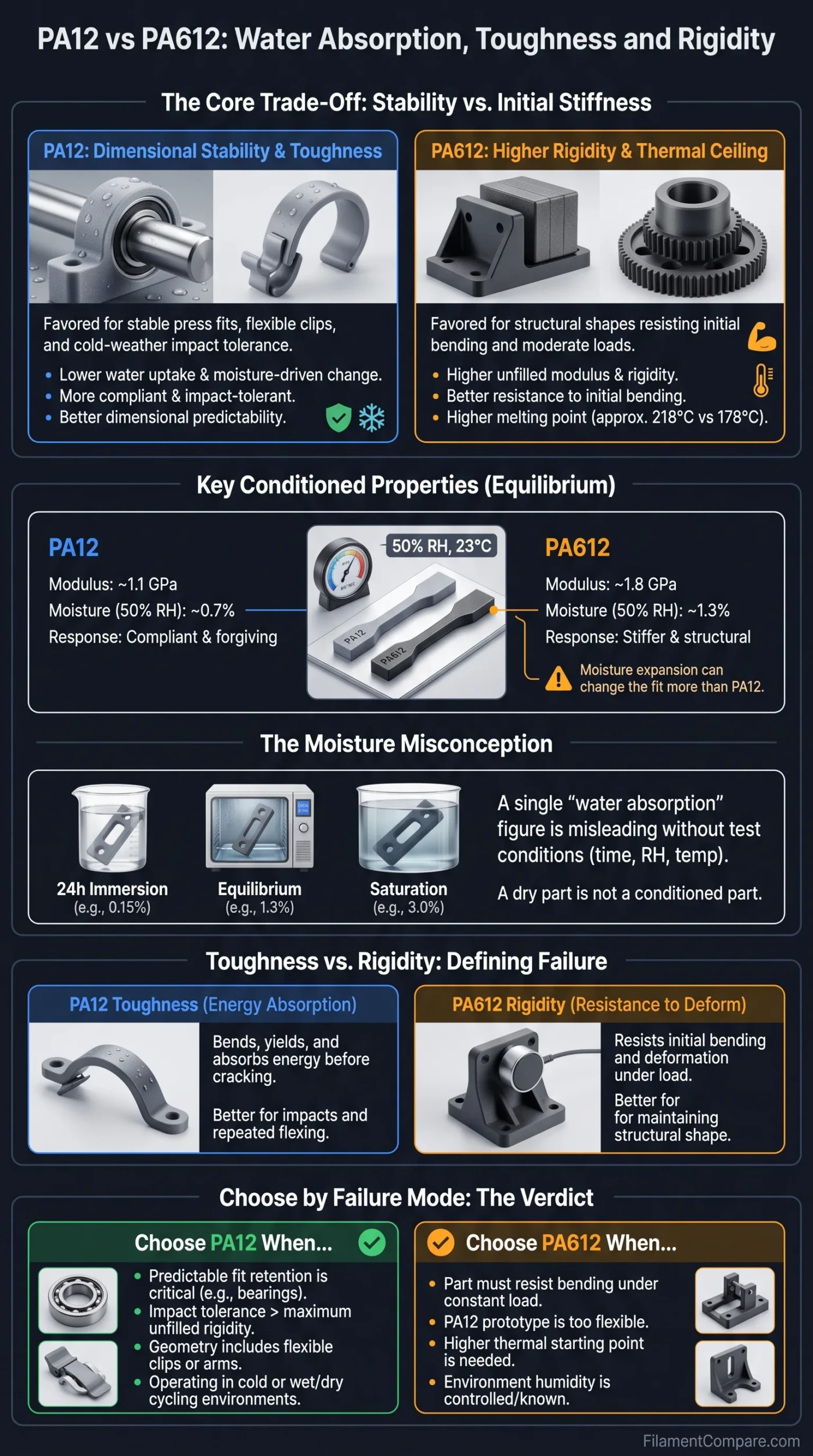
PA12 usually provides the more stable behavior when moisture, dimensional movement, and low-temperature impact are the main concerns, while PA612 can offer a stiffer structural response and a higher thermal ceiling. The choice is not simply “tough nylon versus strong nylon,” because water exposure can change modulus, fit, creep, and fracture behavior without visibly damaging the part.
The most useful comparison separates dry filament behavior from the properties of a finished part after it has reached equilibrium with its environment. A freshly dried PA612 print may feel markedly more rigid than PA12, yet the size and mechanical response of both materials can shift as moisture enters the polymer.
The Better Fit by Priority
Choose PA12 when low water uptake, stable press fits, flexible clips, cold-weather impact tolerance, or predictable behavior across changing humidity levels matters most.
Choose PA612 when the part must resist bending, hold a structural shape under moderate load, or retain more rigidity than a typical unfilled PA12 grade.
Neither material has a universal advantage. The deciding question is whether failure is more likely to begin with dimensional movement and cracking or with excessive deflection and creep.
A same-source comparison of representative conditioned polyamide grades reports about 1,100 MPa modulus for PA12 and 1,800 MPa for PA612, along with moisture contents of 0.7% and 1.3% respectively at 23°C and 50% relative humidity. The same document lists melting points of 178°C for PA12 and 218°C for PA612.[a] These figures describe reference resin grades rather than guaranteed results from every printed filament.
| Decision Point | PA12 | PA612 |
|---|---|---|
| Typical polymer response | More compliant and impact-tolerant | More structural and resistant to initial bending |
| Representative conditioned modulus | About 1.1 GPa | About 1.8 GPa |
| Moisture at 23°C and 50% RH | About 0.7% in the cited resin comparison | About 1.3% in the cited resin comparison |
| Moisture-driven property change | Usually smaller | Usually greater than PA12 but lower than shorter-chain nylons such as PA6 or PA66 |
| Dimensional stability | Stronger starting point for tight fits and measurement-sensitive parts | Good for a nylon, but grade and conditioning still require attention |
| Rigidity | Lower without reinforcement | Higher in comparable unfilled grades |
| Toughness character | More forgiving in flexible, thin, or cold-loaded parts | Can provide a firmer strength-to-toughness balance |
| Representative melting point | About 178°C | About 218°C |
| Long-term loaded geometry | More likely to deflect when the section is too thin | Better starting point where bending stiffness controls the design |
| Press fits and bearing seats | Lower moisture movement makes retention easier to predict | Higher rigidity helps, but moisture expansion can change the fit |
| Filament handling | Must still be printed dry | Must still be printed dry |
| Main selection risk | Choosing it for a part that actually requires more stiffness or creep resistance | Selecting from dry data while ignoring conditioned dimensions and modulus |
A 0.15% Value and a 1.3% Value Can Both Describe PA612
Water-absorption figures are easy to misuse because they may describe different exposure methods. A 24-hour immersion result, equilibrium at controlled humidity, and full saturation do not measure the same state. They also do not indicate how quickly a printed wall of a particular thickness will reach that state.
For example, one natural PA612 stock-shape grade is listed at 0.15% moisture absorption after 24 hours and 3.0% at saturation under ASTM D570.[b] The 1.3% PA612 figure in the earlier comparison instead describes moisture content at 23°C and 50% relative humidity. Neither figure cancels the other; each answers a different question.
Do not place mixed test conditions in one winner table. A 24-hour immersion value for PA612 cannot be compared directly with a saturated PA12 value, a conditioned tensile bar, or a filament manufacturer’s unspecified “water absorption” figure.
Four details should accompany any useful moisture number:
- The test method and exposure medium
- The temperature and relative humidity
- Whether the specimen was dry, conditioned, or saturated
- The grade, reinforcement level, specimen geometry, and manufacturing process
Rate also matters. A thin clip may reach moisture equilibrium sooner than a thick mounting block. Two parts made from the same filament can therefore show different dimensional and mechanical changes at the same point in service.
PA612 Buys Rigidity; PA12 Buys Property Retention
In comparable unfilled grades, PA612 generally begins with a higher elastic modulus. Under the same load and geometry, this can reduce immediate bending and produce a firmer bracket, equipment mount, gear carrier, or housing wall. That advantage is useful only when the printed section, layer direction, temperature, and duration of load have also been considered.
PA12 starts from a more compliant position, but its lower moisture uptake usually means that the difference between the dry part and the conditioned part is smaller. Arkema describes PA12 as combining low water absorption and dimensional stability with impact resistance and flexibility, including in low-temperature applications.[c]
When Maximum Dry Rigidity Matters
- Long unsupported brackets
- Motor or sensor mounts
- Housing walls that must resist flexing
- Fixtures loaded mainly in bending
- Parts where a firmer response is more important than flexible impact absorption
PA612 is normally the stronger unfilled starting point, provided the conditioned properties remain adequate.
When Property Stability Matters More
- Press-fit pins and bushings
- Bearing seats
- Measurement fixtures
- Fluid-adjacent components
- Parts moving between dry storage and humid operation
PA12 usually makes dimensional allowances easier to control because less water enters the polymer.
Rigidity should also be separated from creep resistance. A part may feel stiff during a hand test yet continue to deform after days under bolt preload, belt tension, spring force, or cantilever loading. A datasheet modulus describes the initial stress–strain response under a defined test; it does not replace a sustained-load test on the printed geometry.
Temperature compounds the issue. PA612’s higher melting point does not mean a printed PA612 component remains unchanged near that temperature. Crystallinity, annealing, additives, print orientation, load level, and the grade’s heat-deflection behavior determine whether the part holds its shape.
Toughness Is Not the Same as Softness
A material can have a lower modulus yet resist impact well because it bends, yields, and absorbs energy before cracking. Another material can carry more tensile or bending stress but fail earlier at a notch, sharp corner, poorly bonded layer, or rigid screw boss. Calling one nylon “stronger” without naming the failure mode hides this distinction.
PA12 is often favored for flexible clips, protective housings, pneumatic components, and cold-service parts because its toughness is paired with lower moisture-driven change. Its advantage is most visible where the part must survive deformation rather than prevent it entirely.
PA612 can still be tough, but its appeal is usually a firmer structural balance. It is more appropriate when the part must absorb some shock without behaving like a flexible nylon component during normal loading.
Geometry can reverse an expected material result. A thick PA12 bracket may outlast a thin PA612 bracket. A rounded PA612 clip may survive longer than a PA12 clip with a sharp internal corner. Wall thickness, raster direction, layer bonding, hole spacing, and notch radius remain part of the material decision.
Three forms of toughness should be considered separately:
- Impact toughness: resistance to a sudden strike or drop
- Notch tolerance: resistance to crack initiation at holes, corners, and surface defects
- Fatigue tolerance: survival under repeated flexing, vibration, or load cycling
A single Charpy or Izod value does not fully predict a living hinge, snap-fit arm, bolted flange, or printed layer boundary. The test should resemble the expected movement of the real part.
The First Failure May Be a Loose Fit, Not a Broken Part
Nylon components often become unusable before they fracture. A bearing seat can loosen, a hole can move out of alignment, a cover can stop closing correctly, or a loaded arm can accumulate permanent deflection. These failures make moisture and rigidity part of the tolerance design rather than secondary material properties.
| Part or Failure Mode | Better Starting Point | Why | What Still Requires Testing |
|---|---|---|---|
| Press-fit bearing seat becoming loose | PA12 | Lower moisture movement supports more predictable fit retention | Printed diameter, creep, wall thickness, and operating temperature |
| Long bracket bending under constant load | PA612 | Higher unfilled rigidity can reduce initial deflection | Long-term creep in the conditioned state |
| Thin snap-fit arm cracking during assembly | PA12 | More compliant and forgiving behavior usually suits repeated flexing | Root radius, print orientation, strain level, and cycle count |
| Machine cover vibrating during operation | Depends on geometry | PA612 limits movement; PA12 can absorb deformation without cracking | Resonance, mounting points, wall shape, and impact exposure |
| Gear carrier losing center distance | PA12 | Dimensional stability may matter more than the higher dry modulus | Wear, shaft temperature, lubrication, and tooth load |
| Cold-weather protective housing | PA12 | Low-temperature impact tolerance is one of PA12’s established strengths | Actual minimum temperature and notch geometry |
| Rigid jig used only in controlled indoor air | PA612 | The higher modulus can provide a firmer fixture where humidity is stable | Calibration drift and sustained clamping force |
| Part exposed to repeated wet and dry cycles | PA12 | Lower water uptake reduces the scale of repeated dimensional movement | Chemical exposure, cycle duration, seals, and assembly constraints |
The table identifies a starting point rather than a substitute for prototype testing. A PA612 part can be designed with clearance for moisture expansion, while a PA12 part can gain stiffness through ribs, section depth, shorter spans, or reinforcement. Material and geometry solve different parts of the same problem.
Printing Wet and Operating Wet Are Separate Problems
Moist filament affects the manufacturing process. Water reaching the hot end can vaporize, disturb extrusion, produce surface defects, increase stringing, and weaken the consistency of layer bonding. A finished part absorbing moisture slowly at room temperature is undergoing a different process.
Dry Filament
Needed for stable extrusion, repeatable surface quality, and mechanical coupons that can be compared fairly.
Room-Conditioned Part
Represents many real indoor applications after the polymer has exchanged moisture with surrounding air.
Immersed or Saturated Part
Represents a more severe state that may be relevant to water-contact, washing, outdoor, or fluid-system applications.
Drying the spool does not guarantee that the installed component remains dry. Conversely, a properly conditioned part is not automatically a defective or badly stored part. The useful workflow is to print from dry material and then test samples in the environmental state expected during service.
A practical comparison can use three matched groups:
- Print both materials from verified dry spools using the same geometry and comparable layer orientation.
- Keep one group dry, condition a second group at controlled room humidity, and expose a third group to the relevant water or humidity cycle.
- Measure mass, hole diameter, overall dimensions, deflection under a fixed load, and permanent set after unloading.
- Repeat the fit test with the actual bearing, pin, bolt, or mating component.
This method reveals whether the important difference is water uptake, stiffness loss, dimensional expansion, or creep. It also prevents a dry PA612 coupon from being compared with a PA12 part that has already spent weeks in humid air.
Carbon Fiber Can Hide the Base-Polymer Difference
PA12-CF and PA612-CF should not be used as direct evidence for how unfilled PA12 and PA612 behave. Carbon fiber raises modulus, changes shrinkage, reduces elongation, alters fracture behavior, and can make the reinforcement package more influential than the difference between the polymer matrices.
A commercial PA612-CF15 filament, for example, is listed with a dry Young’s modulus of 5,136 MPa and a wet value of 3,990 MPa. The product contains 15 wt% carbon fiber and is described as a PA6/PA12-based copolyamide formulation.[d] Those figures are useful for that product, but they do not define unfilled PA612 and should not be placed beside an unrelated PA12 resin value as though only the polymer name changed.
Variant warning: PA612 on a filament spool may identify a proprietary copolyamide formulation rather than an unmodified reference resin. Carbon-fiber percentage, fiber length, impact modifiers, crystallization aids, annealing instructions, and moisture-conditioning methods can all change the result.
A fair reinforced-filament comparison should match as many of the following as possible:
- Fiber type and weight percentage
- Drying procedure and measured moisture state
- Annealed or as-printed condition
- Print orientation and specimen layout
- Nozzle diameter and layer height
- Test method and temperature
- Conditioning time before measurement
Abrasive reinforcement also adds a hardware requirement that does not apply to every unfilled grade. A wear-resistant nozzle becomes part of the selection, while the reduced ductility of a fiber-filled filament may make it less suitable for snap fits and repeated bending even when its stiffness is much higher.
Choose by Failure Mode, Not Polymer Rank
Choose PA12 When
- The part must retain a tight fit through changing humidity
- Impact tolerance matters more than maximum unfilled rigidity
- The geometry includes thin clips, flexible arms, or strain during assembly
- Low-temperature cracking is a concern
- Wet and dry cycling could alter dimensions
- Stable mechanical behavior is more valuable than the highest dry modulus
Choose PA612 When
- The part must resist bending under normal service loads
- A PA12 prototype is too flexible even after geometry is improved
- The application needs a higher thermal and stiffness starting point
- The part operates in a controlled or measurable moisture environment
- The supplier provides conditioned mechanical and dimensional data
- The design can accommodate more moisture movement than PA12
Where the Decision Lands
PA12 is the safer dimensional choice. It is normally easier to specify for bearing seats, clips, cold-impact parts, and components that move between dry and humid environments.
PA612 is the stronger rigidity choice. It is normally more suitable for brackets, jigs, carriers, and housings where excessive bending would cause failure before moisture-driven dimensional movement does.
Either material can work when the part is lightly loaded, tolerances are generous, humidity is controlled, and the geometry has already been tested in its conditioned state.
Neither material alone solves a design that needs metal-like stiffness, negligible creep, unrestricted high-temperature loading, or unchanged dimensions during severe immersion. Reinforcement, another polymer family, or a redesigned section may be more appropriate.
The useful distinction is not that PA12 is “tough” while PA612 is “strong.” PA12 places more emphasis on moisture stability, flexible impact response, and consistent fit. PA612 places more emphasis on rigidity and structural response, but that advantage should be checked after the part has absorbed the amount of moisture expected in service.
Technical Sources and Documentation
- [a] Grilamid L – Polyamide 12 by EMS-GRIVORY. Used for the same-source comparison of conditioned modulus, moisture content, melting point, impact behavior, and density across PA12 and PA612.
- [b] TECAMID 612 Natural – Low Moisture Nylon by Ensinger. Used for the PA612 24-hour and saturation moisture-absorption values and the grade-dependent mechanical context.
- [c] Rilsamid Polyamide 12 Material by Arkema High Performance Polymers. Used for the PA12 moisture-stability, impact-resistance, flexibility, and low-temperature behavior discussion.
- [d] Fiberon PA612-CF15 by Polymaker. Used to illustrate why a reinforced commercial filament should not be treated as an unfilled PA612 reference grade.
