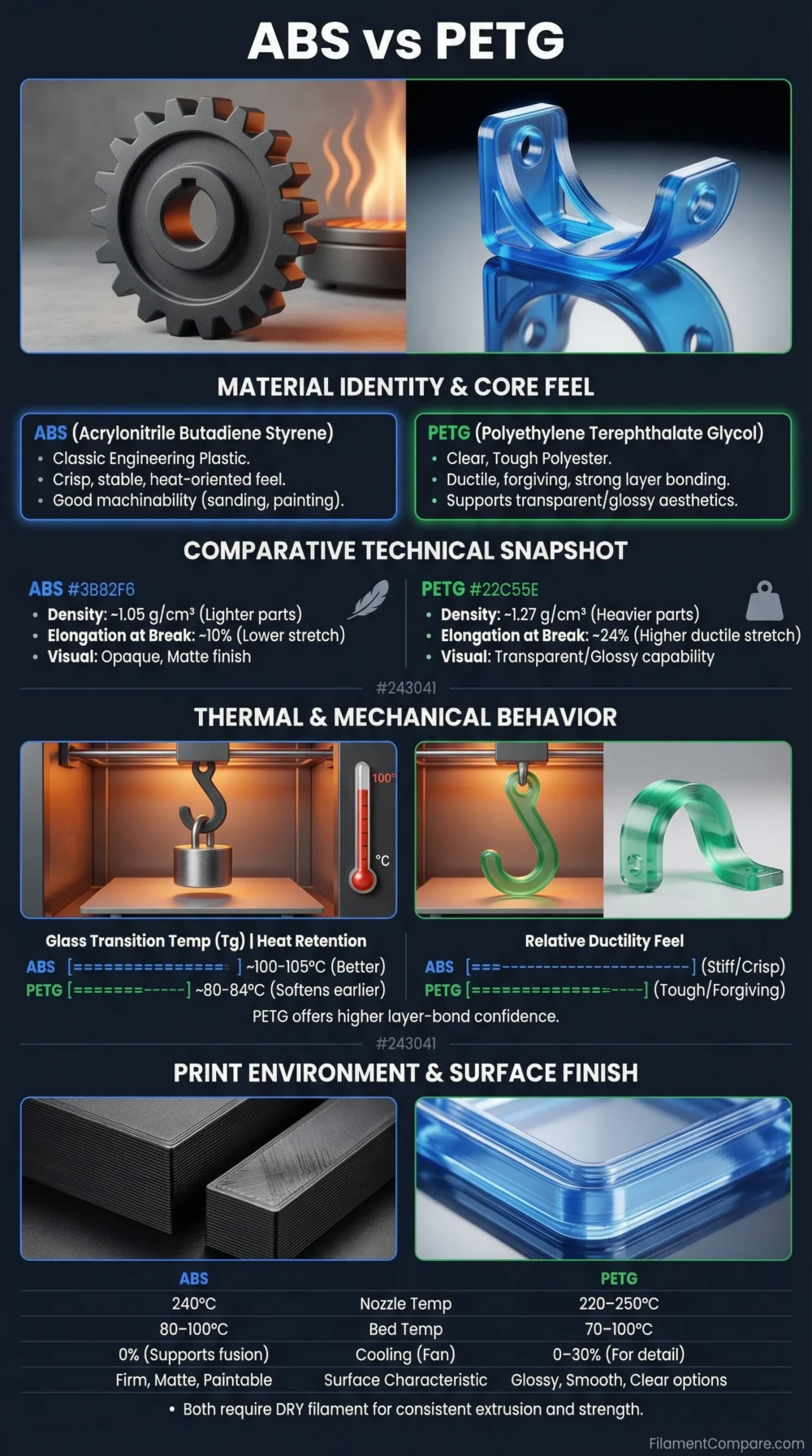
ABS handles heat and post-processing better, while PETG is easier to print and usually gives stronger layer bonding with less enclosure demand. ABS fits parts that need higher shape retention, sanding, acetone smoothing, and a more traditional engineering-plastic feel. PETG is the more practical choice for functional prints when you want toughness, lower warping risk, and fewer printer upgrades.
Choose ABS when heat resistance, acetone smoothing, machining, and a stiffer technical part matter more than print simplicity. Use a warm enclosure, stable bed temperature, and planned ventilation.
Choose PETG when you want functional parts with better print reliability, good toughness, strong layer adhesion, and lower warping risk on an open or semi-open printer.
Best for Beginners
PETG is easier to manage because it does not shrink as aggressively as ABS and usually does not require a fully enclosed chamber.
Better Heat Tolerance
ABS is the better fit for parts exposed to moderate warmth, provided the part is printed well and the design allows for the load direction.
Better Layer Adhesion
PETG usually bonds layers very well, which helps clips, brackets, containers, and practical household parts resist splitting.
Better for Acetone Smoothing
ABS can be vapor-smoothed or chemically post-processed with acetone. PETG is not used the same way.
Better Low-Warp Printing
PETG is more forgiving on large flat parts because it has lower shrink stress than ABS during cooling.
Better for Printer Parts
It depends on location. PETG works well for many brackets and holders; ABS is better near warm motors, enclosed chambers, or heat sources.
| Category | ABS | PETG | Better Choice |
|---|---|---|---|
| Material Family | Acrylonitrile butadiene styrene thermoplastic | Glycol-modified PET copolyester | Use-case based |
| Print Difficulty | More tuning-sensitive; enclosure strongly recommended | Moderate; open printers can often handle it | PETG |
| Typical Nozzle Temperature | Usually around 240–260 °C; Prusa lists 255 °C for ABS[a] | Usually around 230–250 °C; Prusa lists 230–240 °C for PETG[b] | Similar hotend class |
| Typical Bed Temperature | Usually 90–110 °C; larger parts often need the higher end | Usually 70–90 °C depending on brand and surface | PETG |
| Enclosure Requirement | Strongly recommended for medium and large parts | Not normally required, though it can help with stability | PETG |
| Heat Resistance | Better shape retention under moderate warmth; PolyLite ABS lists Vicat softening around 104 °C[c] | Better than PLA, but lower than ABS in many practical heat cases | ABS |
| Toughness | Good impact behavior when printed in a stable warm environment | Good toughness with less brittleness than PLA and strong layer bonding | Use-case based |
| Stiffness | Usually stiffer and more machinable | Slightly more flexible and ductile | ABS |
| Layer Adhesion | Good when chamber temperature and cooling are controlled | Usually very strong with correct temperature and dry filament | PETG |
| Moisture Behavior | Should be kept dry; moisture can cause rough extrusion | More moisture-sensitive in daily use; drying improves stringing and surface quality | ABS |
| Printing Emissions | In a 2026 chamber study, the tested ABS formulations produced higher VOC concentrations and about an order of magnitude higher particle-number concentrations than the tested PET-G formulations; styrene was the dominant ABS VOC.[e] | The tested PET-G formulations produced lower overall VOC and particle-number levels than the tested ABS products, but still emitted compounds including acetaldehyde and phthalic acid esters.[e] | Ventilate both; results vary by formulation |
| Surface Finish | Matte to satin; can be sanded and acetone-smoothed | Glossy to semi-glossy; can show stringing and nozzle marks | Depends on finish goal |
| Outdoor Suitability | Limited long-term UV fit unless stabilized; ASA is often a better outdoor choice | Handles moisture better than many easy filaments, but long UV exposure still depends on formulation | Neither is ideal for long UV exposure |
| Typical Uses | Enclosures, covers, brackets near warmth, sanded prototypes, vapor-smoothed parts | Functional brackets, containers, printer accessories, clips, general durable parts | Use-case based |
| Main Limitation | Warping, emissions, chamber need, and ventilation planning | Stringing, over-adhesion to some beds, moisture sensitivity | Different limits |
ABS and PETG recommendations here are based on manufacturer material pages, technical data sheets, and published FFF emission measurements; actual results can shift with brand, formulation, color, additives, moisture, chamber temperature, part orientation, nozzle temperature, cooling, and slicer settings.
ABS Material Profile
- Polymer type: Acrylonitrile butadiene styrene.
- Print difficulty: Moderate to high, mainly because of shrinkage and warping.
- Nozzle range: Commonly around 240–260 °C, brand-dependent.
- Bed range: Usually around 90–110 °C.
- Enclosure: Recommended for stable results.
- Drying need: Helpful if popping, bubbles, or rough surfaces appear.
- Typical behavior: Stiffer, heat-tolerant, post-process friendly, but sensitive to drafts.
- Best use cases: Warm-area brackets, housings, prototypes, sanded parts, and acetone-smoothed models.
PETG Material Profile
- Polymer type: Glycol-modified copolyester.
- Print difficulty: Moderate, usually easier than ABS.
- Nozzle range: Commonly around 230–250 °C.
- Bed range: Usually around 70–90 °C.
- Enclosure: Not normally needed for standard PETG.
- Drying need: Useful because wet PETG strings, pops, and loses surface quality.
- Typical behavior: Tough, slightly flexible, glossy, sticky on the build plate.
- Best use cases: Clips, holders, containers, brackets, printer accessories, and general durable parts.
These meters are practical print-use indicators, not fixed lab grades. Brand, additives, color, moisture level, print orientation, nozzle temperature, chamber temperature, cooling, and slicer settings can change the result.
Printability and Tuning Behavior
PETG is usually the easier material to print because it shrinks less during cooling. It still needs tuning, but the common problems are easier to correct: stringing, small blobs, overly glossy surfaces, and too much bed adhesion. A dry spool, a clean nozzle, moderate cooling, and a small retraction test often fix most PETG issues.
ABS needs more environmental control. The material cools and contracts more, so drafts, cold rooms, and uneven bed temperatures can lift corners or split tall parts. A warm enclosure does not only improve bed adhesion; it also helps the whole part cool more evenly. That is why ABS behaves much better in enclosed printers than on open-frame machines.
Practical note: If your printer is open-frame and you do not want to add an enclosure, PETG is usually the easier functional choice. If your printer is enclosed, ABS becomes much more predictable, but the enclosure should not be treated as an emissions-control system by itself. Ventilation or suitable filtration still needs to be considered.
Mechanical Behavior and Part Strength
ABS and PETG are both used for functional parts, but they fail in different ways. ABS tends to feel stiffer and more machinable. PETG tends to feel tougher and more ductile, especially across layer lines. In printed parts, the layer direction matters as much as the raw material because FDM parts are anisotropic; UltiMaker notes that printed sample properties vary by orientation in its ABS technical data sheet[d].
For snap-fit parts, PETG can be forgiving because it bends more before breaking. For rigid housings, covers, or parts that need sanding and finishing, ABS often feels better. For load-bearing designs, do not compare only tensile strength. Look at layer adhesion, wall count, print orientation, stress concentration, heat exposure, and creep over time.
Heat Resistance and Shape Retention
ABS has the advantage when a part may sit near warmth, electronics, motors, or an enclosed printer chamber. It is not a replacement for high-temperature materials such as PC, PA-CF, PEI, or PEEK, but it keeps shape better than PETG in many moderate-heat uses.
PETG is still more heat-tolerant than PLA in many prints, but it can soften or creep sooner than ABS under load. This matters for brackets, hooks, clamps, and parts under constant stress. A PETG part may look fine at room temperature yet slowly deform if it is loaded in a warm space.
Heat Rule for Real Parts
Use ABS for warmer functional parts when your printer can control warping. Use PETG when the part needs toughness and layer bonding but will not stay under load in a hot environment.
Surface Finish, Smoothing, and Post-Processing
ABS is easier to sand, prime, glue, and acetone-smooth. That makes it useful for covers, cosplay pieces, prototypes, and product-like housings where the printed layer texture should be reduced. Acetone smoothing should be handled carefully with ventilation and safe chemical practice.
PETG usually prints with a glossier surface. It can look clean on functional parts, but it may show fine strings, nozzle drag marks, and small blobs if temperature or drying is not tuned. It is less convenient for acetone-style smoothing, so most PETG finishing is mechanical: trimming, sanding, drilling, or light heat cleanup.
Moisture, Emissions, and Workspace Conditions
PETG benefits from dry storage. Wet PETG often prints with more stringing, rougher walls, and small popping sounds at the nozzle. Drying can make a bigger difference than changing retraction alone.
ABS should also be stored dry, but workspace emissions deserve separate attention from moisture. Odor does not measure the full emission mixture, and PETG should not be treated as emission-free simply because it usually smells less.
What 2026 ABS vs PET-G Testing Found
A May 2026 chamber study compared commercially available ABS- and PET-G-based filaments from multiple manufacturers. Under the study conditions, the tested ABS filaments produced higher VOC concentrations and particle-number concentrations about an order of magnitude above those measured for the tested PET-G filaments. Most of the measured particles were ultrafine, with dominant sizes around 55–90 nm.[e]
Styrene dominated the VOC profile of the tested ABS products and reached up to 264.75 µg/m³ in the reported measurements. The tested PET-G filaments produced less total VOC and particle output than the ABS products, but they still released compounds including acetaldehyde, formaldehyde, and phthalic acid esters. Some phthalates were measured at higher levels in the PET-G samples, so “PETG emits less” should not be simplified into “PETG produces nothing of concern.”[e]
The results also differed between products made from the same polymer type. That points to formulation, additives, pigments, manufacturer choices, and processing conditions as part of the emission profile. The measurements should therefore be read as results for the tested commercial filaments rather than fixed emission values for every ABS or PETG spool.[e]
Warm-Up and Print Start Matter
The May 2026 study found the highest particle emission rates during the initial warm-up and start of printing, with elevated output also appearing near the final stage of the tested jobs.[e] Ventilation or source extraction should therefore be running before printing begins rather than being switched on only after the machine has been extruding for several minutes.
A separate July 2026 ACS study did not compare PETG directly, but it adds context for ABS emissions. In the ABS and PLA products tested there, the ABS filaments emitted more total VOCs than the PLA filaments, with styrene associated strongly with ABS. The same study also found variation by polymer type, color, and brand.[f]
Workspace setup: Keep the printer away from the normal breathing zone and run ventilation or suitable source control through warm-up, printing, and the period immediately after the job. An enclosure helps ABS temperature stability, but a sealed box without ventilation or filtration can retain emissions instead of removing them.
Build Plate and Adhesion Behavior
ABS needs strong bed adhesion, but too much cooling stress can still lift corners. A heated bed, brim, clean build surface, and enclosure all work together. Large flat ABS parts are the most demanding because they store more shrink stress.
PETG often sticks very strongly to smooth PEI, glass, and some coated beds. A release layer can protect the print surface. This is one of the details that makes PETG different from PLA: the problem is not always lack of adhesion; sometimes it is too much adhesion.
| Use Case | More Suitable Material | Reason |
|---|---|---|
| Beginner functional prints | PETG | Lower warping risk and less need for a controlled chamber. |
| Warm electronics enclosure | ABS | Better shape retention near moderate warmth. |
| Clips and snap-fit parts | PETG | Good layer adhesion and ductile bending behavior. |
| Acetone-smoothed models | ABS | ABS can be chemically smoothed; PETG is not used the same way. |
| Large flat panels | PETG | Lower shrink stress makes edge lifting easier to control. |
| Machined or sanded prototypes | ABS | ABS is easier to sand, fill, prime, and finish. |
| Printer accessories away from heat | PETG | Good toughness and easier printing for brackets, holders, and guides. |
| Parts inside warm enclosures | ABS | Better thermal margin than PETG for chamber-adjacent uses. |
| Containers and utility parts | PETG | Strong layer bonding and practical durability for everyday use. |
| Long outdoor exposure | Neither as default | ASA or UV-stabilized grades are usually a better match for long UV exposure. |
Choose ABS When
- The part needs better heat resistance than PETG.
- You can print inside a warm enclosure.
- The part will be sanded, filled, painted, or acetone-smoothed.
- You want a stiffer housing, cover, or mechanical prototype.
- The part sits near motors, electronics, or a warm printer chamber.
ABS Is Less Suitable When
- Your printer is open-frame and the room is cool or drafty.
- The part is large, flat, and has sharp corners.
- You cannot manage ventilation or enclosure needs.
- The part needs the easiest functional material for daily printing.
Choose PETG When
- You want a functional part without fighting ABS-level warping.
- Layer adhesion and toughness matter more than stiffness.
- Your printer is not enclosed.
- You are printing brackets, clips, holders, containers, or utility parts.
- You want a material that is more forgiving than ABS but tougher than PLA.
PETG Is Less Suitable When
- The part will stay under load in a warm environment.
- You need acetone smoothing or easy chemical finishing.
- The print surface is easily damaged by over-adhesion.
- You cannot dry the filament and need very low stringing.
Choose ABS if heat resistance, stiffness, acetone smoothing, and post-processing are the main goals, and your printer can handle an enclosure, a hot bed, stable chamber conditions, and planned emissions control.
Choose PETG if you want the more practical everyday functional filament: easier printing, strong layer bonding, good toughness, and less warping risk.
Neither fully replaces the other. ABS is the better thermal and finishing material; PETG is the easier functional material for most open-printer users.
ABS vs PETG Questions
Is ABS stronger than PETG?
Not in every sense. ABS is usually stiffer and more heat-resistant, while PETG often has stronger layer adhesion and more ductile behavior. Printed strength depends on orientation, temperature, wall count, moisture, and part design.
Does PETG need an enclosure like ABS?
Standard PETG usually does not need a full enclosure. ABS benefits much more from an enclosure because it shrinks more during cooling and is more sensitive to drafts.
Which one is better for car interior parts?
ABS is generally more suitable than PETG for moderate warmth, but hot car interiors can still exceed the comfort range of many printed plastics. For demanding heat exposure, consider higher-temperature materials or validated material grades.
Which filament warps more?
ABS warps more. It needs a hot bed, stable environment, and usually an enclosure. PETG can still lift on large parts, but it is much easier to keep flat.
Does PETG emit less than ABS?
In a May 2026 chamber study, the tested PET-G products emitted lower overall VOC concentrations and about one-tenth the particle-number concentrations measured from the tested ABS formulations.[e] That result should not be generalized to every spool. Emission profiles differed by manufacturer and formulation, and the PET-G samples still emitted chemicals including acetaldehyde and phthalates.
When should ventilation start for ABS printing?
Before the print begins. The 2026 ABS/PET-G study measured the highest particle-emission rates during warm-up and the start of printing.[e] Source extraction, ventilation, or filtration should therefore already be operating while the printer is heating.
Can PETG replace ABS for printer parts?
For many brackets, holders, cable guides, and utility parts, yes. Near heat sources, motors, hotends, or enclosed chambers, ABS or ASA may be a better fit.
Which one is better for outdoor prints?
For long UV exposure, neither standard ABS nor standard PETG is the default best choice. ASA or UV-stabilized grades are usually more suitable for outdoor parts that stay in sun and weather.
Resources Used
- [a] ABS | Prusa Knowledge Base — Used for ABS printing temperature, bed temperature, enclosure behavior, and practical print limitations.
- [b] PETG | Prusa Knowledge Base — Used for PETG nozzle and bed temperature guidance, printability notes, and functional part suitability.
- [c] PolyLite™ ABS Technical Data Sheet — Used for ABS material data, including density, softening behavior, and technical material context.
- [d] UltiMaker ABS Technical Data Sheet — Used for the note that FFF printed mechanical properties vary with part orientation and sample direction.
- [e] Dobrzyńska, Jankowski & Borucka (2026) — Particle and Chemical Emissions During Fused Filament Fabrication (FFF) Using Commercial ABS- and PET-G-Based Filaments — Published May 4, 2026; used for direct ABS/PET-G VOC and ultrafine-particle measurements, formulation-dependent differences, styrene and acetaldehyde data, phthalate findings, and the warm-up/start emission peak.
- [f] Beard et al. (2026) — 3D Printing Filament Composition, Emissions, and Induced Proinflammatory Responses — Published online July 15, 2026; used as supporting ABS emission context, including the higher VOC output measured from the tested ABS filaments than the tested PLA products and variation associated with filament type, color, and brand.
