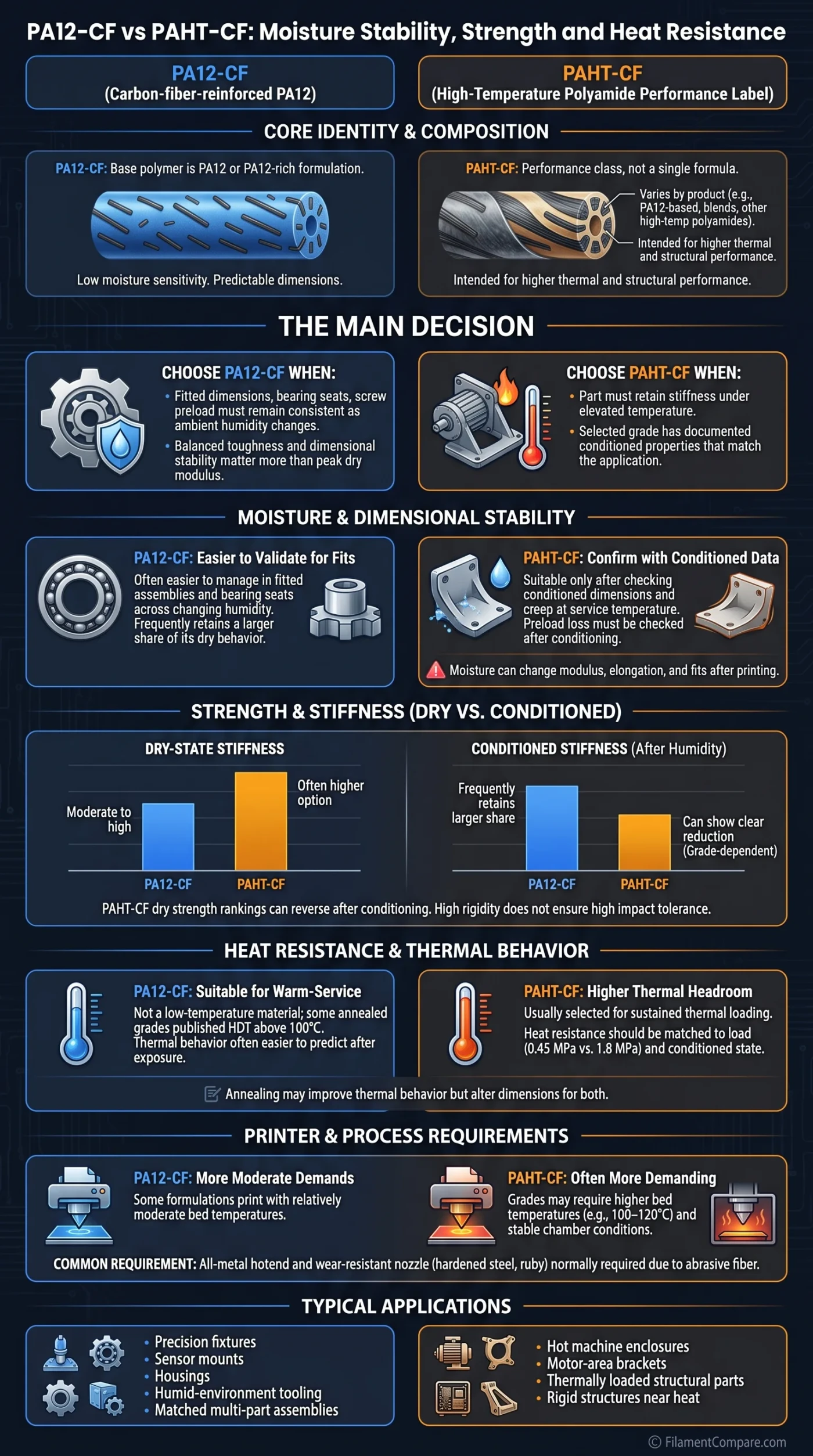
PA12-CF is usually chosen for low moisture sensitivity and predictable dimensions, while PAHT-CF is sold around higher thermal and structural performance. The difficult part is that PAHT-CF is not one standardized polymer chemistry, so its advantage can change with the base resin, conditioning state, print orientation and post-processing used by the manufacturer.
The Better Fit by Priority
Choose PA12-CF when fitted dimensions, bearing seats, screw preload and mechanical behavior must remain relatively consistent as ambient humidity changes. Choose PAHT-CF when the part must retain stiffness under elevated temperature and the selected grade has documented conditioned properties that match the application.
A PAHT-CF grade based on PA12 may narrow the moisture difference considerably. The product name alone is therefore not enough: the resin family, conditioning method, heat-deflection test load and print direction must be checked before either material is treated as the better option.
| Decision Point | PA12-CF | PAHT-CF |
|---|---|---|
| Material identity | Carbon-fiber-reinforced PA12 or a PA12-rich long-chain polyamide formulation | A commercial high-temperature polyamide designation; exact base chemistry varies by product |
| Primary design appeal | Moisture stability, dimensional consistency and balanced toughness | Thermal stiffness, high dry-state rigidity and structural use at elevated temperature |
| Moisture sensitivity | Usually lower than shorter-chain nylon families | Low to moderate depending on whether the grade uses PA12, a blend or another high-temperature polyamide |
| Dimensional change after conditioning | Often easier to manage in fitted assemblies | Can be low, but should be confirmed from conditioned data rather than the product name |
| Dry-state stiffness | Moderate to high depending on fiber content and print orientation | Often the higher-stiffness option among comparable commercial grades |
| Conditioned stiffness | Frequently retains a larger share of its dry behavior | May remain very stiff, although some grades show a clear reduction after humidity conditioning |
| Impact behavior | Often the more forgiving choice where some deflection is acceptable | Grade-dependent; high rigidity does not automatically mean high impact tolerance |
| Heat under load | Suitable for many warm-service parts, especially in annealed grades | Usually selected when sustained thermal loading is the main requirement |
| Tight fits and bearing seats | Usually easier to validate across changing humidity | Suitable only after checking conditioned dimensions and creep at service temperature |
| Print hardware | All-metal hotend and wear-resistant nozzle normally required | All-metal hotend and wear-resistant nozzle required; some grades favor a larger nozzle |
| Bed and chamber demand | Some formulations print with relatively moderate bed temperatures | Often more demanding, although chamber requirements vary widely by formulation |
| Post-processing | Annealing may improve thermal behavior but can alter dimensions | Annealing may be part of the route to the advertised thermal result for some grades |
| Main selection risk | Assuming low moisture sensitivity means the filament can be printed wet | Assuming every PAHT-CF product uses the same resin and test conditions |
| Typical better fit | Precision fixtures, sensor mounts, housings and humid-environment tooling | Hot machine enclosures, motor-area brackets and thermally loaded structural parts |
PAHT-CF Is a Performance Label, Not a Single Polymer Formula
PA12-CF describes the base polymer directly: the matrix is PA12 or a closely identified PA12 formulation reinforced with chopped carbon fiber. PAHT-CF describes an intended performance class. One supplier may use a PA12-based matrix, while another may describe only a high-temperature polyamide reinforced with carbon fiber.
This distinction can change the expected moisture result. Bambu Lab, for example, identifies its PAHT-CF as a PA12-and-carbon-fiber composite[c]. A PAHT-CF product built on PA12 may behave much closer to PA12-CF than to a moisture-sensitive PA6-based composite. Other PAHT-CF products may use different polyamide chemistry or proprietary blends.
Do Not Compare the Acronyms Alone
Before ranking two spools, identify the base polymer, fiber percentage, specimen conditioning, annealing state, print direction and test standard. When one technical data sheet omits the base resin, moisture absorption or conditioned mechanical values, the missing information should be treated as an engineering uncertainty rather than a neutral result.
PA12 itself is known for very low water absorption among commercial polyamides and for the dimensional consistency that follows from that behavior[d]. Carbon fiber can reduce shrinkage and raise stiffness, but it does not erase the moisture response of the polymer surrounding the fibers. The matrix still controls much of the long-term environmental behavior.
Moisture Changes Fits, Preload and Stiffness After Printing
Drying the spool and conditioning the finished part are two different issues. A wet spool can produce bubbles, rough extrusion, inconsistent flow and weak local bonding. A dry spool can produce a clean part that later absorbs moisture from the room, workshop, vehicle, machine enclosure or outdoor environment.
The second process matters when the component contains a press fit, bearing pocket, alignment pin, threaded insert or clamped joint. Moisture can slightly expand the polymer matrix while also changing its modulus and elongation. Even a small movement can affect a fit that was designed with little clearance.
Bearing and Bushing Seats
PA12-CF usually offers the safer starting point when the bore must remain stable through seasonal humidity changes. A printed test coupon should still be conditioned before the final interference value is chosen.
Heat-Set Inserts
Both materials require validation. PAHT-CF may provide higher local stiffness, while PA12-CF may tolerate installation strain with less brittle behavior. Boss wall thickness and layer orientation can matter more than the label.
Clamped Brackets
PAHT-CF can be preferable in heat, but preload loss must be checked after thermal and humidity conditioning. A high dry modulus does not guarantee that bolt tension will remain unchanged.
Matched Multi-Part Assemblies
PA12-CF is often easier to control where several printed pieces must continue sliding, indexing or closing after storage in a humid location.
A current PA12-CF data sheet from Polymaker estimates equilibrium water absorption at about 1.5% for its grade and publishes both dry and water-conditioned mechanical results[a]. That value belongs to one commercial formulation, not every PA12-CF filament, but the presence of wet-state data is useful because it reveals what changes after the part leaves the dryer.
A More Useful Dimensional Test
Print the intended bore, slot or mating feature in the final orientation. Measure it after printing, after controlled drying, after several days at normal room humidity and after exposure to the expected service environment. A generic calibration cube cannot show whether a bearing seat, snap joint or bolted interface remains functional.
Dry Strength Rankings Can Reverse After Conditioning
Carbon-fiber nylons are often compared through one tensile-strength number. That approach hides three separate questions: how stiff the part is in the printed plane, how well the layers carry load through the Z direction and how much of the dry-state behavior remains after moisture conditioning.
PAHT-CF grades can provide high dry tensile and flexural values. That makes them attractive for rigid arms, machine brackets and load-spreading fixtures. The advantage becomes less clear when the application needs impact tolerance, repeated deflection or stable stiffness after humidity exposure.
Forward AM’s Ultrafuse PAHT CF15 data illustrates why dry and conditioned values should be read together. Its published XY tensile strength falls from 103.2 MPa in the dried condition to 62.9 MPa after conditioning at 23°C and 50% relative humidity for 72 hours, while the XY Young’s modulus falls from 8,386 MPa to 5,052 MPa[b]. The material remains stiff, but the size of the change is relevant when a design was calculated from dry values.
A PA12-CF grade may start with a lower dry modulus yet preserve its working behavior more consistently. That can make it the more dependable option for a fixture that must align parts every day, even when the PAHT-CF specimen records the higher laboratory stiffness immediately after drying.
Where PA12-CF Has the Practical Edge
- Press fits exposed to changing room humidity
- Sensor, camera and optical mounts
- Fixtures that must return to the same position
- Parts exposed to light impact or installation flex
- Assemblies where dimensional drift matters more than peak dry modulus
Where PAHT-CF Has the Practical Edge
- Rigid structures that operate near a heat source
- Motor, actuator and electronics brackets
- Parts with limited allowable deflection under load
- Machine tooling used in a controlled environment
- Designs verified with conditioned and elevated-temperature data
Print direction can outweigh the difference between the two resin families. Carbon fibers tend to align with extrusion paths, so strength and stiffness are usually higher along the deposited roads than through the layer stack. A bracket loaded across Z layers may fail at a much lower load than an XY coupon, even when the filament has an impressive tensile specification.
Heat Resistance Must Be Matched to Load and Test Method
Heat resistance is not a single temperature. Glass-transition behavior, Vicat softening temperature, heat-deflection temperature and long-term service performance describe different responses. A part may remain solid near a quoted softening value yet deform much earlier when a bolt, spring, motor or suspended mass applies constant stress.
PAHT-CF normally deserves first consideration when elevated-temperature stiffness is the main requirement. The useful comparison, however, is the heat-deflection value measured at the load closest to the application. A value reported at 0.45 MPa cannot be treated as equal to a value reported at 1.8 MPa.
Moisture and heat should also be considered together. In the Ultrafuse PAHT CF15 example, the published heat-deflection temperature at 0.45 MPa changes from 145°C in the dry state to 128°C after conditioning, while the 1.8 MPa result remains near 92°C. Those values describe one grade under defined tests; they do not establish a universal service temperature for every printed PAHT-CF part.
PA12-CF should not be treated as a low-temperature material. Some annealed PA12-CF formulations publish heat-deflection values above 100°C. Their lower moisture sensitivity may also make thermal behavior easier to predict after environmental exposure. PAHT-CF still tends to offer more thermal headroom, particularly when the manufacturer provides conditioned high-load data.
Annealing Can Improve Heat Performance and Move Critical Dimensions
Annealing can increase crystallinity and raise heat-deflection performance, but shrinkage may occur differently in the X, Y and Z directions. A bearing bore, flat sealing surface or aligned hole pattern should be measured after the full annealing cycle. Data from annealed specimens should not be used to predict an unannealed production part.
Printer Capability Can Erase the Material Advantage
Both materials are abrasive and normally require a hardened-steel, ruby or similarly wear-resistant nozzle. A worn brass nozzle gradually increases in diameter, which changes line width, flow behavior and fitted dimensions before the damage becomes visually obvious.
Typical PA12-CF and PAHT-CF products both use high nozzle temperatures, but their bed and chamber needs can be very different. Some PA12-CF grades are formulated to print on relatively cool beds, while some PAHT-CF grades specify bed temperatures around 100–120°C. These are product-level requirements rather than universal family rules.
PAHT-CF loses much of its theoretical advantage when the printer cannot maintain the hotend temperature, control enclosure drafts or create reliable layer bonding. Under those conditions, a well-tuned PA12-CF part may carry load more reliably than a PAHT-CF part with weak Z adhesion.
| Printing Situation | Better Fit | Reason | Main Check |
|---|---|---|---|
| Open printer with limited bed temperature | PA12-CF grade designed for low-warp printing | Some formulations need less bed heat and tolerate room-temperature printing | Verify the exact product profile rather than assuming all PA12-CF behaves alike |
| Enclosed industrial printer | Either | The machine can support the processing window of both families | Select by service exposure and conditioned properties |
| Printer limited to a brass nozzle | Neither for routine use | Carbon fiber causes rapid nozzle wear | Install a compatible wear-resistant nozzle first |
| Large flat fixture | Often PA12-CF | Lower shrinkage and moisture movement may simplify dimensional control | Test corner lift and post-conditioning flatness |
| Small hot motor bracket | Often PAHT-CF | Thermal stiffness may outweigh the added processing demand | Check temperature at the bracket under actual load |
| Tall part loaded across layers | Neither without orientation review | Z-direction bonding may control failure before resin strength does | Reorient the part or redesign the load path |
| Production from a heated dry box | Either | Controlled feeding reduces moisture-related print defects | Keep the spool dry throughout long prints |
| Part requires post-print annealing | Grade-dependent | Both families may benefit, but distortion risk differs | Use compensated geometry and measure after annealing |
Filament drying is still required even when PA12-CF absorbs less moisture than other nylons. Low moisture sensitivity describes the rate and scale of absorption; it does not mean that a spool can remain exposed indefinitely without print-quality changes. Long jobs benefit from feeding directly from a heated or actively controlled dry box.
Choosing by Exposure, Load and Tolerance
The material choice becomes clearer when the service conditions are written as a combination rather than a single priority. “High strength” is too broad. A useful requirement states whether the part needs tensile capacity, low deflection, impact tolerance, Z-layer strength, creep resistance or dimensional retention after moisture and heat exposure.
Practical Selection Matrix
- Choose PA12-CF when the part contains tight fits, aligned holes, sliding interfaces or bearing seats that must remain consistent as humidity changes.
- Choose PA12-CF when balanced toughness and dimensional stability matter more than obtaining the highest dry-state modulus.
- Choose PAHT-CF when the part carries load near a motor, heater, hot electronics enclosure or process-air system and the technical data sheet provides suitable heat-deflection values.
- Choose PAHT-CF when minimum flex under elevated temperature is more important than moisture-insensitive behavior, provided conditioned data has been reviewed.
- Either material can work when the PAHT-CF grade is PA12-based and both products publish similar conditioned thermal and mechanical properties.
- Either material can work when the service environment is controlled, the load is modest and the part has generous clearances.
- Neither material fully solves poor Z-layer orientation, inadequate wall thickness, sharp stress concentrations or continuous loading above the validated creep range.
- Test both grades when the application combines high humidity, elevated temperature and sustained bolt or spring load. This combined exposure is more informative than separate dry tensile and HDT figures.
For a precision fixture, sensor bracket, fitted enclosure or humid-workshop assembly, PA12-CF is usually the more predictable starting point. Its value is not merely that it absorbs less moisture, but that lower absorption can reduce the movement of dimensions and mechanical behavior after printing.
For a rigid bracket operating close to heat, PAHT-CF is usually the more relevant category. The purchase decision should still be made from the actual grade data. A PAHT-CF filament without identified base chemistry, conditioned results or comparable test methods carries more selection uncertainty than a well-documented PA12-CF product.
The better material is therefore not automatically the one with the highest dry tensile value. It is the grade that preserves the required clearance, stiffness and load capacity after the complete sequence of drying, printing, annealing, humidity exposure, thermal cycling and real part loading.
Technical Sources and Documentation
- [a] Polymaker PolyMide PA12-CF Technical Data Sheet (Used for PA12-CF moisture absorption, dry and wet mechanical behavior, annealing and printing-condition information.)
- [b] Forward AM Ultrafuse PAHT CF15 Technical Data Sheet (Used for dry and conditioned tensile, modulus, heat-deflection and processing data.)
- [c] Bambu Lab PAHT-CF Product Documentation (Used to show that a commercial PAHT-CF grade can use a PA12-based matrix.)
- [d] EMS-GRIVORY Grilamid L PA12 Material Information (Used for the general relationship between PA12, low water absorption and dimensional stability.)
