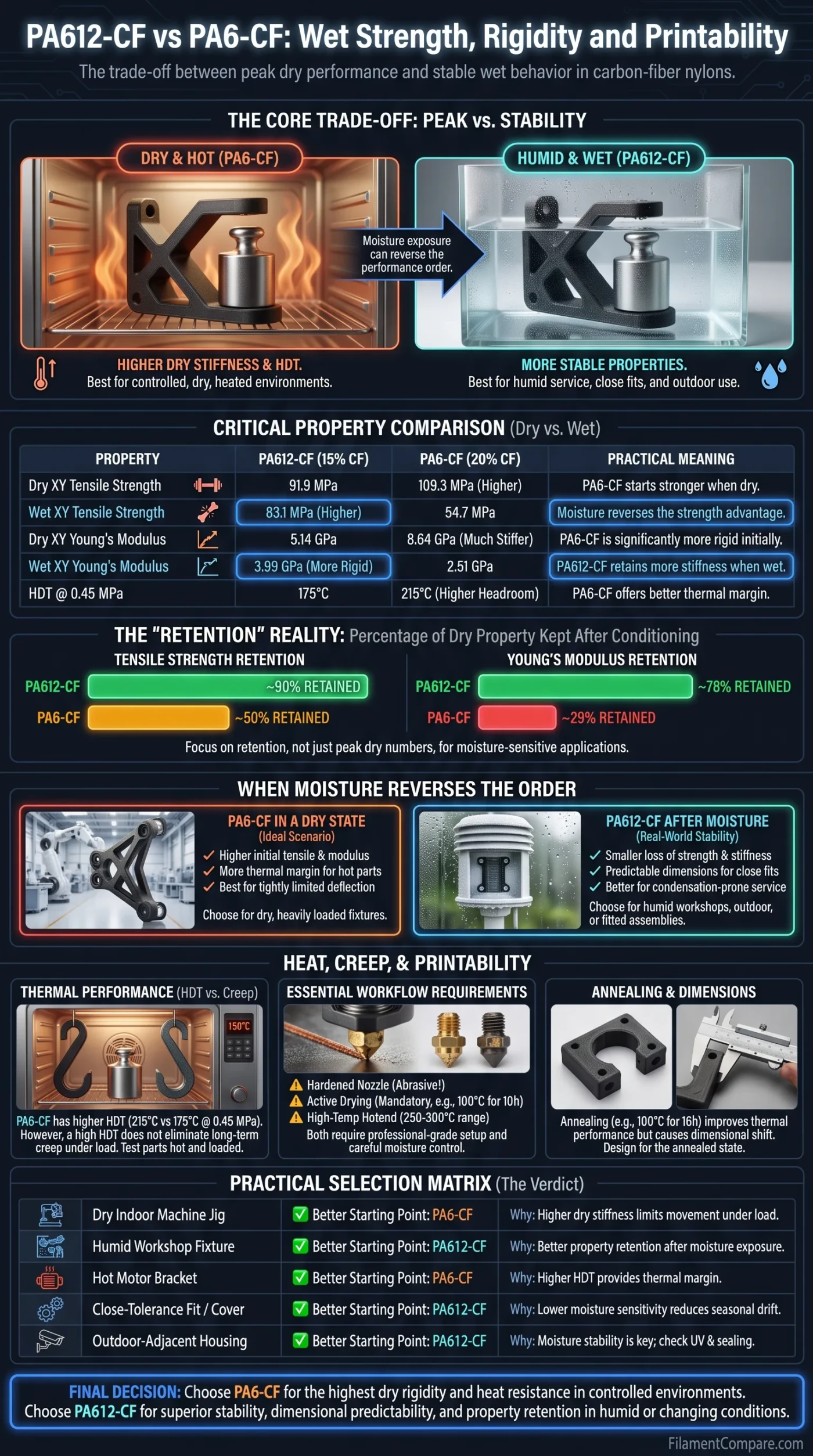
PA6-CF commonly delivers higher dry stiffness, tensile strength, and heat-deflection performance, while PA612-CF gives up some of that peak performance to keep its properties more stable after moisture exposure. The practical choice is therefore not simply the filament with the larger dry number: it is the filament whose behavior still matches the part after installation. For dry, hot, heavily loaded fixtures, PA6-CF is often the more suitable starting point; for humid service, close fits, and parts that must remain predictable across seasons, PA612-CF is often easier to justify.
The Better Fit by Priority
Choose PA6-CF when the part must resist bending, carry a high static load, or remain stiff near elevated temperatures in a controlled, dry environment. Choose PA612-CF when humidity, condensation, washing, or seasonal moisture changes could soften the part or disturb a fitted assembly. Neither material removes the need for drying, an abrasion-resistant nozzle, load-path-aware orientation, and validation on the final geometry.
| Decision Point | PA612-CF | PA6-CF | Practical Meaning |
|---|---|---|---|
| Polymer basis | Long-chain PA formulation; the referenced grade is described as a PA6/PA12 copolymer | PA6 matrix | The polymer matrix still controls much of the moisture and temperature response |
| Referenced carbon-fiber content | 15 wt% | 20 wt% | Part of the dry stiffness gap may come from reinforcement level, not polymer family alone |
| Dry XY tensile strength | 91.9 MPa | 109.3 MPa | PA6-CF begins with the higher tensile capacity in the compared printed specimens |
| Wet XY tensile strength | 83.1 MPa | 54.7 MPa | Moisture conditioning reverses the order in this product-level comparison |
| Dry XY Young’s modulus | 5.14 GPa | 8.64 GPa | PA6-CF is markedly stiffer when dry |
| Wet XY Young’s modulus | 3.99 GPa | 2.51 GPa | PA612-CF retains more rigidity after conditioning |
| HDT at 0.45 MPa | 175°C | 215°C | PA6-CF has more thermal headroom under the lower HDT test load |
| Typical nozzle range for referenced grades | 250–300°C | 280–300°C | PA6-CF places a higher minimum-temperature demand on the hotend |
| Drying need | Mandatory | Mandatory and less forgiving | Lower moisture sensitivity does not make PA612-CF printable straight from damp storage |
| Nozzle wear | Abrasive | Abrasive | Both call for a wear-resistant nozzle rather than standard brass |
| Best starting point | Humid-service fixtures, close fits, outdoor-adjacent housings, dimension-sensitive assemblies | Dry machine tooling, hot fixtures, rigid brackets, high-stiffness structural parts | Service environment should decide before headline strength does |
| Main limitation | Lower dry stiffness and lower HDT than the compared PA6-CF grade | Large moisture-driven loss of stiffness and tensile strength | Each material fails the selection test for a different reason |
Product-level comparison: the numeric values above come from Fiberon PA612-CF15 and PA6-CF20 printed-specimen data, not from identical-fiber formulations. They are useful for showing how these two commercial grades behave, but they should not be treated as universal values for every PA612-CF or PA6-CF filament.
The Fiber Percentage Trap in a PA612-CF vs PA6-CF Comparison
Material names make this comparison look cleaner than it is. PA612-CF and PA6-CF identify the matrix family, but they do not specify fiber loading, fiber length, surface treatment, impact modifiers, processing aids, or the manufacturer’s annealing target. The referenced PA612 grade contains 15 wt% carbon fiber, while the PA6 grade contains 20 wt%; the PA612 product is also described as a copolymer based on PA6 and PA12 rather than a universal recipe shared by every spool carrying a PA612 label.[a]
That difference matters because carbon fiber can raise modulus, reduce print shrinkage, change melt flow, and alter fracture behavior. A dry stiffness result of 8.64 GPa versus 5.14 GPa does not prove that the PA6 matrix alone is responsible for the entire gap. It shows that the tested PA6-CF20 product is stiffer than the tested PA612-CF15 product under the stated preparation and test conditions.
Compare Property Retention, Not Only Peak Values
For moisture-sensitive composites, the most informative number is often the percentage of the dry property that remains after conditioning. Dry values describe a carefully prepared specimen. Retention describes how vulnerable that performance is when the polyamide matrix absorbs water and becomes plasticized.
- PA612-CF15 retained about 90% of its dry XY tensile strength in the referenced wet-state test.
- PA6-CF20 retained about 50% of its dry XY tensile strength.
- PA612-CF15 retained about 78% of its dry XY Young’s modulus.
- PA6-CF20 retained about 29% of its dry XY Young’s modulus.
- Fiber loading, annealing, specimen orientation, moisture content, and test method remain part of the result.
This retention-based reading is more useful for a jig that stays in a humid shop than a simple ranking of dry tensile strength. It also prevents a common mistake: assuming the material with the higher dry number will remain ahead after the environment changes.
Moisture Can Reverse the Mechanical Order
Carbon fiber reduces some of nylon’s printing movement, but it does not seal the polymer matrix from water vapor. The filament can absorb moisture before printing, and the finished part can continue to absorb moisture during service. These are two separate problems: pre-print moisture damages extrusion quality, while post-print moisture can alter modulus, strength, elongation, impact response, and dimensions.
PA6-CF in a Dry State
- Higher initial XY tensile strength in the referenced grades
- Higher dry Young’s modulus and bending modulus
- Better suited to brackets where deflection is tightly limited
- More thermal margin for hot fixtures and machine-adjacent parts
PA612-CF After Moisture Exposure
- Smaller loss of tensile strength after conditioning
- Smaller loss of Young’s modulus and bending modulus
- More predictable behavior for close fits and alignment features
- Better starting point for humid workshops and condensation-prone service
The official PA6-CF20 data show the dry XY tensile value falling from 109.3 MPa to 54.7 MPa and the XY Young’s modulus falling from 8.64 GPa to 2.51 GPa after the listed moisture-conditioning procedure.[b] The PA612-CF15 data show a much smaller change: 91.9 MPa to 83.1 MPa in XY tensile strength and 5.14 GPa to 3.99 GPa in XY modulus.[c]
Wet Does Not Mean Every Property Gets Worse
Moisture plasticization can trade stiffness for ductility. In the referenced PA6-CF20 data, wet notched Charpy impact strength is higher than the dry result even though tensile strength and modulus fall sharply. That does not make a wet PA6-CF part mechanically “better.” It means the failure mode changes: a softer part may absorb a notch impact more readily while becoming less capable of holding alignment, resisting deflection, or maintaining clamp preload.
Do not translate “lower moisture sensitivity” into “no drying needed.” PA612-CF can still extrude with popping, bubbles, rough surfaces, inconsistent flow, and weaker bonding when the spool is damp. Both compared grades are specified for dry storage and dry feeding.
Where the Installed Part Starts to Drift
Moisture-related changes are easiest to miss in parts that do not break. A bearing pocket may tighten, a sliding cover may begin to drag, a camera mount may sag enough to alter aim, or a bolted fixture may lose some preload as the material softens. For these parts, dimensional and stiffness retention matter more than maximum dry tensile strength.
PA612-CF is therefore the more defensible starting point for alignment jigs, sensor housings, locating nests, press-fit features, and assemblies that move between air-conditioned and humid spaces. PA6-CF remains attractive when the part is kept dry and the design genuinely benefits from its higher initial modulus.
Heat, Creep, and Fit Are Three Different Tests
Nozzle temperature is not service temperature, melting temperature is not load-bearing temperature, and HDT is not a universal continuous-use rating. A filament printed near 300°C can still deform far below that temperature when a sustained load is applied. Part geometry, stress level, exposure time, annealing, print orientation, and moisture state all influence the temperature at which a real component stops holding its shape.
PA6-CF Has More Heat-Deflection Headroom
For the annealed Fiberon grades, PA6-CF20 is listed at 215°C HDT under 0.45 MPa and 173°C under 1.8 MPa. PA612-CF15 is listed at 175°C and 114°C under the same respective loads. The wider gap at 1.8 MPa is especially relevant because it shows why a lightly loaded heat shield and a tightly clamped hot fixture should not be treated as the same application.
PA6-CF is the more suitable starting point for hot-air duct brackets, motor-adjacent mounts, heated tooling, and fixtures that must stay rigid as temperature rises. PA612-CF can still offer useful heat resistance, but the lower HDT means less margin when heat and mechanical stress arrive together.
A High HDT Does Not Eliminate Creep
HDT is measured over a defined test, load, and specimen geometry. It does not predict months of bolt tension, spring force, belt load, or cantilever stress. A bracket that survives a short hot test can still relax slowly under a lower temperature if the stress remains applied. Moisture can compound this issue by lowering modulus before the thermal load is considered.
- Use thicker load paths rather than relying only on material modulus.
- Place ribs where they shorten the unsupported span.
- Use washers, inserts, or metal load spreaders around concentrated fastener loads.
- Keep press fits away from thin walls that can expand or relax.
- Test hot parts while loaded, not only after heating them unloaded.
Annealing Improves Thermal Performance but Can Move the Part
The compared technical sheets recommend annealing at 100°C for 16 hours. The same documents also show that dimensions shift between the printed and annealed states, and the movement is not identical in every axis. A hole, ring, bearing seat, or mating face should therefore be sized for the condition in which it will be used, not only for the measurement taken when the print first leaves the bed.
For precision work, machine or ream critical features after annealing when the design allows it. When post-machining is not practical, print a tolerance coupon beside the actual part, anneal both together, and measure the coupon before committing to a production batch.
Printing Both Materials on the Same Machine
Both grades sit beyond an entry-level PLA workflow. They need a hotend that can hold high temperature without a PTFE-lined heat break in the hot zone, a wear-resistant nozzle, dry filament storage, reliable bed adhesion, and enough extrusion consistency to avoid under-feeding a fiber-filled melt. An enclosure may improve repeatability for larger parts even when the referenced product pages do not require a heated chamber.
| Workflow Item | PA612-CF15 | PA6-CF20 | Selection Effect |
|---|---|---|---|
| Recommended nozzle range | 250–300°C | 280–300°C | PA6-CF requires a hotend that performs well near the top of the common engineering-filament range |
| Recommended bed range | 40–50°C | 40–50°C | Bed temperature is not the main equipment separator for these two grades |
| Cooling fan | Off in the referenced profile | Off in the referenced profile | Overcooling can interfere with layer bonding and thermal consistency |
| Drying recommendation | 100°C for 10 hours | 100°C for 10 hours | A dryer that cannot safely maintain the specified temperature is a workflow bottleneck |
| Dry feeding | Required | Required | A long print can reabsorb moisture even after a correct pre-dry cycle |
| Nozzle material | Hardened or other wear-resistant type | Hardened or other wear-resistant type | Brass wear changes extrusion width and can quietly damage dimensional accuracy |
| Annealing recommendation | 100°C for 16 hours | 100°C for 16 hours | Oven stability and post-anneal measurement are part of the process |
| Tuning emphasis | Moisture control, fit compensation, stable flow | Moisture control, high-temperature flow, layer bonding | The same printer may need separate pressure advance, flow, and temperature profiles |
The manufacturer lists up to 300 mm/s for both grades, but that figure should not be read as a guaranteed part speed. Fiber-filled nylon at high flow can exceed the hotend’s melt capacity, especially with a hardened-steel nozzle that transfers heat less efficiently than brass. A clean surface at high speed does not prove that the inner roads are fully fused.
Nozzle Wear Is a Dimensional Problem
Abrasive wear is often discussed as a maintenance cost, yet it also changes part geometry. As the nozzle orifice opens, line width and deposited volume drift. Holes close, exterior dimensions grow, wall overlap changes, and a profile that once produced a controlled fit begins to miss tolerance. This effect is especially relevant when PA612-CF is selected specifically for dimensional consistency.
Orientation Can Outweigh the Resin Choice
The compared dry XY tensile strengths are much higher than their Z-direction values. Short carbon fibers tend to align with extrusion paths, while the interlayer interface remains a separate failure plane. A poorly oriented PA6-CF bracket can therefore fail earlier than a well-oriented PA612-CF version even though the PA6-CF data sheet carries higher dry XY numbers.
Place principal tensile loads along continuous roads where possible. Add generous radii at clip roots, avoid driving fasteners in ways that peel layers apart, and increase local thickness around holes rather than expecting the carbon fiber label to compensate for a weak load path.
A Four-State Test That Exposes the Real Difference
A single dry coupon tends to favor PA6-CF and hides the reason PA612-CF exists. A more useful qualification process tests the same geometry in four states: dry after printing, dry after annealing, moisture-conditioned after annealing, and hot while carrying the intended load. This sequence separates print shrinkage, annealing movement, moisture plasticization, and thermal creep rather than mixing them into one pass-or-fail result.
1. Dry After Printing
Measure baseline length, hole diameter, mass, flatness, and cantilever deflection before annealing. This reveals the printer’s own dimensional behavior.
2. Dry After Annealing
Repeat the same measurements after the full annealing cycle. Record axis-specific movement instead of applying one global shrinkage factor.
3. Moisture-Conditioned
Expose both materials to the same controlled humidity or conditioning procedure, then remeasure fit, mass, stiffness, and fastener preload.
4. Hot Under Load
Apply the actual service load while heating the specimen. Track permanent set after cooling rather than checking only whether it survived.
Use a Part-Shaped Coupon
Generic tensile bars are useful for material screening, but they do not reproduce a split clamp, thin-wall bearing pocket, heat-set insert boss, snap hook, or long cantilever. A compact coupon containing the same wall thickness, hole orientation, fillet radius, insert type, and print direction as the real component will expose design-specific movement much sooner.
- For a bearing seat, test insertion force and retained diameter.
- For a clamp, record torque and gap after humidity conditioning.
- For a jig, measure locating-pin spacing before and after annealing.
- For a hot bracket, measure tip deflection while the load is applied.
- For a threaded boss, repeat the assembly cycle and inspect layer splitting.
The official wet-state specimens for both referenced grades were annealed and then immersed in 60°C water for 48 hours before testing. That is a controlled comparison condition, not a promise that every workshop, outdoor, or splash-exposed part will reach the same moisture content or property values.[d]
Choosing by the Part’s Installed Condition
The selection becomes clearer when the part is described by its environment and failure risk rather than by a broad label such as “functional.” A rigid alignment fixture, a flexible impact guard, a hot motor mount, and a wet pump bracket all ask different things from a carbon-fiber nylon.
| Part or Service Condition | Better Starting Point | Why | What Still Needs Testing |
|---|---|---|---|
| Dry indoor machine jig | PA6-CF | Higher dry stiffness limits movement under clamping and handling loads | Layer orientation and fastener relaxation |
| Humid workshop locating fixture | PA612-CF | Better stiffness and tensile retention after moisture exposure | Pin spacing and flatness after conditioning |
| Hot motor-adjacent bracket | PA6-CF | Higher HDT provides more thermal margin | Loaded creep at the real temperature |
| Close-tolerance cover or sliding fit | PA612-CF | Lower moisture sensitivity reduces the risk of seasonal fit drift | Post-anneal and humid-state clearance |
| Long cantilever carrying a steady load | Depends on temperature and humidity | PA6-CF begins stiffer; PA612-CF may remain more consistent in damp air | Deflection over time in the installed environment |
| Impact-prone guard | Grade and geometry dependent | Impact behavior does not follow tensile strength alone, and moisture changes ductility | Notched impact and repeated-hit testing |
| Outdoor-adjacent sensor housing | PA612-CF | Moisture stability is usually more valuable than maximum dry modulus | UV exposure, sealing, temperature cycling, and fastener loads |
| Heated assembly fixture with tight alignment | Neither by name alone | PA6-CF offers heat resistance; PA612-CF offers moisture stability | Combined heat, humidity, load, and dimensional testing |
| Safety-critical load-bearing component | Neither as an unqualified default | Desktop-printed anisotropy and process variation require application-specific validation | Material traceability, process control, safety factors, and governing requirements |
Where the Decision Lands
- Choose PA6-CF for maximum dry rigidity, higher heat-deflection performance, and parts kept in controlled moisture conditions.
- Choose PA612-CF for humidity-exposed parts, fitted assemblies, locating features, and applications where stable behavior matters more than the highest dry number.
- Either can work for general brackets and housings when loads are moderate, the geometry is well oriented, and the real environment is tested.
- Neither fully solves UV exposure, water sealing, chemical compatibility, long-term creep, or certification by carrying a carbon-fiber label.
PA6-CF wins the dry specification comparison; PA612-CF can win after the part has absorbed the environment around it.
Technical Sources and Documentation
- [a] Fiberon™ PA612-CF15 (Used for the polymer description, carbon-fiber content, printed mechanical values, printing range, and product-level moisture comparison.)
- [b] Fiberon™ PA6-CF20 (Used for carbon-fiber content, printed dry and wet mechanical values, HDT, and recommended printing temperatures.)
- [c] TDS_FIBERON PA612-CF15_V1.1_EN (Used for wet-state retention, thermal test values, drying, annealing, nozzle-wear, and shrinkage information.)
- [d] TDS_FIBERON PA6-CF20_V1.1_EN (Used for the moisture-conditioning method, directional mechanical values, thermal test values, and recommended processing conditions.)
