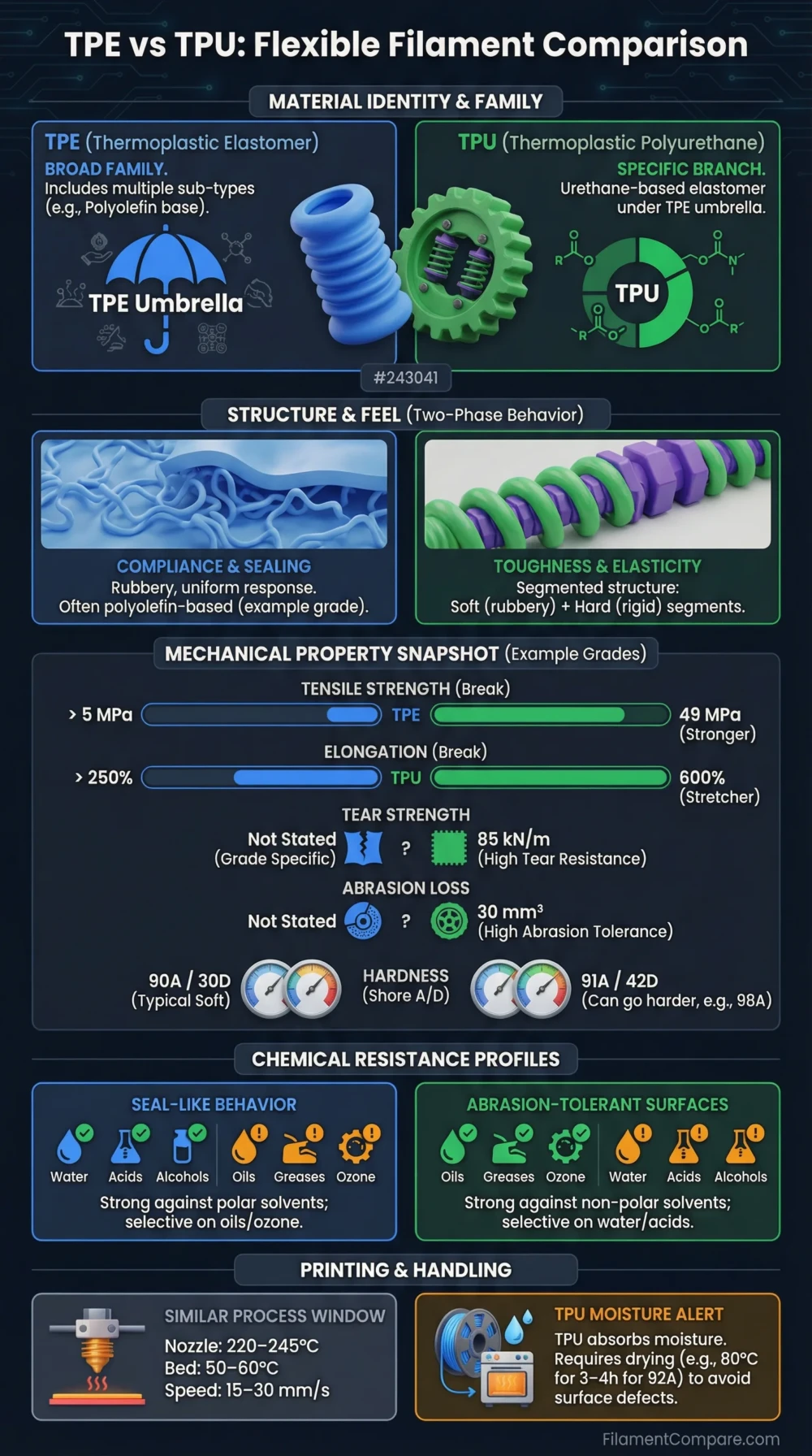
| Comparison Point | TPE Filament (Example Grade) | TPU Filament (Example Grade) |
|---|---|---|
| What It Is | Thermoplastic Elastomer (TPE family; example uses a polyolefin base) | Thermoplastic Polyurethane (TPU, a polyurethane-based elastomer) |
| Polymer Base | Polyolefin (as listed for the example grade) | Polyurethane (as listed for the example grade) |
| Density | 1.15 g/cm³ | 1.20 g/cm³ |
| Hardness (Shore) | 90A and 30D | 91A and 42D |
| Tensile Strength (at break) | > 5 MPa | 49 MPa |
| Elongation (at break) | > 250% | 600% |
| Tear Strength | Not stated in the example sheet | 85 kN/m |
| Abrasion (volume loss) | Not stated in the example sheet | 30 mm³ |
| Flow Indicator | MFI > 25 g/10 min (230°C, 5 kg) | MVI 35 cm³/10 min (210°C, 10 kg) |
| Recommended Print Temperature | 225–245°C | 220–240°C |
| Recommended Heated Bed | 50–60°C | 50–60°C |
| Listed Print Speed Range | 15–25 mm/s | 20–30 mm/s |
| Chemical Resistance (how the example sheet phrases it) | Strong ratings for water/acetone/acids/alkalis/alcohols; more selective around oils/greases/ozone | Strong ratings for oils/greases/ozone; more selective around water/acetone/acids/alkalis/alcohols |
| Reality Check | These numbers are grade-specific. TPE and TPU each cover a wide range of formulations and Shore hardness levels. | |
TPE example values above come from a public technical data sheet for a Flexfill TPE 90A filament grade. ✅Source
- Material Identity and Polymer Family
- Why This Matters in Filament Listings
- Chemistry and Structure That Show Up in Parts
- Mechanical Behavior Side-by-Side
- What “Strength” Looks Like in TPE
- What “Tough Flexible” Looks Like in TPU
- Thermal Behavior and Segment “Signals”
- Chemical and Environmental Resistance as “Profiles”
- 3D Printing Characteristics Without the Hype
- How a TPU Grade Can Shift the Numbers
- What to Compare on Any Datasheet
- A Simple Way to Read “A” and “D” Together
TPU example values above come from a public technical data sheet for a Flexfill TPU 92A filament grade. ✅Source
When people say TPE filament and TPU filament, they’re usually talking about flexible 3D printing filaments used in FFF/FDM printers. The names sound close, but the materials can feel different in real parts because TPE is a family, while TPU is a specific branch with its own chemistry.
Material Identity and Polymer Family
TPE means Thermoplastic Elastomer, a broad category that includes multiple sub-families (styrenic, olefinic, vulcanizate blends, urethane-based, and more). TPU is Thermoplastic Polyurethane, which sits under the TPE umbrella as a urethane-based elastomer class in formal naming systems. ✅Source
Why This Matters in Filament Listings
In store listings, TPE filament can mean “a very elastic filament,” not always a single chemistry. Meanwhile TPU filament often signals a polyurethane-based flexible material with common datasheet fields like tear strength and abrasion. The safest comparison is always grade-to-grade, not just name-to-name.
Chemistry and Structure That Show Up in Parts
TPU is typically described as a segmented material with soft segments (rubbery) and hard segments (more rigid). This “two-phase feel” helps explain why many TPU grades pair elasticity with toughness in a single filament.
TPE filaments can come from different elastomer families. In the example sheet above, the base is listed as polyolefin, which tends to steer the material’s chemical profile and surface behavior in ways that can differ from urethane-based flexible filaments.
- Soft Segment
- Rubbery portion that drives flex, stretch, and “rubber-like” response.
- Hard Segment
- More rigid portion that supports strength, shape retention, and abrasion-style durability.
- Flow Index (MFI/MVI)
- Not a “quality score.” It is a flow indicator measured under a defined load and temperature, useful for comparing grades that were tested the same way.
Mechanical Behavior Side-by-Side
Hardness is one of the fastest ways to map “feel.” Flexible filaments are commonly rated on Shore A, while stiffer plastics are often rated on Shore D. Shore methods are standardized durometer indentation tests, and the chosen scale (A vs D) depends on material stiffness. ✅Source
Relative Feel Map (based on the example grades shown in the table)
What “Strength” Looks Like in TPE
Many TPE filaments focus on compliance and sealing-style deformation. In the example grade, the table shows a lower tensile number paired with a high-flex profile. That combination often translates to a part that moves easily and recovers without needing a rigid hinge design.
What “Tough Flexible” Looks Like in TPU
TPU filaments are widely used when designers want flex plus abrasion-style durability and shock absorption in one part. Open-access additive manufacturing literature commonly describes TPU with traits like toughness and wear/abrasion resistance alongside flexibility. ✅Source
Thermal Behavior and Segment “Signals”
Thermal curves can reveal why TPU feels both rubbery and structured. A representative TPU DSC example shows a glass transition around -32°C (soft segment behavior) and a broad endotherm with a main peak around 167°C (hard-segment melting behavior). ✅Source
For TPE filaments, the thermal picture depends heavily on the TPE family (styrenic vs olefinic vs other blends). That’s why two “TPE” spools with the same Shore A can still differ in heat response and long-term compression feel.
Chemical and Environmental Resistance as “Profiles”
It’s more helpful to treat resistance as a profile than a single score. The example sheets above show a neat contrast: the TPE grade emphasizes strong performance with several common solvents and water-related exposures, while the TPU grade emphasizes oils/greases/ozone. That doesn’t crown a winner; it highlights how polymer family and formulation shift real-world compatibility.
- TPE-style profile often leans toward compliance and seal-like contact behavior with a distinct chemistry-dependent compatibility map.
- TPU-style profile often leans toward abrasion-tolerant surfaces and a compatibility map that frequently highlights oils/greases/ozone.
- Both are grade-driven: additives, softeners, and base polymer details can shift resistance in meaningful ways.
3D Printing Characteristics Without the Hype
The table gives the most reliable comparison point: TPE and TPU example grades sit in a similar hotend temperature band while differing a lot in tensile and elongation. That pattern is common: flexible materials can share process ranges yet produce very different mechanical outputs.
Moisture Note: Some TPU printing guides explicitly mention that TPU can absorb moisture from air and may show visible surface effects if wet. One public guide also lists re-drying conditions by hardness (example: 92A at 80°C for 3–4 hours, 98A at 100°C for 3–4 hours). ✅Source
How a TPU Grade Can Shift the Numbers
Even inside TPU filament, a higher Shore grade can change the balance. One public TPU example at 98A lists 53.7 MPa tensile strength, 318% elongation at break, plus higher tear/abrasion figures than a softer TPU grade. It’s the same material family, just a different hardness target and formulation. ✅Source
What to Compare on Any Datasheet
If your goal is clean filament comparison, these fields usually give the most signal with the least noise. Each one connects directly to how TPE and TPU behave as printed parts, not just as spools.
- Hardness (Shore A and sometimes Shore D): the quickest map of feel and stiffness.
- Tensile at Break plus Elongation: how much load and stretch the material is rated to take in a standardized pull test.
- Tensile Stress at 100% / 300%: how “firm” the material feels while stretched (common in TPU sheets).
- Tear Strength: especially relevant for straps, gaskets, and repeated flex points where a nick could matter.
- Abrasion (often mm³): a practical indicator for contact surfaces like wheels, rollers, and grips.
- Density and Flow Index: helpful for comparing grades tested under the same method and conditions.
- Processing Window: temperature ranges, bed range, and any notes on stability or storage sensitivity.
A Simple Way to Read “A” and “D” Together
When a sheet lists both Shore A and Shore D, it’s giving two lenses on the same material: A captures softer indentation behavior, while D helps show where the same grade sits when compared to harder plastics. For TPE and TPU, that dual view can make “feel” easier to compare across different product pages.
