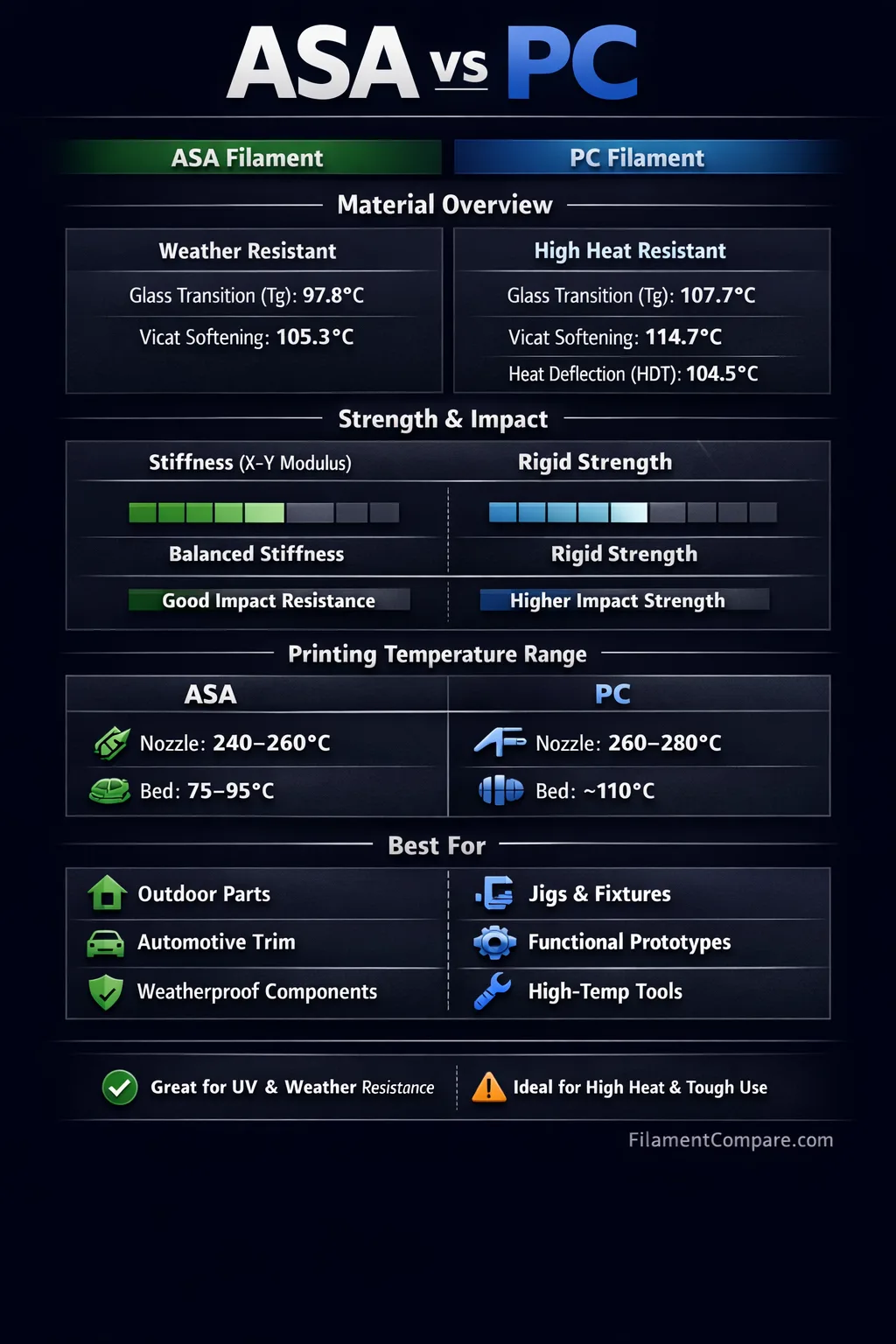
ASA is the more practical choice for weather-exposed parts, while PC is usually the better fit when higher heat tolerance, tensile performance, and load-bearing capacity matter more than printing convenience. Both materials need controlled temperatures, but PC places greater demands on the hot end, build plate, chamber, filament dryness, and part design. The right choice depends on whether the part must survive sunlight and outdoor aging or higher thermal and mechanical stress.
Direct Material Verdict
Choose ASA for exterior housings, garden hardware, vehicle-mounted accessories, signs, sensor covers, and functional parts that need a dependable balance of UV resistance, surface quality, and manageable printing requirements.
Choose PC for brackets, guards, jigs, fixtures, machine components, hot-zone covers, and stressed parts where higher tensile capacity, better shape retention under heat, or stronger through-layer performance justifies a more demanding print process.
There is no single overall winner. ASA is usually the better environmental material; PC is usually the higher-performance engineering option.
Better for Outdoor Exposure
ASA — its polymer family is selected more often for UV- and weather-exposed components.
Higher Heat Potential
PC — many PC and PC-blend grades retain stiffness at higher temperatures than common ASA grades.
Easier Enclosed Printing
ASA — still tuning-sensitive, but generally less demanding than PC on chamber and hot-end capability.
Better Tensile Load Capacity
PC — suitable grades commonly provide higher tensile and bending strength when printed well.
Better Surface Refinishing
ASA — sanding, gluing, painting, and controlled acetone smoothing are established options.
Better for High-Stress Fixtures
PC — a strong candidate for clamps, tooling aids, mounts, and protective engineering parts.
Lower Moisture Burden
ASA — it can absorb moisture, but PC normally demands stricter drying and dry-box habits.
Better for Large Exterior Covers
ASA — enclosure control is still needed, yet large PC parts are more likely to require a heated chamber.
| Decision Area | ASA | PC | Better Fit |
|---|---|---|---|
| Material family | Acrylonitrile styrene acrylate | Polycarbonate or a print-optimized PC blend | Use dependent |
| Print difficulty | Advanced; enclosure strongly recommended | Advanced to expert; stable chamber conditions are more important | ASA |
| Typical nozzle range | Usually about 230–270°C | Usually about 250–290°C | Printer dependent |
| Typical bed range | Usually about 75–110°C | Usually about 90–120°C | ASA needs less |
| Enclosure need | Recommended for small parts and normally needed for larger parts | Normally required; a heated chamber can be useful for larger geometry | ASA |
| Heat resistance | High for a common outdoor filament; grade-dependent | Usually higher, especially in engineering PC grades and tested blends | PC |
| Tensile and bending performance | Good for housings, covers, mounts, and exterior hardware | Often higher when the grade, chamber, and print orientation are suitable | PC |
| Impact behavior | Tough, but results vary widely by formulation and test method | Often associated with high toughness, though filament-grade test results can vary | Check the TDS |
| Layer adhesion | Good with enough chamber warmth and limited cooling | Can be very strong, but moisture or chamber instability can weaken layers | PC when tuned |
| Moisture sensitivity | Moderate; dry if popping, roughness, or weak extrusion appears | High enough that pre-drying and dry storage are often part of the workflow | ASA |
| Warping | Moderate to high, especially on wide or sharp-cornered parts | High; large flat geometry is particularly demanding | ASA |
| UV and weather fit | Usually the preferred choice for long-term exterior exposure | Not automatically UV-stable; outdoor suitability depends on grade and additives | ASA |
| Surface finish | Usually matte to satin, clean, and easy to sand or paint | Often smooth and dense; transparent or light-diffusing grades also exist | Appearance dependent |
| Typical uses | Outdoor enclosures, trim, signs, brackets, covers, garden parts | Jigs, fixtures, guards, mechanical mounts, hot-zone parts, stressed components | Use dependent |
| Main limitation | Warping, fumes, and lower heat ceiling than many PC grades | High printing temperature, moisture control, warping, and build-surface risk | Different limits |
This ASA and PC comparison combines official material guidance and manufacturer datasheets; the patterns are useful for selection, but actual behavior changes with grade, color, additives, moisture, geometry, orientation, chamber temperature, and slicer settings.
Material Profiles
ASA Material Profile
- Polymer type: Amorphous styrenic thermoplastic developed for improved weather resistance
- Print difficulty: Advanced
- Nozzle range: Commonly 230–270°C (brand-dependent)
- Bed range: Commonly 75–110°C
- Enclosure: Strongly recommended; usually needed for medium and large parts
- Drying need: As needed after moisture exposure
- Typical behavior: Good stiffness, clean finish, useful toughness, noticeable shrink stress
- Best uses: Outdoor housings, covers, signage, vehicle accessories, exterior mounts
PC Material Profile
- Polymer type: Amorphous engineering thermoplastic; many filaments are modified PC blends
- Print difficulty: Advanced to expert
- Nozzle range: Commonly 250–290°C
- Bed range: Commonly 90–120°C
- Enclosure: Normally required; heated chamber preferred for demanding geometry
- Drying need: Frequent and often preventive
- Typical behavior: High tensile potential, good heat retention, strong adhesion when dry and hot
- Best uses: Jigs, guards, brackets, fixtures, machine covers, stressed technical parts
Printer presets are not interchangeable. One official ASA profile recommends a 260°C nozzle with a 105–110°C bed[a], while an official PC Blend guide lists 275±10°C for the nozzle and 110±10°C for the bed[b]. Use the spool maker’s profile as the starting point rather than treating either material name as a single recipe.
Relative Printing-Use Scores
ASA
PC
The bars are relative workshop indicators rather than laboratory ratings. Brand formulation, colorants, reinforcement, absorbed moisture, raster direction, wall count, chamber conditions, and slicing choices can change the result.
Printer Requirements and Thermal Control
ASA can be printed on many enclosed prosumer machines with an all-metal hot end, a bed capable of roughly 100°C, and a build surface approved for styrenic materials. Small parts may succeed in a passive enclosure. Wide panels, tall shells, and sharp-cornered bases benefit from warmer, steadier air around the print.
PC raises the hardware threshold. A nominal maximum nozzle temperature is not enough; the hot end must hold that temperature reliably, the extruder path must tolerate sustained heat, and the bed must maintain a high setpoint without thermal errors. For large PC parts, a heated chamber can matter more than another 5°C at the nozzle because it reduces the temperature gradient between fresh layers and the cooling part.
Build-surface caution: both materials can bond aggressively to some PEI surfaces. PC is especially likely to require a glue layer that also acts as a release barrier. Follow the printer and filament maker’s surface instructions; excessive bonding can remove coating or damage a sheet.
Ventilation also belongs in the setup. ASA printing produces styrenic emissions, so a controlled enclosure, suitable filtration, and room ventilation are preferable to placing the printer in a continuously occupied space. Ventilation should not create a cold draft across the active print. PC formulations differ, and the spool’s safety documentation should be checked before selecting ventilation and filtration practices.
Heat Retention, Creep, and Mechanical Loading
PC generally has the higher thermal ceiling, but the gap must be read from the exact filament datasheet. Polymer names do not guarantee identical heat-deflection performance. A modified easy-print PC can behave differently from a high-temperature PC, and an outdoor ASA grade can outperform a low-cost blend in a particular test.
A matched set of manufacturer datasheets illustrates the difference without treating it as universal. The listed ASA grade reports a 98°C glass-transition temperature, 100°C heat-deflection temperature at 1.8 MPa, 43.8 MPa XY tensile strength, and 10.3 kJ/m² notched Charpy impact result[c]. The listed PC grade reports 113°C glass transition, 107°C heat deflection at the same load, 69.1 MPa XY tensile strength, and 4.1 kJ/m² notched Charpy impact result[d].
Those values show why “PC is stronger” needs a definition. In that product pair, PC leads in tensile and bending strength, while ASA records the higher result in the cited notched-impact test. A different PC blend may reverse the impact ranking. Part orientation, layer bonding, wall layout, stress concentration, and temperature during service can matter as much as the resin family.
For a static bracket near a warm motor, PC is usually the safer candidate. For an exterior enclosure that sees knocks, rain, and sunlight but not sustained high load, ASA often makes more sense. Under constant stress, both materials can creep; PC’s higher heat capability does not remove the need for thicker sections, ribs, fillets, metal inserts, or load spreading.
Outdoor Aging and Surface Finish
ASA has the clearer advantage outdoors. Its weathering profile is the main reason it is chosen for exposed covers, clips, trim, instrument housings, antenna mounts, and garden components. Official material guidance describes ASA as suitable for parts exposed to UV light, moisture, and changing outdoor conditions[f].
PC should not be assumed to have the same UV stability. Some PC grades include UV stabilizers, while others can yellow, lose clarity, or experience surface aging under prolonged sunlight. A printed PC part intended for exterior service needs a grade-specific weathering claim, a protective coating, or both. Black pigment alone is not proof of long-term UV performance.
ASA also offers a flexible finishing path. It sands well, accepts many paints after correct preparation, and can be joined or smoothed with acetone-based methods. Vapor smoothing changes dimensions, edge definition, surface chemistry, and sometimes mechanical behavior, so it is better suited to cosmetic shells than tolerance-critical interfaces.
PC can produce a dense, smooth finish, and some grades are translucent or light-diffusing. Printed PC is not equivalent to injection-molded optical polycarbonate: layer lines, internal gaps, moisture bubbles, additives, and surface texture reduce clarity. Transparent-looking filament should therefore be treated as a light-transmission option rather than a guaranteed optical window.
Moisture, Drying, and Storage
Both filaments benefit from sealed storage, but PC is less forgiving. Wet PC may produce popping sounds, steam bubbles, rough walls, stringing, weak interfaces, or inconsistent extrusion. A spool can look dry and still print poorly after several hours in humid air.
ASA can also absorb enough moisture to affect finish and strength, though the problem is often less immediate. Official Prusament drying guidance lists 80°C for four hours for ASA and 85°C for five hours for PC Blend[e]. These are product-specific values, not universal oven settings. Check spool temperature limits, verify dryer accuracy, and avoid heating a plastic spool beyond its rated temperature.
For production work, moisture control is easier when treated as part of the process rather than a troubleshooting step. Store opened spools with desiccant, log drying cycles, and keep PC feeding from a low-humidity box during long prints. Dry filament cannot compensate for a cold chamber, but it removes one major source of random failure.
Warping, Accuracy, and Part Geometry
ASA shrinks as it cools and can lift corners, split tall walls, or pull a brim away from the plate. Rounded corners, generous fillets, split assemblies, consistent wall thickness, and reduced internal material can lower stress. The goal is not maximum bed adhesion alone; it is balanced adhesion that holds during printing and releases without damaging the surface.
PC amplifies the same design problem. Large flat bases, dense infill, sharp transitions, and long straight walls store more contraction stress. A part that fits on the build plate may still be too large for reliable PC printing on a passively enclosed desktop machine. Segmenting the model, using mechanical fasteners, or switching to a reinforced PC grade can be more reliable than forcing one large print.
Carbon- or glass-fiber PC variants can reduce warping and increase stiffness, but they are not direct substitutes for unfilled PC. Reinforcement can lower ductility, change layer behavior, produce a rougher finish, and require a wear-resistant nozzle. The part may become more dimensionally stable while becoming less suitable for snap fits or repeated flexing.
| Use Case | More Suitable Material | Reason |
|---|---|---|
| Outdoor sensor enclosure | ASA | Better established UV and weathering fit |
| Machine fixture near a warm process | PC | Higher heat and tensile potential in suitable grades |
| Garden irrigation bracket | ASA | Outdoor suitability with adequate toughness |
| Load-bearing camera rig mount | PC | Better choice when tensile and bending loads dominate |
| Large exterior equipment cover | ASA | Usually easier than PC for large enclosed prints and better suited to sunlight |
| Hot-air duct accessory | PC | Higher temperature margin, provided the actual service temperature is verified |
| Painted automotive exterior trim | ASA | Good finishing options and outdoor polymer choice |
| Repeatedly tightened clamp | PC | Higher strength potential, with metal inserts preferred for threaded joints |
| Decorative technical housing | ASA | Cleaner refinishing path and lower printer burden |
| Protective tool guard | PC | Useful combination of heat resistance and engineering strength |
| Transparent indicator cover | Grade dependent | PC offers translucent grades, but printed optical clarity is limited |
| Wide flat plate on an unheated enclosure | Neither preferred | Both can warp; geometry or process changes are more important than material choice |
Where Each Material Fits Better
Choose ASA When
- The part will spend long periods outdoors.
- UV stability is more important than the highest possible heat ceiling.
- You need a clean matte or satin finish that can be sanded and painted.
- Your enclosed printer reaches ASA temperatures but is not designed for sustained PC printing.
- The part is a housing, cover, sign, trim piece, mount, or exterior accessory.
ASA Is Less Suitable When
- The part will carry high continuous load near its temperature limit.
- The printer is open-frame and the geometry is large or flat.
- Styrenic emissions cannot be managed with enclosure and ventilation.
- The design needs the higher tensile performance offered by a verified PC grade.
Choose PC When
- Heat retention and load capacity matter more than outdoor weathering.
- The part is a jig, fixture, guard, clamp, bracket, or stressed machine component.
- The printer has a suitable hot end, high-temperature bed, enclosure, and approved surface system.
- You can dry the spool and maintain low humidity during printing.
- The geometry is designed to reduce contraction stress.
PC Is Less Suitable When
- The printer cannot hold stable chamber and bed temperatures.
- The part is wide, flat, and difficult to segment.
- Long-term UV exposure is expected but the grade has no weathering claim.
- A simple, low-maintenance outdoor housing would meet the need in ASA.
Material Selection Matrix
Best Choice by Priority
Choose ASA if the part’s main challenge is sunlight, rain, exterior aging, paintable finish, or producing a medium-to-large technical shell on a capable enclosed desktop printer.
Choose PC if the part’s main challenge is higher service temperature, tensile loading, bending stress, strong layer bonding, or use as a jig, fixture, guard, or machine component.
Choose neither without further testing if the part is safety-related, remains under high continuous load, contacts regulated substances, operates near a heat source with unknown peaks, or requires certified flame, electrical, food-contact, or medical performance. Printed test coupons and the exact grade datasheet are more useful than resin-family assumptions.
Common ASA and PC Questions
Is PC always stronger than ASA?
No. PC often has higher tensile and bending strength, but impact results depend on the formulation, test method, temperature, moisture, and print orientation. Define the load before comparing “strength.”
Can ASA replace PC for hot parts?
Sometimes, when the operating temperature and load remain inside the ASA grade’s verified range. PC provides more thermal margin in many products, but the actual HDT or Vicat value should be checked rather than inferred from the material name.
Can PC be used outdoors?
Only with grade-specific evidence or protection. UV-stabilized PC exists, but standard PC filament should not automatically be treated as a long-term outdoor material. ASA is normally the simpler exterior choice.
Which material warps more?
Both can warp, though PC is usually more demanding on large geometry. Chamber temperature, part shape, bed preparation, infill, wall count, and cooling strategy can change the outcome.
Does PC need a hardened nozzle?
Unfilled PC usually does not. PC-CF and PC-GF contain abrasive reinforcement and normally need a wear-resistant nozzle. Follow the filament maker’s nozzle material and diameter guidance.
Technical References
- [a] ASA | Prusa Knowledge Base (Used for the Prusament ASA temperature profile, enclosure guidance, heat-resistance context, and post-processing notes.)
- [b] Polycarbonate (PC) | Prusa Knowledge Base (Used for PC Blend nozzle and bed temperatures, build-surface separation guidance, and large-part warping behavior.)
- [c] Polymaker™ ASA | Polymaker Wiki (Used for one tested ASA grade’s glass transition, heat deflection, tensile, impact, density, and processing data.)
- [d] PolyLite™ PC | Polymaker Wiki (Used for one tested PC grade’s glass transition, heat deflection, tensile, impact, chamber, drying, and annealing data.)
- [e] Drying filament | Prusa Knowledge Base (Used for product-specific ASA and PC Blend drying examples and dryer-temperature cautions.)
- [f] Method series ASA – UltiMaker (Used for ASA outdoor-use context involving UV exposure and moisture.)
