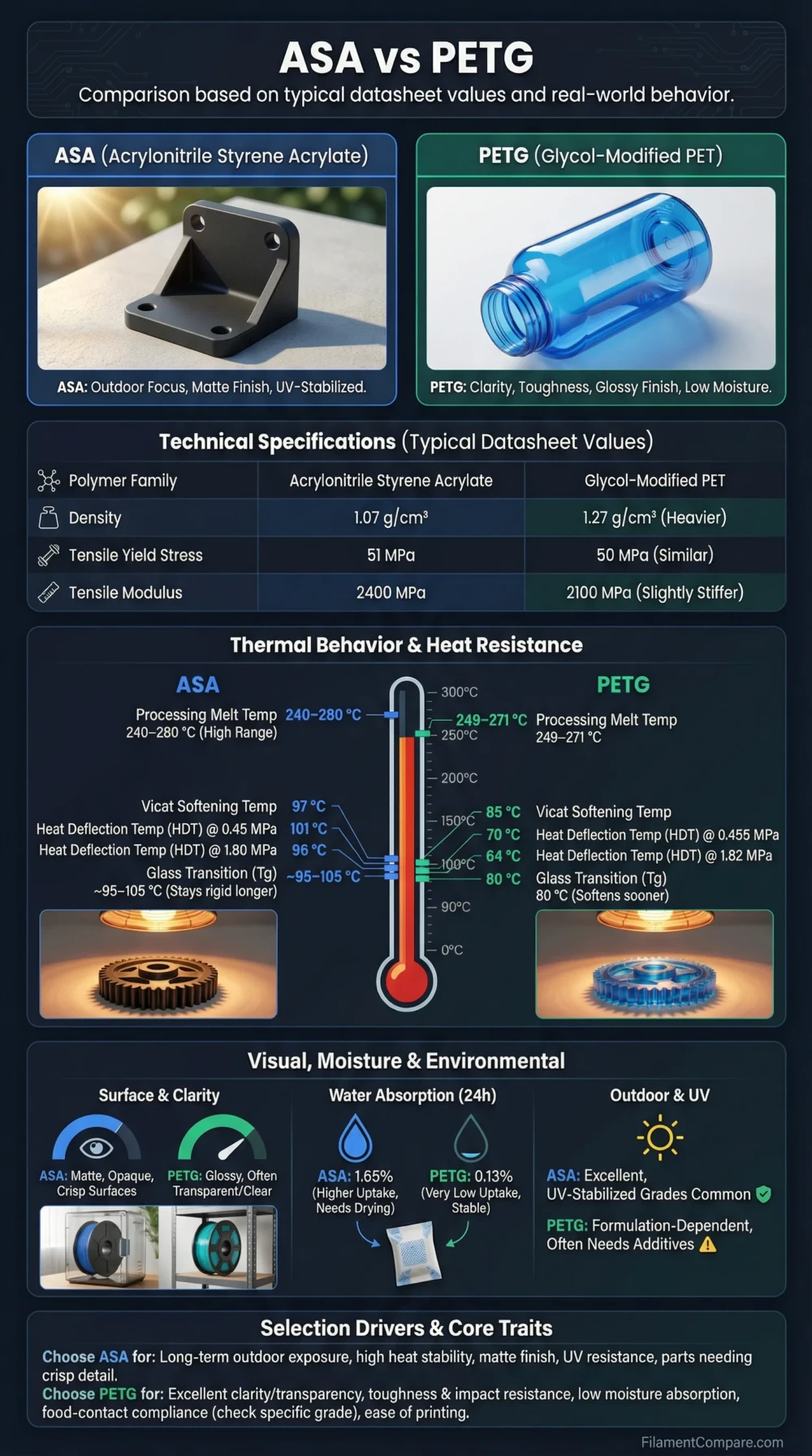
ASA is better for UV exposure, outdoor parts, and higher heat tolerance, while PETG is easier to print, tougher in many everyday functional parts, and more forgiving on open-frame printers. ASA asks for more printer control, especially an enclosure and a hot bed. PETG is the more practical choice when the part does not need long outdoor exposure or elevated temperature resistance.
Choose ASA for outdoor brackets, housings, clips, covers, and functional parts that must handle sunlight and warmer service conditions. Choose PETG for easier printing, strong layer bonding, lower warp risk, and reliable functional parts on common desktop printers.
There is no single winner for every print. ASA fits harsher environments; PETG fits broader day-to-day printing.
Best for Outdoor Use
ASA — better UV and weathering fit than PETG, especially for covers, brackets, and exterior housings.
Best for Easy Printing
PETG — prints well without a full enclosure and usually has lower warp risk.
Better Heat Tolerance
ASA — more suitable for parts exposed to moderate warmth, sun-heated surfaces, or enclosed outdoor spaces.
Better Layer Bonding
PETG — usually forms strong interlayer adhesion with less tuning than ASA.
Better Surface Control
ASA — can produce clean, matte technical parts and can be vapor-smoothed with suitable solvents in controlled conditions.
Better for Open Printers
PETG — more suitable when the printer has no enclosure or chamber temperature control.
Better for Large Flat Parts
PETG — lower shrink and lower enclosure demand make it easier for wide, flat shapes.
Better for Sun-Exposed Covers
ASA — a better match for parts that need color and shape stability outdoors.
| Category | ASA | PETG | Better Fit |
|---|---|---|---|
| Material Family | Acrylonitrile styrene acrylate thermoplastic | Polyethylene terephthalate glycol copolymer | Use-case based |
| Print Difficulty | Moderate to advanced | Beginner to intermediate | PETG |
| Typical Nozzle Temperature | Usually around 250–270 °C; Prusament ASA lists 260 ± 10 °C[a] | Commonly around 230–260 °C depending on brand and speed | Printer-dependent |
| Typical Bed Temperature | Usually about 90–110 °C; Prusament ASA lists 110 ± 5 °C | Usually about 70–90 °C; Prusament PETG lists 80 ± 10 °C[b] | PETG for ease |
| Enclosure Requirement | Recommended, especially for larger parts | Usually not required | PETG |
| Heat Resistance | Higher; Prusament ASA lists HDT values of 93 °C at 0.45 MPa and 86 °C at 1.80 MPa | Moderate; Ultimaker PETG lists HDT of 76.2 ± 0.8 °C at 0.455 MPa[c] | ASA |
| Toughness | Good impact behavior when printed correctly | Very good practical toughness and ductility for daily functional prints | Use-case based |
| Stiffness | Moderate stiffness; printed modulus depends on orientation | Moderate stiffness with slightly flexible feel compared with PLA | Similar range |
| Layer Adhesion | Good with correct chamber control and temperature | Usually strong and forgiving | PETG |
| Moisture Sensitivity | Can benefit from dry storage | Can string more when wet; dry storage helps surface quality | Both need care |
| Warping Risk | Higher, especially on open printers or large parts | Lower than ASA in most desktop setups | PETG |
| Surface Finish | Matte technical look; can hide layer lines well | Often glossy or semi-glossy; can show stringing if wet or too hot | Preference-based |
| Outdoor Suitability | Better fit for UV and weather exposure | Usable for mild outdoor parts, but less suitable for long UV exposure than ASA | ASA |
| Typical Uses | Outdoor housings, brackets, covers, automotive-style exterior accessories, technical parts | Brackets, printer parts, containers, clips, tool holders, functional prototypes | Part-dependent |
| Main Limitation | Needs heat control, ventilation awareness, and better bed adhesion tuning | Stringing, oozing, and less UV/heat performance than ASA | Different limits |
The ASA and PETG comparisons below combine manufacturer datasheets, material guides, and common FDM printing behavior; actual results can shift with brand, color, additives, drying, part geometry, chamber temperature, and slicer settings.
ASA Material Profile
- Polymer type: Acrylonitrile styrene acrylate
- Print difficulty: Moderate to advanced
- Nozzle range: Usually around 250–270 °C
- Bed range: Usually around 90–110 °C
- Enclosure: Strongly recommended for stable results
- Drying need: Helpful for consistent surface quality and flow
- Typical behavior: Heat-resistant, UV-fit, shrink-prone without chamber control
- Best use cases: Outdoor covers, functional housings, sun-exposed brackets, technical parts
PETG Material Profile
- Polymer type: Glycol-modified copolyester
- Print difficulty: Beginner to intermediate
- Nozzle range: Usually around 230–260 °C
- Bed range: Usually around 70–90 °C
- Enclosure: Usually not required
- Drying need: Useful when stringing, popping, or rough surfaces appear
- Typical behavior: Tough, slightly flexible, sticky on beds, prone to oozing if overtuned
- Best use cases: Functional brackets, printer parts, containers, clips, guards, tool holders
These bars are practical printing indicators, not fixed lab ratings. Brand, additives, filament color, moisture level, part orientation, cooling, infill, and slicer setup can change the result.
Printability and Setup Demands
PETG is easier to bring into a stable profile. A heated bed, clean build surface, moderate part cooling, and tuned retraction usually cover most prints. The main PETG tuning issue is not getting it to stick; it is often getting it to stop sticking too much or stringing between travel moves.
ASA needs more control. It prints hot, prefers a warm enclosed build volume, and can shrink enough to lift corners from the bed. A brim, clean PEI surface, stable chamber temperature, and reduced drafts matter more with ASA than with PETG. Small ASA parts can print on capable open machines, but larger shapes become more tuning-sensitive.
Printer Requirement Difference
For PETG, the printer mainly needs a heated bed and an all-metal hotend only if the chosen filament profile runs beyond the safe range of the machine. For ASA, an enclosure is not just a comfort feature; it helps control warping, layer stress, and corner lift.
Heat, UV, and Outdoor Behavior
ASA is the clearer choice when sunlight and outdoor temperature swings are part of the job. Its UV resistance is the main reason it is chosen over ABS and PETG for exterior printed components. It is still not a guarantee of unlimited outdoor life; color, wall thickness, pigment package, load, and local weather exposure all matter.
PETG can work outdoors for mild use, especially when the part is not under constant load or direct sun. For long-term sun exposure, PETG is less suitable than ASA unless the specific product is UV-stabilized. PETG also softens earlier than ASA, so it is less comfortable near sun-heated surfaces, warm enclosures, or parts that hold mechanical load in heat.
Heat note: Neither ASA nor PETG should be treated as a universal high-temperature engineering material. If the part carries load near heat, check the filament’s datasheet, test the geometry, and leave margin below the listed softening or HDT values.
Mechanical Behavior and Layer Strength
PETG is valued for practical toughness. It bends more than PLA before failure, bonds layers well, and handles clips, guards, brackets, and printer parts with a useful mix of strength and ductility. It is not the stiffest filament, but for many functional parts that slight give is helpful.
ASA can also make strong functional parts, but the result depends more on thermal control during printing. Poor chamber stability can reduce layer quality, create internal stress, or cause corner lift. When printed correctly, ASA is a strong technical material for housings, exterior covers, and parts that need heat and UV resistance more than maximum layer forgiveness.
Where ASA Feels Stronger
- Outdoor housings that must resist sunlight
- Parts near moderate heat
- Rigid covers, panels, and brackets
- Technical parts where surface finish and heat resistance matter
Where PETG Feels Stronger
- Parts that need strong layer adhesion
- Clips and brackets used indoors
- Objects printed on open-frame machines
- Functional prints where a little flex helps
Surface Finish, Stringing, and Post-Processing
ASA usually gives a clean technical surface with a less glossy look than PETG. It can also be chemically smoothed with suitable solvents, but that process needs careful handling, ventilation, and material-specific testing. The better approach for most prints is still good slicer tuning and stable temperature control.
PETG often has a glossy or semi-gloss finish. It can look very clean on simple shapes, but fine details may show stringing if the filament is wet, the nozzle is too hot, or travel settings are not tuned. PETG also tends to grab the build plate strongly, so release layers or the correct bed surface can prevent damage.
Moisture, Storage, and Print Consistency
Both materials benefit from dry storage. PETG commonly shows moisture problems as extra stringing, small bubbles, inconsistent gloss, or rougher surfaces. ASA is often less talked about in moisture discussions, but dry filament still improves consistency and reduces surface defects.
For both, use a sealed container with desiccant after opening. If print quality changes over time, drying the spool according to the manufacturer’s temperature limit is safer than simply raising nozzle temperature to hide symptoms.
| Use Case | Better Material | Reason |
|---|---|---|
| Beginner functional prints | PETG | Lower enclosure demand and easier bed/chamber control. |
| Outdoor electrical enclosure | ASA | Better UV and heat fit for exterior service. |
| Printer brackets and mounts | PETG | Good toughness and layer adhesion with simpler printing. |
| Sun-exposed garden clips | ASA | More suitable for sunlight and weather exposure. |
| Large flat panels | PETG | Lower warp risk on common desktop printers. |
| Car-adjacent trim or covers | ASA | Better heat tolerance than PETG, but test for the exact temperature range. |
| Containers and organizers | PETG | Tough, easy to print, and suitable for many indoor utility parts. |
| Cosmetic technical housing | ASA | Matte surface and better outdoor aging fit. |
| Snap-fit clips | PETG | Good ductility and layer bonding for many clip designs. |
| Warm outdoor mounting plate | ASA | Higher heat resistance and better UV behavior. |
Choose ASA When
- The part will live outdoors or near sunlight.
- Heat resistance matters more than easy printing.
- You have an enclosure and a bed that can hold high temperatures.
- The print is a cover, housing, exterior bracket, vent part, or sun-exposed accessory.
- You want a more technical matte finish than typical glossy PETG.
ASA Is Less Suitable When
- The printer is open-frame and placed in a drafty room.
- The part is large, flat, and the machine has weak bed heating.
- You need the easiest possible material for repeated production.
- Ventilation and fume management cannot be handled properly.
Choose PETG When
- You want a tough functional part without advanced printer setup.
- The printer does not have an enclosure.
- Strong layer adhesion is more important than UV resistance.
- The part is used indoors or only sees mild outdoor exposure.
- You need brackets, mounts, clips, containers, guards, or utility parts.
PETG Is Less Suitable When
- The part will sit in direct sun for long periods.
- The part must hold shape under elevated temperature and load.
- Very crisp tiny details are more important than toughness.
- Stringing control is a problem and drying is not available.
Choose ASA if the part needs better UV resistance, higher heat tolerance, and a more outdoor-ready material profile. It is the stronger candidate for exterior housings, sun-exposed brackets, covers, and technical parts printed on an enclosed machine.
Choose PETG if you want a tougher everyday material that prints more easily, bonds layers well, and works on more desktop printers. It is the safer default for indoor functional prints, tool holders, printer parts, and general utility components.
For most users, PETG is the easier first choice. For outdoor and heat-exposed work, ASA is the more suitable material when the printer can handle it.
Common ASA and PETG Questions
Is ASA stronger than PETG?
Not in every meaning of strength. ASA has better heat and UV performance, while PETG often gives easier layer bonding and practical toughness. Tensile strength, stiffness, impact behavior, and layer adhesion should be judged separately.
Can PETG replace ASA outdoors?
PETG can work for mild outdoor use, but it is not a direct replacement for ASA when long UV exposure and warm service conditions matter. For exterior parts, ASA is usually the better fit.
Does ASA always need an enclosure?
Small ASA parts may print without a full enclosure on some machines, but an enclosure is strongly recommended for reliable results. It reduces drafts, corner lift, and layer stress.
Is PETG better for beginners?
Yes, PETG is usually easier than ASA for newer users. It needs less chamber control, has lower warp risk, and works on more common printer setups.
Which material is better for car interior parts?
ASA is more suitable than PETG for moderate warmth, but car interiors can reach temperatures that challenge many printed plastics. Test the part in the real location and avoid safety-critical use without proper material validation.
Should ASA or PETG be dried before printing?
Drying can help both. PETG commonly shows moisture as stringing and rough surfaces. ASA also benefits from dry storage and controlled handling, especially for cleaner technical prints.
Resources Used
- [a] Technical datasheet – Prusament ASA by Prusa Polymers — Used for ASA print temperature, bed temperature, HDT, density, Shore D hardness, and printed specimen property context.
- [b] Prusament PETG — Used for PETG printer requirement context, including bed temperature, extruder temperature, enclosure note, and general printability behavior.
- [c] Ultimaker PETG Technical data sheet — Used for PETG HDT, Vicat softening temperature, glass transition value, tensile data, flexural data, and orientation-related property notes.
- ASA – Prusa Knowledge Base — Used for ASA material behavior, outdoor suitability, UV resistance, temperature resistance, and practical printing notes.
- PETG – Prusa Knowledge Base — Used for PETG beginner suitability, temperature guidance, and practical FDM printing behavior.
