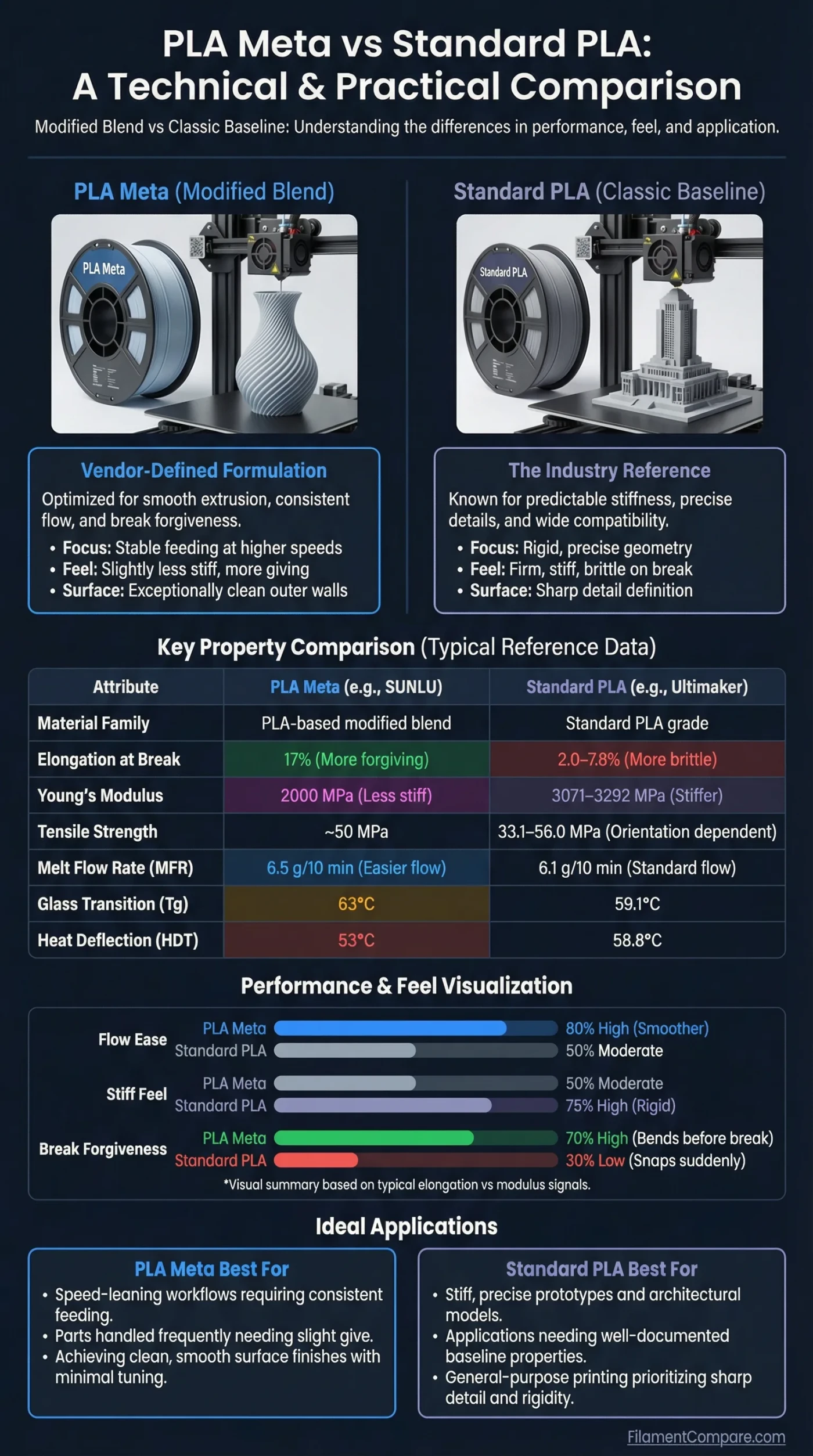
PLA Meta is a modified, higher-flow PLA formulation intended for lower-temperature and faster extrusion, while standard PLA is the broader baseline material with more familiar cross-brand profiles. The name PLA Meta refers here to SUNLU PLA Meta rather than an industry-defined polymer grade[a]. Both remain low-warp PLA-family filaments, and neither gains engineering-grade heat resistance simply because PLA Meta can print at a lower nozzle temperature.
The Practical Choice
Choose PLA Meta when the printer is expected to run faster, smoother flow at moderate nozzle temperatures is useful, or the part needs a little more tolerance to drops and bending than a typical decorative PLA print.
Choose standard PLA when predictable slicer profiles, broad color and brand availability, sharp detail at ordinary speeds, and easy replacement between suppliers matter more than maximum flow.
Neither has a clear heat-performance advantage. For parts exposed to hot vehicles, sustained mechanical load, direct summer sun, or warm machinery, another material family may fit the job better.
Better for High-Speed Extrusion
PLA Meta
Its formulation and recommended temperature ranges are arranged around higher-flow printing.
Better for Familiar Printer Profiles
Standard PLA
Most printers and slicers include tested starting profiles for ordinary PLA.
Better for Glossy Display Models
PLA Meta
It commonly produces a smooth, slightly glossy surface that suits figures, props, and decorative parts.
Better for Brand Flexibility
Standard PLA
PLA is available from many suppliers, while PLA Meta describes a particular SUNLU formulation.
Better for Drop Tolerance
PLA Meta
SUNLU’s current printed-specimen data reports higher impact values than its standard PLA data.
Better for Established Detail Profiles
Standard PLA
A calibrated standard PLA profile can retain corners and tiny features without compensating for unusually easy flow.
Better Heat Tolerance
No meaningful winner
The reported glass-transition, Vicat, and heat-deflection values remain close.
Better for Lower Nozzle Temperatures
PLA Meta
At ordinary speeds, its official starting range begins below SUNLU’s current standard PLA range.
| Decision Area | PLA Meta[b] | Standard PLA[c] | Practical Difference |
|---|---|---|---|
| Material family | Modified PLA formulation | PLA thermoplastic polyester | Both belong to the PLA family, but additives and formulation choices alter flow and printed-part behavior. |
| Meaning of the name | A SUNLU product formulation | A general filament category | PLA Meta results should not be applied automatically to every modified PLA sold under another name. |
| Print difficulty | Easy, with flow calibration recommended | Easy and widely profiled | Both suit beginners; standard PLA normally has more ready-made profiles. |
| Typical nozzle temperature | 185–195°C at 50–100 mm/s; 195–225°C at 100–200 mm/s | 200–210°C at 50–100 mm/s; 210–240°C at 100–200 mm/s | PLA Meta can begin lower, but fast printing still needs enough heat to maintain stable flow. |
| Typical bed temperature | 50–60°C | 50–60°C | Bed requirements are effectively the same in the cited SUNLU data. |
| Enclosure requirement | Usually unnecessary | Usually unnecessary | An open printer is normally suitable unless the room is unusually cold or drafty. |
| Flow and speed | Formulated for lower-temperature, higher-flow printing | Reliable at ordinary and moderate-high speeds with enough nozzle heat | PLA Meta is the more purpose-built choice for speed-focused profiles. |
| Toughness | Higher reported impact response in SUNLU’s current printed-specimen data | Rigid with moderate impact tolerance | PLA Meta may tolerate drops better, but it is not a substitute for PETG, nylon, or TPU where repeated impacts are expected. |
| Stiffness | Higher reported flexural modulus in the cited product data | Rigid and suitable for visual prototypes | PLA Meta is not simply a soft or flexible PLA despite its improved strain tolerance. |
| Layer adhesion | Usually good when flow and cooling are balanced | Usually good with a calibrated temperature | Print orientation and nozzle temperature often matter more than the product name. |
| Heat resistance | Low to moderate for a PLA-family filament | Low to moderate for a PLA-family filament | Lower extrusion temperature does not mean higher service temperature. |
| Moisture sensitivity | Moderate; drying can reduce stringing | Moderate; wet filament may pop, string, or lose surface quality | Both benefit from sealed storage even though they are less moisture-sensitive than many nylon grades. |
| Surface finish | Often smooth and glossy | Brand-dependent; usually smooth with visible layer character | PLA Meta is well suited to decorative prints, while standard PLA offers matte, silk, tough, and other separately formulated variants. |
| Dimensional stability | Low warping, though excess flow can soften corners | Low warping and predictable geometry | Standard PLA can be easier when an existing dimensionally tuned profile must remain unchanged. |
| Outdoor suitability | Limited for long-term exposure | Limited for long-term exposure | Neither should be treated as a direct replacement for ASA or a verified UV-stabilized grade. |
| Typical uses | Fast models, figures, toys, decorative parts, lighting housings that remain away from hot lamps | Prototypes, miniatures, organizers, models, jigs, educational prints | The intended environment remains more important than the label on the spool. |
| Main limitation | Brand-specific behavior and possible over-extrusion when copied into a standard PLA profile | Lower drop tolerance in some formulations and slower flow under demanding speed targets | Both need a short calibration print before a large job. |
| Better choice | High-speed and smooth decorative printing | General-purpose profiles and supplier flexibility | Select by workflow rather than seeking one universal winner. |
This PLA Meta versus PLA comparison uses current SUNLU datasheets and official product documentation as directional evidence; actual results can shift with color, batch, additives, moisture, nozzle design, part orientation, cooling, and slicer settings.
Material and Workflow Profiles
PLA Meta Profile
- Polymer type: Proprietary modified PLA formulation
- Print difficulty: Easy after basic temperature and flow calibration
- Nozzle range: 185–225°C, paired with print speed
- Bed range: 50–60°C
- Enclosure: Normally not needed
- Drying: Controlled drying around 50°C may help when stringing or rough extrusion appears
- Typical behavior: Easy extrusion, low warping, smooth finish, and more flow than many ordinary low-speed PLA profiles expect
- Best uses: Figures, display pieces, toys, fast prototypes, colorful props, and low-load functional parts
Standard PLA Profile
- Polymer type: PLA-based thermoplastic polyester, with formulation varying by manufacturer
- Print difficulty: Easy and supported by most slicers
- Nozzle range: Commonly around 190–230°C; SUNLU’s current cited range extends from 200–240°C according to speed
- Bed range: Usually unheated to about 60°C, depending on plate and adhesive method
- Enclosure: Normally not needed
- Drying: Useful when the spool has absorbed moisture or produces popping and fine strings
- Typical behavior: Stiff, low-warp, dimensionally predictable, and easy to cool
- Best uses: Miniatures, prototypes, organizers, visual models, fixtures, and classroom printing
Relative Printing-Use Scores
PLA Meta
Standard PLA
The meter values are relative printing-use estimates rather than fixed laboratory grades. Brand chemistry, pigment, moisture, nozzle size, print orientation, layer bonding, cooling, and slicer calibration can change the outcome.
What PLA Meta Actually Means
PLA is a polymer family, while PLA Meta is a named commercial formulation. It should therefore be compared with the manufacturer’s own standard PLA rather than treated as a universal category such as PLA, PETG, ABS, or TPU.
This distinction affects buying decisions. A standard PLA spool from another supplier may have a lower recommended nozzle temperature, a tougher modifier package, a matte finish, or a higher maximum volumetric flow than the SUNLU PLA example used here. Likewise, a different company could use words such as “meta,” “pro,” “plus,” or “high speed” for a formulation with unrelated properties.
Comparison boundary: The technical numbers on this page compare SUNLU PLA Meta with SUNLU’s current standard PLA data. They should not be copied directly to every PLA brand or every modified-PLA product.
Flow, Temperature, and Print Speed
PLA Meta’s clearest advantage is not simply that it melts at a lower number. Its profile links temperature to speed: 185–195°C is listed for 50–100 mm/s, while 195–225°C is listed for 100–200 mm/s. That pairing matters because a hotend must transfer more energy per second as filament flow rises.
A low-temperature result from a small test model does not prove that the same temperature will support a large nozzle, thick layers, wide extrusion lines, or a high maximum volumetric flow. When the extruder begins clicking, line width becomes uneven, or the surface turns matte unexpectedly, the practical response is usually to raise temperature, reduce volumetric speed, or both.
Standard PLA remains capable of fast printing. The difference is that PLA Meta is sold and profiled around that workflow, whereas ordinary PLA behavior varies more widely between products. A modern high-flow hotend may also make the difference less noticeable at moderate speeds.
Why Melt-Flow Index Does Not Set Printer Speed Alone
The cited datasheets list a melt mass-flow rate of 5±2 g/10 min for PLA Meta and 6.9±3 g/10 min for standard PLA under the stated 190°C and 2.16 kg test condition. The ranges overlap, and the standard PLA number is not lower even though PLA Meta is presented as the speed-focused product.
This is not necessarily a contradiction. A standardized melt-flow test does not reproduce a printer’s narrow nozzle, changing shear rate, pressure, temperature profile, cooling demand, or rapid acceleration. It is one material indicator, not a direct conversion into millimetres per second. Actual speed testing should use maximum volumetric flow and extrusion consistency on the printer that will run the job.
Mechanical Data Under the Manufacturer’s Test Conditions
| Reported Property | PLA Meta | Standard PLA | How to Read the Difference |
|---|---|---|---|
| Tensile strength | 50±5 MPa | 40±6 MPa | PLA Meta has the higher central value in this dataset, but print orientation and bonding can alter real-part tensile behavior. |
| Elongation at break | 10±3% | 10±5% | The current datasheets show similar central values rather than a large flexibility gap. |
| Flexural strength | 85±6 MPa | 65±6 MPa | The reported PLA Meta specimens resisted a higher bending stress before failure. |
| Flexural modulus | 2900±300 MPa | 2300±300 MPa | PLA Meta is reported as stiffer in bending within this manufacturer dataset. |
| Notched Izod impact strength | 6.5±2.5 kJ/m² | 5±3 kJ/m² | The ranges overlap, although PLA Meta has the higher central value. |
| Unnotched Izod impact strength | 8±3 kJ/m² | 4.5±1.5 kJ/m² | PLA Meta shows the clearer reported advantage here, subject to specimen and print conditions. |
| Shore hardness | 83.5 | 80 | Both remain hard, rigid PLA-family materials rather than flexible filaments. |
| Heat-deflection temperature | 57±3°C at 0.45 MPa | 55±5°C at 0.45 MPa | The ranges overlap heavily, so PLA Meta should not be selected for a meaningful heat upgrade. |
| Glass-transition temperature | 63°C | 63°C | No reported difference in this measurement. |
| Vicat softening temperature | 54°C | 54°C | No reported difference in this measurement. |
| Density | 1.21 g/cm³ | 1.23 g/cm³ | The small difference is unlikely to control a normal buying decision. |
The values above describe printed test specimens, not raw polymer pellets and not every possible printed part. The PLA Meta specimens were reported as printed at 100–260 mm/s and 220°C, while the standard PLA sheet states 160–260 mm/s and 220°C. Both used 100% infill and a 90-degree raster orientation, but the stated speed ranges are not identical.
The comparison therefore supports a cautious statement: SUNLU’s current data points toward higher bending stiffness and better impact response for PLA Meta, while a home printer may produce a smaller, equal, or larger gap depending on layer bonding and part geometry.
Heat Resistance and Shape Retention
PLA Meta’s lower extrusion temperature can be mistaken for a service-temperature benefit. These are separate properties. Extrusion temperature describes the processing window inside the hotend; heat-deflection temperature, glass transition, load, part geometry, and exposure time influence whether a finished print retains its shape.
The cited sheets report the same 63°C glass-transition temperature and the same 54°C Vicat softening temperature. Their heat-deflection ranges also overlap. A PLA Meta hook, bracket, phone mount, or enclosure panel can therefore soften or creep in many of the same warm conditions that affect ordinary PLA.
Where Both Materials Have Thermal Limits
- Parts left inside a closed vehicle during warm weather
- Mounts placed near motors, heaters, radiators, lamps, or power electronics
- Fixtures carrying a steady load in a warm room
- Outdoor parts exposed to direct sun for long periods
- Dishwasher, boiling-water, or other high-temperature cleaning cycles
Annealing may alter shape retention, crystallinity, dimensions, and warping, but the result must be measured on the finished part rather than assumed from the filament label.
Surface Detail, Corners, and Flow Calibration
PLA Meta can produce smooth outer walls because material reaches the nozzle easily and fills lines consistently. This can help fast decorative models, curved surfaces, figures, and props where a polished visual result is preferred.
Easy flow can also expose an incorrect extrusion multiplier. A standard PLA profile that already runs slightly rich may create raised seams, thick top surfaces, softened lettering, or rounded corners when PLA Meta is loaded without recalibration. Reducing flow by a small measured amount is better than lowering temperature until layer bonding becomes unreliable.
Standard PLA can be the simpler choice for tiny text, miniatures, press-fit dimensions, and parts already validated with an established profile. PLA Meta may match or exceed that detail after tuning, but its advantage is more visible when speed and smooth deposition are part of the target.
Calibrate First
Run a temperature test, flow check, pressure-advance calibration, and a dimensioned test part before a long print.
Match Heat to Flow
Use the lower end for moderate speed and raise temperature as layer width, nozzle size, or volumetric demand increases.
Inspect the Corners
Bulging corners, thick seams, and filled-in lettering can indicate excess flow rather than insufficient cooling alone.
Moisture, Drying, and Spool Handling
Neither material normally absorbs moisture as rapidly as nylon, yet storage still affects print quality. Fine strings, popping sounds, bubbles, inconsistent gloss, rough walls, and weak-looking extrusion can appear after a spool has remained in humid air.
Both cited datasheets list a 50°C drying temperature, and the PLA Meta sheet specifically notes that drying can help reduce stringing. Use a controlled filament dryer or another device that can hold a verified temperature without overheating the spool. Household ovens can cycle above their displayed setting, especially at low temperatures.
Storage practice: Return either spool to a sealed bag or dry box with active desiccant after printing. Drying is corrective; sealed storage reduces how often it is needed.
Best Material by Print Type
| Print or Requirement | More Suitable Choice | Reason |
|---|---|---|
| First beginner print | Either | Both are low-warp materials; standard PLA has more default profiles, while PLA Meta can also print easily after checking temperature. |
| High-speed decorative model | PLA Meta | Its temperature and speed recommendations are arranged around smooth higher-flow extrusion. |
| Miniature using an established profile | Standard PLA | A proven profile reduces the chance of excess flow filling tiny recesses or lettering. |
| Large cosplay prop | PLA Meta | Faster deposition and low warping can shorten production time while retaining a smooth outer surface. |
| Dimensioned prototype | Standard PLA initially | Start with the known profile; PLA Meta can be used after flow and pressure advance are recalibrated. |
| Part likely to be dropped | PLA Meta | The manufacturer’s current printed-specimen data reports higher impact values, though geometry and orientation still matter. |
| Rigid low-load bracket | PLA Meta | Its reported flexural strength and modulus are higher in the cited SUNLU dataset. |
| Snap-fit clip used repeatedly | Neither by default | PLA Meta may tolerate strain better than some standard PLA, but PETG, polypropylene, nylon, or another suitable grade may provide better fatigue behavior. |
| Hot car accessory | Neither | The reported heat measurements remain within the normal PLA range and can be exceeded inside a parked vehicle. |
| Permanent outdoor fixture | Neither | Long-term sun, heat, weather, and load call for a verified outdoor-oriented material such as an appropriate ASA grade. |
| Multicolor system using generic PLA profiles | Standard PLA | Generic PLA profiles and replacement colors are easier to source across many brands. |
| Fast batch of figures or toys | PLA Meta | Its flow-focused profile and glossy finish fit repeated visual parts that do not face high heat. |
Where Each Filament Fits Better
Choose PLA Meta When
- The printer will run at moderate or high volumetric flow.
- A smooth, glossy finish is preferred.
- The part may experience occasional drops or light impacts.
- Low warping and quick model production matter.
- A SUNLU-specific profile can be saved and maintained.
- The job includes figures, toys, props, ornaments, or fast prototypes.
PLA Meta Is Less Suitable When
- The workflow must switch freely between unrelated brands without recalibration.
- The part will remain under load in a warm environment.
- Long-term outdoor exposure is expected.
- A standard PLA profile cannot be adjusted for flow or temperature.
- The design needs repeated flexing comparable to a true flexible or fatigue-resistant material.
Choose Standard PLA When
- The printer already has a reliable general PLA profile.
- Sharp visual detail and dimensional repeatability are the main goals.
- Many colors, finishes, suppliers, or spool sizes must remain available.
- The print runs at ordinary speed and does not need a flow-focused formulation.
- The part is a prototype, miniature, organizer, model, fixture, or educational object.
- Consistent replacement across common product lines is useful.
Standard PLA Is Less Suitable When
- The existing filament cannot keep up with the target volumetric flow.
- The part is frequently dropped or hit.
- Repeated bending, snap action, or fatigue loading is expected.
- The environment may reach temperatures near normal PLA softening conditions.
- The job requires verified weathering, chemical, or engineering performance.
Material Selection Matrix
Best Choice by Priority
Choose PLA Meta if faster deposition, smooth extrusion, a glossy decorative finish, and the higher mechanical values reported in SUNLU’s present product data match the print.
Choose standard PLA if the priority is an established slicer profile, easy switching between suppliers, ordinary-speed detail, broad availability, and predictable general-purpose printing.
Choose neither if the part must survive hot vehicles, long outdoor exposure, repeated flexing, sustained warm-load creep, or demanding mechanical service. PLA Meta changes the printing workflow more than it changes the temperature class of the finished part.
There is no universal winner. PLA Meta is the more targeted speed-and-flow product; standard PLA is the more transferable material category.
PLA Meta and PLA Questions
Is PLA Meta the Same as PLA Plus?
No. Both names can describe modified PLA products, but neither defines one fixed industry recipe. PLA Meta in this comparison is SUNLU’s named formulation, and its behavior should be checked against its own datasheet.
Can PLA Meta Use a Normal PLA Slicer Profile?
A normal PLA profile is a reasonable starting point, but temperature, flow ratio, pressure advance, and maximum volumetric flow should be recalibrated. A profile designed for thicker-flow standard PLA may over-extrude PLA Meta.
Is PLA Meta Mechanically Stronger Than PLA?
SUNLU’s current test data reports higher PLA Meta tensile, bending, stiffness, and impact values than its standard PLA figures. That does not establish the same ranking against every PLA brand, color, print orientation, or part design.
Does PLA Meta Have Better Heat Resistance?
Not by a useful margin in the cited data. Both sheets list 63°C glass transition and 54°C Vicat softening, while their heat-deflection ranges overlap. PLA Meta’s lower nozzle temperature is a processing feature, not a warm-environment rating.
Does PLA Meta Need Drying?
Drying is useful when stringing, popping, bubbles, or rough extrusion appear. The official sheet lists 50°C as a drying reference and notes that drying can reduce stringing. Store the spool sealed after use.
Is PLA Meta Better for a Fast CoreXY Printer?
It can be a better match when standard PLA becomes flow-limited, but printer speed alone is not enough. The hotend’s volumetric capacity, nozzle size, acceleration, cooling, line width, and part geometry still set the usable limit.
Technical References
- [a] PLA Meta (SUNLU’s official material page identifies PLA Meta as a named SUNLU product and provides its stated mechanical, physical, and printing properties.)
- [b] Technical Data Sheet ISO — PLA Meta (Used for the PLA Meta temperature ranges, drying reference, printed-specimen mechanical values, thermal data, density, test conditions, and handling notes.)
- [c] Technical Data Sheet ISO — PLA (Used for the standard SUNLU PLA settings, mechanical and thermal values, density, test-specimen conditions, and drying reference.)
