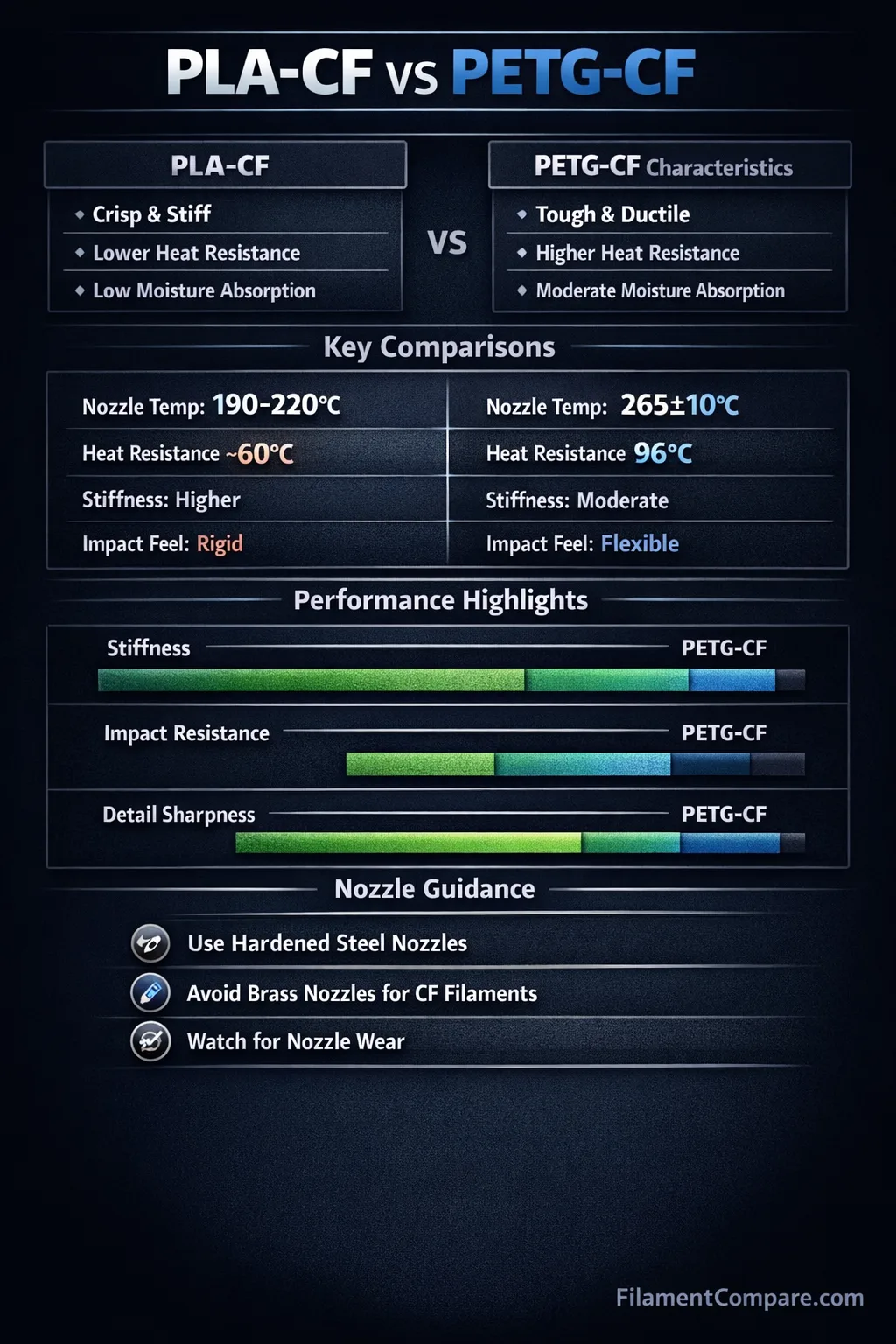
PLA-CF favors low-warp stiffness and clean dimensional detail, while PETG-CF is usually better suited to parts that need stronger layer bonding, moderate heat tolerance, and repeated handling. Both materials contain abrasive carbon fibers, so neither should be printed as though it were standard PLA or PETG. Fiber percentage, fiber length, resin formulation, moisture, print orientation, and nozzle condition can change the result noticeably.
Choose PLA-CF for rigid prototypes, dimensional fixtures, visual housings, light-duty brackets, and matte parts used mainly at room temperature.
Choose PETG-CF for functional mounts, guards, tool holders, brackets, and enclosures that need better interlayer performance or occasional exposure to moisture and moderate warmth.
Neither material is a direct replacement for PA-CF, PC-CF, PET-CF, or other higher-temperature engineering composites.
Best Choice by Printing Priority
Lowest-Warp Setup
PLA-CF
Its PLA base and carbon reinforcement usually produce stable geometry with limited corner lift.
Clean Matte Detail
PLA-CF
Sharp corners, lettering, shallow textures, and cosmetic surfaces are generally easier to control.
Stronger Layer Bonding
PETG-CF
The PETG base normally provides a more forgiving bond between printed layers.
Moderate Heat Exposure
PETG-CF
It normally retains useful shape and stiffness at higher temperatures than standard PLA-CF grades.
Repeated Handling
PETG-CF
It is usually the safer choice for mounts, holders, guards, and parts that are regularly installed or removed.
Tight Room-Temperature Geometry
PLA-CF
Lower shrinkage and reduced oozing can make small dimensional features easier to reproduce.
Open-Frame Printing
PLA-CF
Both can work without a heated chamber, but PLA-CF normally needs less environmental control.
Nozzle Wear Control
Neither
Both are abrasive and should be paired with wear-resistant extrusion hardware.
| Comparison Area | PLA-CF | PETG-CF | Better Choice |
|---|---|---|---|
| Material family | PLA-based composite with chopped or milled carbon fiber | Glycol-modified PET-based composite with chopped or milled carbon fiber | Depends on the part |
| Print difficulty | Easy to moderate | Moderate | PLA-CF |
| Typical nozzle temperature | Often around 190–230°C for standard grades | Often around 240–270°C | Printer-dependent |
| Typical bed temperature | Approximately 25–60°C | Approximately 60–70°C | PLA-CF for lower bed demand |
| Representative drying guidance | 55°C for 6 hours in one official 8% CF grade[a] | 65°C for 3 hours in one official 8% recycled-CF grade[b] | Both benefit from dry storage |
| Enclosure need | Usually not required | Usually not required, though draft control may improve large parts | PLA-CF |
| Warping tendency | Low | Low to moderate, depending on geometry and cooling | PLA-CF |
| Stringing and oozing | Usually limited after flow calibration | More likely when wet or printed too hot | PLA-CF |
| Stiffness | High, but strongly dependent on fiber loading and resin blend | High; some PETG-CF grades equal or exceed PLA-CF modulus | Grade-dependent |
| Layer adhesion | Moderate to good; orientation remains important | Usually stronger and more forgiving in the Z direction | PETG-CF |
| Impact behavior | Rigid and dimensionally stable, but thin stressed areas may fail abruptly | Usually more tolerant of handling, though carbon fiber reduces the ductility of standard PETG | PETG-CF for general functional use |
| Heat resistance | Common grades remain limited by the PLA base | Usually higher than PLA-CF, but below high-temperature engineering composites | PETG-CF |
| Representative HDT | About 50–54°C in the referenced PLA-CF grade | About 66–69°C in the referenced PETG-CF grade | PETG-CF |
| Moisture sensitivity | Lower in routine storage, though wet filament can still affect finish and extrusion | More likely to show stringing, bubbles, or inconsistent surfaces after moisture exposure | PLA-CF |
| Surface finish | Fine matte texture with strong layer-line masking | Matte technical texture with less gloss than standard PETG | Both |
| Dimensional accuracy | Usually easier for tight room-temperature tolerances | Good after flow, temperature, and shrinkage calibration | PLA-CF |
| Mild outdoor use | Limited by heat and long-term weather exposure | More suitable than PLA-CF for sheltered or occasional outdoor use | PETG-CF |
| Long-term UV exposure | Not automatically UV-stabilized | Not automatically UV-stabilized | Consider ASA-CF |
| Nozzle requirement | Wear-resistant nozzle recommended | Wear-resistant nozzle recommended | Tie |
| Typical applications | Prototypes, visual housings, jigs, fixtures, models, rigid indoor components | Mounts, guards, holders, brackets, enclosures, workshop parts | Use-case based |
| Main limitation | Lower thermal margin and less forgiving failure behavior | Higher printing temperature, greater moisture sensitivity, and more tuning | Different limitations |
Composite Material Profiles
PLA-CF Material Profile
- Polymer type: PLA-based carbon-fiber composite
- Print difficulty: Easy to moderate
- Nozzle range: Commonly around 190–230°C
- Bed range: Commonly around 25–60°C
- Enclosure: Normally unnecessary
- Drying need: Recommended after open storage or when surface quality declines
- Typical behavior: Rigid, low-warp, matte, dimensionally tidy
- Best use cases: Fixtures, visual prototypes, housings, rigid indoor components
PETG-CF Material Profile
- Polymer type: PETG-based carbon-fiber composite
- Print difficulty: Moderate
- Nozzle range: Commonly around 240–270°C
- Bed range: Commonly around 60–80°C, depending on grade
- Enclosure: Usually optional
- Drying need: Recommended before demanding or long prints
- Typical behavior: Rigid, matte, stronger between layers, more tuning-sensitive
- Best use cases: Brackets, mounts, guards, tool holders, functional enclosures
Relative Printing and Performance Indicators
What Carbon Fiber Changes in Each Polymer
PLA-CF and PETG-CF are not made from a universal “carbon-fiber filament” recipe. They remain PLA-based and PETG-based materials, with chopped or milled fibers dispersed through the polymer. The base resin still controls much of the heat response, layer bonding, moisture behavior, and failure pattern.
Carbon fibers commonly raise stiffness, reduce visible shrinkage, and create a matte surface that hides layer lines. They can also reduce flexibility. A part may feel more rigid in the hand without becoming more tolerant of shock, bending, screw pressure, or repeated flexing.
Fiber Content Matters
The matched reference products used for several numerical examples on this page both contain approximately 8% carbon fiber by weight. Even with similar fiber percentages, their measured properties differ because the PLA and PETG matrices, fiber treatment, additives, and manufacturing processes are not the same.
A higher carbon percentage does not automatically produce a better printed part. Excessive fiber loading can reduce melt flow, weaken layer interfaces, increase nozzle blockage risk, and make thin sections less forgiving.
Stiffness, Layer Strength, and Failure Mode
Both filaments are intended to feel rigid, but stiffness is only one form of mechanical performance. Tensile strength, bending stiffness, impact behavior, elongation, and Z-direction strength should be considered separately.
PLA-CF usually produces a firm and dimensionally stable part, which is useful for measurement fixtures, camera mounts, light-duty machine covers, and parts that should not flex during assembly. The same rigidity can concentrate stress around sharp corners, thin clips, countersunk holes, and overtightened fasteners.
PETG-CF is normally the more forgiving choice between printed layers. In the referenced 8% CF data pair, the PETG-CF grade reports much higher Z-direction tensile strength than the PLA-CF grade. That does not prove that every PETG-CF formulation will outperform every PLA-CF spool, but it illustrates why polymer family and layer orientation cannot be ignored.
Heat, Creep, and Shape Retention
Carbon fiber does not turn ordinary PLA into a high-temperature polymer. It can reduce printing shrinkage and raise rigidity, but the PLA matrix still begins losing useful stiffness at comparatively modest temperatures. A PLA-CF bracket that works well in a workshop may deform when continuously loaded near a heater, motor, sun-facing window, or warm enclosure.
PETG-CF usually has a wider thermal margin. Representative datasheets place common PETG-CF heat-deflection behavior above the compared PLA-CF grade, making it more suitable for moderate warmth. Hot vehicle interiors, engine compartments, heated machinery, and continuous high-load conditions can still exceed its practical range (especially when a thin part remains under tension).
Creep also matters. A material may survive a short temperature test but slowly bend when the same temperature and mechanical load are maintained for days or weeks. Thick walls, ribs, shorter unsupported spans, larger washers, and reduced fastener stress can be as important as changing filament.
Nozzle Wear, Drying, and Print Tuning
Carbon-filled filament continuously rubs against the nozzle bore. A standard brass nozzle may initially print well, then gradually enlarge and change extrusion width, dimensional accuracy, surface texture, and flow rate. Wear-resistant hardened steel, tungsten carbide, ruby-tipped, or manufacturer-approved composite nozzles are more suitable for regular use. Polymaker specifically recommends a hardened nozzle for its PETG-rCF08 formulation because of the material’s abrasiveness[c].
A 0.4 mm wear-resistant nozzle can handle many commercial PLA-CF and PETG-CF grades. A 0.6 mm nozzle often offers a wider flow path and a larger margin against partial clogs, particularly during long prints. Very small nozzles leave less clearance for fiber bundles; Bambu Lab does not recommend carbon-fiber-filled filament with its 0.2 mm nozzle[d].
PLA-CF Tuning Priorities
- Start with the manufacturer’s PLA-CF profile rather than a standard PLA preset.
- Check flow ratio before applying dimensional compensation.
- Use enough nozzle temperature for stable layer bonding.
- Keep cooling high enough for corners and overhangs, but reduce it if layers separate.
- Inspect small holes after several abrasive spools because nozzle wear can change extrusion width.
PETG-CF Tuning Priorities
- Dry the spool when stringing, bubbles, roughness, or weak extrusion appears.
- Use lower cooling than a typical PLA-CF profile.
- Reduce speed when layer adhesion declines on thick or tall parts.
- Calibrate retraction conservatively; excessive retraction can increase heat-creep or feed issues.
- Use an appropriate release layer when the selected PETG-CF adheres aggressively to a smooth build surface.
Surface Finish and Dimensional Control
PLA-CF often gives the cleaner cosmetic result with less effort. Fine layer lines blend into the matte surface, corners stay sharp, and embossed text remains readable. It is a practical option for instrument cases, display housings, control panels, inspection fixtures, and prototypes where appearance and geometry matter more than thermal margin.
PETG-CF removes much of the glossy appearance associated with standard PETG. The carbon texture masks small inconsistencies and can make functional parts look more uniform. Fine strings, travel marks, bridge sag, and small internal threads may still require more tuning than PLA-CF.
Application Recommendations
| Use Case | More Suitable Material | Reason |
|---|---|---|
| Cosmetic prototype | PLA-CF | Clean matte finish, sharp detail, and limited warping |
| Inspection or assembly fixture | PLA-CF | Stable geometry and easy room-temperature printing |
| Electronics housing in a cool indoor space | PLA-CF | Good detail and predictable dimensional behavior |
| Electronics housing near moderate warmth | PETG-CF | Higher thermal margin than ordinary PLA-CF grades |
| Wall-mounted tool holder | PETG-CF | Better fit for repeated loading and stronger interlayer performance |
| Rigid drill or marking jig | PLA-CF | High rigidity and tidy hole geometry (metal bushings may still be needed for wear) |
| Functional machine guard | PETG-CF | More forgiving layer bonding and better moderate-temperature fit |
| Camera or sensor bracket | Depends | PLA-CF favors precision; PETG-CF favors handling and thermal margin |
| Snap-fit clip | PETG-CF | Normally more suitable than PLA-CF, though unfilled PETG may flex better |
| Large flat presentation panel | PLA-CF | Lower warping tendency and cleaner surface detail |
| Sheltered outdoor bracket | PETG-CF | Better moisture and heat fit than PLA-CF; UV stability remains grade-dependent |
| Long-term sun-exposed component | Neither by default | ASA-CF or a verified UV-stabilized grade is usually more suitable |
| Hot vehicle interior fixture | Neither by default | PETG-CF is better than PLA-CF, but higher-temperature materials offer more margin |
| High-temperature machine fixture | Neither | Consider PET-CF, PC-CF, PA-CF, PPA-CF, or another verified engineering grade |
Where Each Composite Fits Better
Choose PLA-CF When
- The part will spend most of its life at room temperature.
- Low warping and clean dimensional detail are major priorities.
- A matte cosmetic surface is needed without extensive tuning.
- The component must remain rigid rather than flex under light load.
- The printer has an open frame and limited bed-temperature capability.
- The project is a prototype, jig, fixture, housing, or visual mechanical model.
PLA-CF Is Less Suitable When
- The part will remain under load in a warm environment.
- Repeated flexing or impact absorption is expected.
- The design contains thin snap arms or highly stressed layer interfaces.
- Long outdoor exposure is expected without verified UV stabilization.
Choose PETG-CF When
- The part needs better interlayer strength than a typical PLA-CF print.
- Moderate heat, occasional moisture, or repeated handling is expected.
- The project is a bracket, mount, guard, tool holder, or functional enclosure.
- A matte technical finish is desired without standard PETG gloss.
- The printer can maintain stable higher nozzle and bed temperatures.
- Some additional tuning is acceptable in exchange for a wider functional range.
PETG-CF Is Less Suitable When
- The cleanest small text, bridge, or surface detail is the first priority.
- The filament cannot be stored or dried properly.
- The printer’s hotend cannot sustain the required temperature safely.
- The part needs repeated elastic bending; unfilled PETG or another polymer may work better.
Material Selection Matrix
Choose PLA-CF if the main priorities are low warping, crisp geometry, matte appearance, stiffness, and simple printing for indoor or room-temperature use.
Choose PETG-CF if the part needs stronger layer bonding, better tolerance of handling, occasional moisture exposure, or a higher thermal margin.
Choose another composite if the part must survive long-term sunlight, hot vehicle interiors, continuous elevated temperatures, strong chemicals, heavy impact, bearing wear, or structural loads that require verified engineering data.
There is no universal winner. PLA-CF is normally the easier precision composite, while PETG-CF is normally the more versatile functional composite.
Common PLA-CF and PETG-CF Questions
Is PLA-CF stronger than PETG-CF?
Not in every sense. PLA-CF may feel very rigid and hold accurate geometry, while PETG-CF often has better layer strength and a wider functional temperature range. Tensile strength, stiffness, impact behavior, and Z-direction strength must be compared separately.
Does PETG-CF require an enclosure?
Many desktop PETG-CF grades can be printed without one. Draft protection may still improve layer consistency on large, tall, or slowly printed parts. Follow the spool manufacturer’s chamber guidance.
Can a brass nozzle print PLA-CF or PETG-CF?
It may extrude the material initially, but carbon fiber can wear the bore rapidly. A worn nozzle changes line width, flow, tolerances, and surface quality. A wear-resistant nozzle is the more suitable setup.
Is a 0.4 mm nozzle large enough?
It is suitable for many commercial carbon-filled grades when the manufacturer approves it. A 0.6 mm nozzle provides more clearance and may reduce partial-clog risk during long prints. A 0.2 mm nozzle is generally unsuitable for fiber-filled filament.
Which one is better outdoors?
PETG-CF is normally more suitable than PLA-CF for sheltered or occasional outdoor use because of its better heat and moisture fit. Neither should be assumed to have long-term UV stability unless the grade is specifically documented for it. ASA-CF is often a better candidate for exposed outdoor parts.
Can standard PLA and PETG profiles be reused?
They can provide a starting reference, but they should not be treated as finished profiles. Carbon fiber changes flow, cooling response, extrusion pressure, surface texture, and hardware wear. Begin with the filament manufacturer’s settings, then calibrate temperature, flow ratio, pressure advance, retraction, and cooling.
Technical References
- [a] PLA-CF | Polymaker Wiki (Used for representative PLA-CF nozzle and bed ranges, drying guidance, moisture absorption, thermal behavior, and mechanical test values. The figures describe PolyLite PLA-CF rather than every commercial PLA-CF formulation.)
- [b] Fiberon™ PETG-rCF08 | Polymaker Wiki (Used for representative PETG-CF print temperatures, drying conditions, heat-deflection values, tensile properties, and moisture data. The listed results apply to the documented 8% recycled-carbon-fiber grade.)
- [c] Fiberon™ PETG-rCF08 Product and Printing Recommendations (Used for the hardened-nozzle requirement, enclosure guidance, cooling recommendations, and official printing range for the PETG-CF reference material.)
- [d] Printing with 0.2mm Nozzles – Frequently Asked Questions | Bambu Lab Wiki (Used for the manufacturer warning that carbon-fiber-infused filament is not recommended with a 0.2 mm nozzle.)
