| Comparison Point | Nylon (PA) | ASA |
|---|---|---|
| Polymer Family | Polyamide (PA) | Acrylic Styrene Acrylonitrile (ASA) |
| Nozzle Temperature (°C, used range) | 220–250 | 260–280 |
| Bed Temperature (°C, used range) | 90–120 | 100–120 |
| Print Speed (mm/s, used range) | 30–60 | 30–60 |
| Glass Transition Temperature (°C) | 49 | 112 |
| Melting Temperature | 195–197 °C | Amorphous (no single melt point) |
| Heat Deflection Temperature (°C, HDT @ 1.8 MPa) | 57 | 92 |
| Heat Deflection Temperature (°C, HDT @ 0.45 MPa) | 113 | 101 |
| Printed Part Density (kg/m³) | 1115 | 1069 |
| Tensile Strength (MPa, ISO 527, XY) | 61.4 (dried) / 32.2 (conditioned) | 34.6 |
| Young’s Modulus (MPa, ISO 527, XY) | 2419 (dried) / 395 (conditioned) | 1828 |
| Elongation at Break (%, ISO 527, XY) | 9.6 (dried) / 143.3 (conditioned) | 4.5 |
| What That Usually Feels Like | From stiff (dry) to very ductile (conditioned) | stiff and dimensionally steady at higher temps |
ASA-side processing ranges and property numbers above are taken from an ASA filament technical data sheet for printed specimens. ✅Source
- Core Identity of Each Material
- Nylon (PA) as a Filament Material
- ASA as a Filament Material
- Processing Windows and Print Environment Reality
- Two Official Reference Points (Commonly Quoted)
- Mechanical Personality in Real Parts
- What “Conditioned vs Dried” Really Means for Nylon (PA)
- Moisture, Stability, and Surface Behavior
- UV and Long-Term Look
- Surface Finish and Post-Processing
- Where Each Filament Commonly Shows Up
- Nylon (PA) Common Application Patterns
- ASA Common Application Patterns
- A Clean Way to Read the Differences
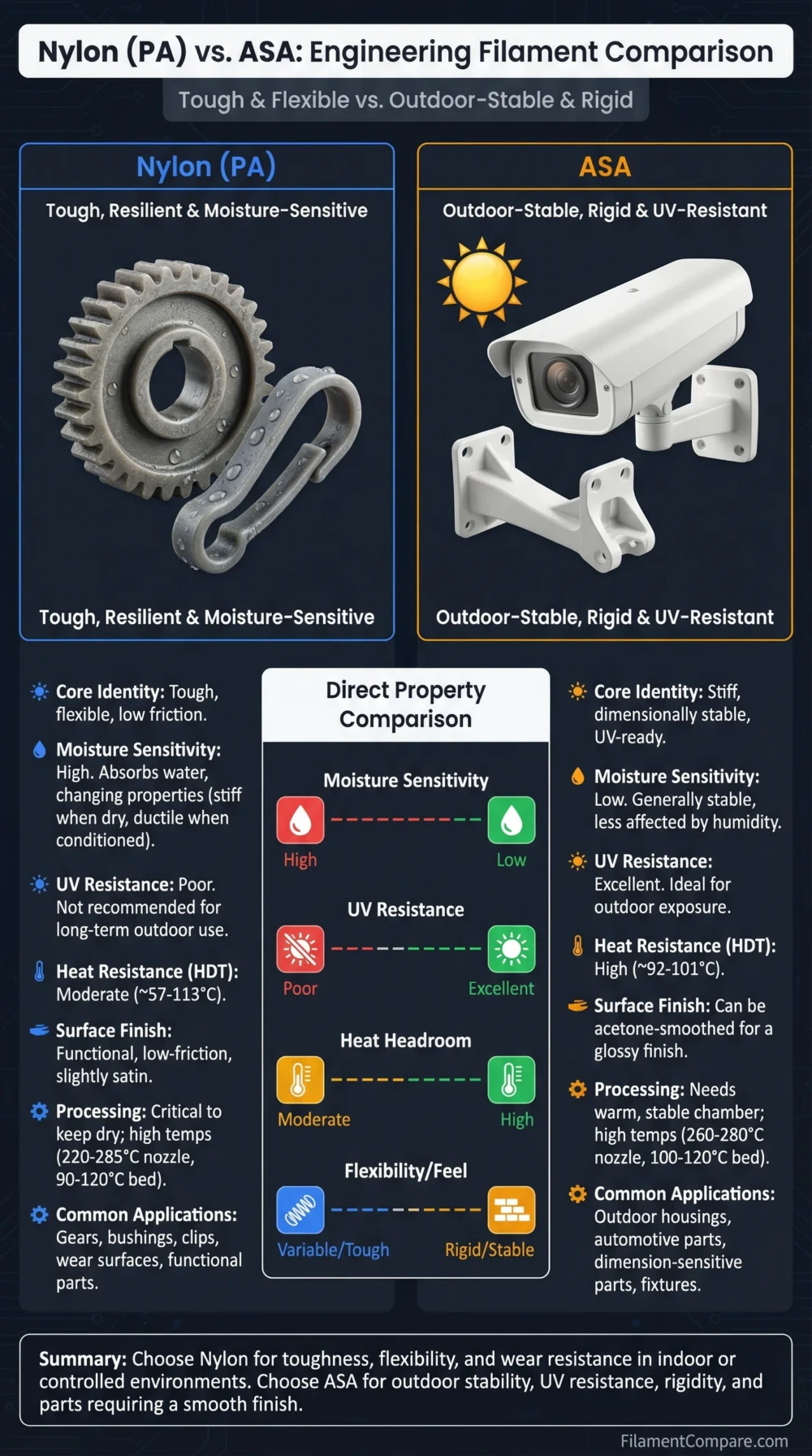
Nylon (PA) and ASA are both seen as engineering-grade materials and are often discussed alongside other engineering-grade 3D printing filaments. Yet they bring very different material behavior to the table. PA is famous for a “tough and flexible” feel that can shift a lot with moisture. ASA leans into outdoor stability, UV resistance, and a more shape-holding response under heat.
- Nylon (PA): Low Friction
- Nylon (PA): Wear-Friendly Surfaces
- Nylon (PA): Moisture-Responsive Feel
- ASA: UV-Ready Outdoors
- ASA: Higher-Temp Stability
- ASA: Acetone-Compatible Finish
Core Identity of Each Material
Nylon (PA) as a Filament Material
- Polymer Family
- Polyamide blends (often labeled PA6, PA12, PA, or “nylon”).
- Signature Feel
- tough, resilient, and often pleasantly slippery (low friction is a common reason it’s chosen).
- Behavior That Stands Out
- Moisture interaction can change the stiffness and ductility, sometimes dramatically.
ASA as a Filament Material
- Polymer Family
- Acrylic-styrene family (ASA), often discussed as a close relative to ABS.
- Signature Feel
- stiff, solid, and typically more dimensionally steady when temperatures climb.
- Behavior That Stands Out
- Outdoor-ready stability thanks to strong UV resistance and a reputation for holding appearance well outdoors.
Processing Windows and Print Environment Reality
Both Nylon (PA) and ASA typically live in the higher-temperature part of the FFF world, yet the environment story is different. ASA is widely associated with a warm, stable surrounding air to keep parts consistent at scale. PA often puts more emphasis on the state of the filament itself, because moisture can reshape outcomes.
Numbers in Context: The table above mixes processing ranges and measured properties taken from printed test specimens. That’s useful for comparison, and it also means brand, blend, and printer profile can move the needle.
Two Official Reference Points (Commonly Quoted)
- Polyamide (Nylon) reference settings are often quoted around 285 °C nozzle and 110 °C bed, and it’s openly described as hygroscopic (with storage affecting weight and behavior). ✅Source
- ASA reference settings are often quoted around 260 °C nozzle and 105–110 °C bed, with a commonly cited temperature resistance note (up to 93 °C) and a well-known acetone-compatible finish option. ✅Source
Mechanical Personality in Real Parts
Nylon (PA) usually gets described with words like tough, resilient, and forgiving under repeated motion. ASA often reads as more rigid and shape-holding, especially when parts are exposed to warmer conditions. If you look at the table, one detail jumps out: PA can shift from stiff to very ductile depending on conditioning, while ASA is more consistent in that same lens.
What “Conditioned vs Dried” Really Means for Nylon (PA)
In many PA datasheets, you’ll see separate rows for dried and conditioned specimens. That isn’t marketing fluff. It’s a direct clue that humidity can act like a material dial, changing stiffness and elongation in a way you can feel in functional assemblies.
Moisture, Stability, and Surface Behavior
Nylon (PA) is famously moisture-aware. It can absorb water from the air and that can shift the feel of a part from more rigid to more flexible. ASA is often described as partially moisture-absorbing, yet it’s generally discussed as more dimensionally steady over time in everyday indoor storage.
Relative Behavior Snapshot (visual cue, not a lab scale)
UV and Long-Term Look
ASA is widely talked about as an outdoor filament because of its UV stability and its ability to keep a clean surface appearance over time. Nylon (PA) is often selected for moving parts and wear surfaces; outdoor use is still possible, yet it tends to be discussed more in terms of grade, additives, and the environment it will live in.
Surface Finish and Post-Processing
If your focus is a clean surface with a glossy option, ASA is well known for acetone compatibility that can visually unify layer lines. Nylon (PA) more commonly leans into functional surfaces where a slightly satin texture and low friction matter more than shine.
Small Detail, Big Impact: When a part needs tight fit and repeatable geometry, people often talk about ASA. When a part needs movement, wear tolerance, or a springy feel, people often talk about Nylon (PA).
Where Each Filament Commonly Shows Up
Nylon (PA) Common Application Patterns
- Gears, bushings, and low-friction interfaces
- Clips and snap-like parts where resilience matters
- Wear surfaces where a smooth slide is helpful
- Functional parts that benefit from layer bonding and toughness
ASA Common Application Patterns
- Outdoor housings and fixtures where UV stability is valued
- Automotive-style brackets and covers needing heat tolerance
- Dimension-sensitive parts where shape hold matters
- Clean-finish parts that may benefit from acetone smoothing
A Clean Way to Read the Differences
- Outdoor exposure: UV and appearance stability are the headline for ASA.
- Moisture interaction: Nylon (PA) is known for a bigger property shift with humidity.
- Mechanical feel: PA often reads as more resilient; ASA often reads as more shape-holding.
- Thermal behavior: ASA is frequently associated with higher softening headroom.
- Surface options: ASA is well known for acetone finishing; PA is commonly valued for functional surfaces.
