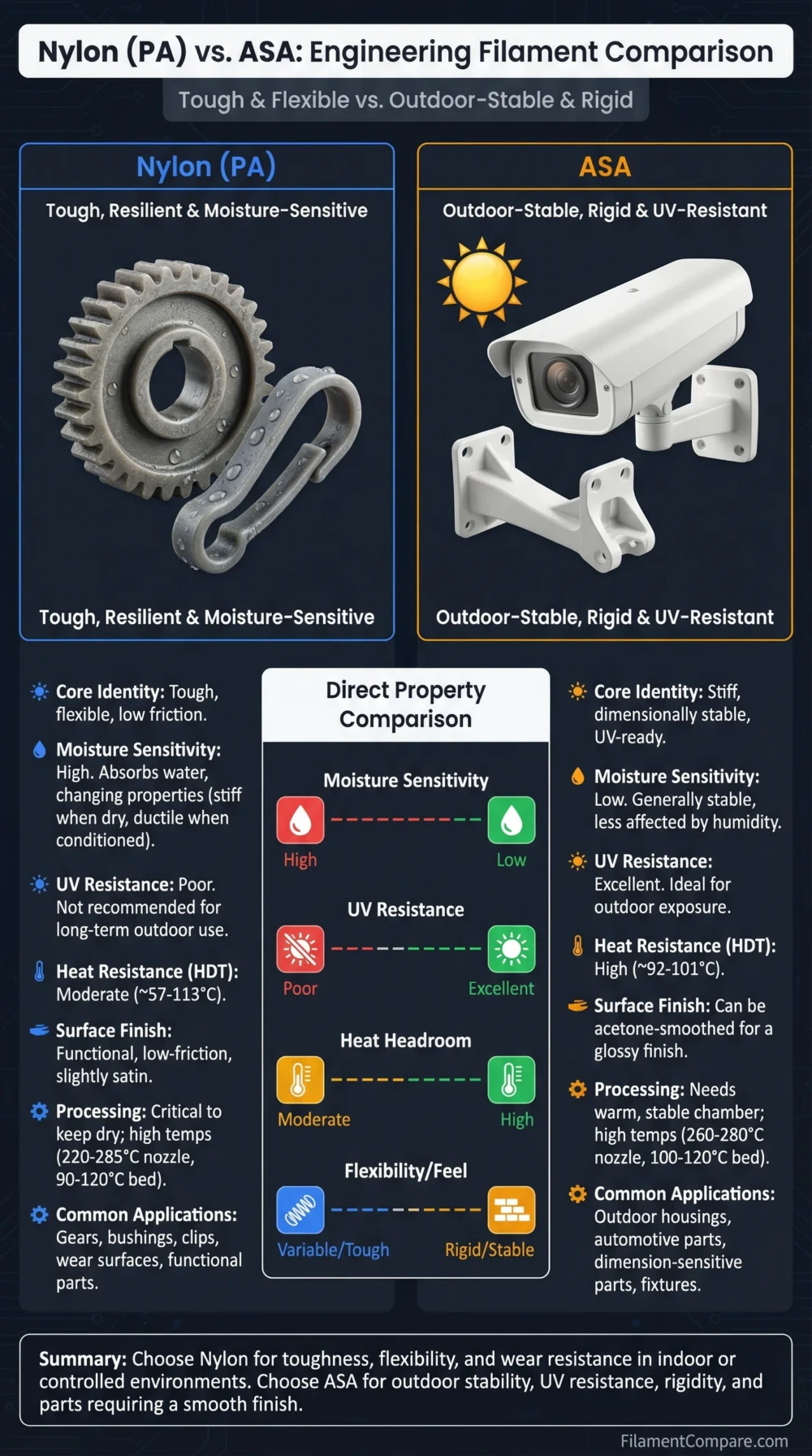
Nylon is usually the better choice for tough, wear-prone, moving, or impact-loaded parts, while ASA is usually the better choice for UV exposure, outdoor housings, and cleaner cosmetic prints. Nylon behaves more like an engineering material that rewards drying and tuning; ASA behaves more like a weather-resistant ABS alternative that rewards enclosure control. Choose between them by asking whether the part needs abrasion resistance and ductility or UV stability and exterior durability.
Choose Nylon for gears, bushings, hinges, clips, jigs, functional prototypes, and parts that need toughness with some flex. It is more demanding to store and print because moisture can quickly affect surface quality, layer bonding, and stringing.
Choose ASA for outdoor brackets, covers, enclosures, automotive-style trim, sun-exposed fixtures, and parts where UV resistance, heat tolerance, and a smoothable surface matter more than low-friction wear behavior.
Better for Outdoor Parts
ASA is the safer default because UV resistance is one of its main advantages.
Better for Wear Surfaces
Nylon fits sliding, rubbing, and low-friction applications better than standard ASA.
Better for Tough Clips
Nylon handles repeated bending and impact better when printed dry and oriented well.
Better for Clean Exterior Finish
ASA usually gives a cleaner hard-plastic look and can be acetone smoothed.
Better for Low Moisture Hassle
ASA is still partly hygroscopic, but it is usually less demanding than Nylon during storage and printing.
Better for Functional Fixtures
Nylon is often preferred for jigs and fixtures where toughness, fatigue behavior, and abrasion resistance matter.
Better for Heat and Sun Together
ASA is usually a better fit when moderate heat and outdoor exposure appear in the same part requirement.
Better for Low-Friction Motion
Nylon has the advantage for bushings, guides, and parts that rub against other surfaces.
| Property | Nylon | ASA | Better Choice |
|---|---|---|---|
| Material Family | Polyamide; common 3D printing types include PA6, PA12, PA6/66, and copolyamides | Acrylonitrile Styrene Acrylate; a styrenic engineering thermoplastic | Use-case based |
| Print Difficulty | Medium to high; very drying-sensitive | Medium to high; enclosure and warp control matter | ASA for storage ease; Nylon for tuned engineering workflows |
| Typical Nozzle Temperature | Usually about 240–280°C, grade-dependent | Usually about 250–270°C; Prusament ASA lists 260 ± 10°C in its TDS[a] | Similar hotend class |
| Typical Bed Temperature | Usually about 70–110°C, grade-dependent; some PA12 grades use hotter beds | Usually about 100–110°C; Prusa recommends 105°C first layer and 110°C after that for ASA[b] | Similar heated-bed need |
| Enclosure Requirement | Recommended for consistency, especially large PA parts | Recommended; more important on large, sharp-cornered, or flat parts | Both benefit |
| Heat Resistance | Grade-dependent; Ultimaker Nylon lists HDT at 0.455 MPa of 89.2 ± 5.6°C for printed samples[c] | Prusament ASA lists HDT of 93°C at 0.45 MPa and 86°C at 1.80 MPa[d] | Close; ASA often better for sun-exposed heat |
| Toughness | High; ductile behavior is a main reason to use Nylon | Good impact resistance, but less suited to low-friction wear than Nylon | Nylon |
| Stiffness | Moderate; standard Nylon can feel slightly flexible | Moderate to good; usually a harder, more rigid exterior part material | Depends on geometry |
| Layer Adhesion | Can be very good when dry; moisture can reduce consistency | Good, but warping stress can affect large prints | Both can perform well when tuned |
| Moisture Sensitivity | High; drying before and during printing is often needed | Lower than Nylon in typical handling, but still moisture-sensitive enough to store sealed | ASA |
| Surface Finish | Functional, sometimes slightly matte or textured; wet filament causes roughness and bubbles | Cleaner hard-plastic finish; can be sanded, glued, or acetone smoothed | ASA |
| Outdoor Suitability | Usable in some cases, but UV-stabilized grades should be chosen for longer exposure | Usually more suitable because ASA is known for UV and weather resistance | ASA |
| Typical Uses | Gears, bushings, clips, hinges, jigs, fixtures, impact-resistant functional parts | Outdoor covers, brackets, enclosures, trim, heat-exposed housings, weather-facing prints | Use-case based |
| Main Limitation | Moisture absorption, stringing, drying need, possible warping | Warping, odor, ventilation need, enclosure preference | Different limits |
This Nylon vs ASA comparison is based on manufacturer datasheets and official material guides, but real print results can shift with brand, PA type, ASA blend, color, additives, drying state, print orientation, enclosure temperature, and slicer settings.
Nylon Material Profile
- Polymer type: Polyamide, commonly sold as PA6, PA12, PA6/66, or modified copolyamide.
- Print difficulty: Medium to high; drying is part of the workflow, not an optional extra.
- Nozzle range: Usually 240–280°C, depending on the Nylon grade and printer profile.
- Bed range: Often 70–110°C; some PA12 and specialty blends need higher bed temperatures.
- Enclosure: Recommended for dimensional consistency and lower warp risk.
- Drying need: High. Wet Nylon often prints with stringing, popping, bubbles, rough surfaces, and weaker-looking layers.
- Typical behavior: Tough, ductile, wear-resistant, low-friction, and more flexible than many rigid filaments.
- Best use cases: Moving parts, clips, hinges, fixtures, tooling, bushings, and impact-loaded functional parts.
ASA Material Profile
- Polymer type: Acrylonitrile Styrene Acrylate, often used as a weather-resistant alternative to ABS.
- Print difficulty: Medium to high; warping control matters more than moisture control.
- Nozzle range: Usually around 250–270°C, with many profiles near 260°C.
- Bed range: Usually around 100–110°C.
- Enclosure: Recommended, especially for large parts and sharp corners.
- Drying need: Moderate. ASA should still be stored dry, but it is usually less demanding than Nylon.
- Typical behavior: UV-resistant, heat-tolerant, tough, sandable, acetone-smoothable, and prone to warp if ambient temperature is unstable.
- Best use cases: Outdoor brackets, enclosures, covers, fan shrouds, housings, and exterior cosmetic-functional prints.
The score bars are practical printing indicators, not fixed laboratory ratings. Brand formulation, PA grade, ASA blend, color, fiber additives, moisture level, layer direction, wall count, infill, cooling, and enclosure temperature can move the result.
Printability and Tuning Behavior
Nylon and ASA are both technical filaments, but they fail in different ways. Nylon usually becomes frustrating when it is not dry enough. The print may hiss, bubble, string heavily, show a fuzzy surface, or lose clean layer definition. ASA is more often affected by thermal stress: corners lift, large flat parts pull inward, and tall prints can split if the print chamber is too cool or drafty.
For Nylon, the first tuning step is usually filament drying. A dry box or active filament dryer can make a larger difference than small slicer changes. Retraction should be tuned after drying, not before, because wet Nylon can make a good retraction profile look wrong.
For ASA, the first tuning step is usually ambient temperature control. A stable enclosure, clean bed surface, controlled fan speed, brim, and conservative cooling help reduce warping. Ventilation should also be considered because ASA is a styrenic material and can produce noticeable odor during printing.
Mechanical Behavior and Wear
Nylon is often selected when a printed part needs to bend slightly instead of cracking. It is useful for snap-fit clips, cable guides, living-hinge-like features, functional brackets, and workshop fixtures. Its low-friction behavior also makes it a better match for bushings, sliding guides, and gears than standard ASA.
ASA is tough enough for many practical parts, but its strength profile is different. It behaves more like a rigid exterior-grade plastic. That makes it a good fit for covers, panels, housings, and brackets where shape retention and weather exposure matter more than repeated rubbing or flexing.
Print orientation still matters for both. A Nylon clip printed with layers across the flex zone can fail earlier than a better-oriented ASA part. A thick ASA bracket printed in a warm enclosure can outperform a damp Nylon part printed with weak interlayer bonding. Material choice helps, but part design still decides much of the result.
Heat, UV, and Weather Exposure
ASA is usually the safer pick for outdoor parts because UV resistance is part of its normal value proposition. It also handles moderate warmth better than PLA and many easy-print materials. For sun-exposed covers, garden fixtures, sensor housings, brackets, and exterior trim, ASA is often the more direct choice.
Nylon can handle heat well depending on the grade, but outdoor UV exposure is more grade-sensitive. Standard Nylon parts used outdoors may need a UV-stabilized formulation, paint, coating, or planned inspection. Nylon absorbs moisture from the environment as well, which can change dimensions and stiffness over time.
Neither material should be described as fully weatherproof in every situation. Long sun exposure, hot enclosures, chemical contact, mechanical load, and water exposure can change performance. For outdoor prints, ASA is normally the more predictable starting point; for moving outdoor parts, a UV-stabilized Nylon or a filled engineering grade may be worth testing.
Moisture, Drying, and Storage
This is one of the most practical differences. Nylon is strongly associated with drying because it absorbs moisture enough to affect print quality and part behavior. A spool that looked fine last week can print with rough surfaces and stringing after exposure to humid air.
ASA also benefits from dry storage, but it is usually more forgiving during normal handling. If the printer area is humid, store both materials in sealed bags or dry boxes with desiccant. For Nylon, printing directly from a dry box is often a better workflow than drying once and leaving the spool exposed during a long print.
Practical storage note: Nylon should be treated as a moisture-managed material. ASA should be treated as a warp-managed material. Both need care, but the source of trouble is not the same.
Surface Finish and Post-Processing
ASA usually wins for exterior appearance. It can produce crisp, hard-looking parts with a finish closer to injection-molded plastic than many Nylon prints. ASA can also be sanded and acetone smoothed, though smoothing can soften edges and reduce fine detail.
Nylon has a more functional look. Depending on the grade, it may print slightly matte, satin, or textured. When dry, it can look clean. When wet, it can look rough and fuzzy. Nylon is not the better choice when the main goal is a smooth, decorative exterior surface.
Printer Requirements
Hotend
Both materials usually need a hotend capable of around 260°C. Some Nylon grades go higher, so all-metal hotends are preferred for many PA workflows.
Build Plate
Nylon may need dedicated adhesives or engineering build surfaces. ASA often works well on PEI-style surfaces with a suitable release layer, depending on the printer.
Enclosure
ASA benefits strongly from an enclosure for warp control. Nylon also benefits, especially for larger or more dimensionally sensitive parts.
Filled Nylon and ASA Variant Notes
Carbon fiber or glass fiber changes this comparison. Nylon-CF and Nylon-GF are usually stiffer, more dimensionally stable, and easier to print cleanly than unfilled Nylon in some workflows, but they are abrasive and require a hardened nozzle. They may also lose some ductility compared with unfilled Nylon.
ASA can also be blended, modified, matte-finished, recycled, or filled. These variants can change stiffness, surface texture, impact behavior, and shrinkage. Do not assume that a generic Nylon vs ASA comparison replaces a product datasheet when the part has a load, temperature, or tolerance requirement.
| Use Case | More Suitable Material | Reason |
|---|---|---|
| Outdoor sensor housing | ASA | Better UV and weather fit for sun-exposed housings. |
| Sliding guide or bushing | Nylon | Better low-friction and wear behavior. |
| Snap-fit clip | Nylon | Better ductility and repeated flex behavior when printed dry. |
| Exterior bracket | ASA | Good match for UV exposure, moderate heat, and rigid shape retention. |
| Workshop jig | Nylon | Tough and abrasion-resistant for repeated handling. |
| Cosmetic enclosure | ASA | Cleaner surface and easier sanding or acetone smoothing. |
| Gear prototype | Nylon | Better wear resistance and toughness for contact surfaces. |
| Large flat panel | ASA with enclosure, or another lower-warp material | ASA can work, but large flat parts need careful warp control. |
| Humid storage workflow | ASA | Usually less drying-sensitive during ordinary handling. |
| Part exposed to rubbing and impact | Nylon | Better balance of toughness, ductility, and abrasion resistance. |
| Sun-exposed decorative trim | ASA | Better UV fit and surface finishing options. |
| Dimensionally controlled engineering part | Depends on grade | Filled Nylon, PA12, or well-tuned ASA may be needed depending on load and environment. |
Where Each Material Fits Better
Choose Nylon When
- The part needs toughness, ductility, or impact absorption.
- The part will slide, rub, flex, snap, or handle repeated movement.
- You can dry the filament properly before printing.
- You are printing jigs, fixtures, clips, hinges, bushings, or mechanical prototypes.
- A slightly flexible engineering feel is useful rather than a hard exterior shell.
Nylon Is Less Suitable When
- You cannot dry or store filament carefully.
- The part needs a clean cosmetic exterior with minimal tuning.
- The print will sit outdoors for long periods without a UV-stabilized grade or coating.
- You need tight dimensional consistency without testing the exact grade.
Choose ASA When
- The part will be used outdoors or near UV exposure.
- You need a rigid housing, cover, bracket, enclosure, or exterior component.
- You want a cleaner hard-plastic finish or acetone smoothing option.
- You have an enclosure and can manage warping on larger parts.
- The part needs moderate heat resistance plus better weather fit than easier-print materials.
ASA Is Less Suitable When
- The part needs low-friction sliding or high wear resistance.
- You cannot provide ventilation and a stable printing environment.
- The model is very large, flat, and sharp-cornered without enclosure control.
- The application needs repeated flexing where Nylon’s ductility is useful.
Choose Nylon if the part is mechanical, moving, impact-loaded, wear-prone, or needs some flex. It is the better material for functional durability when moisture is controlled.
Choose ASA if the part is outdoors, sun-exposed, cosmetic-functional, or needs a rigid shell with better UV fit. It is the better material for exterior housings and weather-facing prints.
No single overall winner applies. Nylon and ASA solve different problems: Nylon is the tougher wear material; ASA is the better outdoor shell material.
Common Nylon and ASA Questions
Is Nylon stronger than ASA?
It depends on what “stronger” means. Nylon is usually better for toughness, ductility, wear, and impact absorption. ASA is usually better for rigid outdoor parts where UV exposure and surface finish matter.
Is ASA easier to print than Nylon?
ASA is usually easier to store and keep dry, but it can warp. Nylon is often more moisture-sensitive, so it needs stricter drying and storage. Both are harder than PLA or PETG.
Can Nylon be used outdoors?
Yes, but standard Nylon is more grade-sensitive outdoors. For long sun exposure, use a UV-stabilized Nylon, a coating, or choose ASA when weather resistance is the main requirement.
Does ASA need an enclosure?
Small ASA parts may print without one on some machines, but an enclosure is strongly recommended for larger parts, sharp corners, and better dimensional consistency.
Which material is better for car interior parts?
ASA is often the more direct choice for rigid trim and covers because of heat and UV fit, but hot vehicle interiors can still exceed comfortable material limits. Test the exact print geometry and grade before relying on the part.
Which one needs more drying?
Nylon. ASA should still be stored dry, but Nylon typically needs more active drying control before and during printing.
Resources Used
- [a] Technical datasheet – Prusament ASA by Prusa Polymers — Used for ASA print temperature, bed temperature, density, HDT, moisture absorption, and mechanical reference values.
- [b] ASA | Prusa Knowledge Base — Used for practical ASA print settings, enclosure guidance, outdoor suitability, UV resistance, and ventilation notes.
- [c] Ultimaker Nylon Technical data sheet — Used for Nylon HDT, Vicat softening temperature, glass transition, tensile behavior, flexural values, impact data, and orientation notes.
- [d] Prusament ASA — Used for ASA material behavior, outdoor fit, heat resistance description, post-processing options, and printer requirement context.
