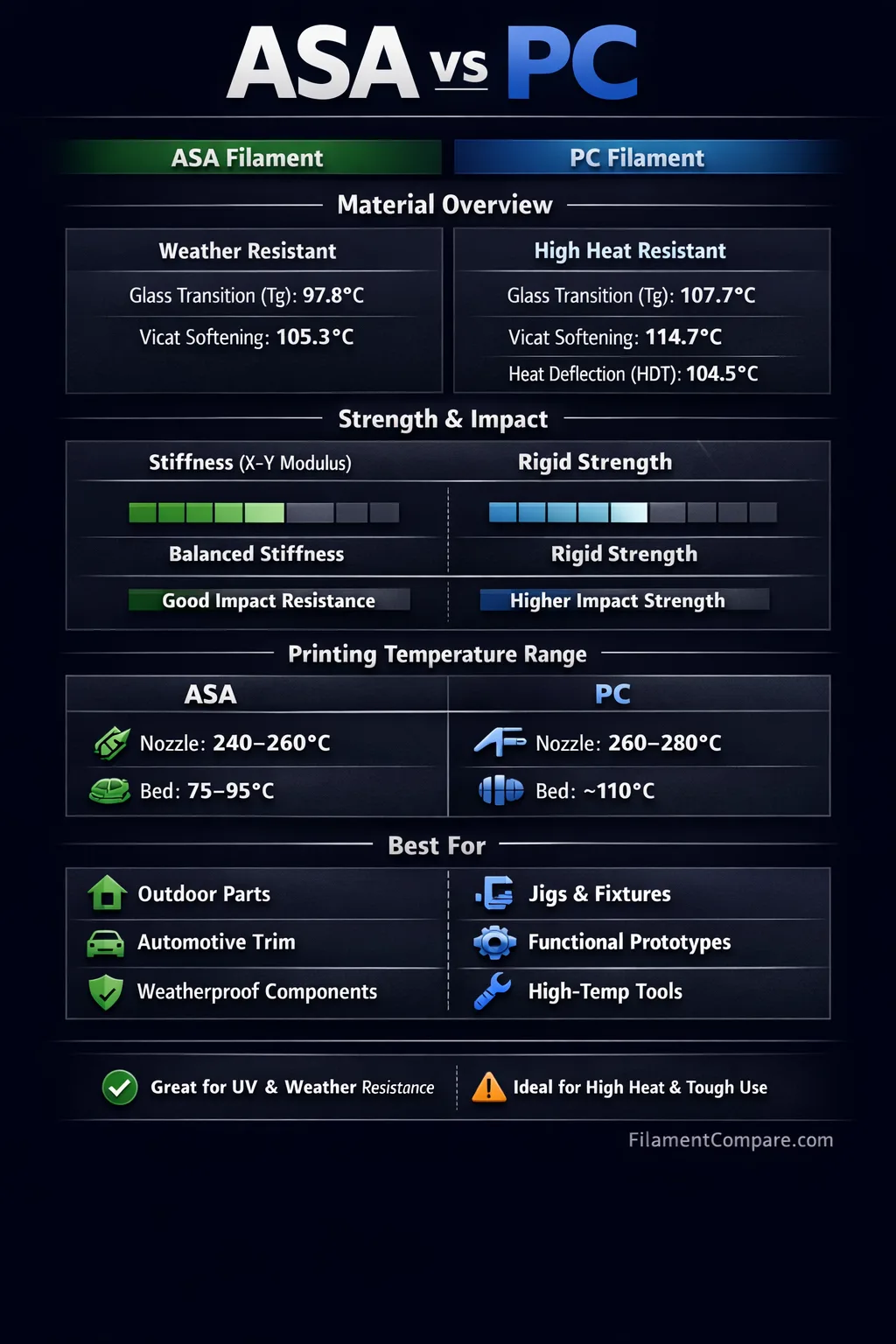
| Category | ASA | PC | What This Tells You |
|---|---|---|---|
| Polymer Family | Acrylic Styrene Acrylonitrile (ASA) | Polycarbonate (PC) | Basic chemistry influences weathering behavior, heat response, and impact profile. |
| Density | 1.10 g/cm³ | 1.18–1.20 g/cm³ | Mass per volume affects part weight and can slightly influence “feel” and inertia in moving assemblies. |
| Glass Transition (Tg) | 97.8 °C | 107.7 °C | Where the material shifts from glassy to rubbery-leaning behavior in many real conditions. |
| Vicat Softening | 105.3 °C | 114.7 °C | A practical “softening under load” signal for fixtures, housings, and warm environments. |
| Heat Deflection (HDT) | Not specified in this sheet | 104.5 °C | How a loaded bar deflects at temperature; helpful for functional parts that see warmth and stress. |
| Young’s Modulus (X–Y) | 2379 ± 157 MPa | 2394 ± 98 MPa | Stiffness in the printed plane; useful for panels, brackets, and dimensional hold. |
| Tensile Strength (X–Y) | 43.8 ± 0.8 MPa | Yield: 53.3 ± 1.2 MPa Break: 43.2 ± 1.5 MPa | Strength numbers depend on test definition (yield vs break) and print orientation. |
| Charpy Impact (Notched) | 10.3 ± 0.4 kJ/m² | 11.6 ± 1.4 kJ/m² | Quick signal for “shock handling” in real parts like clips, covers, and guards. |
| Typical Nozzle Range (Manufacturer Guide) | 240–260 °C | 260–280 °C | Printing window affects layer bonding and surface; exact sweet spot varies by setup. |
| Typical Bed Range (Manufacturer Guide) | 75–95 °C | ~110 °C | Bed heat supports flatness and adhesion for larger parts. |
ASA numeric values and recommended ranges above follow a typical ASA filament technical sheet example. ✅Source
- Material Identity and Base Behavior
- What “Amorphous” Means Here
- Thermal Benchmarks That Matter
- ASA Heat Signals
- PC Heat Signals
- Mechanical Profile in Printed Parts
- How the Numbers Usually Read
- Weathering and Outdoor Exposure
- Print Temperature Ranges as Information (Not a Recipe)
- Where the Temperature Difference Shows Up in Real Parts
- Use-Case Fit Without Guesswork
- ASA Common Fits
- PC Common Fits
- Decision Signals That Stay True Across Brands
PC numeric values above follow a typical PC filament technical sheet example with printed-sample testing notes. ✅Source
PC nozzle and bed temperature ranges are shown using an official material printing guidance page. ✅Source
Picking between ASA and PC is mostly about environment and temperature. ASA filament is widely chosen when weather exposure matters, while PC filament is often selected for parts that need a confident, engineering-style feel under heat and impact. Both can produce clean, professional parts, and both benefit from being treated as engineering-grade 3D printing filaments rather than “basic plastics.”
- ASA • outdoor-ready surfaces
- PC • heat-leaning functional parts
- Amorphous-style behavior in many grades
- Strong layer bonding focus
- Filament TDS matters most
Material Identity and Base Behavior
ASA is an acrylic-based styrenic polymer family that’s known for a stable-looking surface when used in outdoor-facing parts. In the filament world, ASA is often positioned as a “real-world ABS-style” option with weathering as a core reason people choose it.
PC is a polycarbonate family material associated with tough, engineering-leaning applications. In filament form, PC products frequently emphasize dimensional stability and heat resistance, with technical sheets often listing an amorphous profile (no clear melting point in DSC reporting for some grades).
What “Amorphous” Means Here
- Amorphous Polymer
- Not a crystal-forming plastic in the common “sharp melting point” sense; many grades soften across a range. This often supports clean detail and stable surfaces when dialed in.
- Tg (Glass Transition)
- The temperature zone where the material shifts toward softer behavior. It’s not a failure point, but it’s a useful threshold for functional expectations.
- Vicat Softening
- A practical measure for “when the surface starts to give” under a defined load and heating rate. Great for comparing everyday heat scenarios.
- HDT (Heat Deflection)
- Deflection under load at temperature; helpful for parts that must remain straight and true while warm.
Thermal Benchmarks That Matter
ASA Heat Signals
ASA Tg values in many filament technical sheets sit around the high double digits °C. A common example lists Tg 97.8 °C and Vicat 105.3 °C, which lines up with the way ASA is typically used for real-world enclosures and housings that see warmth but not extreme heat.
- Tg helps estimate when panels feel less rigid in warm air.
- Vicat helps anticipate surface “give” around heat sources.
- Printed orientation and infill still shape real performance.
PC Heat Signals
PC filament sheets often show a slightly higher thermal profile in the same reporting style. One example lists Tg 107.7 °C, Vicat 114.7 °C, and HDT 104.5 °C (at the stated load and method), which fits the common positioning of PC as a heat-leaning functional filament.
- Vicat is a handy comparison point for fixtures that may warm up.
- HDT is valuable when a part carries load while warm.
- Enclosure temperature and cooling strategy influence final stability.
Mechanical Profile in Printed Parts
Important context: many published numbers are measured on 3D printed specimens at defined settings. That’s useful, because it reflects real FFF behavior, yet it also means orientation, layer height, and cooling can shift results.
Stiffness Feel (X–Y Modulus) relative impression from typical sheets
Impact Handling (Notched Charpy) relative impression from typical sheets
Heat-Under-Load Confidence HDT/Vicat-informed, not a guarantee
How the Numbers Usually Read
- ASA often shows a balanced “stiff + practical” profile in printed samples, suitable for covers, mounts, and panels.
- PC is frequently presented as a confident choice for functional prototypes and tools, with strong interest in toughness and heat performance.
- In both materials, Z-direction strength (interlayer) can differ from X–Y, so sheet numbers should be read as context, not a promise.
Weathering and Outdoor Exposure
ASA is commonly described as a weatherable polymer with strong resistance to weathering and cosmetic change in outdoor use, which is why ASA filament shows up so often in parts like outdoor housings, trim-style components, and exterior covers. ✅Source
PC can also be used in outdoor-adjacent builds, and there are many stabilized and application-specific polycarbonate products in the broader plastics world. In filament form, readers typically treat PC filament as a functional material first, then validate outdoor expectations using the exact brand’s technical sheet.
Print Temperature Ranges as Information (Not a Recipe)
ASA printing ranges are often published around 240–260 °C at the nozzle and 75–95 °C at the bed, with many brands also mentioning a warm enclosed environment as part of consistent output. The point is simple: ASA likes steady warmth, and steady warmth helps surfaces stay clean and dimensions stay calm.
PC is typically published with a higher print-temperature window, such as 260–280 °C, and a bed that can sit around ~110 °C in official profiles. The value of this info is expectation-setting: PC lives in the engineering-temp zone and is often paired with a controlled build environment for best repeatability.
Where the Temperature Difference Shows Up in Real Parts
- Layer Bonding Behavior: both ASA and PC can form strong bonds, and the “feel” often changes noticeably inside their proper temperature window.
- Dimensional Confidence: steady heat during printing supports predictable geometry, especially on longer prints with thin walls.
- Surface Finish: these materials can look clean and professional; many users describe ASA as “exterior-friendly” and PC as “engineering-clean” when tuned.
Use-Case Fit Without Guesswork
ASA Common Fits
- Outdoor housings, covers, and enclosures where weathering matters.
- Automotive-style trims and exterior-looking parts where a stable finish is valued.
- Functional prototypes that need a reliable balance of stiffness and everyday durability.
PC Common Fits
- Jigs and fixtures where shape holding under warmth supports repeat work.
- Tooling and functional parts that benefit from a confident, engineering-style material profile.
- Light-transmitting concepts in grades that support translucent output and clean surfaces.
Decision Signals That Stay True Across Brands
- ASA usually gets selected when outdoor cosmetics and weather resistance are central to the part’s job.
- PC is often selected when heat-leaning function and an engineering feel are central to the part’s job.
- Read the TDS first: Tg, Vicat, HDT, and impact values are the cleanest “spec language” for comparing this brand to that brand.
- Orientation matters: if a sheet lists X–Y and Z values, that’s a practical window into layer-to-layer performance in real prints.
