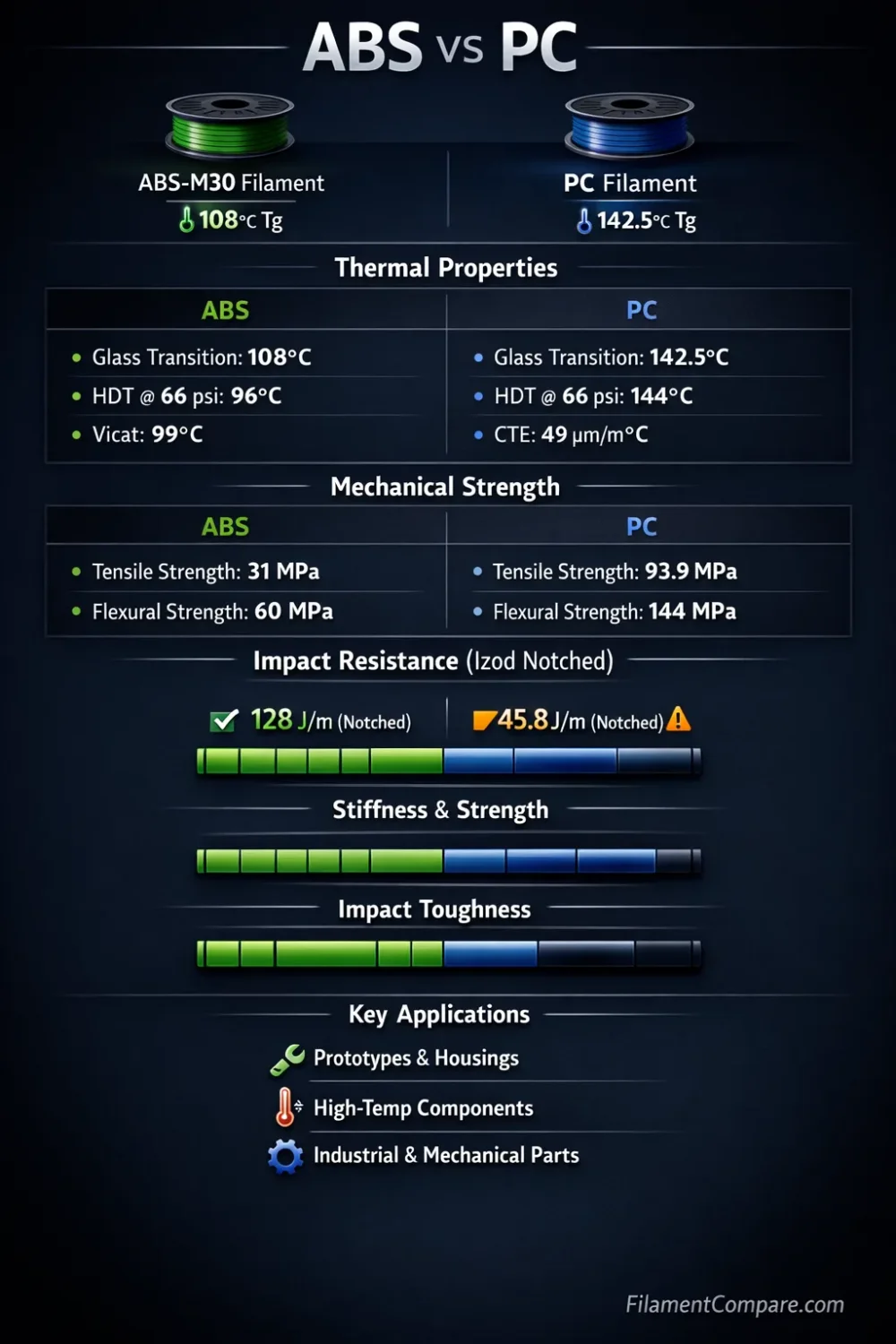
| Material (Filament-Grade Example) | Thermal Profile (Numbers That Define Heat Behavior) | Strength & Stiffness (Printed-Part Numbers) | Impact, Electrical, and Other Measured Values |
|---|---|---|---|
|
ABS-M30 Production-grade ABS filament example |
|
|
|
|
PC (Polycarbonate) FDM thermoplastic filament example |
|
|
|
Numbers in the table are documented values from specific filament-grade references. Real-world parts vary with printer, orientation, and test method.
- Material Identity and Polymer Behavior
- ABS Filament As a Practical Material
- PC Filament As a Practical Material
- Thermal Performance: Where The Heat Line Sits
- Mechanical Behavior: Strength, Stiffness, and Direction
- Impact Response and Durability Feel
- Moisture and Material Conditioning Notes
- Surface, Finish, and Detail Traits
- Electrical and Insulation Notes
- Common Use Profiles For ABS and PC
ABS and PC are both engineering-grade 3D printing filaments, so the conversation usually lands on heat behavior, mechanical response, and dimensional stability. The key difference is where each polymer “softens” in practical terms, which shows up through Tg, HDT, and Vicat rather than a sharp melting point for many common grades.
Material Identity and Polymer Behavior
ABS Filament As a Practical Material
ABS (acrylonitrile-butadiene-styrene) is commonly treated as an amorphous polymer family. That matters because softening is often described through Tg and HDT, while a single “melt point” can be not applicable for many grades. In filament form, ABS is valued for its balanced feel between stiffness and impact response.
PC Filament As a Practical Material
PC (polycarbonate) is typically positioned for parts that keep their shape at higher temperatures. That’s tied to a higher glass transition and strong printed-part results in many datasheets. PC also tends to get discussed in terms of thermal expansion and anisotropy, because printed strength depends on direction and orientation.
- Glass Transition (Tg)
- Tg marks the shift where an amorphous polymer transitions from glassy to more viscoelastic behavior. It’s a temperature region, not a magic on/off switch. ✅Source
- HDT (Heat Deflection Temperature)
- HDT is measured under a defined load and reports when a standard specimen reaches a specified deflection as temperature rises. It’s a comparative value, strongly linked to stiffness at heat. ✅Source
- Vicat Softening Temperature
- Vicat reports the temperature where a standardized indenter reaches a set penetration depth under a defined load. It’s often used alongside HDT to describe softening for polymers with no definite melt point.
Thermal Performance: Where The Heat Line Sits
PC generally sits higher on the temperature ladder because its Tg is typically higher than ABS in filament-grade references. That changes how parts feel near heat: shape holding, deflection under load, and expansion tend to show up sooner or later depending on where Tg lands.
Relative Visual ABS vs PC (qualitative)
These bars are a visual aid built around Tg/HDT positioning and typical engineering expectations, not a substitute for a datasheet.
One useful detail: PC filament is widely used in research-grade additive manufacturing studies where glass transition and mechanical behavior are measured on printed samples, which reinforces how central Tg and test method are when comparing polymers. ✅Source
Mechanical Behavior: Strength, Stiffness, and Direction
Both ABS and PC can show anisotropy because extrusion-based printing creates a layered structure. That’s why datasheets often publish values by orientation (like XZ and ZX). In practice, what people notice is the blend of stiffness, yield behavior, and impact response in the final part.
- ABS commonly reads as a balanced engineering choice where flexural strength and impact can sit in a comfortable middle zone.
- PC is frequently associated with higher strength and a firmer structural feel, especially in filament references where tensile values are reported by orientation.
- Orientation labeling matters: published values are tied to a defined build direction, so comparisons stay clean when the same test style is used.
Impact Response and Durability Feel
Impact tests like Izod describe how a material behaves when it meets a sudden hit. ABS is often appreciated for a tough and forgiving feel, while PC is commonly associated with high impact resistance as a material family. The interesting part is that printed results can differ by orientation and specimen type, so the most honest comparisons keep the same test format across both materials.
Moisture and Material Conditioning Notes
PC is commonly described as a polymer that can absorb moisture over time, and published resin property pages often include water absorption values. That matters because moisture can change melt behavior during extrusion, which can influence surface appearance and consistency. A reference polycarbonate resin property listing reports water absorption at 0.15% (24 hours) for one typical PC data set. ✅Source
Surface, Finish, and Detail Traits
Surface quality often becomes a story about flow, layer definition, and how the polymer transitions near Tg. ABS is widely known for being friendly to post-processing workflows like sanding and polishing, while PC is often described as a more rigid and clear polymer family in general plastics contexts. In filament form, both can deliver crisp geometry when the print system and settings are tuned for the material’s thermal behavior.
Electrical and Insulation Notes
Both materials are frequently treated as insulating plastics in many use cases, so datasheets often publish volume resistivity, dielectric values, and related measurements. For filament comparison, the practical takeaway is simple: electrical numbers can vary by grade and additives, and the cleanest reading comes from filament-grade datasheets that state the test method and conditions.
Common Use Profiles For ABS and PC
When people compare ABS and PC, the choice usually maps to what the part needs to “hold onto”: temperature, strength, or a certain feel in daily handling. Both materials show up across prototypes, fixtures, and functional parts, with the difference mainly driven by thermal margin and how the design loads the part.
- ABS is often associated with general engineering prototypes and parts where a tough response and clean post-processing are appreciated.
- PC is frequently associated with higher heat environments and parts where stiffness and strength are prioritized.
- PC blends and specialty ABS variants exist, so “ABS vs PC” can also mean comparing a standard family to a tuned formulation.
