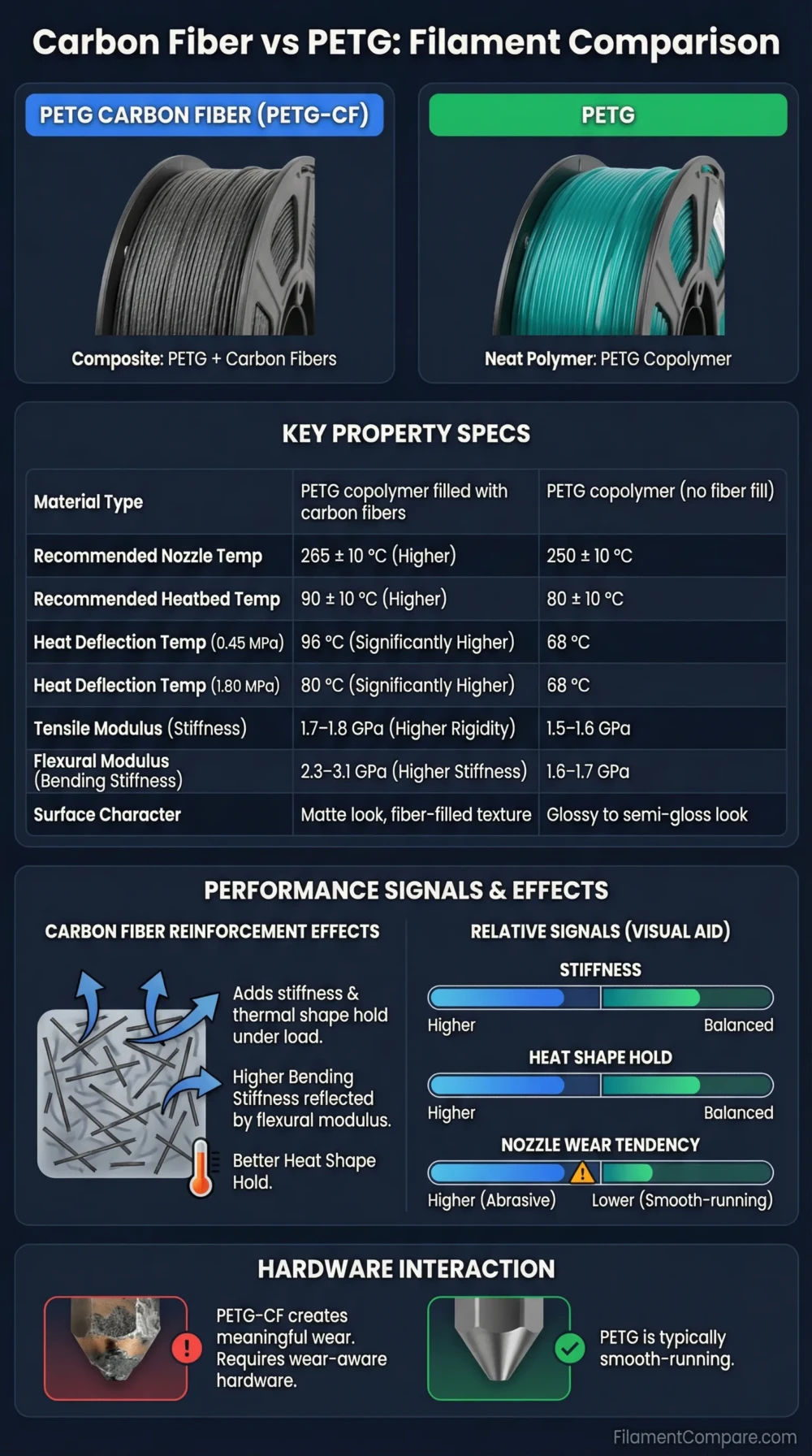
Carbon fiber filament is usually stiffer, lighter-feeling, more dimensionally stable, and more wear-intensive on the printer, while PETG is tougher, easier to print, less abrasive, and more forgiving for everyday functional parts. The right choice depends on whether the part needs rigidity and clean matte texture or ductility and simple printing. Carbon fiber blends are not one single material, so this comparison treats them as carbon fiber-reinforced FDM filaments, with PETG-CF used as the closest direct reference where useful.
Choose carbon fiber filament when you need higher stiffness, lower visible layer lines, reduced warping, and better dimensional stability in brackets, fixtures, drone parts, mounts, and engineering-looking prototypes.
Choose PETG when you need a tougher, less brittle, lower-cost, non-abrasive filament for general functional prints, containers, clips, guards, brackets, and parts that benefit from better layer bonding.
For most users, PETG is the safer daily material. Carbon fiber filament is the better fit when the printer is ready for abrasive material and the part benefits from stiffness more than flex or impact absorption.
Best for Beginners
PETG is easier to start with because it does not require a hardened nozzle and tolerates common desktop printer setups well.
Better Stiffness
Carbon fiber filament is the better choice when the part should resist bending under moderate load.
Better Layer Adhesion
PETG usually has strong interlayer bonding, which helps functional prints hold together under mixed stress.
Better Surface Texture
Carbon fiber filament gives a matte, technical surface that hides layer lines better than glossy PETG.
Better Nozzle Wear Control
PETG is the simpler option because standard brass or stainless nozzles are usually suitable.
Better for Snap-Fit Parts
PETG is usually more suitable for clips and snap features because it keeps more ductility than most carbon fiber-filled blends.
Better Dimensional Stability
Carbon fiber filament usually shrinks and warps less because the fibers help restrict movement as the polymer cools.
Better Low-Cost Utility
PETG is usually cheaper per spool and does not add the cost of hardened nozzles or abrasive-material maintenance.
| Category | Carbon Fiber Filament | PETG | Better Choice |
|---|---|---|---|
| Material Family | Composite filament: chopped carbon fiber in a base polymer such as PETG, PLA, PA, PC, ABS, or PET | Polyethylene terephthalate glycol-modified thermoplastic polyester | Depends on base polymer |
| Print Difficulty | Medium; abrasive, more sensitive to nozzle choice, drying, and flow tuning | Easy to medium; stringing and bed adhesion need tuning, but hardware demand is lower | PETG |
| Typical Nozzle Temperature | Usually about 240–280°C, depending on base polymer and grade; Prusament PETG-CF lists 265±10°C[a] | Usually about 220–260°C; many PETG grades sit around 230–250°C | Grade-dependent |
| Typical Bed Temperature | Usually about 70–100°C; PETG-CF examples often use around 80–100°C | Usually about 70–90°C | Similar |
| Enclosure Requirement | Not always needed for PETG-CF or PLA-CF; more useful for PA-CF, PC-CF, ABS-CF, and larger parts | Usually not required | PETG |
| Nozzle Requirement | Hardened steel, ruby, tungsten carbide, or another wear-resistant nozzle is strongly preferred because CF is abrasive | Standard brass or stainless nozzles are usually fine | PETG |
| Stiffness | Usually higher than the same base polymer without fiber | Moderate stiffness with useful ductility | Carbon fiber filament |
| Toughness | Varies; often stiffer but less flexible and sometimes lower in impact tolerance than the unfilled base material | Good toughness for common functional parts | PETG |
| Layer Adhesion | Can be lower than unfilled versions because fibers interrupt polymer continuity between layers | Usually strong, one of PETG’s main practical strengths | PETG |
| Heat Resistance | Often better than the same unfilled base polymer, but the base polymer still sets the main temperature limit | Moderate; UltiMaker lists PETG HDT at 76.2±0.8°C at 0.455 MPa for printed samples[b] | Grade-dependent |
| Moisture Sensitivity | Depends on base polymer; PA-CF is much more moisture-sensitive than PETG-CF or PLA-CF | Moderate; drying helps reduce stringing and surface defects | Depends on grade |
| Surface Finish | Matte, low-gloss, technical texture; hides layer lines well | Glossy to semi-glossy; can show stringing and reflections | Carbon fiber filament |
| Outdoor Suitability | Depends on base polymer; PETG-CF and ASA-CF fit outdoor use better than PLA-CF | Suitable for mild outdoor use, but UV exposure and heat still matter | Base-polymer dependent |
| Typical Uses | Jigs, fixtures, mounts, brackets, drone frames, RC parts, tool holders, technical prototypes | Functional prints, containers, brackets, guards, clips, printer parts, outdoor utility parts | Use-case based |
| Main Limitation | Abrasive, usually more expensive, less flexible, not ideal for tiny nozzles or very small detail | Stringing, glossy finish, moderate stiffness, can over-adhere to some build plates | Different limits |
This Carbon Fiber vs PETG comparison uses manufacturer material pages, datasheet-style values, and common FDM printing behavior; real results can shift with base polymer, fiber loading, color, moisture, nozzle size, orientation, and slicer profile.
Carbon Fiber Filament Profile
- Polymer type: Composite filament with chopped carbon fibers in a thermoplastic matrix.
- Print difficulty: Medium; hardware and drying matter more than with standard PETG.
- Nozzle range: Often 240–280°C for PETG-CF and similar blends, but PA-CF and PC-CF may need higher settings.
- Bed range: Commonly 70–100°C, depending on the base polymer.
- Enclosure: Optional for many PETG-CF blends; useful or needed for higher-temperature bases.
- Drying need: Recommended. Essential for nylon-based CF blends.
- Typical behavior: Stiff, matte, low-warp, abrasive, less flexible than the unfilled base polymer.
- Best use cases: Rigid fixtures, brackets, mounts, alignment tools, drone parts, functional prototypes.
PETG Material Profile
- Polymer type: PETG thermoplastic polyester for FDM/FFF printing.
- Print difficulty: Easy to medium; less beginner-friendly than PLA but easier than most engineering composites.
- Nozzle range: Usually about 220–260°C, depending on brand and speed profile.
- Bed range: Usually about 70–90°C.
- Enclosure: Usually not required.
- Drying need: Helpful when stringing, bubbling, or rough surface texture appears.
- Typical behavior: Tough, slightly flexible, good layer adhesion, low warping, glossy surface.
- Best use cases: General functional prints, brackets, containers, guards, printer parts, utility prototypes.
These bars are relative print-use indicators, not lab ratings. Brand, fiber loading, base polymer, moisture level, nozzle size, layer direction, infill pattern, and temperature tuning can move the result in either direction.
What Carbon Fiber Changes in a Filament
Carbon fiber filament is not pure carbon fiber. It is a thermoplastic filament filled with short chopped fibers. The base polymer still controls much of the behavior: PLA-CF behaves differently from PETG-CF, PA-CF, PC-CF, or ASA-CF. The carbon fibers mainly change stiffness, surface texture, shrinkage, and dimensional control.
The clearest benefit is rigidity. A carbon fiber-filled blend usually bends less than the same polymer without fiber. That makes it useful for brackets, measuring fixtures, alignment tools, camera mounts, RC parts, drone frames, and functional prototypes where flex would make the part feel loose or inaccurate.
The tradeoff is ductility. Fibers can make a print feel more rigid, but they may also reduce elongation and impact absorption compared with the unfilled base material. This matters for snap tabs, clips, hinges, press-fit parts, and parts that are dropped or twisted.
PETG’s Main Advantage Is Practical Toughness
PETG is popular because it sits between easy hobby materials and more demanding engineering plastics. It is tougher than PLA in many printed-part situations, has strong layer bonding, resists warping well, and does not usually need an enclosure. It also avoids the nozzle wear problem that comes with carbon fiber-filled materials.
For everyday functional prints, that balance is valuable. PETG can flex slightly before failure, which helps with guards, clips, brackets, cable guides, storage parts, printer accessories, and mild outdoor utility parts. It is not the stiffest material, and it can string if wet or printed too hot, but it is usually easier to troubleshoot than abrasive composites.
Practical note: PETG can bond strongly to smooth PEI, glass, or some coated plates. Use the build surface and release method recommended by the printer or plate maker to reduce the risk of surface damage.
Stiffness, Strength, and Impact Behavior
“Stronger” is too vague for this comparison. Carbon fiber filament is usually stronger in the sense of higher stiffness and better shape control. PETG is often stronger in the sense of tougher layer bonding and better ductility. A PETG part may bend and survive where a stiffer CF blend cracks or splits, especially across layer lines.
For load-bearing parts, print orientation can matter more than the material name. A carbon fiber bracket printed with the wrong layer direction can still fail along layer boundaries. A PETG bracket printed with better wall count, thicker sections, and the right orientation may outperform a poorly designed CF print.
Use Carbon Fiber for Rigidity
Choose it when the part must resist bending, stay flat, or hold alignment.
Use PETG for Toughness
Choose it when the part needs some flex, layer bonding, and damage tolerance.
Redesign Before Overbuying
Wall count, ribs, fillets, orientation, and infill pattern can improve either material.
Printability, Hardware, and Nozzle Wear
PETG can be printed on most modern FDM printers with a heated bed. It benefits from correct cooling, clean bed surface, tuned retraction, and dry filament. The main problems are stringing, blobs, and occasional over-adhesion.
Carbon fiber filament needs more care. The fibers are abrasive and can wear a brass nozzle quickly. A hardened steel, tungsten carbide, ruby, or similar wear-resistant nozzle is the normal choice. Many CF blends also work better with a 0.4 mm or 0.6 mm nozzle, while very small nozzles are more clog-prone.
Because fibers change melt flow, carbon fiber filaments often need slower speeds, adjusted flow rate, and careful pressure advance or linear advance tuning. The reward is a cleaner matte surface and lower visible warping, but the setup is not as simple as loading standard PETG.
Heat Resistance and Outdoor Use
Carbon fiber can improve heat behavior compared with the same unfilled base polymer, but it does not turn a low-temperature polymer into a high-temperature one. PLA-CF still has PLA-like heat limits. PETG-CF is closer to PETG. PA-CF and PC-CF can handle more demanding thermal use, but they need more capable printers.
Standard PETG has moderate heat resistance for functional prints, but hot enclosed spaces can still exceed its comfort range. For parts exposed to sun, heat, and weather, PETG can work for mild outdoor use, while ASA, ASA-CF, PC-CF, or UV-stabilized grades may be better choices for longer exposure.
Carbon Fiber Variant Notes
- PLA-CF: Easier to print, stiff, matte, but still limited by PLA-like heat behavior.
- PETG-CF: Good middle ground: stiffer and cleaner-looking than PETG, but more abrasive and less ductile.
- PA-CF: Better for engineering stiffness and toughness, but moisture control and printer capability matter much more.
- PC-CF: Higher heat potential, but usually needs high nozzle temperature, enclosure control, and careful setup.
Surface Finish, Detail, and Dimensional Accuracy
Carbon fiber filament usually wins on visual texture. The matte finish reduces shine and hides layer lines, giving prototypes and fixtures a more technical look. It is useful when the part should look refined without sanding or painting.
PETG is more glossy and can show fine strings or small blobs if retraction, cooling, temperature, or drying is not tuned. It can still produce clean parts, but it does not hide surface defects as well as a carbon fiber blend.
For dimensional accuracy, carbon fiber-filled materials often have an edge because the fiber content reduces shrinkage and curling. That helps with flat brackets, tool holders, jigs, and fixtures. PETG is still stable enough for many functional parts, especially when wall thickness and cooling are controlled.
Moisture, Storage, and Drying
Both materials can benefit from drying, but the level depends on the exact filament. PETG absorbs enough moisture to cause stringing, popping, rough walls, and weak-looking extrusion. Drying the spool often improves print quality more than changing retraction settings repeatedly.
Carbon fiber filament inherits moisture behavior from its base polymer. PETG-CF needs similar care to PETG. PA-CF needs stricter drying and sealed storage. If the spool is nylon-based, printing from a dry box is often a better workflow than drying once and leaving it exposed.
| Use Case | More Suitable Material | Reason |
|---|---|---|
| Beginner functional prints | PETG | Lower hardware demand and no abrasive nozzle requirement. |
| Rigid brackets and mounts | Carbon fiber filament | Higher stiffness helps the part resist bending under moderate load. |
| Clips and snap-fit features | PETG | Better ductility is usually safer for parts that flex during assembly. |
| Jigs and fixtures | Carbon fiber filament | Lower warping and better dimensional control help alignment surfaces stay accurate. |
| Containers and utility boxes | PETG | Good toughness, easier printing, and lower cost suit everyday utility prints. |
| Matte technical prototypes | Carbon fiber filament | The fiber texture hides layer lines and gives a clean low-gloss finish. |
| Printer parts | PETG | Reliable layer adhesion and moderate heat resistance make PETG a common choice for printer components. |
| Drone or RC frames | Carbon fiber filament | Stiffness-to-weight behavior is useful when flex must be reduced. |
| Parts printed with a brass nozzle | PETG | Carbon fiber-filled filament can wear brass nozzles quickly. |
| Large flat parts | Carbon fiber filament | Fiber reinforcement can reduce curling and improve flatness. |
| Impact-prone guards | PETG | PETG’s ductility can absorb knocks better than many stiff CF blends. |
| Outdoor utility parts | PETG or PETG-CF | Both can work for mild outdoor use, but UV, heat, and color choice still matter. |
Choose Carbon Fiber Filament When
- The part needs higher stiffness than standard PETG.
- You want a matte surface that hides layer lines.
- Dimensional stability matters more than flexibility.
- The printer has a hardened or wear-resistant nozzle.
- You are printing jigs, fixtures, mounts, drone parts, brackets, or technical prototypes.
- You can dry the filament and tune flow, speed, and retraction.
Carbon Fiber Is Less Suitable When
- You only have a brass nozzle and do not want nozzle wear.
- The part needs repeated flexing, snap-fit movement, or hinge-like behavior.
- You need transparent, glossy, or bright-color parts.
- You print tiny details with a small nozzle.
- Low spool cost matters more than stiffness or finish.
Choose PETG When
- You want a reliable functional filament for daily use.
- The part benefits from toughness and strong layer bonding.
- You need clips, guards, containers, brackets, covers, or printer parts.
- You want to print with standard nozzles and a heated bed.
- You prefer lower material cost and easier replacement parts.
- You need slightly flexible behavior rather than maximum stiffness.
PETG Is Less Suitable When
- The part must be very rigid under load.
- You need a matte engineering texture without post-processing.
- Stringing would be hard to clean from the model geometry.
- The part will sit in hot environments near PETG’s softening range.
- You need the lower shrinkage behavior of a fiber-filled blend.
Best Settings Range
Settings vary by brand, but these ranges are a useful starting point before checking the spool label or manufacturer profile.
| Setting | Carbon Fiber Filament | PETG |
|---|---|---|
| Nozzle | Hardened 0.4 mm or 0.6 mm; 0.6 mm reduces clog risk with some blends | Brass, stainless, or hardened 0.4 mm works for most prints |
| Nozzle Temperature | Usually 240–280°C for PETG-CF-style blends; higher for PA-CF or PC-CF | Usually 220–260°C |
| Bed Temperature | Usually 70–100°C | Usually 70–90°C |
| Cooling | Low to moderate, depending on base polymer and overhangs | Low to moderate; too much cooling can reduce layer bonding |
| Speed | Moderate; abrasive and fiber-filled materials often need stable flow rather than maximum speed | Moderate to fast, depending on high-flow formulation and printer capability |
| Drying | Recommended; essential for PA-CF | Recommended when stringing or rough extrusion appears |
| Build Plate | Textured PEI, satin PEI, engineering plate, or adhesive layer depending on base polymer | Textured or satin PEI often works well; use release aid if the plate maker recommends it |
Material Selection Matrix
Choose carbon fiber filament if the part needs stiffness, flatness, clean matte texture, reduced warping, and a more technical look. It is the better fit for mounts, jigs, fixtures, drone parts, RC parts, alignment tools, and rigid brackets when the printer has a wear-resistant nozzle.
Choose PETG if the part needs toughness, layer adhesion, slight flex, lower cost, and simple hardware compatibility. It is the better fit for daily functional prints, clips, containers, guards, printer parts, and general utility components.
Neither material replaces the other. PETG is the practical default; carbon fiber filament is the more specialized option when stiffness and dimensional control are worth the added setup and nozzle wear.
Carbon Fiber vs PETG Questions
Is carbon fiber filament stronger than PETG?
It depends on what “stronger” means. Carbon fiber filament is usually stiffer and more dimensionally stable. PETG is usually tougher and more ductile, especially for parts that flex or take impact.
Is PETG-CF better than regular PETG?
PETG-CF is better for stiffness, matte texture, dimensional stability, and reduced stringing in many cases. Regular PETG is better for toughness, snap-fit behavior, lower cost, and printer friendliness.
Do you need a hardened nozzle for carbon fiber filament?
Yes, a wear-resistant nozzle is strongly recommended. Carbon fiber-filled filament is abrasive and can wear brass nozzles quickly, which changes extrusion width and print quality.
Can a normal printer print carbon fiber filament?
Many printers can print PETG-CF or PLA-CF after a hardened nozzle upgrade. Higher-temperature blends such as PA-CF or PC-CF may need higher nozzle temperature, better drying, and an enclosure.
Is carbon fiber filament lighter than PETG?
Carbon fiber-filled parts can feel efficient for stiffness-to-weight designs, but spool density and final part weight depend on the base polymer, fiber loading, walls, infill, and slicer settings. It is better to judge by stiffness-to-weight, not filament name alone.
Which is better for outdoor parts, carbon fiber or PETG?
PETG and PETG-CF can both work for mild outdoor utility parts. For long UV exposure, high heat, or weather-critical parts, ASA, ASA-CF, PC-CF, or UV-stabilized grades may be more suitable depending on the requirement.
Resources Used
- [a] Prusament PETG Carbon Fiber (Used for PETG-CF print setup, hardened nozzle requirement, dimensional stability, stiffness, matte surface, and Prusa’s stated comparison against regular PETG.)
- [b] PETG 3D printing material – UltiMaker (Used for PETG material properties, including printed-sample mechanical data and HDT reference in the main comparison table.)
- [c] Carbon Fiber (CF) Reinforced Filament – Raise3D (Used for the definition of CF-reinforced filament, typical benefits such as high stiffness, lower warpage, dimensional stability, and hardened nozzle guidance.)
- [d] Raise3D Hyper Speed PETG CF Filament – RFID (Used for PETG-CF positioning, recycled carbon fiber loading example, surface finish notes, and PETG-CF use-case context.)
