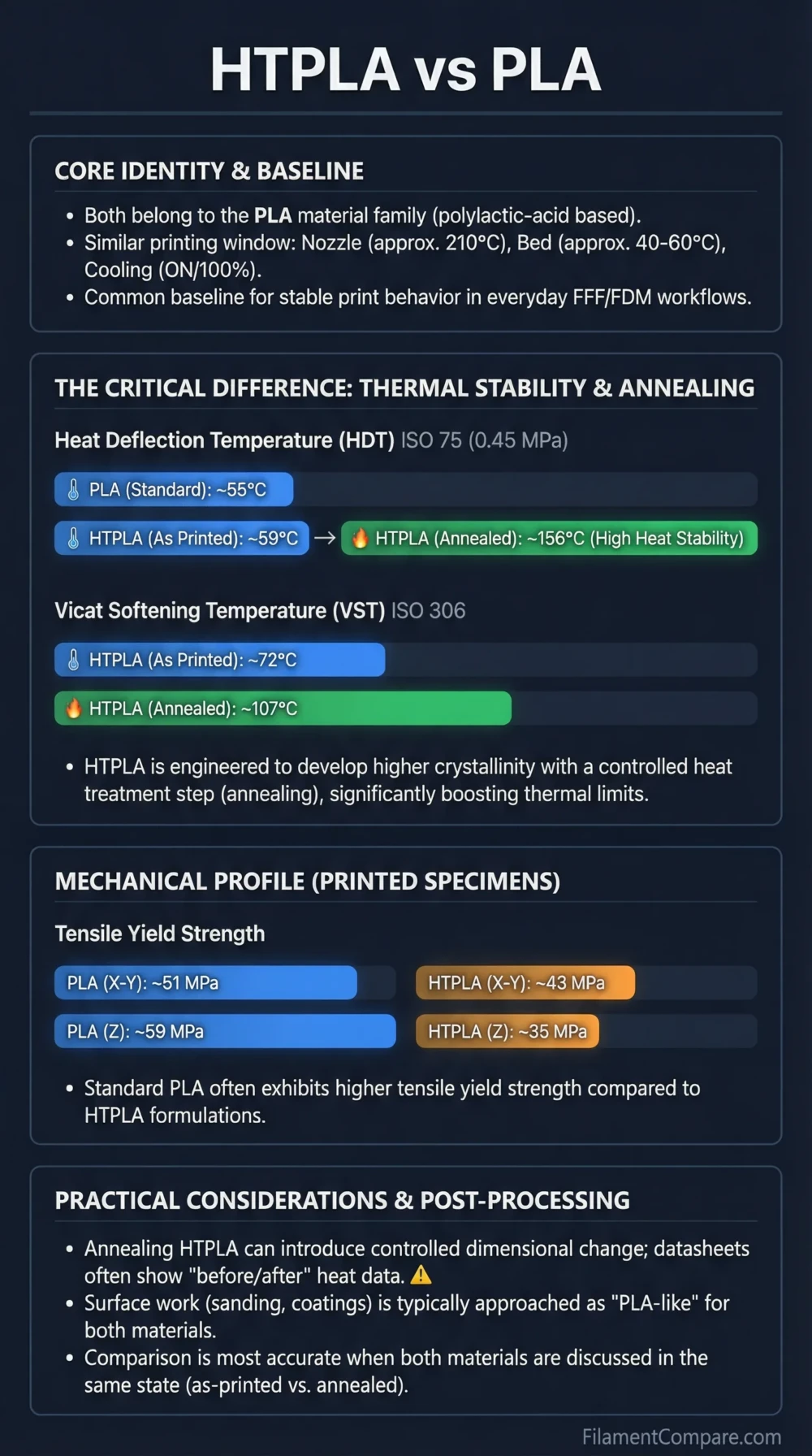
HTPLA is a heat-treatable PLA variant made for better temperature resistance after annealing, while standard PLA is simpler, cheaper, and more predictable for everyday prints. Both belong to the PLA family, so they can feel similar on the printer, but they are not aimed at the same job. Newer HTPLA grades also show that heat-focused PLA does not always have to trade away impact durability. Choose PLA for easy models and prototypes; choose HTPLA when the part may see moderate heat and you are willing to manage the annealing step.
Choose PLA for beginner-friendly printing, visual models, prototypes, miniatures, and low-warp parts where heat exposure is not part of the job.
Choose HTPLA when you want PLA-like printability with improved shape retention after heat treatment. It is the better fit for brackets, jigs, tool organizers, fixtures, and warm-environment parts where standard PLA may soften too early. Tougher newer grades, including Polymaker HT-PLA Pro, also target better impact and fatigue behavior than earlier heat-focused PLA formulations.
There is no single winner for every print. PLA is the easier daily material; HTPLA is the more heat-focused option when annealing, shrinkage, and dimensional change are acceptable trade-offs.
Best for Beginners
PLA is the safer first choice because it needs less tuning, usually prints with low warp, and does not require post-print heat treatment.
Better Heat Tolerance
HTPLA has the advantage after annealing. Some grades are designed to keep useful shape at temperatures where normal PLA begins to soften.
Better for Visual Models
PLA usually offers the widest color range, matte/silk options, clean detail, and easy surface quality without extra processing.
Better for Warm Fixtures
HTPLA is more suitable for workshop jigs, tool holders, and light-duty fixtures that may see warmth but not heavy continuous load.
Better for Tight Tolerances
PLA is usually easier to size accurately because annealed HTPLA can shrink or distort unless the part is planned for that process.
Better for Low-Warp Printing
PLA and many HTPLA grades both print with low warp, but PLA wins when the goal is predictable dimensions straight off the build plate.
Better for Post-Annealed Parts
HTPLA is made for heat treatment. Standard PLA can be annealed in some cases, but HTPLA grades are usually formulated for that workflow.
Better for Nozzle Wear Control
PLA and non-filled HTPLA are usually non-abrasive. Fiber-filled HTPLA variants are different and may require a hardened nozzle.
| Category | HTPLA | PLA | Better Choice |
|---|---|---|---|
| Material Family | PLA-based, heat-treatable semi-crystalline formulation | Standard polylactic acid thermoplastic polyester | Both are PLA-family materials |
| Print Difficulty | Usually easy, similar to PLA, but post-processing adds complexity | Very easy for most FDM printers | PLA |
| Typical Nozzle Temperature | Usually about 190–235 °C depending on grade and printer[a] | Usually about 190–230 °C; many profiles sit near 210–215 °C[b] | Similar |
| Typical Bed Temperature | Usually around 50–70 °C, though some grades can print on lower bed heat | Usually around 50–60 °C, and some machines can print it without strong bed heat | Similar |
| Enclosure Requirement | Usually not required for printing; controlled annealing is separate | Usually not required | Similar |
| Heat Resistance | Better after annealing; the metric matters. Polymaker HT-PLA Pro lists 107.6 °C HDT at 0.45 MPa after annealing, while its annealed Vicat value is higher and should not be treated as the same test[h] | Lower; many PLA grades soften or deform near warm-environment temperatures | HTPLA |
| Toughness | Grade-dependent; newer products such as HT-PLA Pro are formulated to improve impact and repeated-load durability while retaining heat-focused behavior[i] | Often stiff but can fracture rather than flex under impact | Grade-dependent |
| Stiffness | Usually stiff; annealing can improve shape retention but may change dimensions | Stiff and crisp, useful for models and dimensionally stable prototypes | Similar before heat exposure |
| Layer Adhesion | Usually PLA-like, but brand and annealing behavior matter | Good enough for models; weaker than tougher engineering filaments in impact-loaded parts | Similar |
| Moisture Sensitivity | Similar to PLA in many grades; drying can help older or stringy spools | Moderate sensitivity; wet PLA may string, pop, or lose surface quality | Similar |
| Surface Finish | Clean PLA-like finish; translucent grades may turn opaque after heat treatment | Clean detail, broad color range, many finish variants | PLA |
| Outdoor Suitability | Better heat fit than PLA after annealing, but not automatically UV/weather resistant | Less suitable for long outdoor use due to heat and UV limits | HTPLA for heat, neither for long UV exposure |
| Typical Uses | Warm jigs, tool mounts, light fixtures, shop parts, annealed brackets | Prototypes, miniatures, toys, display parts, visual models, low-load brackets | Use-case based |
| Main Limitation | Heat-focused performance is grade- and test-dependent; annealing can also cause shrinkage or distortion | Lower heat resistance; not ideal near hot cars, heaters, or sun-warmed surfaces | Different limits |
This HTPLA and PLA comparison uses manufacturer material pages, technical data sheets, and printer material guides; the values describe common trends, while real results can change with brand, color, additives, moisture, part geometry, annealing process, and slicer settings.
HTPLA Material Profile
- Polymer type: PLA-based heat-treatable formulation, often designed to crystallize after annealing.
- Print difficulty: Easy to moderate; printing is PLA-like, but final performance depends on post-print heat treatment.
- Nozzle range: Usually about 190–235 °C, grade-dependent.
- Bed range: Often around 50–70 °C; some grades print with standard PLA-style profiles.
- Enclosure: Usually not required for printing.
- Drying need: Not as demanding as nylon, but dry filament gives cleaner extrusion and less stringing.
- Typical behavior: Low warp when printed, better thermal shape retention after annealing, possible shrinkage during heat treatment.
- Current product example: Polymaker HT-PLA Pro, released in July 2026, is a newer heat-stable PLA grade aimed at combining annealed heat resistance with improved impact and fatigue durability.[i]
- Best use cases: Warm fixtures, brackets, workshop parts, tool holders, light-duty functional parts, annealed jigs.
PLA Material Profile
- Polymer type: Polylactic acid, a bio-based thermoplastic polyester in many commercial formulations.
- Print difficulty: Easy; one of the most forgiving FDM materials.
- Nozzle range: Usually about 190–230 °C, with many profiles around 210–215 °C.
- Bed range: Usually around 50–60 °C.
- Enclosure: Usually not required.
- Drying need: Helpful for old or moisture-exposed spools, but not usually as demanding as PETG, nylon, or TPU.
- Typical behavior: Low warp, crisp detail, good stiffness, lower heat tolerance.
- Best use cases: Prototypes, visual models, miniatures, educational prints, decorative parts, low-load indoor components.
Relative Performance Scores
These bars are relative printing-use indicators rather than fixed lab ratings. Brand, additives, color, moisture level, wall thickness, annealing method, print orientation, and slicer settings can move the result.
Heat Resistance and Annealing Behavior
The main reason to choose HTPLA over PLA is thermal shape retention. Standard PLA is useful for indoor parts, but it can soften near warm ambient conditions; Prusa’s PLA guide warns that PLA gets soft and deforms over about 60 °C[b]. Bambu PLA Basic data similarly lists a heat deflection temperature of 57 °C for that formulation.[d] That does not mean every PLA part fails at exactly the same temperature. Load, wall thickness, infill, part geometry, color, and sun exposure all matter.
HTPLA changes the workflow. The part is printed first, then heated in a controlled way so the polymer structure becomes more crystalline. NatureWorks notes that annealing Ingeo 3D870 in the 110–120 °C range can promote crystallization and improve the heat deflection temperature of printed parts[e]. Proto-pasta describes the same basic idea for HTPLA: amorphous printed parts can be heat treated into a more crystalline state, which improves the useful temperature range.[c]
Vicat Softening Is Not Loaded Heat Resistance
Heat numbers need the test method beside them. Vicat softening temperature is not the same as heat deflection temperature under load. A high Vicat figure can show that a material resists localized softening, but it does not mean a printed bracket can carry a stated load at that same temperature.
Polymaker HT-PLA Pro is a useful current example. Its technical data sheet lists an annealed Vicat softening temperature of 150.5 °C, while the annealed HDT is 107.6 °C at 0.45 MPa and 68.6 °C at 1.8 MPa.[h] The lower HDT at the heavier test load shows why a single “heat resistance” temperature should not be used as a universal service rating for a printed part.
HT-PLA Pro product example: Polymaker introduced HT-PLA Pro on July 29, 2026 as a tougher member of its heat-stable PLA family. The update matters because HTPLA should no longer be described as automatically trading toughness for heat stability; the result now depends much more on the individual formulation.[i]
Annealing is not a free upgrade. HTPLA may shrink, grow slightly in one axis, or distort during heat treatment. For decorative models, screw-aligned brackets, and tight-fit assemblies, test coupons are worth printing before committing to a full part.
Printability and Tuning Differences
PLA remains the easier material. It prints at low temperatures, does not usually need an enclosure, and has a large profile base across slicers and printer brands. For users who want fast iteration, PLA is hard to beat.
HTPLA often prints with similar basic settings, but the target is different. A clean print is only the first stage; the part also needs to survive heat treatment without losing the dimensions that matter. Proto-pasta’s HTPLA guidance gives an example print range of 205–235 °C and a heat-treatment range around 95–120 °C, while also noting that hardware, layer height, extrusion width, speed, and flow settings affect the result[f].
Polymaker HT-PLA Pro stays close to a PLA-style hardware setup: its current data sheet specifies a 230 °C nozzle, 25–65 °C build plate, no heated chamber requirement, and printing speeds up to 300 mm/s. For higher temperature resistance, Polymaker gives a 100 °C, 30-minute annealing step.[h]
PLA Tuning Focus
- First-layer adhesion
- Cooling for sharp detail
- Stringing control on wet spools
- Bed adhesion for tall or narrow parts
- Flow tuning for clean surfaces
HTPLA Tuning Focus
- PLA-like print settings before annealing
- Part support during heat treatment
- Shrinkage compensation for accurate dimensions
- Wall thickness consistency
- Annealing temperature and time control
Dimensional Accuracy After Printing
PLA is usually more predictable straight off the bed. If a hinge clearance, snap-fit gap, or press-fit pocket is tuned in PLA, the printed part often stays close to that size unless the part sees heat later.
HTPLA can be accurate before annealing, but the annealing process can change dimensions. Some HTPLA documentation recommends scaling parts before heat treatment to offset shrinkage. This is one of the most practical differences: HTPLA can handle heat better after processing, but PLA usually wins when the part must match the CAD model immediately after printing.
For HTPLA brackets with holes, slots, lids, or mating faces, print a small calibration strip with the same wall thickness and anneal it before final sizing. The shrinkage pattern can be printer- and part-dependent.
Mechanical Behavior Under Load
For room-temperature stiffness, PLA and HTPLA can feel close. Both are generally rigid compared with PETG or TPU. The difference appears when heat enters the use case. PLA may keep its size in a cool room but lose stiffness near warm surfaces. HTPLA is meant to keep shape better after annealing, but load still matters.
A thin HTPLA hook under constant load in a hot area is still a risk. A thick annealed HTPLA spacer, jig, or tool holder has a much better chance of holding geometry. For impact-heavy or flexible parts, neither standard PLA nor HTPLA should be judged by the family name alone; PETG, ASA, nylon, TPU, or a tougher HTPLA grade may fit better depending on the part.
HT-PLA Pro changes the old assumption that a heat-stable PLA must also be relatively brittle. Polymaker reports higher impact and layer-bond performance than its regular HT-PLA and describes nearly tenfold better fatigue-impact performance in its own heated, humid repeated-impact test.[i] That fatigue result comes from a manufacturer-built test rig rather than a standard ISO fatigue method, so it is best used as product-specific durability evidence, not as a universal HTPLA rating.
Surface Finish, Color, and Part Appearance
PLA has the wider finish ecosystem: silk, matte, marble, wood-fill, glitter, translucent, high-speed, lightweight, and many recycled or specialty blends. It is usually the stronger choice for appearance-first prints.
HTPLA can still look clean, but annealing may change appearance. Translucent HTPLA can become more opaque after heat treatment, and supported faces may show small marks if the part is braced during annealing. That is acceptable for fixtures and shop parts. It may be less suitable for display models where surface consistency matters more than heat resistance.
Outdoor, UV, and Warm-Environment Use
HTPLA is not automatically an outdoor material. It can be more suitable than PLA for mild heat exposure after annealing, but UV stability depends on the formulation. Polymaker states that its HT-PLA has similar UV and weather behavior to generic PLA and is not modified specifically for UV or weather resistance[g].
For sun-facing outdoor parts, ASA or UV-stabilized engineering grades are usually a better starting point. HTPLA is better viewed as a heat-improved PLA-family material, not a full weathering replacement.
| Use Case | More Suitable Material | Reason |
|---|---|---|
| Beginner prints | PLA | Lower tuning load and no annealing step. |
| Visual models | PLA | Wider color and finish range with clean detail. |
| Warm workshop jig | HTPLA | Annealed parts can keep shape better than standard PLA in moderate heat. |
| Miniatures | PLA | Sharper small details and simpler profile control. |
| Tool holder near a warm machine | HTPLA | Better thermal shape retention after heat treatment. |
| Tight-fit enclosure parts | PLA | More predictable dimensions straight from the printer. |
| Car interior accessory | HTPLA, with caution | More suitable than PLA for warmth, but hot car interiors may still exceed the part’s comfort range depending on load and geometry. |
| Large decorative print | PLA | Low warp and no need to manage post-print shrinkage. |
| Annealed bracket | HTPLA | Designed for heat treatment and improved temperature stability. |
| Long-term outdoor sign | Neither as first choice | Heat and UV exposure make ASA or UV-stabilized grades more suitable. |
| Food-contact container | Neither without controls | Filament grade, nozzle material, layer lines, contamination, coating, and local rules all matter. |
Where Each Material Fits Better
Choose HTPLA When
- The part may see moderate heat after printing.
- You can anneal the part in a controlled oven or heat-transfer setup.
- Some shrinkage compensation is acceptable.
- The part is a fixture, jig, bracket, holder, or workshop component.
- You want PLA-like printing but better thermal shape retention.
HTPLA Is Less Suitable When
- The part must be dimensionally exact with no post-processing tests.
- You cannot safely or evenly anneal the printed part.
- The print is thin, unsupported, or highly detailed and may distort during heat treatment.
- The use case involves long-term UV exposure unless the grade is designed for it.
- You need elastomeric flexibility, very high repeated-impact performance, or creep resistance beyond what the selected HTPLA grade documents.
Choose PLA When
- You want the easiest printing workflow.
- The part is decorative, educational, or prototype-focused.
- Dimensional predictability matters more than heat resistance.
- You need a broad choice of colors and surface finishes.
- The print will stay indoors and away from warm surfaces.
PLA Is Less Suitable When
- The part may sit in sunlight, a hot car, or near a heater.
- The part must hold load in a warm environment.
- Impact resistance is more important than stiffness.
- The part needs long outdoor life.
- The design depends on thin snap-fits that must flex repeatedly.
Printer Requirements and Build Plate Needs
Both materials work on common open-frame FDM printers. A direct drive extruder is not required. A hardened nozzle is not required for normal PLA or non-filled HTPLA. The exception is fiber-filled HTPLA, such as carbon fiber or glass fiber variants, where abrasive fillers can wear brass nozzles.
For bed adhesion, PLA is usually easy on PEI, textured plates, smooth plates, glue-assisted glass, or similar surfaces. HTPLA follows similar printing behavior, but the final part may need a flat, supported annealing setup. The build plate solves the print; it does not solve the heat-treatment geometry.
Storage and Drying Notes
PLA and HTPLA are not usually as moisture-sensitive as nylon, but they still print better when dry. Wet filament can cause stringing, popping sounds, rougher surfaces, weaker extrusion consistency, and small bubbles in the printed line.
For normal home use, sealed bags with desiccant are enough for most spools. If a spool has been open for a long time or starts printing with fine hairs between travel moves, drying at a material-safe temperature can help. Do not dry PLA-family materials at temperatures that soften the spool or the filament. Polymaker’s HT-PLA Pro data sheet gives 60 °C for 6 hours when the material has absorbed moisture and recommends dry storage during printing and storage.[h]
Best Choice by Priority
Choose PLA if you want the simplest print setup, clean visual quality, low warp, wide color choice, and predictable dimensions without extra work.
Choose HTPLA if the part needs better warm-environment shape retention and you can test, anneal, and compensate for size changes.
Use another material if the part needs long-term outdoor UV resistance, repeated flexing beyond the selected grade’s data, chemical resistance, or continuous load at high temperature. Tougher HTPLA grades now cover more functional work than older formulations, but they do not replace every engineering filament.
Common HTPLA and PLA Questions
Is HTPLA just normal PLA?
No. HTPLA is PLA-based, but it is formulated for heat treatment. The printing feel can be close to PLA, yet the post-print behavior is different.
Does HTPLA need to be annealed?
Not for every print, but annealing is the reason most users choose it. Without heat treatment, the thermal advantage can be much smaller and grade-dependent.
Is PLA easier to print than HTPLA?
Yes for most users. HTPLA can print easily, but the full workflow is more demanding because annealing can change dimensions.
Can HTPLA replace ABS or ASA?
Only in some cases. HTPLA can offer better heat behavior than PLA after annealing, but ABS and ASA still have different toughness, post-processing, and outdoor-use characteristics.
Is HTPLA safe for car interior parts?
It is more suitable than standard PLA for moderate warmth, but a hot parked car can still be harsh. Use thick geometry, anneal properly, avoid continuous load when possible, and test before relying on the part.
Does annealing HTPLA make it shrink?
Often, yes. The amount depends on the grade, part shape, wall thickness, infill, temperature, time, and support method during heating.
Does a 150 °C Vicat value mean an HTPLA part can carry load at 150 °C?
No. Vicat softening and HDT under load are different tests. Polymaker HT-PLA Pro, for example, lists 150.5 °C Vicat after annealing but 107.6 °C HDT at 0.45 MPa and 68.6 °C at 1.8 MPa.[h] Part geometry, print orientation, load, time, and environment still have to be considered.
Resources Used
- [a] Ingeo Biopolymer 3D870 Technical Data Sheet — Used for PLA-based heat-treatable resin print temperature, annealing temperature, glass transition, and HDT context in the technical comparison and annealing sections.
- [b] PLA | Prusa Knowledge Base — Used for standard PLA print settings, beginner suitability, heat limitation, UV limitation, and food-contact caution notes.
- [c] Iridescent Ice Clear Translucent HTPLA – Proto-Pasta — Used for HTPLA heat-treatment claims, higher-temperature resistance context, and the practical note that real-world results can be lower than theoretical HDT claims.
- [d] PLA Basic Technical Data Sheet — Used as a standard PLA reference for heat deflection temperature, density, melt temperature, and common PLA thermal limits.
- [e] Ingeo Biopolymer 3D870 Technical Data Sheet — Used for the annealing workflow, 110–120 °C anneal guidance, and the explanation that crystallization can improve printed part heat deflection behavior.
- [f] HTPLA – Protoplant, makers of Protopasta — Used for HTPLA heat-treating process notes, 95–120 °C oven guidance, and print-temperature tuning context.
- [g] Polymaker™ HT-PLA & HT-PLA-GF — Used for HT-PLA heat stability claims, UV/weather caution, PLA-like hygroscopic behavior, and the distinction between non-filled HT-PLA and glass-fiber-filled HT-PLA-GF.
- [h] Polymaker™ HT-PLA Pro Technical Data Sheet, V1.4 — Used for Vicat, HDT at 0.45 MPa and 1.8 MPa, annealing conditions, printing settings, and drying guidance.
- [i] Polymaker — HT-PLA Pro: Engineering Toughness Into Heat-Stable PLA — Published July 29, 2026; used for the product launch context and the manufacturer’s impact, layer-adhesion, and repeated-impact comparisons with regular HT-PLA.
