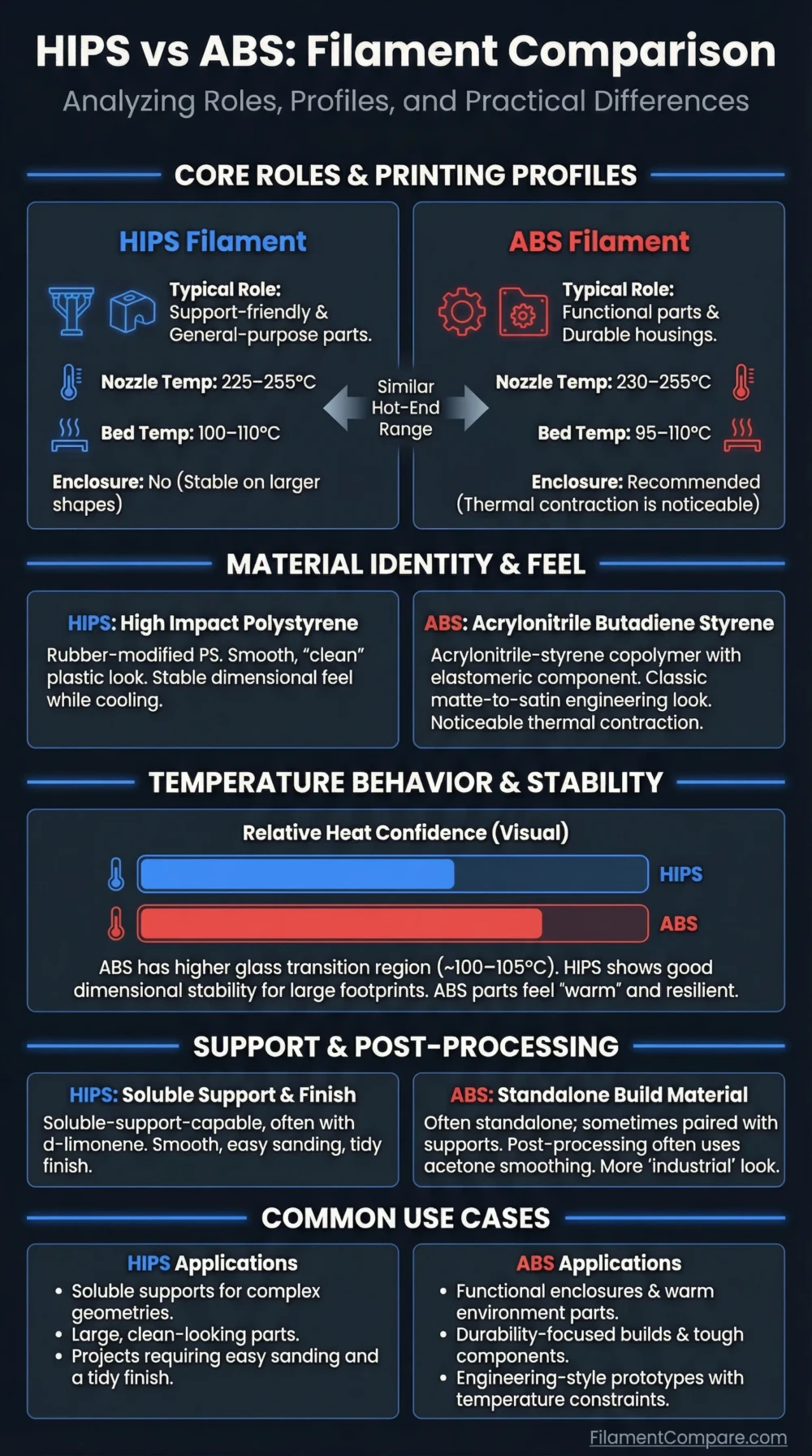
| Attribute | HIPS Filament | ABS Filament | Why It Matters |
|---|---|---|---|
| Typical Role | Support-friendly and general-purpose parts | Functional parts and durable housings | Many users keep HIPS filament for supports, while ABS filament is often picked for parts that will see higher heat. |
| Recommended Nozzle Range (°C) | 225–255 | 230–255 | Both can live in a similar hot-end range, so the same hardware can often run HIPS filament and ABS filament. |
| Recommended Bed Range (°C) | 100–110 | 95–110 | Bed temperature is a big driver for first-layer stability on HIPS and ABS. |
| Enclosure (Typical) | No | Recommended | A steady print environment can help keep ABS filament parts consistent, especially on larger footprints. |
| Dimensional Feel While Cooling | Stable feel on larger shapes | Thermal contraction is more noticeable | This is why users often talk about HIPS filament for big pieces and ABS filament with temperature control. |
| Surface Character | Smooth, “clean” plastic look | Classic matte-to-satin engineering look | If you want a tidy surface out of the nozzle, HIPS filament is known for a neat finish; ABS filament is popular for a more “industrial” look. |
| Solvent-Style Post Options | Often discussed with d-limonene and acetone | Often discussed with acetone | Post-processing talk around HIPS filament and ABS filament often centers on how they react to common solvents. |
| Common Pairing | Supports for more complex prints | Standalone parts; sometimes paired with supports | People often keep HIPS filament on hand specifically for support work, while ABS filament is a main build material. |
Note: The top table focuses on printing ranges and printer setup signals. Later sections add resin datasheet numbers to show how HIPS and ABS can look on standardized tests.
- Material Identity and Polymer Structure
- What “Feels” Different in Practice
- Keyword Match for Search and Clarity
- Temperature Behavior and Dimensional Stability
- What Cooling Can Look Like on Real Parts
- Resin Datasheet Numbers (Reference-Style)
- Example HIPS Resin Values (STYRON 438)
- Example ABS Resin Values (LG Chem HI121)
- Support Behavior and Solvent Compatibility
- Print Profile Signals (Information-Only)
- HIPS Filament Signals
- ABS Filament Signals
- Air and Indoor Comfort Considerations
- Use-Case Matching (Multi-Angle)
- Where HIPS Filament Commonly Shows Up
- Where ABS Filament Commonly Shows Up
- A Simple Comparison Lens
- HIPS Support Material
- ABS Engineering Feel
- Both High-Temp Printing
- Both Good Impact Profiles
When people compare HIPS filament and ABS filament, they’re usually deciding between a support-friendly plastic and a classic engineering thermoplastic, both commonly discussed among engineering-grade 3D printing filaments. They can print in similar heat ranges, yet their “personality” on the bed feels different. This page keeps it spec-first, with real numbers where a reliable reference exists.
Material Identity and Polymer Structure
- HIPS Filament
- High Impact Polystyrene is polystyrene modified with rubber additives, often used in 3D printing as a soluble-support-capable filament and also for regular parts with a smooth, tidy finish ✅Source
- ABS Filament
- Acrylonitrile Butadiene Styrene is commonly described as a blend of an acrylonitrile-styrene copolymer with an elastomeric (often butadiene-based) component, giving ABS its well-known balance of stiffness and toughness ✅Source
What “Feels” Different in Practice
HIPS filament often comes across as smooth and stable on larger shapes, while ABS filament is known for a more heat-resilient vibe in functional parts. Both are amorphous plastics, so they don’t have a sharp melt point like some semi-crystalline materials.
Keyword Match for Search and Clarity
- HIPS filament: high impact polystyrene, rubber-modified PS, dissolvable-support discussions
- ABS filament: acrylonitrile butadiene styrene, heat-tolerant parts, engineering plastic
- HIPS vs ABS: nozzle temperature overlap, bed temperature, enclosure behavior
Temperature Behavior and Dimensional Stability
ABS filament is typically discussed in the context of a higher glass transition region, and the ABS family can show a visible transition around 100–105°C depending on the ABS type ✅Source. That helps explain why ABS filament parts are often chosen for environments that feel “warm” to the touch.
Relative Heat Confidence (visual, not a lab scale)
What Cooling Can Look Like on Real Parts
HIPS filament is often described as having good dimensional stability, which helps when the footprint gets big. ABS filament can show a more noticeable thermal contraction feel as it cools, which is why many profiles pair ABS with a steadier ambient temperature.
Resin Datasheet Numbers (Reference-Style)
These values are shown as reference points from resin datasheets. Filament brands can differ due to pigments, additives, and extrusion targets. Still, this gives a grounded feel for how HIPS and ABS typically sit on standardized tests.
Example HIPS Resin Values (STYRON 438)
| Property | Typical Value | Unit / Method |
|---|---|---|
| Density | 1.04 | g/cm³ (ASTM D792) |
| Melt Flow Rate | 5 | g/10 min (ASTM D1238, 200°C/5 kg) |
| Tensile Strength (Yield) | 4800 psi (≈33.1 MPa) | ASTM D638 |
| Flexural Modulus | 372000 psi (≈2565 MPa) | ASTM D790 |
| Notched Izod (23°C) | 1.7 ft-lb/in (≈90.7 J/m) | ASTM D256 |
| Vicat Softening Point | 105 | °C (ASTM D1525) |
| HDT @ 1.82 MPa (Unannealed) | 77.2 | °C (ASTM D648) |
Grade reference STYRON 438 is documented as a high-impact polystyrene resin with the typical values listed above ✅Source.
Example ABS Resin Values (LG Chem HI121)
| Property | Typical Value | Unit / Method |
|---|---|---|
| Specific Gravity | 1.04 | ISO 1183 |
| Melt Flow Rate | 21 | g/10 min (ISO 1133, 220°C/10 kg) |
| Tensile Strength at Yield | 46 | MPa (ISO 527) |
| Flexural Modulus | 2200 | MPa (ISO 178) |
| Izod Notched (23°C, 4 mm) | 28 | kJ/m² (ISO 180/1A) |
| Vicat Softening Temperature | 93 | °C (ISO 306, 50N) |
| HDT @ 1.8 MPa (Unannealed) | 75 | °C (ISO 75) |
HI121 is an ABS injection-molding grade with the typical physical, mechanical, and thermal values shown above, useful as a grounded reference for ABS family behavior ✅Source.
Support Behavior and Solvent Compatibility
HIPS filament gets a lot of attention as soluble support, especially when the goal is clean internal channels or complex overhang zones. Many profiles treat ABS filament as a standalone build material first, then add a support strategy if needed. The big idea is simple: HIPS is often chosen when “support removal” is part of the plan, while ABS is often chosen when “part performance” is the star.
Print Profile Signals (Information-Only)
HIPS Filament Signals
- Nozzle: often placed in the 225–255°C range in common profiles
- Bed: commonly shown around 100–110°C
- Behavior: frequently described as stable on larger parts with a tidy surface feel
If you’re scanning a slicer preset list, HIPS filament typically looks “close to ABS filament” on raw temperatures, yet the support story and surface character often stand out.
ABS Filament Signals
- Nozzle: commonly shown around 230–255°C in many profiles
- Bed: often placed in the 95–110°C range
- Environment: profiles frequently reference a steadier print space for consistency
In many ecosystems, ABS filament presets are the ones that “look most like engineering plastic,” especially when you compare them to HIPS filament presets side by side.
Air and Indoor Comfort Considerations
Material extrusion printing can release gases and ultrafine particles during heating, and emissions can vary by filament type and setup. EPA research summaries describe VOCs and ultrafine particle emissions in consumer-style printing, including work that specifically mentions ABS as a common filament studied ✅Source. Many users treat good airflow as a normal part of running HIPS filament and ABS filament.
Use-Case Matching (Multi-Angle)
This section stays descriptive. It lists where each material is commonly seen, based on typical community and manufacturer positioning, without pushing a “do this” checklist.
Where HIPS Filament Commonly Shows Up
- Soluble-support discussions for complex geometries and internal channels
- Large, clean-looking parts where a smooth surface is valued
- Projects that like easy sanding and a tidy finish path
People who keep HIPS filament in their lineup often like its support flexibility and the way HIPS can act as a clean “helper material” next to other common filaments.
Where ABS Filament Commonly Shows Up
- Functional enclosures and parts that see warm environments
- Durability-focused builds where the toughness feel matters
- Engineering-style prototypes where temperature behavior is a key constraint
ABS filament stays popular because it sits in a comfortable zone between strength and impact resistance. It’s also a familiar material across many manufacturing contexts, which is why ABS stays easy to spec and discuss.
A Simple Comparison Lens
- Support-first thinking tends to pull attention toward HIPS filament.
- Heat-first thinking tends to pull attention toward ABS filament.
- Profile overlap is real; the “why” usually comes from use-case and post-processing intent.
