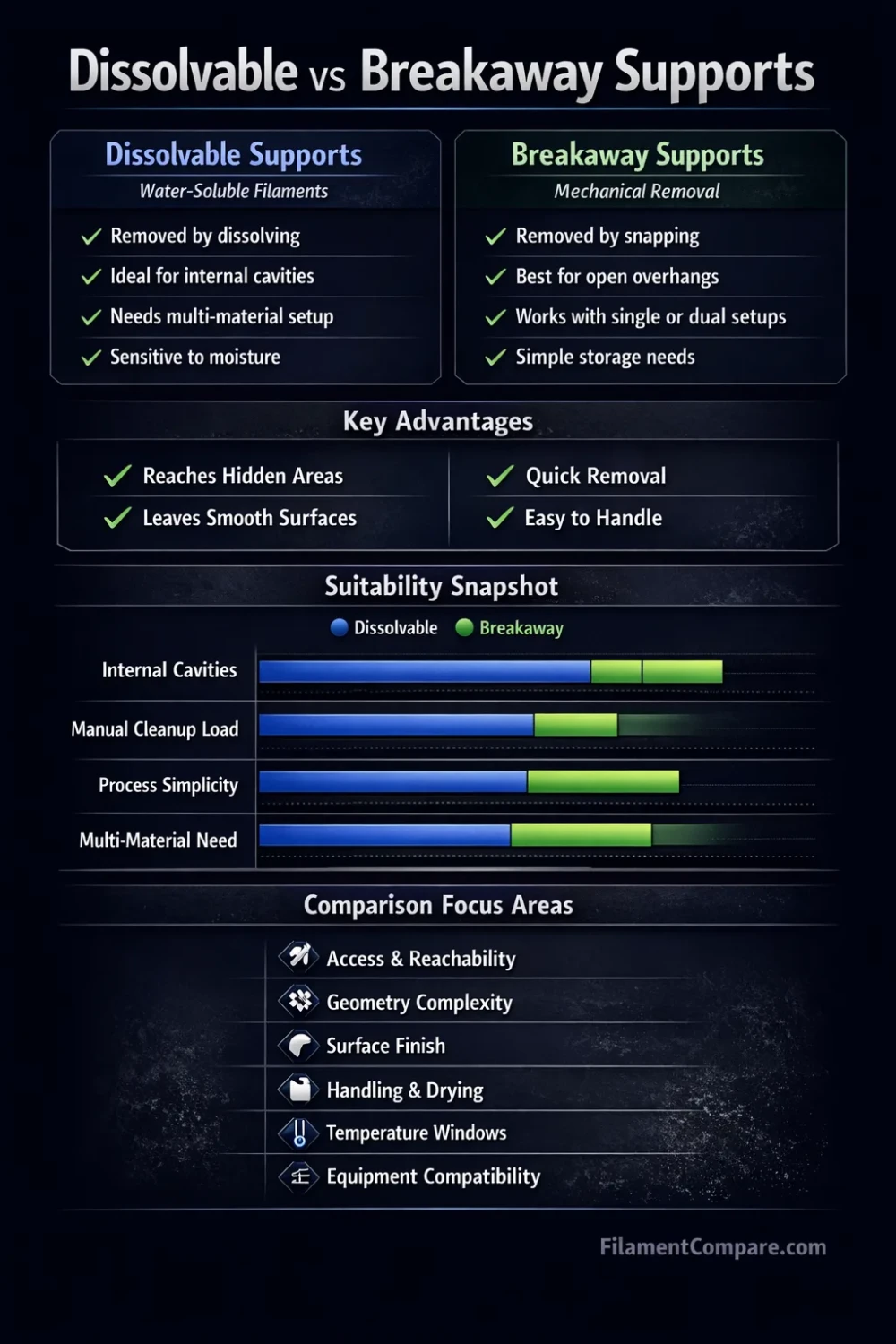
Dissolvable supports remove through water or a specified solvent, while breakaway supports are separated by hand or with tools. Dissolvable support is the stronger choice for trapped cavities, internal channels, delicate lattices, and print-in-place mechanisms; breakaway support is usually faster and less costly when every contact area can be reached. The correct choice depends more on geometry, material compatibility, and post-processing access than on the support filament alone.
The Practical Choice
Choose dissolvable support when mechanical removal would be impossible, risky, or likely to leave fragments inside the part. It also fits parts where support-contact surfaces must remain clean and tool marks would be difficult to repair.
Choose breakaway support for exposed overhangs, broad flat interfaces, routine prototypes, and production work where an operator can reach the support. Removal is immediate, there is no soaking stage, and storage is often easier than with highly moisture-sensitive soluble grades.
There is no general winner. Geometry access decides first; workflow cost and cleanup time decide second.
Best for Internal Channels
Dissolvable support can leave through water flow or the specified solvent where pliers cannot reach.
Best for Fast Manual Removal
Breakaway support is usually quicker for open geometry because it can be peeled away as soon as the part cools.
Best for Print-in-Place Parts
Dissolvable support better suits captured hinges, caged mechanisms, and moving assemblies with restricted access.
Best for Lower Support Cost
Breakaway support is commonly the more economical dedicated support option, especially when support volume is high.
Best for Fragile Detail
Dissolvable support reduces the need to pull against thin walls, pins, text, and lattice features.
Best for Humid Workspaces
Breakaway support is often easier to manage, although some engineering breakaway grades still require dry storage.
Best for Same-Day Turnaround
Breakaway support avoids a dissolving and drying stage when the structure is easy to access.
Best for Zero-Gap Interfaces
Dissolvable support is often selected when a dense contact layer can be printed directly against the model and later removed without peeling.
| Decision Area | Dissolvable Supports | Breakaway Supports | Better Choice |
|---|---|---|---|
| Support family | PVA, BVOH, water-soluble copolymers, HIPS, and proprietary soluble grades | Dedicated peel-away support blends, model-material supports, and application-specific engineering support grades | Use-case based |
| Removal method | Water or a manufacturer-specified solvent; agitation and water changes may shorten removal time | Hand removal, pliers, flush cutters, picks, or light scraping | Depends on access |
| Print difficulty | Usually more tuning-sensitive because of moisture uptake, nozzle switching, adhesion matching, and purge control | Usually simpler, although interface bonding must still be tuned for clean release | Breakaway |
| Typical nozzle temperature | Grade-dependent; commonly selected to overlap the paired model material, with low-temperature and engineering-temperature products available | Grade-dependent; PLA-oriented products may print near normal PLA ranges, while PA, PET, or PPA support grades can require much higher temperatures | Match the model material |
| Typical bed temperature | Usually governed by the model material and the support product profile | Usually governed by the model material and the support product profile | No category winner |
| Enclosure need | Determined mainly by the model material and the chosen soluble grade | Determined mainly by the model material and the chosen breakaway grade | No category winner |
| Internal cavities | Suitable when liquid can enter and dissolved material can leave | Unsuitable when the support cannot be reached or extracted | Dissolvable |
| Contact-surface risk | Low mechanical-removal risk; residue and incomplete dissolving still require attention | Removal force can mark the underside or damage thin features if bonding is too strong | Dissolvable |
| Moisture sensitivity | Often high, especially for PVA and BVOH; dry storage and pre-drying may be needed | Often lower than PVA/BVOH, but formulation-dependent and not always moisture-tolerant | Breakaway |
| Post-processing time | Can range from minutes to many hours depending on support mass, water movement, temperature, and access | Often minutes for exposed support, followed by minor cleanup if needed | Breakaway |
| Printer requirements | Normally dual extrusion or automated material switching; a reliable purge strategy is needed | Can use the model material on a single nozzle, or a dedicated support filament with dual extrusion or material switching | Breakaway |
| Purge waste | Can be high on single-nozzle multi-material systems because contamination weakens dissolution and interface behavior | Can also be high with a dedicated second material, though same-material breakaway support avoids material switching | System-dependent |
| Large support volume | Material cost and dissolving time rise quickly | Usually easier to justify when the support can be removed in sections | Breakaway |
| Best use | Hidden cavities, delicate parts, print-in-place assemblies, smooth supported surfaces | Accessible overhangs, routine prototypes, fixtures, broad interfaces, production turnover | Geometry-dependent |
| Main limitation | Moisture control, slower cleanup, compatibility limits, and liquid disposal requirements | Requires physical access and may leave marks or fragments | Different limits |
This comparison combines official dissolvable and breakaway support datasheets and manufacturer guidance; the patterns describe general behavior, while the actual result can change with the support chemistry, model polymer, color, additives, moisture level, printer architecture, and slicer settings.
Support Material Profiles
Dissolvable Support Profile
- Material type: Water-soluble PVA, BVOH, related copolymers, solvent-soluble HIPS, or proprietary engineering support.
- Print difficulty: Medium to high; moisture, nozzle standby behavior, purge volume, and cross-material adhesion need attention.
- Nozzle range: Product-specific. Use the manufacturer profile rather than a category-wide temperature.
- Bed range: Set around the model material and verified support compatibility.
- Enclosure: Not required for every pairing, but engineering polymers may need an enclosed or heated chamber and a matching soluble grade.
- Drying need: Often high. Some PVA products require drying before use and sealed storage during printing[d].
- Typical behavior: Can form a close support interface, then soften and disperse during the specified removal process.
- Best uses: Internal passages, captured mechanisms, delicate geometry, and surfaces where tool contact is undesirable.
Breakaway Support Profile
- Material type: Dedicated low-bond support blends, model-material supports, or polymer-specific engineering support grades.
- Print difficulty: Low to medium when the support profile matches the model polymer.
- Nozzle range: Product-specific. UltiMaker, for example, uses 215–230°C for its Breakaway profile[b], while high-temperature engineering grades may print much hotter.
- Bed range: Usually follows the model material and support supplier guidance.
- Enclosure: Determined by the model material; not all breakaway supports are low-temperature products.
- Drying need: Often less demanding than PVA or BVOH, but engineering grades can still be highly moisture-sensitive.
- Typical behavior: Bonds firmly enough to carry overhangs, yet is designed to separate at the interface.
- Best uses: Open overhangs, accessible cavities, broad support roofs, prototypes, jigs, and repeat production parts.
Relative Workflow Performance
Dissolvable Supports
Breakaway Supports
The meter values are comparative printing-workflow indicators rather than laboratory ratings. Brand chemistry, support density, contact gap, moisture, model orientation, purge settings, part access, and operator technique can change the result.
Removal Method Sets the Geometry Limit
Breakaway support works only when the operator can reach it, grip it, bend it, and pull it through an opening. A support tower under an external bridge is easy to remove. The same material inside a curved cooling duct, captured bearing cage, hollow manifold, or narrow lattice may remain trapped even when the interface separates cleanly.
Dissolvable support changes that design limit. Water-soluble PVA is intended for multi-extrusion parts with complex geometry and can reduce scraping or cutting marks on detailed surfaces[a]. Bambu Studio guidance also identifies water-soluble material as suitable for complex internal supports where mechanical removal is difficult[c].
Liquid access still matters. A fully sealed cavity will trap dissolved support solution. Internal channels need an inlet, an outlet, and enough cross-section for fresh liquid to reach the support and carry softened material away.
Interface Quality and Support Contact
A support interface has to solve two opposite tasks: it must hold the overhang during printing, yet release without tearing the supported surface. With same-material breakaway support, slicers normally create a vertical separation gap. A larger gap improves removal but leaves a rougher underside; a smaller gap improves support but can fuse the support to the model.
Dedicated breakaway filament uses a deliberately controlled bond with the model polymer. UltiMaker describes its Breakaway as adhering to the build material while peeling away for a smoother, more accurate surface, and notes that it is quicker to remove and easier to store than soluble support in its system. Polymaker likewise positions PolySupport as a hand-removable interface for compatible PLA-family materials[e].
Dissolvable support can often use a denser interface and, in some validated material pairings, a zero or near-zero top contact gap. That can improve the underside of horizontal surfaces. The benefit depends on clean material switching: model polymer mixed into the soluble interface can create stubborn residue, while soluble polymer mixed into the model can weaken local layers.
Interface Settings That Matter
- Top contact distance: Controls fusion versus underside roughness.
- Interface layer count: More dense layers can improve support consistency but add time and material changes.
- Interface density: Higher density supports flat surfaces more evenly.
- XY separation: Too little can weld side walls to support; too much can let edges sag.
- Purge volume: Must be enough to keep the model and support chemistries from contaminating each other.
- Cooling and speed: The support roof must remain dimensionally stable until the model layer is deposited.
Printer Workflow, Purging, and Print Time
A dual-nozzle printer can keep model and support materials in separate melt paths. This reduces cross-contamination and avoids large purge towers, although nozzle alignment, inactive-nozzle oozing, and thermal compatibility still matter.
A single-nozzle material changer has a different cost profile. Every switch can require retracting one filament, loading the other, flushing the melt zone, and stabilizing pressure. A model with many short interface segments may create hundreds of swaps. In that case, support filament consumption may be smaller than the purge waste, and print time can rise far beyond the single-material estimate.
For both support categories, using the secondary material only for the dense interface is often more efficient than printing the entire support structure from it. The bulk support can be printed in the model material, while dissolvable or dedicated breakaway filament is reserved for the contact layers (provided the slicer and material pairing support that workflow).
Moisture, Storage, and Material Matching
PVA and BVOH can absorb moisture quickly. Wet soluble filament may foam, pop, string, ooze during standby, lose dimensional consistency, or become brittle on the spool. A dry box, sealed container, fresh desiccant, and printing directly from controlled storage are often more useful than drying only after defects appear.
Breakaway does not automatically mean moisture-insensitive. Low-temperature PLA-oriented products may be easy to store, while PA-, PET-, or PPA-oriented support grades may need very dry handling. The safe rule is to follow the individual support datasheet rather than assuming all peel-away materials behave alike.
Compatibility also covers more than nozzle temperature. The two materials must bond enough at the interface, remain stable at the selected bed and chamber temperature, avoid excessive shrinkage mismatch, and separate through the intended process. BVOH products, for example, list compatibility with selected PLA, ABS, and polyamide families, but that does not make every BVOH spool suitable for every formulation[f].
Water, Solvent, and Cleanup
Water-soluble does not mean instant removal. Dissolving speed depends on support thickness, interface density, water temperature allowed by the model material, circulation, water replacement, and the distance liquid must travel. Thick support can soften on the outside while remaining firm in the center.
Warm water and gentle circulation often shorten PVA or BVOH removal, but the model material sets the safe temperature. Thin PLA parts can distort in water that is too warm. After dissolving, rinse passages, confirm that no gel remains, and dry the part before measuring dimensions or loading it mechanically.
HIPS and some proprietary supports use a specified solvent instead of water. That adds chemical handling, ventilation, container compatibility, and disposal requirements. Use only the solvent named by the support manufacturer and follow local waste rules. Even for water-soluble support, do not assume that every quantity can be sent directly to a drain; manufacturer instructions and local wastewater limits take priority.
| Print Scenario | More Suitable Option | Reason |
|---|---|---|
| External bridge with open sides | Breakaway | Fast removal and no soaking stage. |
| Curved internal cooling duct | Dissolvable | Mechanical tools may not reach around bends. |
| Print-in-place bearing or hinge | Dissolvable | Support can be removed without forcing apart captured components. |
| Large prototype with broad support towers | Breakaway | Lower material and cleanup cost when all faces are accessible. |
| Thin lattice or fragile decorative detail | Dissolvable | Reduces pulling force on slender features. |
| Daily fixture production | Breakaway | Parts can move to inspection immediately after manual cleanup. |
| Sealed hollow body with no drain opening | Neither without redesign | Dissolved material cannot leave, and breakaway support cannot be extracted. |
| High-temperature engineering polymer | Matched product only | Use a soluble or breakaway grade rated for the model polymer, nozzle, bed, and chamber. |
| Single-nozzle printer without material switching | Same-material breakaway | A dedicated second support filament cannot be used automatically. |
| Single-nozzle multi-material printer with many tiny support islands | Breakaway or redesign | Frequent soluble-material swaps may add heavy purge waste and time. |
| Presentation surface facing support | Dissolvable | A dense interface can reduce tool marks when the material pairing is tuned. |
| Humid shop without dry storage | Breakaway, formulation-dependent | Many soluble grades degrade rapidly after moisture exposure. |
Where Each Support Method Fits Better
Choose Dissolvable Supports When
- The support is trapped inside a channel, cage, assembly, or undercut.
- Thin walls or delicate features could break during peeling.
- The supported face needs minimal mechanical cleanup.
- The design includes print-in-place motion.
- The printer can keep the support dry and manage material changes reliably.
- A validated soluble grade exists for the model polymer and chamber conditions.
Dissolvable Supports Are Less Suitable When
- The part must be used immediately after printing.
- Support volume is very large and soaking capacity is limited.
- The workspace cannot provide dry storage or controlled feeding.
- The model material can deform during the recommended dissolving process.
- The cavity has no liquid path for entry, circulation, and drainage.
- Wastewater or solvent handling cannot follow the product instructions.
Choose Breakaway Supports When
- Every support contact area is visible and reachable.
- Fast removal matters more than hidden-cavity access.
- The print has broad, simple overhangs or support roofs.
- Support cost and operator turnaround are priorities.
- The printer has one nozzle and will use model-material supports.
- A polymer-specific breakaway grade is available for the model material.
Breakaway Supports Are Less Suitable When
- Support is trapped behind a narrow opening or inside a closed mechanism.
- Removal force could snap pins, text, thin walls, or lattices.
- The underside must be very smooth without sanding.
- The interface tends to weld because temperature or contact distance is too high.
- Small fragments would be hard to inspect or remove from the finished part.
- Tool access could scratch a cosmetic surface.
Material Selection Matrix
Best Choice by Priority
Choose dissolvable support if the part contains inaccessible geometry. Internal channels, captured assemblies, and fragile structures justify the added drying, switching, dissolving, and cleanup work.
Choose breakaway support if the supports are exposed and production speed matters. It is usually the more direct workflow for ordinary overhangs, prototypes, tools, and parts that tolerate light manual cleanup.
Redesign instead of forcing either method when a cavity is sealed, the support liquid cannot drain, the printer cannot handle a compatible second material, or purge waste exceeds the value of the supported feature.
These support methods do not replace one another. Dissolvable support expands the geometry that can be printed; breakaway support keeps accessible work faster and simpler.
Common Dissolvable and Breakaway Support Questions
Are dissolvable supports always better for surface finish?
No. They reduce damage from pulling and tools, but the supported surface still depends on interface density, cooling, layer height, purge quality, and model-support adhesion. A well-tuned breakaway interface can also leave a clean surface.
Can PVA support every filament?
No. Standard PVA is mainly used with compatible lower-temperature materials and selected manufacturer-tested pairings. High-temperature polymers may need BVOH, a high-temperature soluble support, or a polymer-specific breakaway grade.
Can breakaway support be printed with one nozzle?
Yes, when the support is made from the same model material. A dedicated breakaway filament normally needs dual extrusion or automated material switching unless the filament is changed manually at planned layers.
Why does soluble support leave residue?
Common causes include thick support sections, stagnant water, low removal temperature, contaminated support material, blocked channels, or insufficient rinsing. Fresh liquid must reach the support and carry the softened polymer out.
Should the entire support tower use the secondary material?
Not always. Printing only the dense interface with dissolvable or dedicated breakaway filament can reduce cost and material changes. The bulk structure can remain in the model material when the slicer and geometry allow it.
Is PETG a breakaway support for PLA?
It can act as a low-bond interface in some printer and slicer setups because PLA and PETG do not readily fuse to each other. Results vary by formulation, temperature, contamination, and purge quality, so test a small interface part before using the pairing on a long print.
Technical References
- [a] PVA 3D printing materials – UltiMaker (Used for water-soluble support behavior, complex geometry, reduced mechanical surface damage, and published PVA material information.)
- [b] How to print with UltiMaker Breakaway (Used for the manufacturer’s 215–230°C nozzle range and product-specific print guidance.)
- [c] Support | Bambu Lab Wiki (Used for slicer support guidance and the role of water-soluble material in complex internal structures.)
- [d] Support Filament Usage Guide | Bambu Lab Wiki (Used for dry-storage and drying guidance for support filaments, including PVA.)
- [e] PolySupport™ – Polymaker (Used for dedicated breakaway support behavior, hand removal, and manufacturer-listed material compatibility.)
- [f] Ultrafuse® BVOH – FORWARD AM (Used for water-soluble BVOH behavior and the need to verify compatibility with the selected model material.)
