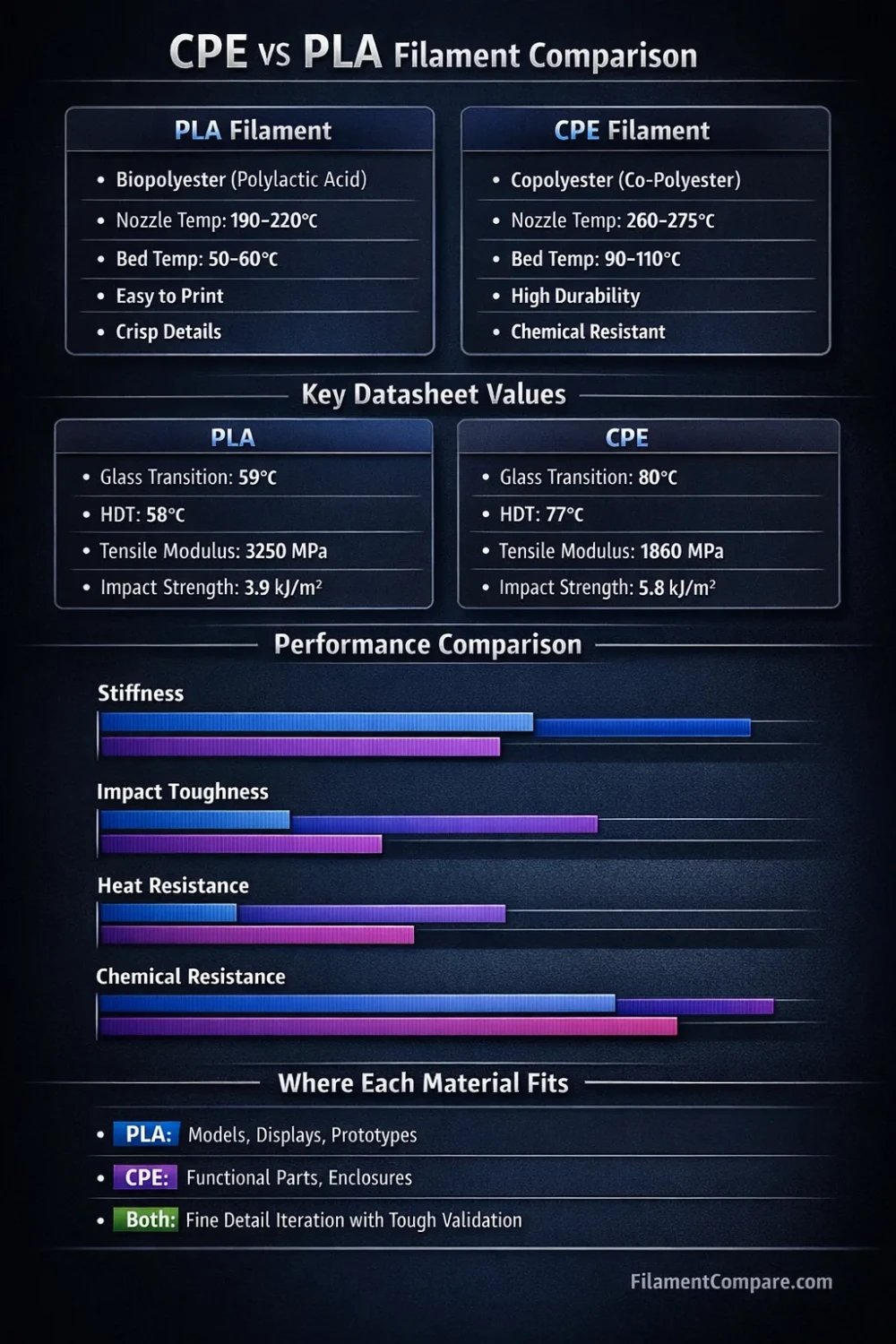
| Attribute | PLA | CPE |
|---|---|---|
| Material Family | Biopolyester (commonly known as polylactic acid) | Copolyester family (often grouped under co-polyester) |
| Typical Nozzle Temperature Range (°C) | 185–235 | 275 |
| Typical Bed Temperature Range (°C) | 50–60 | 90–110 |
| Enclosure (Common Profile Expectation) | No | No |
| Drybox / Dry Storage (Common Profile Expectation) | Usually Not Required | Often Marked as Helpful |
| Hardened Nozzle (Common Profile Expectation) | No | No |
| What This Table Represents | Profiles and hardware expectations commonly listed in a public material guide. Exact numbers can vary by brand, printer, and diameter. | |
Note: PLA filament and CPE filament can share similar “headline” use cases, yet their polymer behavior and thermal window feel different in real projects.
- Material Identity and Resin Family
- PLA Filament Identity
- CPE Filament Identity
- Verified Material Data From Manufacturer Datasheets
- PLA Filament Datasheet Values (3D-Printed Samples)
- CPE Filament Datasheet Values (3D-Printed Samples)
- Performance Profile in Real Parts
- A Real Project Example (PLA and CPE)
- Surface Finish and Visual Character
- Heat, Shape Retention, and “Warm Environments” Language
- PLA Heat Profile (What It Signals)
- CPE Heat Profile (What It Signals)
- Chemicals, Handling, and Material-Friendly Notes
- Standards Language and End-Of-Life Clarity
- Where Each Material Fits
If you’re comparing PLA filament with CPE filament, focus on the material families first. PLA is known for crisp detail and a friendly processing window. CPE is a copolyester option that often leans into tougher, more chemically resilient parts.
Material Identity and Resin Family
PLA Filament Identity
PLA is described as a plant-based polyester in common material references. In practical filament terms, PLA filament is often chosen when you want clean edges, surface clarity, and consistent geometry in everyday prints. For a broader explanation of how different PLA formulations behave in 3D printing—including PLA+, HT-PLA, Meta PLA, and other variants—see the Ultimate PLA Filament Guide. ✅Source
- Common feel: stiff, sharp, and dimensionally neat.
- Visual style: high-resolution surfaces with defined features.
- Where it often appears: models, fixtures, prototypes, and display parts.
CPE Filament Identity
CPE is typically presented as a copolyester (often discussed in the same neighborhood as other polyester-based filaments). In many profiles, CPE filament is associated with strong layer bonding, stable geometry, and chemical resistance, plus a note that dry storage can be relevant for this family. ✅Source
- Common feel: tough, resilient, and functional-part friendly.
- Visual style: often clean with professional tones and translucency options.
- Where it often appears: mechanical prototypes, enclosures, and short-run parts.
- Glass Transition (Tg)
- Tg is the temperature region where a polymer shifts from glassy to more rubbery behavior. It’s a key clue for heat feel in service.
- Heat Deflection Temperature (HDT)
- HDT is measured under a defined load and is a practical proxy for shape retention in warm conditions, especially for functional parts.
- Copolyester
- A polyester family where the polymer chain is tuned using multiple monomers. In filament discussions, it often signals toughness and chemical resistance compared with simpler blends.
Verified Material Data From Manufacturer Datasheets
PLA Filament Datasheet Values (3D-Printed Samples)
- Specific gravity: 1.24 g/cm3
- Glass transition (Tg): 59.1 °C
- Melting temperature: 151.8 °C
- HDT @ 0.455 MPa: 58.8 °C
- Vicat softening temperature: 64.5 °C
- Tensile (Young’s) modulus (XY): 3250 MPa
- Tensile stress at yield (XY): 52.5 MPa
- Charpy impact strength (notched, 23 °C): 3.9 kJ/m2
- Hardness (Shore D): 84
These values help explain why PLA filament is often described as stiff and detail-forward, with a service heat range that matches its Tg and HDT. ✅Source
CPE Filament Datasheet Values (3D-Printed Samples)
- Specific gravity: 1.27 g/cm3
- Glass transition (Tg): 80.0 °C
- Melting temperature: Amorphous (no clear melt peak)
- HDT @ 0.455 MPa: 77.2 °C
- Vicat softening temperature: 83.4 °C
- Tensile (Young’s) modulus (XY): 1863 MPa
- Tensile stress at yield (XY): 45.3 MPa
- Charpy impact strength (notched, 23 °C): 5.8 kJ/m2
- Hardness (Shore D): 76
These values highlight why CPE filament is often positioned for tough, functional parts, with a higher Tg/HDT profile than many common entry polymers. ✅Source
Performance Profile in Real Parts
Reading Tip: The bars below are a relative visual. They summarize typical perceptions for PLA filament and CPE filament when used for prototypes and functional prints.
Stiffness Feel (relative)
Impact-Toughness Feel (relative)
Heat Comfort Zone (relative)
Chemical Resilience (relative)
Why these bars make sense: public manufacturer summaries commonly position CPE as a tough, chemically resistant copolyester option, while PLA is often shown as stiffer and detail-friendly. ✅Source
A Real Project Example (PLA and CPE)
Surface Finish and Visual Character
PLA filament is often picked for crisp edges and fine surface detail, especially on small features. CPE filament is frequently used when you want a professional look paired with functional durability, including options that lean translucent or muted.
- Detail sharpness: PLA usually reads sharper on tiny text and thin edges.
- Functional “clean” look: CPE often looks even and tool-like on brackets and covers.
- Color behavior: both families support wide palettes, while copolyesters often include pleasing translucent options.
Heat, Shape Retention, and “Warm Environments” Language
Practical meaning: when parts sit near heat sources, a filament’s Tg and HDT explain why two materials that look similar on the spool can behave differently in use. PLA and CPE both have well-documented lab values, so you can compare them with confidence.
PLA Heat Profile (What It Signals)
Tg around 59 °C and an HDT around 59 °C usually align with everyday indoor use cases. This is why PLA filament is often seen in models and precision prototypes that aren’t meant to live in warm environments.
CPE Heat Profile (What It Signals)
Tg around 80 °C and an HDT around 77 °C typically translate into a broader warm-use comfort zone. This is a common reason CPE filament appears in functional covers, mechanical prototypes, and parts that may see warm air or mild heat exposure.
Chemicals, Handling, and Material-Friendly Notes
CPE filament is widely framed as a chemically resistant copolyester option, which is why it often shows up in functional parts and workshop-friendly prints. PLA filament is commonly used for general-purpose items, and it shines when you want surface quality and clean geometry.
- For prototypes: PLA often supports fast iteration and sharp detail.
- For tougher use: CPE often supports impact-resilient parts and dimensionally stable prints.
- Neutral safety note: always check a filament’s published guidance for application suitability and intended use.
Standards Language and End-Of-Life Clarity
Terms such as compostable and organically recyclable refer to defined standards. For plastics intended for organic recycling, these standards require disintegration during composting, ultimate aerobic biodegradation, and verification of no harmful effects on compost or living organisms. The criteria apply to industrial composting conditions, not typical home compost systems.
✅SourceHelpful framing: PLA filament is often discussed in sustainability contexts, but real-world outcomes depend on local infrastructure and certified labeling. CPE filament is usually discussed as a durable polyester-family choice where long service life is part of the value.
Where Each Material Fits
- PLA filament often fits projects prioritizing fine detail, surface readability, and clean geometry for models, display parts, fixtures, and rapid prototypes.
- CPE filament often fits projects prioritizing toughness, chemical resilience, and warmer-use comfort for functional prototypes and short-run parts.
- Both together can make sense when you want PLA for visual iteration and CPE for functional validation—same design intent, different material emphasis.
