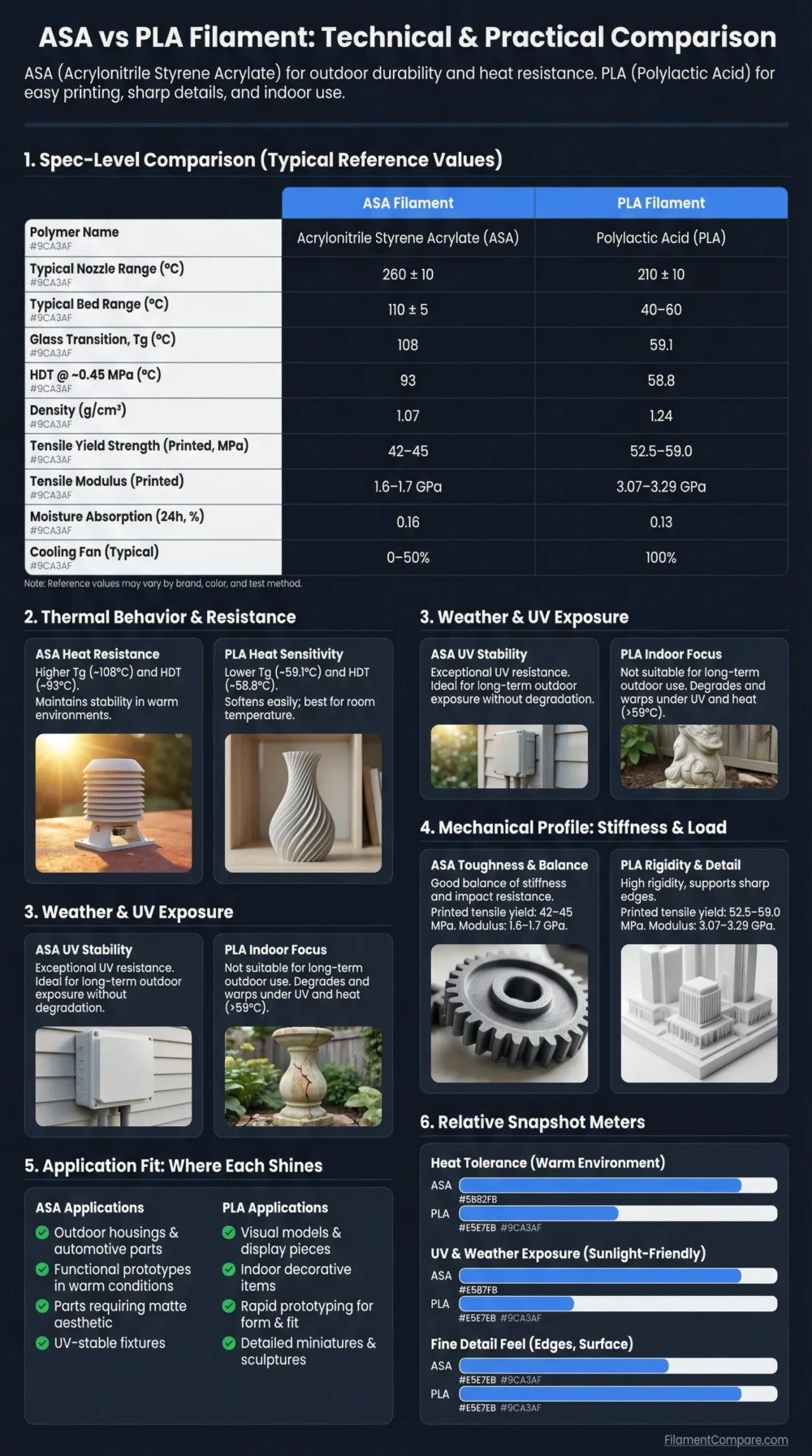
ASA is built for outdoor, warmer, and more durable parts, while PLA is easier to print and better for clean-looking models, prototypes, and beginner work. PLA wins on simplicity, low warping, and surface detail. ASA wins when the part must handle sunlight, moderate heat, and real use outside the printer room.
Choose PLA if you want easy printing, sharp detail, low odor, and reliable results on an open-frame printer. Choose ASA if the part needs better UV resistance, higher heat tolerance, and more outdoor durability, and you have an enclosed, well-ventilated printer setup.
Best for Beginners
PLA is the easier choice because it prints at lower temperatures and usually does not need an enclosure.
Better Outdoor Fit
ASA is more suitable for sunlight and weather exposure than standard PLA.
Better Heat Tolerance
ASA keeps its shape better in warm environments where PLA may soften or creep.
Better Surface Detail
PLA is usually cleaner for decorative models, figures, prototypes, and parts with crisp visible features.
Better for Large Flat Prints
PLA is easier to manage because it has lower shrinkage and less warping risk.
Better for Technical Outdoor Parts
ASA is the stronger pick for brackets, housings, covers, and fixtures used outside.
| Category | ASA | PLA | Better Choice |
|---|---|---|---|
| Material Family | Acrylonitrile styrene acrylate engineering thermoplastic | Polylactic acid, a bio-based thermoplastic polyester | Use-case based |
| Print Difficulty | Medium to high; tuning-sensitive | Low; beginner-friendly | PLA |
| Typical Nozzle Temperature | Usually around 240–275°C depending on grade[a] | Usually around 185–235°C depending on grade[b] | PLA for easier printing |
| Typical Bed Temperature | Usually around 90–110°C | Usually around 50–60°C | PLA |
| Enclosure Requirement | Recommended, especially for medium and large parts | Not usually needed | PLA |
| Heat Resistance | Much better; UltiMaker lists ASA thermal resistance at 96°C[c] | Lower; UltiMaker lists PLA thermal resistance around 52–49°C[d] | ASA |
| UV Resistance | Good fit for sunlight exposure | Less suitable for long outdoor exposure | ASA |
| Warping Risk | Higher; needs warm, stable print environment | Low in normal desktop printing | PLA |
| Surface Finish | Satin to matte depending on brand; can be acetone smoothed with care | Clean detail, glossy to matte depending on formulation | Depends on model |
| Moisture Behavior | Partially moisture-sensitive; dry storage helps | Mild to moderate sensitivity; old or damp spools can string or become brittle | Similar handling |
| Ventilation Need | Higher; print in a ventilated area | Lower, though normal room ventilation is still sensible | PLA |
| Typical Uses | Outdoor brackets, covers, enclosures, automotive-adjacent fixtures, garden parts | Models, prototypes, jigs for light use, figures, display parts, classroom prints | Use-case based |
| Main Limitation | Warping, fumes, enclosure need, higher print temperatures | Lower heat resistance and less outdoor durability | Depends on priority |
This ASA and PLA comparison uses manufacturer material guides and technical data as a baseline, but real print results can shift with brand, color, additives, moisture level, slicer profile, part shape, and print orientation.
ASA Material Profile
- Polymer type: Acrylic styrene acrylonitrile.
- Print difficulty: Medium to high.
- Nozzle range: Commonly around 240–275°C.
- Bed range: Commonly around 90–110°C.
- Enclosure: Recommended for stable results.
- Drying need: Helpful when the spool has absorbed moisture.
- Typical behavior: Tough, UV-resistant, heat-tolerant, but prone to warping if the chamber is too cool.
- Best use cases: Outdoor covers, housings, mounts, fixtures, and parts exposed to sunlight.
PLA Material Profile
- Polymer type: Polylactic acid thermoplastic polyester.
- Print difficulty: Low.
- Nozzle range: Commonly around 185–235°C.
- Bed range: Commonly around 50–60°C, with some grades printing on cooler beds.
- Enclosure: Usually not required.
- Drying need: Useful for old, brittle, or stringing-prone spools.
- Typical behavior: Stiff, detailed, low-warp, and easy to tune.
- Best use cases: Visual models, prototypes, educational prints, fixtures for light indoor use, and decorative parts.
The meter values are relative print-use indicators, not fixed lab ratings. Brand formulation, pigment, additives, moisture, part orientation, layer height, cooling, and slicer settings can change the result.
Printability and Printer Requirements
PLA is the easier material for most desktop printers. It works with lower nozzle temperature, moderate bed heat, strong part cooling, and open-frame machines. Small parts, large models, and thin decorative details are usually easier to complete without chamber tuning.
ASA is more demanding because it shrinks more as it cools. The print needs a warm, stable environment, limited drafts, a hotter bed, and careful first-layer adhesion. For small ASA parts, a well-tuned open printer may sometimes work. For larger flat parts, an enclosure is the safer setup.
Ventilation note: ASA should be printed in a well-ventilated area. An enclosure helps print stability, but it does not replace sensible air handling, especially during longer prints.
Heat Resistance and Shape Retention
Heat resistance is one of the clearest differences between ASA and PLA. PLA is stiff at room temperature, but it can soften or deform in warm environments. A PLA part left near a sunny window, inside a warm car, or near a heat source may lose shape depending on load and part geometry.
ASA handles warmth better and is a better fit for outdoor fixtures, equipment covers, and parts that may see moderate heat. It is still not a replacement for high-temperature engineering plastics such as PC, PEI, PEEK, or PPS. Thin ASA parts under constant load can still creep over time.
Outdoor and UV Performance
ASA is usually the better choice for sunlight exposure. It was developed as a weather-resistant alternative in the ABS family, and many filament brands position it for outdoor parts, covers, and fixtures.
Standard PLA is less suitable for continuous outdoor use. It may work for short-term signs, temporary garden markers, and decorative objects, but sunlight, heat, and moisture can shorten service life. For outdoor PLA use, thicker walls, lighter colors, protective coatings, and replaceable designs can help, but ASA remains the stronger material fit.
Mechanical Behavior and Part Strength
PLA is stiff and can show high tensile strength in datasheets, but that does not mean it is always the better functional material. Stiffness helps with rigid models and dimensionally stable prototypes, yet PLA can be more brittle under impact and less tolerant of heat-related load.
ASA is tougher and more forgiving for practical parts that may be handled, mounted, bumped, or exposed outside. The tradeoff is print reliability: a well-printed PLA part can outperform a poorly printed ASA part. For ASA, chamber stability and layer bonding matter as much as the material name.
Surface Finish, Detail, and Post-Processing
PLA usually produces sharper visible detail with less tuning. It is a strong option for display models, small features, low-layer-height prints, and cosmetic prototypes. Matte, silk, wood-filled, and tough PLA blends can change the look and behavior, so those variants should not be treated as identical to standard PLA.
ASA can also produce clean parts, especially on a stable enclosed printer. It has a practical advantage for post-processing because it can be sanded and chemically smoothed with acetone under controlled conditions. Smoothing can improve appearance, but it may soften fine edges and change dimensions slightly.
Build Plate and Adhesion Behavior
PLA is generally easy on the build plate. A clean PEI sheet, glass surface with suitable adhesion method, or textured plate can be enough. Too much squish or overly aggressive adhesion can still cause elephant foot, but PLA is forgiving compared with ASA.
ASA needs stronger first-layer control. A hot bed, draft control, brim for larger parts, and a suitable release layer can reduce lifting. On some surfaces, ASA may stick too strongly, so printer-specific build plate guidance matters. The goal is not just adhesion; it is controlled adhesion that releases safely after cooling.
| Use Case | Better Material | Reason |
|---|---|---|
| Beginner Prints | PLA | Lower temperature, less warping, and easier slicer profiles. |
| Visual Models | PLA | Cleaner detail and easier surface quality on common printers. |
| Outdoor Brackets | ASA | Better fit for sunlight, weather, and moderate warmth. |
| Car Interior Accessories | ASA | More suitable than PLA for heat, though hot interiors may still exceed safe limits. |
| Large Flat Prints | PLA | Lower shrinkage and less corner lifting. |
| Garden Labels and Fixtures | ASA | Better UV and outdoor durability for longer use. |
| Classroom and Office Printing | PLA | Lower odor and simpler printer requirements. |
| Technical Housings | ASA | Better heat, weather, and impact behavior for functional covers. |
| Miniatures and Decorative Parts | PLA | Sharper detail with fewer print environment demands. |
| Acetone-Smoothed Parts | ASA | Compatible with acetone smoothing, unlike standard PLA. |
Choose ASA When
- The part will be used outdoors.
- UV exposure is expected.
- The part may see moderate heat.
- You need a tougher functional part than standard PLA.
- You have an enclosure and can manage ventilation.
- You want sanding or acetone smoothing options.
ASA Is Less Suitable When
- Your printer is open-frame and placed in a drafty room.
- The part is large, flat, and difficult to keep warm.
- You need the easiest possible print workflow.
- You cannot provide suitable ventilation.
Choose PLA When
- You want the easiest filament to print.
- The part is mainly visual, decorative, or a prototype.
- You are printing on an open desktop printer.
- Sharp detail and low warping are more important than heat resistance.
- You are making classroom, office, or hobby prints.
- You need fast iteration with fewer failed prints.
PLA Is Less Suitable When
- The part will stay outdoors for long periods.
- The part may sit in warm sunlight or a hot enclosure.
- Impact resistance is more important than stiffness.
- The part must keep shape under heat and load.
Choose PLA for simple printing, prototypes, models, figures, classroom projects, and indoor parts that do not face heat or sunlight.
Choose ASA for outdoor parts, warm environments, UV exposure, durable housings, and functional prints where printer setup can support the material.
Neither material replaces the other. PLA is the practical everyday filament; ASA is the better outdoor and heat-aware option when your printer can handle it.
Common ASA and PLA Questions
Is ASA stronger than PLA?
ASA is usually tougher and more useful for outdoor functional parts, while PLA is stiffer and can show good tensile strength in controlled prints. “Stronger” depends on whether you mean stiffness, impact resistance, heat resistance, or layer bonding.
Can I print ASA on an open printer?
Small ASA parts may print on some open printers, but results are less predictable. For larger parts, an enclosure is strongly recommended because cooling drafts increase warping and layer stress.
Is PLA good for outdoor use?
PLA can be used outdoors for temporary or low-demand parts, but it is not the better choice for long sunlight exposure or warm weather. ASA is usually a better fit for outdoor use.
Does ASA need drying?
ASA is not as moisture-sensitive as nylon, but dry storage still helps. If the spool pops, strings, smells harsher than usual, or gives rough surfaces, drying may improve consistency.
Which filament is better for prototypes?
PLA is better for most early prototypes because it is faster and easier to print. ASA is better when the prototype must be tested outdoors, near heat, or in a more demanding functional setting.
Resources Used
- [a] ASA – Prusa Knowledge Base (Used for ASA print temperature, bed temperature, enclosure, warping, ventilation, UV resistance, and practical printing notes.)
- [b] PLA – Prusa Knowledge Base (Used for PLA print temperature, bed temperature, low-warp behavior, beginner suitability, and typical PLA use cases.)
- [c] ASA for Method series – UltiMaker (Used for ASA thermal resistance and material property context.)
- [d] PLA 3D printing Material for Method – UltiMaker (Used for PLA thermal resistance and material property context.)
