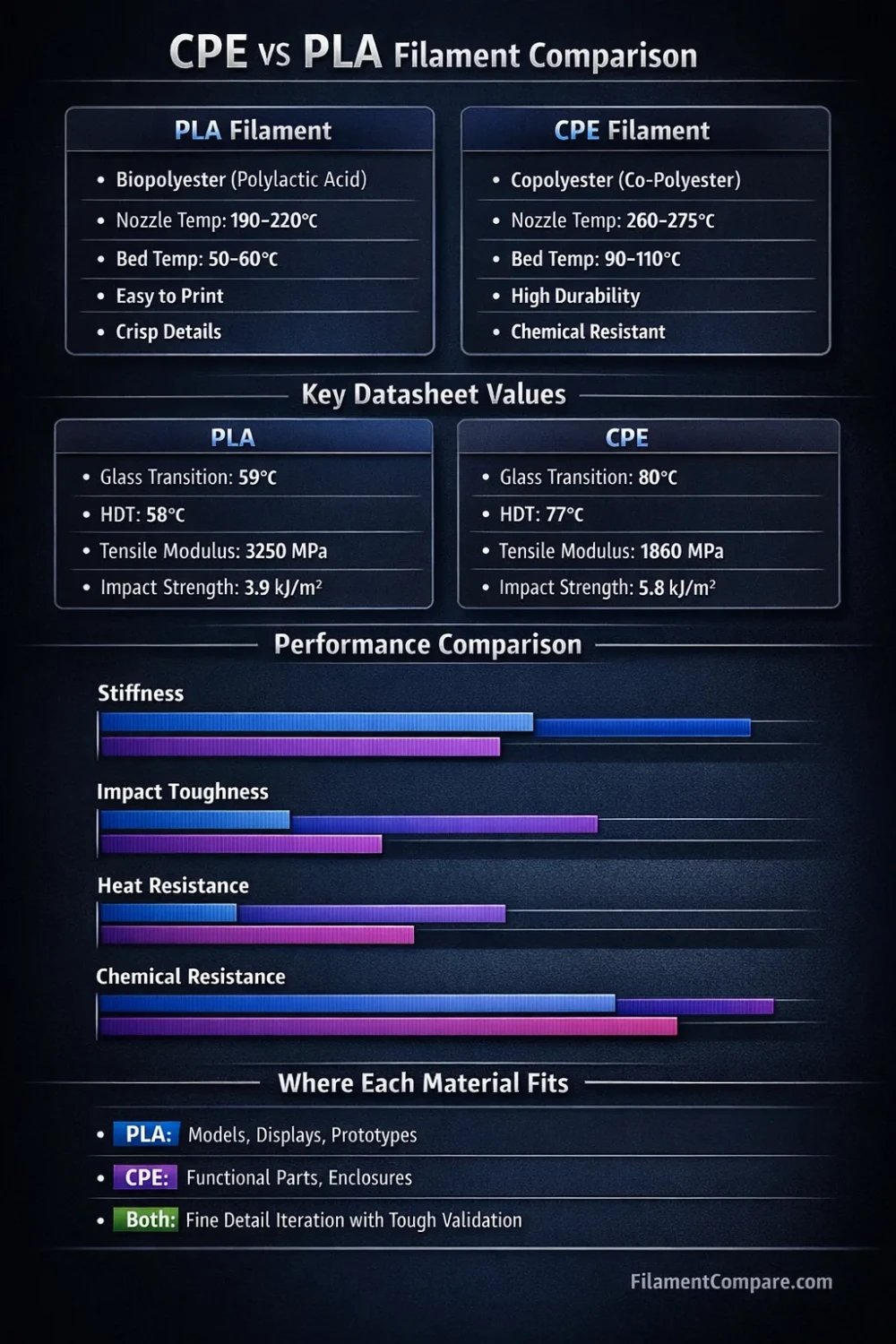
PLA is easier to print and holds fine detail well, while CPE generally offers greater toughness, stronger interlayer bonding, and better shape retention under moderate heat. Choose PLA for visual models, low-warp prototypes, and routine desktop printing. Choose CPE when the part must tolerate repeated handling, mild chemical exposure, or mechanical loading without snapping as readily.
Direct Material Verdict
Choose PLA for beginners, decorative models, dimensionally tidy prototypes, large low-warp prints, and projects where cost or surface detail matters most.
Choose CPE for functional housings, clips, brackets, protective parts, liquid-handling prototypes, and components that need more toughness or moderate heat tolerance.
There is no universal winner. PLA favors printing simplicity and stiffness, while CPE favors functional durability and layer bonding.
Best for First Prints
PLA
A broad processing window, low warping, and modest printer requirements make setup easier.
Better for Functional Parts
CPE
Its tougher behavior and stronger layer adhesion suit housings, brackets, and working prototypes.
Better Surface Detail
PLA
Sharp corners, small text, and fine decorative features are usually easier to preserve.
Better Impact Absorption
CPE
Standard CPE grades tend to deform more before fracture than ordinary PLA formulations.
Better Heat Tolerance
CPE
Most standard grades retain useful stiffness at temperatures where unannealed PLA may begin to creep.
Better for Large Flat Prints
PLA
Low thermal contraction reduces lifted corners and makes open-printer workflows more forgiving.
Better Layer Adhesion
CPE
Properly dried and tuned CPE commonly produces dependable bonding between deposited layers.
Better for Low-Cost Iteration
PLA
It is widely available and usually costs less, making repeated design revisions more economical.
| Comparison Point | CPE | PLA | More Suitable Choice |
|---|---|---|---|
| Material Family | Copolyester; exact resin chemistry varies by product | Polylactic acid, a thermoplastic polyester | Application-dependent |
| Print Difficulty | Moderate; temperature, moisture, retraction, and plate adhesion need attention | Low; generally forgiving on calibrated desktop printers | PLA |
| Typical Nozzle Temperature | Usually about 240–275°C, depending on the formulation | Usually about 190–220°C, depending on the formulation | Printer-dependent |
| Typical Bed Temperature | Usually about 60–90°C | Often 0–60°C; a heated bed is helpful but not always required | PLA |
| Enclosure Requirement | Normally optional for standard grades; useful for large parts or draft control | Normally unnecessary | PLA |
| Heat Resistance | Usually higher than ordinary unannealed PLA; grade-dependent | Limited under sustained warmth unless a heat-modified grade or controlled annealing process is used | CPE |
| Stiffness | Moderate; usually less rigid than standard PLA | High stiffness under normal room conditions | PLA |
| Toughness | Generally higher, with more deformation before failure | Lower impact tolerance in many standard formulations | CPE |
| Layer Adhesion | Usually strong when printed hot enough with dry filament | Good for routine models, though brittle fracture can follow layer boundaries | CPE |
| Warping | Low to moderate; large geometries may still lift | Usually low | PLA |
| Stringing | More likely; dry filament and tuned retraction are important | Usually easier to control | PLA |
| Moisture Sensitivity | Noticeable; wet material may hiss, string, foam, or lose surface quality | Lower during ordinary handling, but long-open spools can still benefit from drying | PLA |
| Build Plate Adhesion | Can be very strong on smooth PEI; a release layer may be needed | Predictable on clean PEI, coated steel, glass, or suitable adhesive surfaces | PLA |
| Surface Finish | Smooth or glossy, sometimes with visible stringing | Clean detail with matte, satin, silk, or glossy options depending on formulation | PLA |
| Chemical Exposure | Usually more suitable for contact with selected oils, cleaners, and dilute chemicals | More limited; compatibility must be checked for the actual substance | CPE |
| Outdoor Use | More suitable than PLA for limited outdoor service, but not automatically rated for long-term UV exposure | Less suitable for prolonged heat and sunlight | CPE |
| Typical Uses | Mechanical prototypes, enclosures, containers, clips, brackets, and protective parts | Concept models, miniatures, organizers, display pieces, fixtures, and rapid prototypes | Use-case based |
| Main Limitation | Higher printing temperature, stronger plate adhesion, moisture response, and stringing | Lower heat tolerance and more brittle impact behavior | Different limitations |
Material Profiles and Printer Needs
CPE Material Profile
- Polymer type: Copolyester, often based on terephthalate chemistry
- Print difficulty: Moderate
- Nozzle range: Commonly 240–275°C (product label takes priority)
- Bed range: Commonly 60–90°C
- Enclosure: Usually optional for ordinary parts
- Drying need: Recommended when stringing, bubbling, haze, or rough extrusion appears
- Typical behavior: Tough, slightly yielding, smooth, and strongly bonded between layers
- Best uses: Functional enclosures, clips, brackets, containers, and test parts
Copolyester settings can vary widely. For example, colorFabb recommends approximately 235–255°C for different _XT print conditions and a build plate near 70°C[g].
PLA Material Profile
- Polymer type: Polylactic acid thermoplastic polyester
- Print difficulty: Low
- Nozzle range: Commonly 190–220°C
- Bed range: Unheated to about 60°C
- Enclosure: Normally unnecessary
- Drying need: Occasional rather than constant for many indoor workflows
- Typical behavior: Stiff, crisp, dimensionally tidy, and relatively brittle under impact
- Best uses: Models, prototypes, miniatures, organizers, and low-load fixtures
PLA is derived from renewable feedstocks in many commercial formulations, but feedstock origin alone does not define the disposal route or service performance of a printed object[f].
Relative Printing and Part Performance
CPE
PLA
What the CPE Label Actually Covers
CPE means copolyester, but it does not identify one universal filament recipe. Different manufacturers may use different copolyester resins, modifiers, pigments, or proprietary blends under the same broad label. Nozzle temperature, flexibility, transparency, heat response, and chemical compatibility can therefore vary more than the name suggests.
PETG also belongs to the wider copolyester category from a chemistry perspective. In filament retail, however, CPE is often used for branded copolyester products positioned separately from ordinary PETG. A CPE profile should not be copied blindly to another copolyester spool (even when both products look similar).
CPE and CPE+ Are Not Interchangeable Names
CPE+ normally denotes a modified, higher-performance product rather than another spelling of standard CPE. Within UltiMaker’s own material range, regular CPE is listed with thermal resistance near 77°C, while CPE+ is listed at 100°C and has much higher reported impact strength[e]. Those figures describe the named UltiMaker products, not every spool carrying a CPE or CPE+ label.
Printability and Build Plate Behavior
PLA reaches a useful printing viscosity at lower temperatures and cools with relatively little contraction. This helps it maintain corners, bridges, text, and dimensional features without an enclosure. Cooling can usually be applied more aggressively once the first layers are stable.
CPE needs more thermal energy and often benefits from gentler cooling. An extrusion temperature that is too low can produce weak bonding or rough flow, while excessive heat may increase stringing, gloss variation, and soft overhangs. A temperature tower should be judged by layer bonding and surface consistency, not stringing alone.
Build plate behavior deserves special attention. Some CPE grades bond very firmly to smooth PEI, creating a risk of surface damage when the part is removed. Prusa recommends a satin or powder-coated surface for its documented CPE profile, with a nominal 275°C nozzle and 90°C bed[c]. Other products use lower temperatures, so these settings should not be treated as a universal CPE prescription.
PLA First-Layer Direction
- Clean build surface
- Moderate first-layer compression
- Low or moderate bed heat
- Little or no fan on the first layers
- Normal cooling after adhesion is secure
CPE First-Layer Direction
- Use the manufacturer’s preferred plate
- Add a release layer on smooth surfaces when instructed
- Avoid excessive first-layer compression
- Allow the bed to cool before removal
- Reduce drafts around large footprints
Shared Calibration Checks
- Verify actual nozzle temperature
- Calibrate extrusion flow
- Check pressure advance or linear advance
- Tune retraction after drying
- Inspect wall bonding before infill strength
Stiffness, Toughness, and Layer Direction
PLA often feels stronger during a simple hand-bending test because it is stiff. Stiffness means the part resists elastic deflection; it does not automatically mean the part will absorb more impact energy. A rigid PLA bracket can hold its shape well under a steady light load yet crack suddenly after a drop or forced snap-fit assembly.
CPE is usually less rigid but tougher. It can flex or yield farther before breaking, which is useful for clips, protective cases, clamps, and parts exposed to knocks. The trade-off is that a thin CPE wall may feel less firm than an equally thick PLA wall.
Part orientation still matters more than the material name in many failures. UltiMaker’s printed CPE test data reports a tensile modulus around 1.86 GPa in the flat direction and lower tensile break performance for upright specimens, illustrating the directional nature of FFF parts[a]. More walls, rounded internal corners, suitable print orientation, and a higher local section thickness can improve a functional design more effectively than changing filament alone.
Strength Terms That Should Not Be Mixed
PLA normally leads in stiffness. CPE normally leads in toughness and interlayer reliability. Actual tensile results can change with orientation, temperature, walls, infill pattern, moisture, and the exact commercial grade.
Heat Exposure and Shape Retention
Ordinary PLA can soften or creep when a loaded part remains warm for an extended period. UltiMaker reports a heat-deflection temperature of approximately 58.8°C at 0.455 MPa for its printed PLA specimens[b]. This does not mean every PLA object fails at one exact temperature; wall thickness, stress, grade, crystallinity, and exposure time all affect deformation.
Standard CPE grades often provide more thermal headroom. UltiMaker’s regular CPE datasheet reports a heat-deflection result near 77.2°C under the stated test condition and a glass-transition value near 80°C. That makes CPE more suitable than ordinary PLA for moderately warm housings, workshop fixtures, or equipment-adjacent parts.
Neither material should be selected for a hot vehicle interior, heated machinery, or continuous high-temperature service from the material name alone. Direct sunlight behind glass and enclosed equipment spaces may exceed the comfort range of standard CPE. ASA, polycarbonate, nylon blends, CPE+, or another verified engineering grade may be more appropriate when the service temperature is higher.
Moisture, Stringing, and Storage
CPE commonly absorbs enough moisture during storage to change extrusion behavior. Typical symptoms include fine strings, popping sounds, cloudy transparent prints, rough walls, bubbles, and inconsistent flow. Increasing retraction before drying may hide part of the symptom while leaving weakened or uneven extrusion.
PLA can also take up moisture, especially after long exposure to humid air, but many standard spools remain easier to handle during routine indoor use. A wet PLA spool may become brittle on the reel, produce rough surfaces, or develop small extrusion bubbles.
Store CPE With
- A sealed container or dry box
- Fresh desiccant with an indicator
- A low-humidity feed path for long prints
- A dryer setting approved by the filament maker
- Cooling before resealing after drying
Store PLA With
- A closed bag or sealed box between projects
- Desiccant in humid environments
- Protection from heat and direct sunlight
- Drying only within the producer’s stated limits
- Loose spool ends secured to prevent tangles
Drying temperatures should not be guessed. Excessive heat can soften the filament on its spool, deform windings, or cause strands to fuse together. The spool material may also have a lower temperature limit than the filament.
Best Material by Print Scenario
| Print Scenario | More Suitable Material | Reason |
|---|---|---|
| First calibration model | PLA | Lower temperatures and low warping simplify troubleshooting. |
| Miniatures and display models | PLA | Fine details, corners, text, and overhangs are easier to preserve. |
| Functional electronics housing | CPE | Better impact tolerance and moderate heat resistance suit handled enclosures. |
| Snap-fit clip | CPE | Greater strain tolerance reduces sudden brittle fracture during assembly. |
| Large architectural model | PLA | Low contraction supports broad flat geometry and tidy dimensional features. |
| Workshop tool holder | Depends on load | PLA suits rigid static holders; CPE suits parts likely to be struck or flexed. |
| Protective corner guard | CPE | Tougher behavior allows more energy absorption before fracture. |
| Warm equipment bracket | CPE | Standard CPE usually retains shape better than ordinary PLA under moderate warmth. |
| Dimension-check prototype | PLA | Clean corners and predictable low-warp printing aid fit checks. |
| Container for non-food workshop items | CPE | Improved toughness and broader chemical resistance are useful around tools and supplies. |
| Outdoor label or fixture | CPE, conditionally | CPE is the better of the two, but a UV-stabilized grade or ASA may be preferable for long exposure. |
| Fast low-cost design iteration | PLA | Lower material cost and easier processing reduce iteration time. |
| Thin translucent shell | CPE | Some copolyester grades provide useful translucency and tough thin walls. |
| Rigid alignment jig | PLA | Higher stiffness helps the fixture resist small elastic movements at room temperature. |
Where Each Material Fits Better
Choose CPE When
- The part must survive drops, knocks, or repeated handling.
- Layer separation would be more damaging than slight flexibility.
- The design includes clips, tabs, covers, or protective features.
- Moderate warmth exceeds the comfort range of ordinary PLA.
- A selected cleaner, oil, or dilute chemical must be tolerated (verify compatibility first).
- A smooth or translucent functional shell is wanted.
- The printer can reach the required nozzle and bed temperatures.
CPE Is Less Suitable When
- The printer hot end cannot safely sustain the required temperature.
- The spool cannot be kept dry during a long print.
- Very fine decorative detail is more important than toughness.
- The build surface cannot be protected from excessive adhesion.
- The part needs certified long-term UV or high-temperature performance.
- Low cost is the main purchasing condition.
Choose PLA When
- The model is decorative, educational, visual, or used for fit checking.
- Sharp text, corners, and small surface features matter.
- The printer has no enclosure and limited bed heating.
- A large model must print with low corner lift.
- The part benefits more from stiffness than impact absorption.
- Multiple prototypes will be printed at low material cost.
- Simple multicolor or support-material workflows are planned.
PLA Is Less Suitable When
- The part will remain loaded in a warm environment.
- Drops, shocks, or repeated flexing are expected.
- The design relies on thin snap-fit tabs.
- Long outdoor exposure is expected.
- The part will contact chemicals without a verified compatibility test.
- Sudden brittle fracture would create a service problem.
Practical Recommendation
Choose by the Part’s Failure Risk
Choose PLA if the print is mainly a model, prototype, organizer, jig, miniature, or low-load indoor part. It is the more practical default when easy printing, fine detail, low warping, stiffness, and price have priority.
Choose CPE if the component must tolerate impact, flexing, handling, moderate warmth, or selected chemical exposure. It is usually the more suitable choice for working housings, clips, guards, brackets, and functional prototypes.
Use another material if the part needs verified long-term sunlight resistance, sustained high-temperature service, very high rigidity under heat, or a regulated contact rating. CPE and PLA cover different desktop-printing needs, and neither replaces every engineering filament.
CPE vs PLA Questions
Is CPE stronger than PLA?
CPE is usually tougher and more impact-tolerant, while PLA is normally stiffer. The better material depends on whether the part must resist bending, absorb impact, maintain rigidity, or hold together across layer lines.
Can CPE be printed on an open printer?
Most standard CPE filaments can be printed without a heated enclosure. A heated bed, draft control, dry filament, and a hot end rated for the specified temperature are still important. Large parts may benefit from partial enclosure or reduced room airflow.
Does CPE warp more than PLA?
Usually yes, though standard CPE still warps less aggressively than materials such as ABS in many desktop workflows. PLA remains the easier option for broad, flat models and open-printer use.
Can PLA replace CPE for a functional bracket?
PLA can work for a rigid indoor bracket with low impact and low heat exposure. CPE is more suitable when the bracket may be struck, flexed, mounted near moderate warmth, or stressed across its layer lines. Geometry and orientation should be reviewed before changing material.
Is CPE suitable for outdoor parts?
CPE is generally a better outdoor candidate than PLA, but standard CPE should not be assumed to be weatherproof or UV-stabilized. Long-term outdoor components should use a grade with documented UV performance, or a material such as ASA when its printing requirements can be met.
Are printed CPE or PLA containers automatically food-safe?
No. A raw resin or filament compliance statement does not certify the finished printed object. Pigments, additives, nozzle material, printer contamination, layer grooves, cleaning method, coatings, service temperature, repeated use, and local rules all affect suitability.
Technical References
- [a] Ultimaker CPE Technical data sheet (Used for printed mechanical properties, directional test results, heat-deflection temperature, glass transition, and the stated limitations of UltiMaker CPE.)
- [b] PLA 3D printing material (Used for UltiMaker PLA stiffness, printed tensile data, melting temperature, heat-deflection result, and model-making applications.)
- [c] CPE (Used for CPE printing settings, moisture behavior, stringing, strong PEI adhesion, chemical resistance, and build-sheet guidance.)
- [d] PLA (Used for typical PLA nozzle and bed settings, low-warp behavior, detail performance, heat limitations, and common print applications.)
- [e] S series CPE+ (Used to distinguish the named CPE+ formulation from regular CPE and to document its listed thermal and impact properties.)
- [f] Ingeo Technology (Used for the description of commercial PLA production from plant-derived renewable feedstocks without making an unconditional disposal claim.)
- [g] How to print with _XT (Used to show how one official copolyester profile uses lower nozzle and bed temperatures than another CPE product, reinforcing the need to follow the exact spool documentation.)
