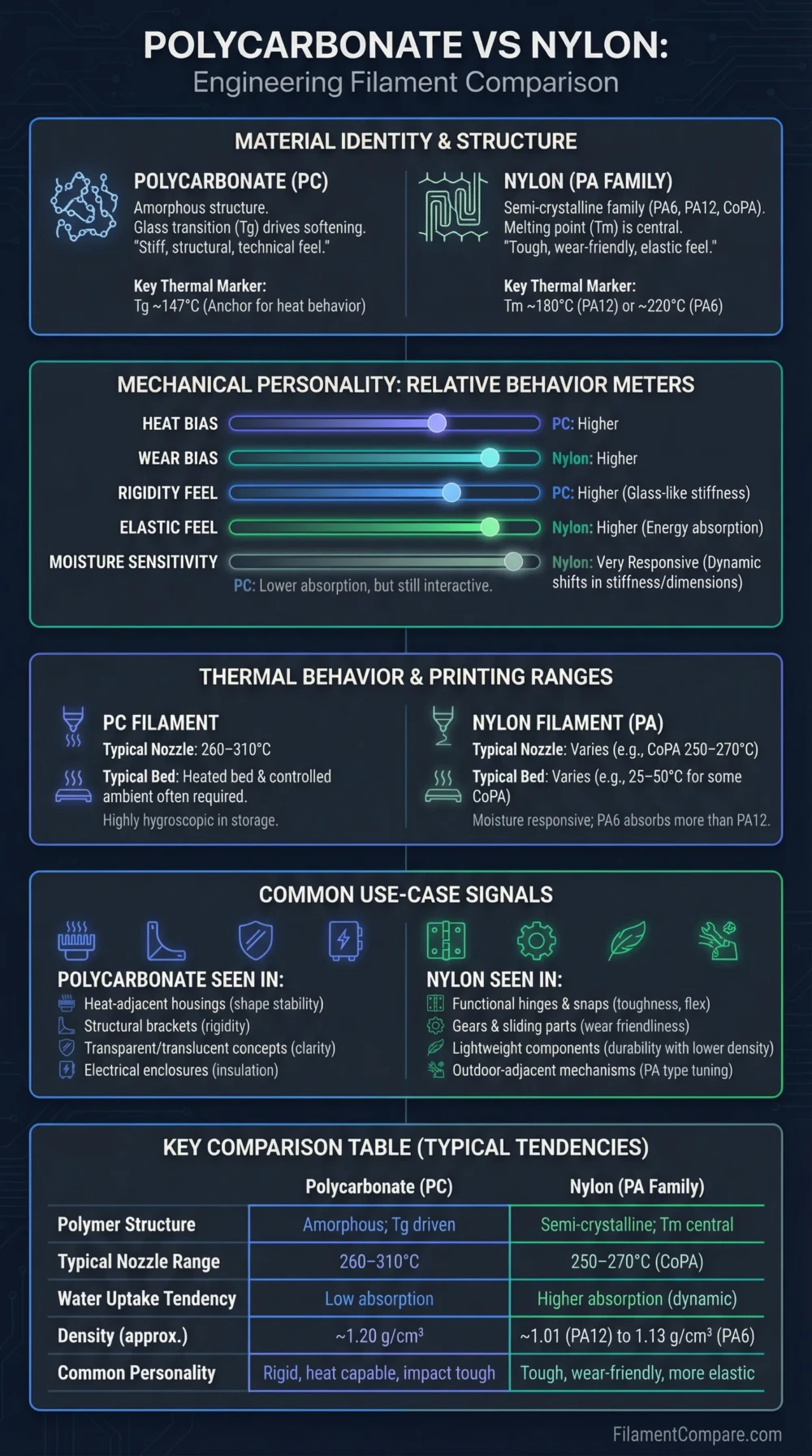
Polycarbonate stays stiffer and usually retains its shape better in warm service, while nylon bends farther, tolerates repeated movement well, and often suits wear-facing parts. Both are engineering filaments that demand dry material and capable hardware, but they fail in different ways. Choose PC for rigid housings, heat-adjacent fixtures, and impact-resistant structures; choose nylon for gears, clips, bushings, and parts that need toughness with controlled flex.
The Practical Choice
Choose polycarbonate when the part must stay rigid, hold dimensions under moderate warmth, or resist impact without feeling flexible. Choose nylon when repeated bending, low-friction contact, abrasion, or fatigue resistance matters more than maximum stiffness. Neither material is a universal replacement for the other, and some annealed or fiber-filled nylon grades can outperform standard PC in selected thermal or structural tests.
Rigid Structural Parts
Polycarbonate usually gives brackets, guards, and housings a firmer feel with less elastic movement.
Gears and Bushings
Nylon is often preferred for sliding contact, repeated motion, and wear-facing geometry.
Moderate Heat Exposure
Polycarbonate is the simpler default when shape retention matters and post-print annealing is not planned.
Living Hinges and Clips
Nylon generally tolerates more repeated deflection before a thin feature becomes brittle.
Dimensional Consistency
Polycarbonate is usually less affected by ambient moisture after printing, although the filament still needs dry storage.
Impact With Flex
Nylon can absorb energy through deformation rather than relying mainly on rigidity.
Clear or Translucent Concepts
Polycarbonate has the better optical starting point, though FFF layer lines prevent glass-like clarity.
Lower Bed Temperature
Some nylon grades print on cooler beds than PC, but PA6, PA12, CoPA, and filled nylons do not share one universal profile.
| Decision Area | Polycarbonate (PC) | Nylon (PA Family) | More Suitable Choice |
|---|---|---|---|
| Material Family | Amorphous engineering thermoplastic; many spools are modified PC blends | Semi-crystalline polyamide family including PA6, PA12, PA11, CoPA, and blends | Depends on grade |
| Print Difficulty | Advanced; high thermal contraction and chamber control often matter | Advanced; moisture, adhesion, and grade-specific warping require attention | Neither is beginner-first |
| Typical Nozzle Temperature | Usually about 250–290°C for printable PC blends; one official profile lists 250–270°C[a] | Usually about 240–285°C across unfilled PA grades; one CoPA profile lists 250–270°C[b] | Printer-dependent |
| Typical Bed Temperature | Often 90–115°C | About 25–110°C depending on PA type, blend, and build surface | Nylon can need less heat |
| Enclosure Need | Strongly recommended; a heated chamber helps large parts | Recommended for many unfilled grades; selected low-warp or fiber-filled grades may differ | Grade-dependent |
| Drying Need | High; wet PC can string, foam, and lose surface quality | Very high; many nylons absorb moisture rapidly and may need printing from a dryer | PC is usually easier to keep stable |
| Heat-Related Shape Retention | Usually predictable in standard unfilled printing grades | Ranges widely; annealed PA6, CoPA, and reinforced grades can be very heat capable | PC for simplicity; nylon by grade |
| Stiffness | Usually higher in the finished part | Can be stiff when dry, then soften as moisture content rises | Polycarbonate |
| Repeated Flex and Fatigue | Tough but generally less forgiving in thin flexing features | Often better for clips, hinges, and cyclic deflection | Nylon |
| Layer Adhesion | Can be strong with enough chamber and nozzle heat | Often very good when dry and printed hot enough | Both can perform well |
| Wear and Sliding Contact | Usable, but not the usual first choice for low-friction motion | Commonly selected for gears, bushings, guides, and wear surfaces | Nylon |
| Dimensional Stability in Humidity | Usually more stable than common unfilled nylons | Moisture can alter dimensions, modulus, and fit | Polycarbonate |
| Surface Finish | Can be smooth and glossy; warping or wet filament can spoil walls | Often satin to semi-matte; moisture can cause bubbles and rough extrusion | Aesthetic preference |
| Outdoor Use | Use a UV-stabilized grade when long exposure is expected | PA type, water uptake, and UV package must be checked | Neither by name alone |
| Typical Uses | Rigid housings, machine guards, hot-end-adjacent fixtures, impact-resistant brackets | Gears, bushings, clips, cable guides, hinges, wear parts, flexible functional components | Use-case based |
| Main Limitation | Warping, high bed and chamber demand, and aggressive bed adhesion | Moisture sensitivity, property drift after conditioning, and grade-to-grade variation | Different constraints |
This Polycarbonate vs Nylon comparison combines manufacturer data sheets and established technical guidance, so the values describe broad material trends rather than fixed results; brand, color, additives, moisture, geometry, orientation, and print settings can all change the outcome.
Material Profiles for Real Printing Conditions
Polycarbonate Material Profile
- Polymer type: Amorphous engineering thermoplastic, commonly sold as a print-tuned blend.
- Print difficulty: Advanced; thermal contraction and chamber temperature need control.
- Nozzle range: Commonly 250–290°C (verify the spool profile).
- Bed range: Commonly 90–115°C.
- Enclosure: Recommended; heated air is useful for large or thick parts.
- Drying: Required when exposed; typical maker-grade instructions range around 70–90°C for several hours.
- Typical behavior: Rigid, impact capable, heat tolerant, and prone to corner lift when the thermal environment changes.
- Best uses: Housings, fixtures, protective parts, structural brackets, and warm-service components.
Nylon Material Profile
- Polymer type: Polyamide family; PA6, PA12, PA11, CoPA, and blends behave differently.
- Print difficulty: Advanced; moisture condition can matter as much as slicer tuning.
- Nozzle range: Commonly 240–285°C for unfilled desktop grades.
- Bed range: About 25–110°C, depending on formulation and build surface.
- Enclosure: Often helpful; not mandatory for every low-warp or fiber-filled grade.
- Drying: Usually essential, and highly hygroscopic grades may print best directly from a heated dry box.
- Typical behavior: Tough, wear friendly, flexible in thin sections, and mechanically responsive to absorbed moisture.
- Best uses: Gears, bushings, clips, hinges, guides, wear components, and lightweight mechanisms.
Relative Performance by Printing Priority
Polycarbonate
Nylon
The meter values are relative indicators for printed-part selection, not laboratory ratings. A different resin grade, pigment, reinforcement, moisture condition, layer direction, wall count, or slicer profile can move any score.
Stiffness, Toughness, and Repeated Loading
“Strength” is too broad to settle this comparison. Polycarbonate usually feels stronger when the requirement is rigidity under load, resistance to sudden impact, or keeping a mounting face aligned. Nylon usually feels stronger when the requirement is surviving movement, bending without cracking, or absorbing repeated shocks.
A thick PC bracket can resist deflection better than a similar unfilled nylon bracket. A thin nylon latch may cycle many more times because it can flex and recover. For bolts, bearings, and press fits, the load duration also matters: nylon can creep under constant stress, and moisture can make that movement more noticeable. PC is not creep-free, but it generally offers a firmer baseline for dimension-sensitive fixtures.
Dry Nylon and Conditioned Nylon Are Not the Same Part
One CoPA data sheet reports a dry XY Young’s modulus of 2703 MPa and a moisture-conditioned value of 724 MPa, while notched impact rises from 6.9 to 27.7 kJ/m² under the manufacturer’s stated test conditions[c]. The practical lesson is not that every nylon will change by the same amount. It is that moisture can trade stiffness for ductility, so a fit checked immediately after drying may not match the same part after environmental conditioning.
Heat Resistance and Shape Retention
Polycarbonate is usually the more direct choice for a rigid part that will see moderate warmth. Printable PC blends often keep their shape better than common unfilled nylon grades without needing a separate annealing plan. Even so, “PC” does not guarantee one service temperature; blends can lower or shift thermal performance.
Nylon needs a grade-specific reading. PA6, PA12, PA11, and CoPA have different melting behavior, crystallinity, conditioning response, and heat deflection. An Ultimaker PA6/66-based nylon sheet lists 89.2 ± 5.6°C HDT at 0.455 MPa and a melting temperature of 188.4°C[d]. Those values describe that tested product, not every nylon spool. Annealed or fiber-reinforced grades may retain shape at higher temperatures, while moisture-conditioned unfilled nylon may become less rigid.
Hot car note: PC is generally more suitable than ordinary nylon for a rigid cabin part, but a closed vehicle can exceed the comfort range of many printable blends. Check the actual TDS, expected load, color, wall thickness, and whether the part sits near glass, a heater outlet, or direct sun.
Moisture, Drying, and Dimensional Change
Both materials need dry handling. Nylon is usually more sensitive and can absorb enough water to cause popping, bubbles, stringing, weak-looking surfaces, inconsistent extrusion, and changing mechanical behavior. PC can also print badly when wet, so it should not be treated like a low-maintenance filament simply because nylon absorbs more.
The more important difference appears after printing. Nylon continues to exchange moisture with the environment. That can alter stiffness, size, snap-fit force, and bearing clearance (especially with PA6). PC is usually more dimensionally steady in changing humidity, although its exact water uptake depends on the blend.
PC Storage Workflow
- Seal the spool with fresh desiccant after use.
- Dry before a long or appearance-sensitive print.
- Keep the feed path enclosed when room humidity is high.
- Listen for popping and inspect for a rough, foamy wall texture.
Nylon Storage Workflow
- Dry before tuning retraction or temperature.
- Print from an active dryer for highly hygroscopic grades.
- Condition finished test coupons before locking a press fit.
- Store samples and production spools under the same moisture routine.
Warping, Bed Adhesion, and Printer Requirements
PC normally asks more from the machine: an all-metal hotend, a bed that can remain near 100°C, a stable enclosure, and a surface protected by the correct adhesive or release layer. Prusa’s PC guidance lists a 275°C nozzle and 110–115°C bed for its PC Blend, warns that PC can warp and crack, and recommends a glue layer on selected surfaces to prevent damage from excessive adhesion[e].
Nylon settings are less uniform. Some CoPA and PA12 products use a relatively cool bed; other PA grades use much higher bed temperatures and benefit from a warm enclosure. Prusa’s general polyamide guidance uses 285°C nozzle and 110°C bed recommendations, describes low friction and abrasion resistance, and advises drying for at least four hours below 90°C[f]. Always follow the exact spool instructions rather than copying a generic “nylon profile.”
Hotend
Use an all-metal heat path rated above the selected nozzle temperature. PTFE-lined hotends may not be suitable.
Build Surface
PC may need a release layer; nylon may need PA adhesive, glue, or a dedicated sheet. The surface choice is material-grade specific.
Chamber
PC benefits strongly from stable warm air. Unfilled nylon often does too, while selected low-warp and fiber-filled grades can be more tolerant.
Wear, Friction, and Moving Parts
Nylon has the clearer advantage for gears, bushings, rollers, chain guides, and sliding mechanisms. Its lower-friction feel, abrasion resistance, and ability to deform slightly can reduce brittle tooth damage and help a moving interface tolerate small alignment errors.
That does not make every nylon gear accurate. Moisture can change tooth spacing and bore fit, while long-term load can cause creep. Use generous root fillets, confirm backlash after conditioning, and avoid treating a printed nylon bearing as a direct substitute for a rated industrial bearing.
PC works better when the moving part must remain rigid, carry a stable mounting geometry, or resist impact without much flex. It is less often chosen as the rubbing surface itself. For a mechanism, a PC frame with nylon wear inserts can be more sensible than forcing one polymer to do both jobs.
Surface Finish, Transparency, and Post-Processing
Natural PC can begin as a transparent or translucent resin, but an FFF print contains layer boundaries, internal air gaps, and surface texture. Thin walls may look clear enough for a light cover or inspection window, yet ordinary printing will not produce optical glass clarity. Sanding, coating, wall-only geometry, and matched extrusion can improve transmission, but they also change dimensions.
Nylon commonly produces a satin or lightly textured surface. It can be machined, drilled, dyed in some formulations, and smoothed mechanically, but absorbed moisture may affect cutting behavior. PC can also be drilled and sanded, though stress concentration and unsuitable solvents can trigger cracking. Test any adhesive, cleaner, paint, or vapor treatment on a sample from the same spool.
Fiber-filled variants: PC-CF and PA-CF are separate choices, not simple upgrades. Carbon fiber usually raises stiffness, lowers warping, changes impact behavior, and requires a wear-resistant nozzle. It can also make nylon behave more like a rigid structural material, reducing the difference seen between plain PC and plain nylon.
Best Material by Part Type
| Use Case | More Suitable Material | Reason |
|---|---|---|
| Rigid machine bracket | Polycarbonate | Higher stiffness and more stable alignment under moderate warmth. |
| Snap-fit enclosure clip | Nylon | Better tolerance for repeated deflection, provided the fit accounts for moisture conditioning. |
| Spur gear | Nylon | Wear behavior, lower-friction contact, and fatigue resistance suit repeated motion. |
| Protective electronics housing | Polycarbonate | Rigid walls, impact resistance, and heat-related shape retention are useful. |
| Cable chain link | Nylon | Repeated flex and impact absorption are usually more useful than maximum rigidity. |
| Hotend fan duct | Polycarbonate | Common PC blends are often chosen for heat-adjacent printer components (confirm distance and airflow temperature). |
| Bushing or sliding guide | Nylon | Low-friction and abrasion-friendly behavior better matches the contact surface. |
| Dimension-sensitive fixture | Polycarbonate | Humidity usually changes the finished dimensions less than it does with common unfilled nylon. |
| Thin living hinge | Nylon | Flexible thin sections can survive more cycling when geometry and layer direction are correct. |
| Translucent light guard | Polycarbonate | Natural PC has a better optical base, though layer lines remain visible. |
| Large flat panel | Neither is easy | Both can warp; PC needs strong chamber control, while nylon selection and moisture preparation become decisive. |
| Outdoor mechanism | Grade-dependent | Use UV-stabilized grades and account for water uptake; ASA may be a simpler option for a rigid exposed housing. |
| Food-contact container | Neither by material name | Grade certification, colorants, nozzle history, layer porosity, cleaning, coating, and local rules must all be checked. |
Where Each Material Fits Better
Choose Polycarbonate When
- The part must stay rigid under load.
- Moderate heat exposure is expected.
- Impact resistance matters, but flexible movement is not the main function.
- Humidity-related dimensional change must be limited.
- The design is a housing, guard, bracket, fixture, or structural frame.
- The printer has a hot bed and controlled chamber.
Polycarbonate Is Less Suitable When
- The printer cannot maintain high nozzle, bed, and chamber temperatures.
- The part covers most of the build plate and cannot tolerate corner lift.
- A thin feature must bend thousands of times.
- The build surface cannot be protected from aggressive adhesion.
- The rubbing face needs low friction and sustained wear behavior.
Choose Nylon When
- The part needs controlled flex, toughness, or repeated movement.
- Gears, bushings, rollers, clips, and guides are the main use.
- Low-friction contact is more useful than maximum stiffness.
- Thin sections must absorb impact without cracking.
- A lightweight mechanism can tolerate moisture-aware fit design.
- The spool can be dried and kept dry during printing.
Nylon Is Less Suitable When
- A tight tolerance must remain unchanged across humidity swings.
- The part carries a constant load that could cause creep.
- Drying and active spool management are not practical.
- The exact PA grade is unknown or its data sheet is unavailable.
- A rigid, heat-adjacent housing is needed without annealing or conditioning tests.
Material Selection Matrix
Best Choice by Priority
Choose polycarbonate if the design needs rigidity, impact resistance, warm-service shape retention, and steadier dimensions in changing humidity. It is the more direct choice for structural housings and fixtures when the printer can control warping.
Choose nylon if the design needs wear resistance, repeated flex, low-friction motion, or impact absorption through controlled deformation. It is the more useful choice for gears, clips, bushings, and moving components when drying and moisture-conditioned tolerances are part of the process.
Do not decide by tensile strength alone. Compare stiffness, layer direction, impact mode, fatigue, creep, humidity, temperature, and contact wear. A tested PA-CF or annealed nylon may beat an ordinary PC blend in one target property, while a print-tuned PC may remain easier to dimension and validate for a rigid assembly.
Polycarbonate vs Nylon Questions
Is polycarbonate stronger than nylon?
Polycarbonate is usually stiffer and better at holding shape under load. Nylon is often tougher in repeated flex, wear, and fatigue. The answer changes with PA type, PC blend, moisture, reinforcement, print orientation, and test method.
Which filament is better for gears?
Nylon is usually the better starting point because it combines wear resistance, low-friction behavior, and tooth toughness. Check backlash after the part has reached its normal moisture condition.
Does polycarbonate also need drying?
Yes. PC absorbs moisture and can string, foam, pop, or lose surface quality when wet. Nylon is normally more demanding, but both should be sealed and dried according to the spool maker’s instructions.
Can an open-frame printer handle PC or nylon?
Small parts made from a print-tuned PC blend or low-warp nylon may succeed, but a stable enclosure improves reliability for many grades. Large unfilled PC and nylon parts are much more sensitive to drafts and uneven cooling.
Is nylon always more heat resistant than PC?
No. Nylon covers many PA types, and thermal performance changes with crystallinity, moisture, annealing, and reinforcement. Standard PC often offers a more predictable rigid heat response, while selected annealed or reinforced nylons can exceed it.
Are PC and nylon prints safe for food contact?
Material family names are not enough to make that claim. The exact certified grade, pigments, additives, nozzle material, previous filament contamination, layer porosity, cleaning method, coating, temperature, and local requirements all matter.
Technical Resources Consulted
- [a] PolyMax™ PC (Official Polymaker technical data page used for the cited PC nozzle range and for checking bed, chamber, drying, thermal, and mechanical reference values. The manufacturer notes that printed-part results change with process conditions.)
- [b] PolyMide™ CoPA (Official Polymaker product page used for the cited CoPA nozzle range and for checking the matching bed and annealing profile. It represents one nylon copolymer rather than the whole PA family.)
- [c] PolyMide™ CoPA (The official Polymaker data page supports the dry and moisture-conditioned modulus and impact example in the mechanical section. Values apply only to the stated specimen preparation and conditioning method.)
- [d] Ultimaker Nylon Technical data sheet (Official manufacturer TDS used for the cited HDT and melting-temperature example. It also identifies the tested nylon’s intended applications and limits.)
- [e] Polycarbonate (PC) (Prusa Research material guidance used for the cited PC Blend temperatures, enclosure advice, warping behavior, moisture handling, and build-surface separation warning.)
- [f] Polyamide (Nylon) (Prusa Research material guidance used for the cited general polyamide temperatures, drying instruction, abrasion behavior, low-friction use, and enclosure considerations.)
