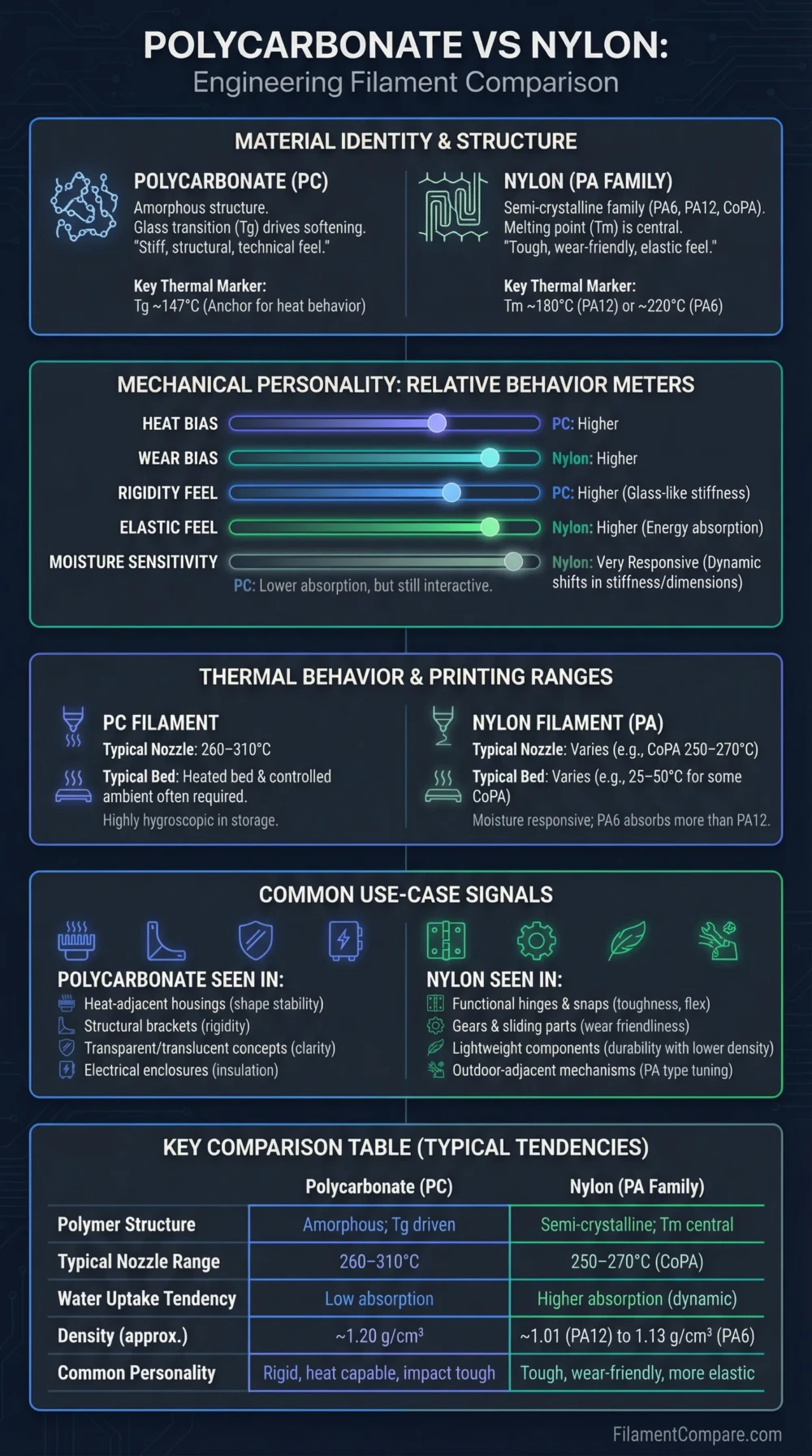
Nylon filament is widely recognized as moisture responsive because polyamides attract and hold water molecules inside the polymer structure. That can shift stiffness, dimensions, and the “feel” of a part over time. PC filament also interacts with moisture, yet typical resin sheets often show lower absorption numbers than many PA grades. Both materials are commonly discussed alongside other engineering-grade 3D printing filaments when evaluating performance in functional prints.
- Mechanical Personality: Stiffness, Toughness, and Flex
- Printing Ranges You’ll See on Real Filament Profiles
- Use-Case Signals When You Compare PC and Nylon
- Polycarbonate Is Commonly Seen In
- Nylon Is Commonly Seen In
- Material Identity and What “Nylon” Really Means
- Thermal Behavior That Shows Up in Real Parts
- Polycarbonate Heat Identity
- Nylon Heat Identity
- Moisture Interaction and Why It Matters for Nylon vs PC
- Mechanical Personality: Stiffness, Toughness, and Flex
In open-access testing on 3D printed polymers, researchers observed that nylon-based specimens absorbed markedly more water than PLA and that changes in moisture exposure tracked with changes in flexural behavior (including large shifts in modulus over immersion time), highlighting how nylon can be mechanically dynamic under moisture + temperature exposure✅Source
Mechanical Personality: Stiffness, Toughness, and Flex
Relative Behavior (Typical Trends, Grade Dependent)
Polycarbonate parts often read as stiff and structural. When people describe a PC print as “solid,” they usually mean the combination of rigidity and impact-capable behavior that still feels confident at elevated temperatures.
Nylon prints often feel tough in a different way: less “glass-like” stiffness and more energy absorption with a wear-friendly surface character. Many nylon parts also feel smoother in motion, which is why polyamides show up in gears, sliding interfaces, and mechanical contact roles.
Printing Ranges You’ll See on Real Filament Profiles
- PC filament commonly appears with higher nozzle requirements and is frequently paired with controlled ambient printing environments for consistency.
- Nylon filament ranges depend on the PA type; many “nylon” spools are PA6, PA12, or CoPA blends with slightly different thermal profiles.
- Moisture interaction is commonly discussed for both families; nylon is typically more responsive, while PC is often lower uptake in resin datasheets.
A nylon filament example: a CoPA nylon profile lists 250–270°C nozzle temperature, 25–50°C build plate temperature, and notes that the material is very hygroscopic (moisture interactive)✅Source
Use-Case Signals When You Compare PC and Nylon
Polycarbonate Is Commonly Seen In
- Heat-adjacent housings where shape stability matters
- Structural brackets that favor rigidity and a technical feel
- Transparent or translucent concepts where clarity is part of the design language
- Electrical enclosures where insulation is part of the expectation
Nylon Is Commonly Seen In
- Functional hinges and snap-like parts where toughness and flex feel are valued
- Gears and sliding parts where wear friendliness and surface behavior matter
- Lightweight mechanical components where durability can pair with lower density
- Outdoor-adjacent mechanisms where PA type selection (PA12 vs PA6) can tune moisture response
| Category | Polycarbonate (PC) Filament | Nylon (PA) Filament (PA6 / PA12 / CoPA Family) |
|---|---|---|
| Polymer Structure | Amorphous; glass transition drives softening behavior | Semi-crystalline family; melting point is central (varies by PA type) |
| Typical Nozzle Range | 260–310°C is commonly listed for PC filament profiles | 250–270°C is commonly listed for CoPA-style nylon profiles (varies by PA type) |
| Typical Bed Range | Often paired with heated beds and controlled ambient setups | Ranges vary; some nylon profiles list 25–50°C for specific CoPA formulations |
| Key Thermal Marker | Glass transition around 147°C (material-dependent) | Melting temperature often around 180°C (PA12) or 220°C (PA6) in resin datasheets |
| Water Uptake Tendency | Typically low water absorption compared to polyamides | Typically higher water absorption (especially PA6); PA12 is usually lower than PA6 |
| Density (Typical Resin Datasheet Values) | Around 1.20 g/cm³ (grade dependent) | Often around 1.01 g/cm³ (PA12) to 1.13 g/cm³ (PA6) (grade dependent) |
| Common “Personality” in Parts | Rigid, heat capable, often impact tough | Tough, often wear-friendly, can feel more elastic |
This comparison focuses on PC filament and the broader nylon filament family (PA6, PA12, and blends). Numbers can shift by brand, additives, and color, so the most trustworthy way to read them is as material tendencies rather than a single universal spec.
Verified reference points that help anchor the comparison: PC shows a glass transition around 147°C and is described as generally amorphous✅Source
PC resin datasheet examples commonly list density around 1.20 g/cm³ and low water absorption values such as 0.15% (23°C / 50% RH) and 0.36% (23°C water), with “rigidity up to 140°C” stated for typical grades✅Source
Material Identity and What “Nylon” Really Means
Polycarbonate (PC) is typically discussed as a single, recognizable engineering plastic. In filament form, PC filament usually keeps the same core identity: rigid, heat-capable, and often chosen when a part needs a stiff structure with a technical feel.
Nylon is different. “Nylon filament” is a family label for polyamides (PA), and the most common names you’ll see are PA6, PA12, and copolyamides (often written as CoPA). That matters because PA6 and PA12 can behave like cousins: same overall vibe, different details.
- Glass Transition Temperature (Tg)
- Tg is where an amorphous polymer shifts into a softer, more rubbery response. For PC, Tg is a key anchor for heat behavior.
- Melting Temperature (Tm)
- Tm is where semi-crystalline polymers melt. For nylon (PA), Tm is one of the main thermal signposts.
- Water Absorption (ISO 62)
- Water absorption changes mass and dimensions and can shift stiffness. PA6 usually absorbs more than PA12; PC is typically lower.
Thermal Behavior That Shows Up in Real Parts
Polycarbonate Heat Identity
PC typically leans on Tg-driven behavior rather than a sharp melting point. When you see PC used for heat-exposed parts, it’s usually because the stiffness and shape stability stay convincing in warmer environments.
Filament makers commonly publish higher nozzle requirements for polycarbonate filament. One widely used reference lists 260–310°C as the nozzle range and also describes PC as highly hygroscopic (moisture-interacting) in storage and handling✅Source
Nylon Heat Identity
Nylon (PA) is typically semi-crystalline, so you’ll often see a more direct focus on melting temperature and heat deflection. The “nylon feel” in parts often combines toughness with a more forgiving flex profile than PC.
Resin datasheets show how much PA type changes the story: a PA12 technical datasheet lists 180°C melting temperature, 1.6% water absorption (equilibrium, immersion), and 1.01 g/cm³ density, with thermal values like Vicat 142°C and HDT (0.45 MPa) 135°C✅Source
PA6 reference point: a PA6 product datasheet lists density 1130 kg/m³ (about 1.13 g/cm³), water absorption 9–10% (saturation in water at 23°C), moisture absorption 2.6–3.4% (23°C / 50% RH), and melting temperature 220°C (DSC)✅Source
Moisture Interaction and Why It Matters for Nylon vs PC
Nylon filament is widely recognized as moisture responsive because polyamides attract and hold water molecules inside the polymer structure. That can shift stiffness, dimensions, and the “feel” of a part over time. PC filament also interacts with moisture, yet typical resin sheets often show lower absorption numbers than many PA grades.
In open-access testing on 3D printed polymers, researchers observed that nylon-based specimens absorbed markedly more water than PLA and that changes in moisture exposure tracked with changes in flexural behavior (including large shifts in modulus over immersion time), highlighting how nylon can be mechanically dynamic under moisture + temperature exposure✅Source
Mechanical Personality: Stiffness, Toughness, and Flex
Relative Behavior (Typical Trends, Grade Dependent)
Polycarbonate parts often read as stiff and structural. When people describe a PC print as “solid,” they usually mean the combination of rigidity and impact-capable behavior that still feels confident at elevated temperatures.
Nylon prints often feel tough in a different way: less “glass-like” stiffness and more energy absorption with a wear-friendly surface character. Many nylon parts also feel smoother in motion, which is why polyamides show up in gears, sliding interfaces, and mechanical contact roles.
