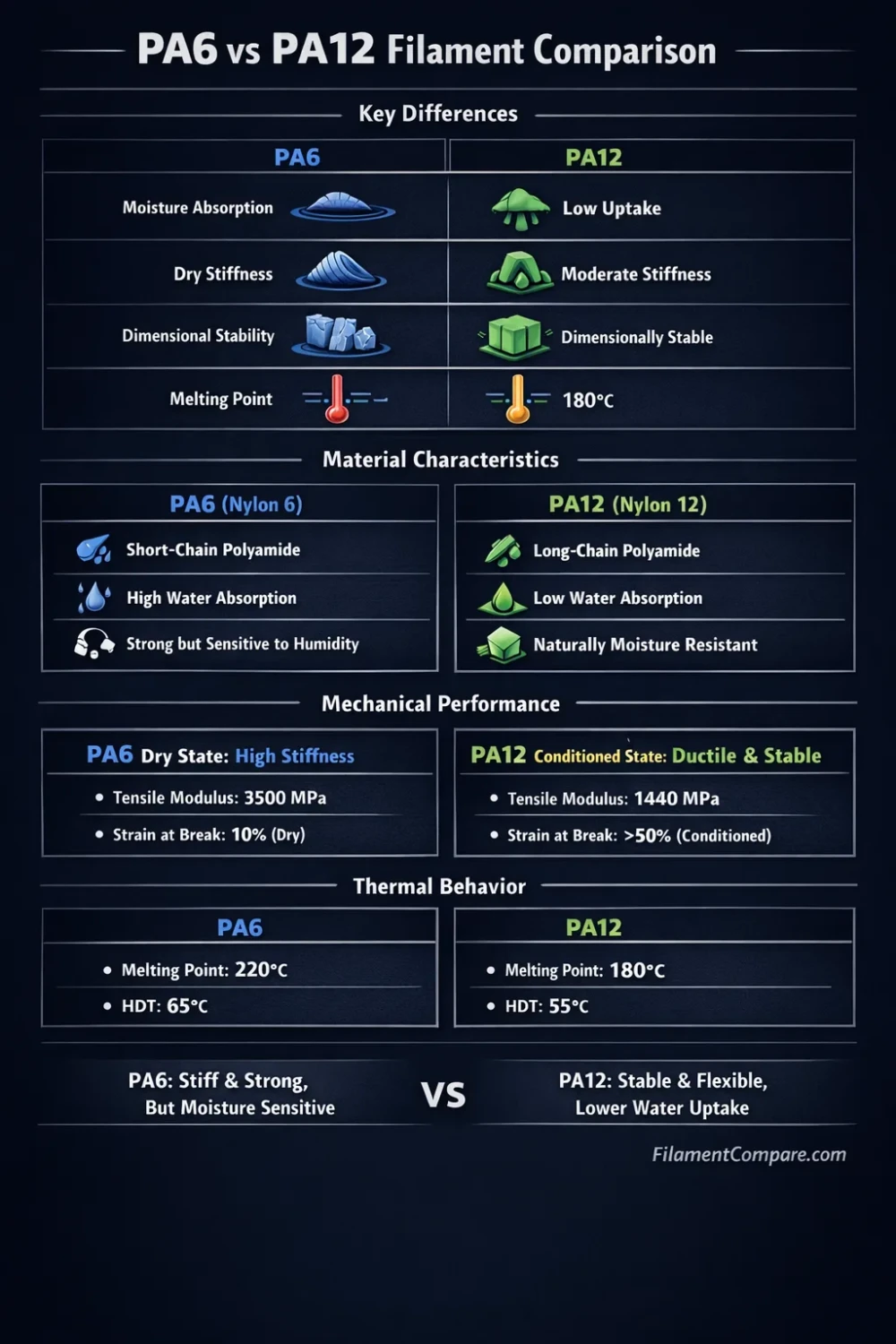
| Property | PA6 (Nylon 6) | PA12 (Nylon 12) | What It Usually Means for Filament Use |
|---|---|---|---|
| Reference Grade Behind The Numbers | Ultramid® B3S (unfilled PA6) | Rilsamid® AESNO TL (unfilled PA12) | Real filaments can shift with brand formulation, fillers, and moisture state. |
| Polymer Chain “Type” | Shorter-chain polyamide | Longer-chain polyamide | Chain length often shows up as differences in moisture uptake and “feel” (stiff vs flexible). |
| Density | 1130 kg/m³ | 1.01 g/cm³ | PA12 commonly sits on the lighter side for similar part volume. |
| Melting Temperature (DSC) | 220 °C | 180 °C | Melting point influences the thermal window and the “heat headroom” of the polymer family. |
| Melt Volume-Flow Rate (MVR) | 160 cm³/10 min (275 °C / 5 kg) | 8 cm³/10 min (235 °C / 5 kg) | MVR is a flow indicator but test temperatures differ, so treat it as a directional clue. |
| Water Absorption In Water (23 °C) | 9–10% (saturation) | 1.6% (equilibrium) | This is the headline difference behind dimensional stability and “dry vs conditioned” behavior. |
| Moisture Absorption In Air (23 °C / 50% RH) | 2.6–3.4% | Not listed in this grade sheet | Grade sheets often separate humid air vs water immersion; compare like-for-like conditions. |
| Tensile Modulus (MPa) | 3500 (dry) / 1200 (conditioned) | 1500 (dry) / 1440 (conditioned) | PA6 can feel very stiff when dry, then noticeably more flexible with moisture. |
| Tensile Yield Strength (MPa) | 90 (dry) / 45 (conditioned) | 50 (dry) / 43 (conditioned) | Yield strength shifts show how moisture can “move” load-bearing behavior. |
| Strain At Break | 10% (dry) / >50% (conditioned) | >50% (dry) / >50% (conditioned) | PA12 often reads as consistently ductile across moisture states in many unfilled grades. |
| HDT (1.8 MPa) | 65 °C | 55 °C | HDT is one way to compare shape retention under load at elevated temperature. |
| Hardness (Shore D) | 81 (dry) / 70 (conditioned) | 73 (dry) / 72 (conditioned) | Hardness changes hint at surface feel and “firmness” as moisture changes. |
| Molding Shrinkage (ISO 294-4) | 0.9% (parallel) / 0.9% (normal) | 1.1–1.2% (parallel) / 1.1–1.2% (normal) | Shrink is a useful dimensional clue, but printing geometry and cooling can shift outcomes. |
This PA6 and PA12 comparison pulls from manufacturer datasheets plus carefully checked reference standards, so the values reflect typical trends under standard test conditions and real filament results can vary with grade selection, moisture state, and process setup [Source-2✅].
- Relative Property Snapshot
- Material Identity and Chemistry
- Moisture Interaction and Dimensional Behavior
- PA6 Moisture Profile
- PA12 Moisture Profile
- Mechanical Performance: Dry and Conditioned
- PA6 Mechanical Signature
- PA12 Mechanical Signature
- Thermal Behavior and Flow Data
- PA6 Thermal Notes
- PA12 Thermal Notes
- Dimensional Change and Shrinkage Signals
- Chemical Contact and Wear Personality
- What Commonly Moves The Numbers
- Plain-Language Take On The Comparison
PA6 and PA12 sit under the broad “nylon filament” umbrella and are commonly grouped with other engineering-grade 3D printing filaments, yet they can feel like two different materials once moisture, stiffness, and thermal behavior enter the picture. The goal here is simple: clear, spec-linked differences you can map to real part expectations without fluff.
Important Context: “PA6 filament” and “PA12 filament” are often sold in multiple grades (unfilled, glass-filled, carbon-filled, plasticized, copolyamide blends). That’s why ranges and conditioning notes matter more than a single number.
Relative Property Snapshot
Moisture Uptake Tendency (lower is usually steadier)
Dry Stiffness “Feel” (unfilled grades)
Ductility Consistency Across Moisture (dry vs conditioned)
Thermal Headroom (melting point + HDT trend)
Material Identity and Chemistry
- PA6 (Nylon 6)
- Single-monomer nylon commonly produced via ring-opening polymerization of caprolactam [Source-4✅].
- PA12 (Nylon 12)
- A long-chain polyamide made from a 12-carbon chain monomer (often cited as omega-aminolauric acid or laurolactam), which links closely to lower moisture uptake versus shorter-chain nylons [Source-5✅].
- Why Chain Length Matters
- Longer-chain nylons often show less water affinity, steadier mechanical response in humidity, and a more flexible baseline feel in many unfilled grades.
Moisture Interaction and Dimensional Behavior
The most practical separation between PA6 and PA12 is how strongly they interact with water. Standardized test methods exist because moisture can shift dimensions and mechanical properties in measurable ways [Source-6✅].
PA6 Moisture Profile
- High saturation uptake is common for many PA6 grades (table values show 9–10% in water).
- Mechanical “feel” can shift noticeably between dry and conditioned states.
- Datasheets often report both humid air and water immersion figures—compare the same condition.
PA12 Moisture Profile
- Lower water absorption is a defining trait in many PA12 families (table value: 1.6% in water for the referenced grade).
- Conditioning tends to produce a more stable mechanical response in many unfilled PA12 grades.
- PA12 is widely described as dimensionally steadier than shorter-chain nylons in humid environments.
Mechanical Performance: Dry and Conditioned
With nylon filaments, it’s normal to see two sets of mechanical numbers. One set reflects a drier state, the other reflects a conditioned state. That single detail explains why PA6 can read as “rigid today, pliable tomorrow,” while PA12 often stays closer to its baseline.
PA6 Mechanical Signature
- High dry stiffness is common in unfilled grades (table example: 3500 MPa dry modulus).
- Conditioning can move stiffness downward, producing a more forgiving bend behavior (table example: 1200 MPa conditioned modulus).
- Elongation can rise sharply with moisture, which can feel like added toughness in real parts.
PA12 Mechanical Signature
- Mid-range stiffness is common in many unfilled PA12 grades (table example: 1500 MPa dry modulus).
- Conditioned modulus often stays close to dry values in many PA12 grade sheets, supporting a steady feel.
- High elongation is frequently reported even in dry state, aligning with a ductile part behavior.
Thermal Behavior and Flow Data
Most spec sheets tie melting point to DSC testing, and that’s the cleanest way to compare PA6 vs PA12 without mixing process-specific assumptions. DSC methods are standardized for polymers and blends, which keeps thermal numbers more comparable across sources [Source-7✅].
PA6 Thermal Notes
- Higher melting point is common for PA6 families (table example: 220 °C).
- HDT values can look strong at lower load, showing shape retention potential in certain conditions.
- When reinforced (GF/CF), PA6 often shifts toward a stiffer and higher-HDT profile.
PA12 Thermal Notes
- Lower melting point is common for PA12 families (table example: 180 °C).
- HDT at 1.8 MPa often sits slightly lower than many PA6 unfilled grades, yet remains useful for many functional parts.
- Flow indicators (MVR) vary widely by grade, so grade-to-grade comparisons matter.
Dimensional Change and Shrinkage Signals
Shrinkage values come from molding standards, yet they still help describe how PA6 and PA12 can behave as cooling-driven, semi-crystalline polymers. A representative PA12 molding shrinkage set (1.1–1.2%) is published for one unfilled PA12 grade, which places it in a similar order of magnitude to many PA6 unfilled references [Source-3✅].
Why This Still Helps: Even when the test comes from molding, the same fundamentals drive filament outcomes: crystallization, thermal gradients, and polymer mobility. That’s why shrinkage should be read as a trend marker, not a guaranteed print dimension.
Chemical Contact and Wear Personality
Both PA6 and PA12 are widely used in functional environments, so most people care about oils, greases, and common fluids. PA12 is often highlighted for chemical resistance and for keeping properties steadier in humidity, while PA6 is widely used for strong, stiff applications when moisture state is controlled [Source-5✅].
On the PA6 side, technical overviews describe polyamide materials as showing high resistance to lubricants and various engine-related fluids, including many hydrocarbons, which is one reason nylon families appear so often in demanding part categories [Source-8✅].
What Commonly Moves The Numbers
If two spools are labeled “PA6” or “PA12,” the label tells you the family, not the exact performance. The grade modifiers below are the usual reasons the same nylon name can behave differently.
- Fillers and reinforcements (glass, carbon) shift stiffness, creep, and thermal response, often changing the “feel” more than the base polymer.
- Plasticization increases flexibility and can change impact behavior while also moving hardness and yield response.
- Copolyamides (blends within the nylon family) can shift crystallization behavior and melt characteristics, changing dimensional trends.
- Stabilizer packages can improve long-term property retention in specific environments without changing the polymer family name.
- Moisture state is a real “hidden variable” for nylon filament, especially for PA6, because conditioned and dry values can diverge.
Plain-Language Take On The Comparison
PA6 often shines when you want high dry stiffness and a classic nylon strength profile, with the understanding that moisture can shift the feel. PA12 often fits when you want a steadier nylon personality across humidity and a more naturally ductile baseline in many unfilled grades.
