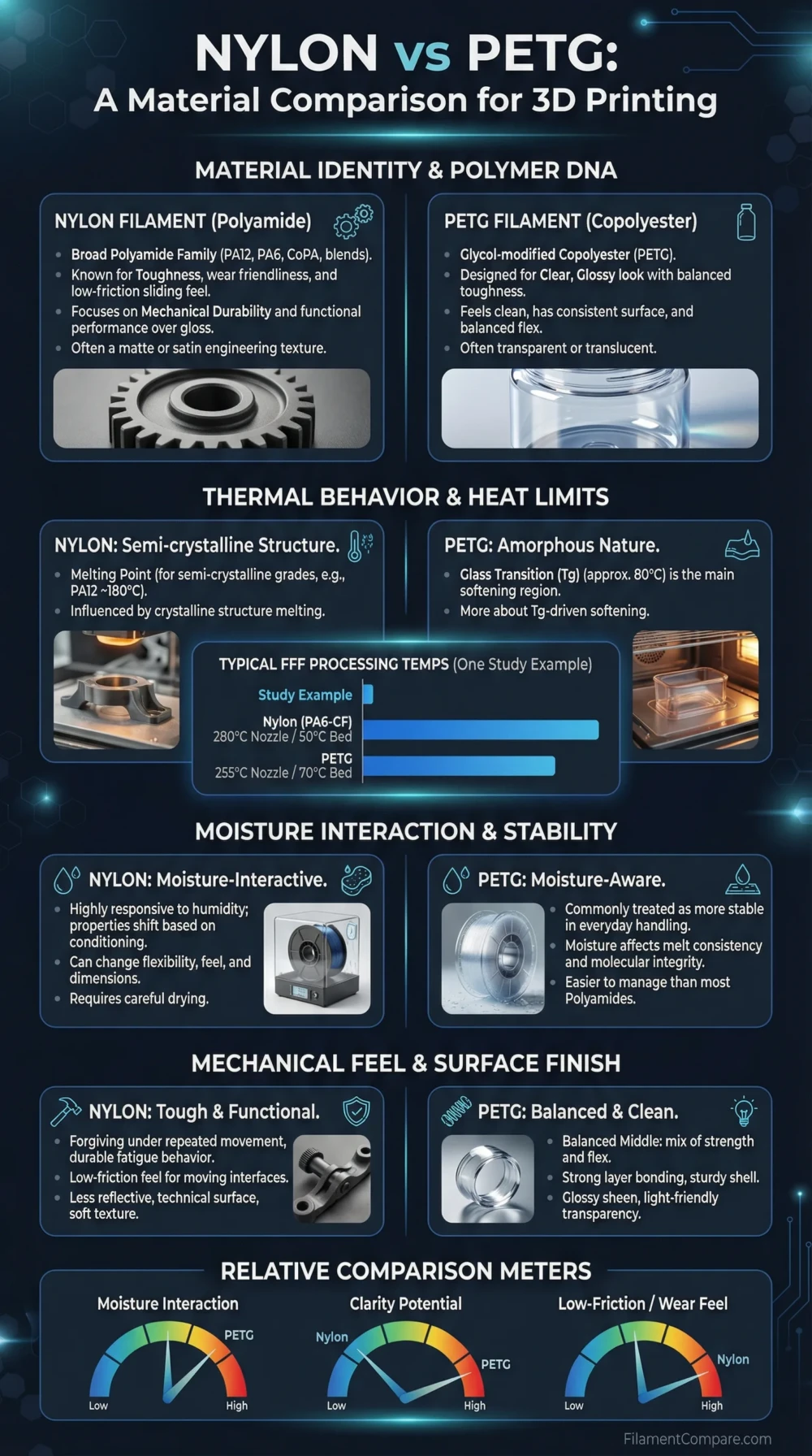
Nylon is usually the better choice for wear-resistant, impact-tolerant mechanical parts, while PETG is easier to print and more predictable on a normal desktop printer. PETG suits brackets, containers, fixtures, and everyday functional prints without much tuning. Nylon offers higher engineering potential, but it asks for dry filament, stronger bed adhesion control, and often a warmer print environment.
Choose PETG if you want a practical functional filament with low warping, good layer bonding, moderate heat resistance, and easier printer compatibility.
Choose Nylon if the part needs abrasion resistance, fatigue resistance, impact absorption, or long-term mechanical toughness and you can keep the filament dry before and during printing.
Best for First Functional Prints
PETG is more forgiving for users moving beyond PLA. It still needs temperature and retraction tuning, but it does not usually demand the same drying and enclosure discipline as Nylon.
Better for Wear-Prone Parts
Nylon is the better fit for bushings, sliding guides, gears, and hinges where rubbing or repeated motion matters more than simple stiffness.
Better for Large Flat Prints
PETG is usually easier to keep flat on the bed. Nylon grades can lift or distort if adhesion, drying, and ambient temperature are not controlled.
Better for Impact Absorption
Nylon tends to absorb impact better because it is tougher and less brittle in many printed part designs, especially when printed dry and hot enough for strong fusion.
Better for Moisture-Tolerant Workflow
PETG still benefits from drying, but it is less demanding than Nylon in day-to-day spool handling.
Better for Mechanical Prototypes
PETG is often the faster prototyping choice. Nylon becomes more useful when the prototype must behave closer to a moving or load-bearing engineering part.
| Category | Nylon | PETG | Better Choice |
|---|---|---|---|
| Material Family | Polyamide family, often PA6, PA12, PA6/66, or copolyamide | Glycol-modified polyester | Use-case based |
| Print Difficulty | Medium to high; moisture and warping are the main issues | Low to medium; stringing and bed adhesion tuning are common | PETG |
| Typical Nozzle Temperature | Usually around 250–270°C for many copolyamide grades; some low-temp nylons print lower[a] | Usually around 230–250°C, with brand profiles varying by formulation[b] | Printer-dependent |
| Typical Bed Temperature | Often 50–90°C depending on grade, build surface, and adhesion system | Usually around 70–90°C | Grade-dependent |
| Enclosure Requirement | Helpful, sometimes strongly recommended for larger parts | Usually not required, though draft control helps | PETG |
| Heat Resistance | Often better than PETG in engineering nylon grades, but varies widely by PA type and conditioning | Moderate; better than PLA but not a high-temperature engineering plastic | Nylon |
| Toughness | High toughness and impact absorption when printed well | Good toughness for everyday functional parts | Nylon |
| Stiffness | Can be less rigid than PETG in unfilled grades; filled nylon is different | Moderate stiffness with good part shape retention | Formulation-dependent |
| Layer Adhesion | Can be strong when dry and printed hot enough | Usually strong and reliable for normal desktop printing | PETG |
| Moisture Sensitivity | High; wet nylon can bubble, string, weaken, and print with rough surfaces | Moderate; wet PETG can string and lose finish quality | PETG |
| Surface Finish | Matte to semi-matte, sometimes slightly textured | Glossy to semi-gloss, with possible stringing | Preference-based |
| Outdoor Suitability | Usable in selected applications, but moisture uptake and UV exposure need attention | More common for mild outdoor fixtures than PLA, but not a substitute for ASA or UV-stabilized grades | Condition-dependent |
| Typical Uses | Gears, bushings, hinges, clips, fixtures, mechanical parts, wear surfaces | Brackets, containers, mounts, printer parts, jigs, outdoor-ish utility parts | Use-case based |
| Main Limitation | Moisture control, bed adhesion, and warping sensitivity | Stringing, glossy finish, and lower wear performance than Nylon | Depends on priority |
This Nylon vs PETG comparison is based on manufacturer material guides and technical data sheets, so the trends are useful for selection, but real results still change with brand, color, additives, moisture level, nozzle temperature, cooling, and print orientation.
Nylon Material Profile
- Polymer type: Polyamide, commonly PA6, PA12, PA6/66, or copolyamide.
- Print difficulty: More tuning-sensitive than PETG.
- Nozzle range: Often 250–270°C for many desktop nylon grades; low-temp grades exist.
- Bed range: Commonly 50–90°C depending on formulation and build surface.
- Enclosure: Helpful for larger or warp-sensitive parts.
- Drying need: High. Nylon should be dried before printing and stored sealed with desiccant.
- Typical behavior: Tough, wear-resistant, slightly flexible, moisture-sensitive.
- Best use cases: Gears, bushings, hinges, jigs, fixtures, clips, and moving mechanical parts.
PETG Material Profile
- Polymer type: Glycol-modified polyester.
- Print difficulty: Easier than Nylon, but more stringing-prone than PLA.
- Nozzle range: Usually 230–250°C, with some high-flow grades using different profiles.
- Bed range: Usually 70–90°C.
- Enclosure: Usually not needed for normal-sized parts.
- Drying need: Moderate. Drying improves stringing control and surface finish.
- Typical behavior: Tough, slightly flexible, glossy, low-warp compared with many engineering filaments.
- Best use cases: Brackets, printer parts, boxes, organizers, mounts, tool holders, and general utility prints.
These bars are relative print-use indicators, not lab ratings. Brand, grade, additives, moisture content, print orientation, wall count, infill, cooling, and slicer settings can move the result in either direction.
Printability and Tuning Differences
PETG is the easier material for most desktop printers. It needs a heated bed, controlled cooling, and retraction tuning, but the workflow is familiar: load the filament, set the right profile, manage stringing, and watch first-layer adhesion. PETG can stick too strongly to some smooth build plates, so a release layer may be useful depending on the surface.
Nylon is more demanding because the material is highly moisture-sensitive and more likely to warp. Wet nylon often produces popping, bubbles, rough layers, weak surface quality, and extra stringing. Prusa’s nylon guidance specifically emphasizes drying polyamide before printing and using a high ambient temperature for better results[c].
For small parts, some nylon grades can print on open desktop machines. For larger fixtures or flat mechanical parts, a warm enclosure, suitable bed surface, dry box, and slow cooling become much more important.
Mechanical Behavior and Part Strength
Nylon and PETG are both useful for functional parts, but they do not fail in the same way. PETG is a good general-purpose material when a part needs toughness, layer adhesion, and a little flex without the brittleness of PLA. It works well for brackets, mounts, tool holders, cases, and printer components.
Nylon is better when the part sees repeated movement, rubbing, vibration, or impact. It is commonly chosen for gears, bushings, snap elements, sliding parts, mechanical jigs, and hinge-like features. UltiMaker’s Nylon TDS lists high elongation at break in flat and side orientations, which helps explain why printed nylon can behave more ductile than many stiff desktop materials[d].
There is one important detail: moisture changes nylon behavior. A freshly dried nylon print may feel different from the same part after it has absorbed moisture from the air. This can make the part tougher and more flexible, but it can also affect dimensional stability. For tight assemblies, test-fit the part after conditioning, not only immediately after printing.
Heat Resistance and Shape Retention
Nylon generally has better engineering heat potential than PETG, especially in PA6, PA12, copolyamide, and fiber-filled grades. Polymaker’s PolyMide CoPA material is described as a Nylon 6 and Nylon 6.6 copolymer built for a balance of tensile strength and heat resistance[e]. That does not mean every nylon spool will outperform every PETG spool in every thermal test; grades vary heavily.
PETG has moderate heat resistance and is much more comfortable than PLA in warm indoor utility use. Prusament PETG is described as tough with good thermal resistance and low warping, which is one reason it is common for printer parts and utility components[f]. Still, hot car interiors, sustained load, or sun-heated dark parts can exceed what ordinary PETG handles comfortably.
For parts under both heat and load, do not select by material name alone. Check the exact grade’s TDS, print orientation, annealing notes, and whether the part is carrying load continuously.
Moisture Sensitivity and Storage
This is one of the biggest practical differences between Nylon and PETG. Nylon absorbs moisture quickly enough that storage and printing from a dry box can change the result. A spool that prints well on Monday can print poorly later if it sits open in a humid room.
PETG is also hygroscopic, but the workflow penalty is usually smaller. Wet PETG may show more stringing, oozing, surface haze, and rougher walls. Wet Nylon can show all of those plus more severe bubbling and mechanical inconsistency.
For Nylon, drying is not an optional polish step. It is part of the process. For PETG, drying is more of a quality-control step unless the spool has been stored badly or the print has demanding surface and strength requirements.
Surface Finish, Detail, and Dimensional Behavior
PETG often prints with a glossy or semi-gloss surface. It can look clean on simple models, but fine details may suffer if stringing, oozing, or over-soft cooling is not tuned. PETG also tends to leave stronger marks where supports contact the model.
Nylon often has a more matte, technical-looking finish. It can make strong functional parts, but small details and sharp corners are not usually its main advantage. Warping and moisture can also affect dimensional accuracy more than users expect, especially on long flat parts or tight mechanical assemblies.
For dimensional parts, PETG is usually easier to dial in. For moving parts that need sliding contact or wear resistance, Nylon may be worth the extra calibration.
Fiber-Filled Nylon and PETG Variants
Standard Nylon and standard PETG are only the baseline. Carbon fiber, glass fiber, high-speed, matte, recycled, translucent, and modified grades can change the comparison.
Carbon fiber or glass fiber nylon can become stiffer, more dimensionally stable, and easier to print with lower warp than unfilled nylon in some cases. The tradeoff is abrasive wear on brass nozzles, a rougher surface, possible lower layer ductility, and higher material cost. Use a hardened nozzle for abrasive filled grades.
PETG variants can also change the workflow. Some high-flow PETG grades reduce clumping and improve speed, while matte or filled PETG may reduce gloss. These variants do not turn PETG into Nylon; they simply shift its print behavior and finish.
| Use Case | More Suitable Material | Reason |
|---|---|---|
| Beginner functional prints | PETG | Easier workflow, lower warp risk, and fewer storage demands. |
| Printer brackets and utility mounts | PETG | Good layer adhesion and toughness without engineering-grade printer requirements. |
| Gears and sliding parts | Nylon | Better wear behavior and lower friction in many moving applications. |
| Large flat panels | PETG | Usually easier to keep flat and attached to the bed. |
| Snap-fit clips | Nylon or PETG | Nylon handles repeated flex better; PETG works for simpler clips with easier printing. |
| Outdoor utility parts | PETG | PETG is common for mild outdoor use, but long UV exposure may call for ASA or UV-stabilized grades. |
| Bushings and wear pads | Nylon | Better suited to rubbing contact and repeated motion. |
| Containers and boxes | PETG | Good toughness, easier sealing geometry, and simpler printing. |
| Mechanical jigs | Use-case based | PETG is easier for general jigs; Nylon is better for wear, impact, and repeated loading. |
| Tight tolerance assemblies | PETG | Less moisture-driven dimensional change and easier calibration. |
Choose Nylon When
- The part rubs, slides, pivots, or sees repeated motion.
- You need better impact absorption than ordinary PETG.
- The part must survive flexing or fatigue better than a stiff material.
- You can dry the spool and keep it dry during printing.
- Your printer can reach the needed nozzle temperature safely.
- You can manage bed adhesion, draft control, and possible warping.
Nylon Is Less Suitable When
- You do not have a filament dryer or sealed storage.
- The part is large, flat, and must stay dimensionally predictable.
- You need a simple print on an open-frame entry printer.
- The surface must be glossy or highly decorative.
Choose PETG When
- You want a functional filament that is easier than Nylon.
- The part is a bracket, mount, enclosure, holder, or utility component.
- Low warping and reliable bed adhesion matter more than wear resistance.
- You need good layer bonding on a typical desktop printer.
- You want a practical step up from PLA without a full engineering-material workflow.
- The part needs moderate heat resistance, not high-temperature performance.
PETG Is Less Suitable When
- The part is a gear, bushing, or sliding wear component.
- You need repeated flexing with high fatigue tolerance.
- Stringing-sensitive fine detail is the main goal.
- The part will face sustained heat under load.
Choose PETG for general functional printing, brackets, mounts, organizers, containers, printer parts, and low-warp utility parts. It is the more practical default for most desktop users.
Choose Nylon for moving mechanical parts, wear surfaces, impact-tolerant fixtures, hinge-like designs, and parts where toughness matters more than print convenience.
Neither material replaces the other. PETG wins on workflow and predictability; Nylon wins when the part has a real mechanical job and the printer setup can support it.
Common Nylon and PETG Questions
Is Nylon stronger than PETG?
Nylon is usually tougher and more wear-resistant, while PETG is easier to print with strong layer adhesion. “Stronger” depends on whether you mean tensile strength, stiffness, impact resistance, fatigue behavior, or layer bonding.
Does Nylon need an enclosure?
Small nylon parts may print without a full enclosure, depending on the grade. Larger or flatter nylon parts benefit from a warmer, draft-controlled environment because warping and edge lift become more likely.
Is PETG better for outdoor prints?
PETG is often used for mild outdoor utility parts, but it should not be treated as fully weatherproof. Long sun exposure, heat, load, and color choice affect lifespan. ASA or UV-stabilized materials are often better for long-term outdoor use.
Why does Nylon print badly after sitting out?
Nylon absorbs moisture from the air. Wet nylon can pop, bubble, string, and produce rough or weaker layers. Drying the spool and printing from a dry box can make a large difference.
Can PETG replace Nylon for gears?
PETG can work for light-duty gears or prototypes, but Nylon is usually the better choice for wear, rubbing contact, and repeated motion. For loaded gears, part design, print orientation, lubrication, and material grade matter as much as the material name.
Resources Used
- [a] PolyMide™ CoPA Technical Data Sheet — Used for Nylon CoPA print temperature, bed temperature, and controlled test context. It supports the Nylon profile and the technical settings ranges.
- [b] PETG – Prusa Knowledge Base — Used for PETG printing behavior, heated bed guidance, cooling notes, and common PETG tuning issues such as stringing and oozing.
- [c] Polyamide (Nylon) – Prusa Knowledge Base — Used for nylon drying, moisture behavior, and high ambient temperature guidance in the printability section.
- [d] Ultimaker Nylon Technical data sheet — Used for Nylon mechanical behavior, including printed tensile and elongation data across print orientations.
- [e] PolyMide™ CoPA — Used for the description of PolyMide CoPA as a Nylon 6 and Nylon 6.6 copolymer with heat and mechanical performance positioning.
- [f] Prusament PETG — Used for PETG’s general material positioning: toughness, thermal resistance, low warping, and common functional-print use.
