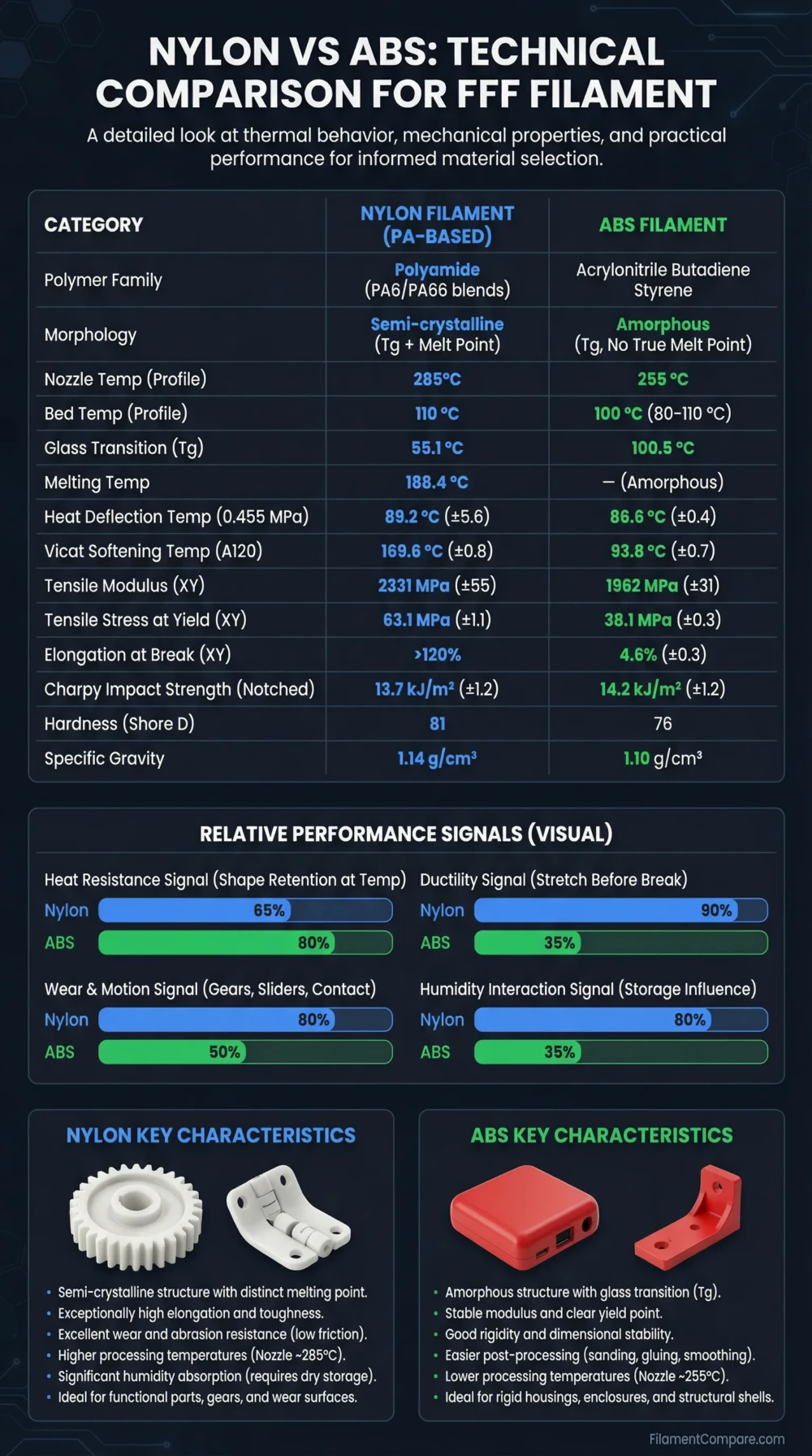
Nylon is tougher, more wear-resistant, and better for moving mechanical parts, while ABS is easier to post-process, usually more dimensionally stable after printing, and more practical for enclosed-printer functional prototypes. Nylon fits parts that need fatigue resistance, low friction, and impact absorption. ABS fits housings, brackets, covers, and parts that need moderate heat resistance without Nylon’s moisture control demands.
Choose Nylon when the part needs toughness, sliding wear resistance, impact absorption, or repeated flexing. It is the better engineering choice for gears, bushings, hinges, cable guides, and parts that see vibration or friction.
Choose ABS when you want a functional material with moderate heat resistance, smoother finishing options, lower moisture sensitivity, and a more predictable workflow in an enclosed FDM printer. It is usually the more practical choice for housings, prototypes, fixtures, and painted or acetone-smoothed parts.
Better for Wear Parts
Nylon handles sliding contact better because it has low friction and good abrasion behavior compared with many standard FDM plastics.
Better for Vapor Smoothing
ABS is the better fit when acetone vapor smoothing, solvent welding, sanding, priming, or painting is part of the workflow.
Better for Impact Absorption
Nylon usually absorbs shock better, especially in parts designed with enough wall thickness and correct print orientation.
Better for Dry Storage Simplicity
ABS is less demanding than Nylon for everyday storage, although both materials still benefit from clean, dry spool handling.
Better for Enclosed Printer Prototypes
ABS is often easier to tune for larger rigid prototypes when the printer has a stable enclosure and a heated bed.
Better for Functional Flex
Nylon is more suitable when a part needs slight controlled flex instead of ABS-style rigidity.
Better for Painted Parts
ABS sands and primes well, making it a strong option for visual prototypes that still need usable heat resistance.
Better for Chemical Exposure
Nylon can be a better fit for some oils, greases, and mechanical environments, but compatibility depends on the exact grade and chemical.
| Category | Nylon | ABS | Better Choice |
|---|---|---|---|
| Material Family | Polyamide; common FDM types include PA6, PA12, and blends | Acrylonitrile butadiene styrene thermoplastic | Depends on part requirement |
| Print Difficulty | High; moisture, warping, adhesion, and temperature control matter | Medium to high; enclosure and bed adhesion are important | ABS |
| Typical Nozzle Temperature | Usually about 230–260°C for some standard Nylon profiles, with PA6 grades often needing higher temperatures[a] | Usually about 225–260°C depending on printer, nozzle, and profile[b] | Similar range |
| Typical Bed Temperature | Often 40–70°C for some Nylon profiles, but higher-temperature Nylon grades may need hotter beds | Usually needs a heated bed; 80°C is used in UltiMaker ABS test conditions[c] | Printer-dependent |
| Enclosure Requirement | Strongly recommended for large or warp-prone parts | Strongly recommended, especially for large flat prints | Both benefit |
| Heat Resistance | Grade-dependent; many Nylon prints tolerate moderate warmth but can soften under load | UltiMaker describes ABS as heat resistant below 100°C[d] | Grade-dependent |
| Toughness | High; strong impact and fatigue behavior when printed dry and hot enough | Good impact resistance with more rigid behavior | Nylon |
| Stiffness | Usually less stiff than ABS unless reinforced with carbon fiber or glass fiber | More rigid in standard grades | ABS |
| Layer Adhesion | Can be very good when dry, hot, and enclosed | Good with stable chamber temperature and correct cooling | Settings-sensitive |
| Moisture Sensitivity | High; polyamide absorbs moisture and print quality changes noticeably[e] | Lower than Nylon, though dry storage is still useful | ABS |
| Surface Finish | Slightly matte or technical finish; can string if wet | Smoother finishing options; acetone smoothing is possible | ABS |
| Outdoor Suitability | Not ideal for long UV exposure unless the grade is stabilized or protected | Can discolor and lose properties outdoors without stabilizers | Use ASA for outdoor priority |
| Typical Uses | Gears, hinges, bushings, clips, mechanical fixtures, wear parts | Enclosures, covers, brackets, fixtures, prototypes, painted parts | Use-case based |
| Main Limitation | Moisture control and print tuning | Warping, odor, ventilation, and enclosure need | Different limits |
This Nylon vs ABS comparison uses manufacturer material guides, technical data sheets, and common FDM printing behavior; the real result can shift with grade, color, additives, drying, orientation, enclosure temperature, and slicer settings.
Material Profiles for Nylon and ABS
Nylon Material Profile
- Polymer type: Polyamide, commonly PA6, PA12, copolyamide, or filled Nylon grades
- Print difficulty: High, mainly because of moisture sensitivity and warping
- Nozzle range: Often 230–260°C for standard profiles; some PA6 grades need more
- Bed range: Commonly warm to hot, depending on grade and build surface
- Enclosure: Recommended for stable layer bonding and lower warp risk
- Drying need: High; wet Nylon causes bubbles, stringing, weak surfaces, and rough texture
- Typical behavior: Tough, slightly flexible, fatigue resistant, and good for sliding contact
- Best use cases: Gears, bushings, hinges, cable guides, living hinges, clamps, and mechanical parts
ABS Material Profile
- Polymer type: Acrylonitrile butadiene styrene
- Print difficulty: Medium to high, mostly because of warping and chamber control
- Nozzle range: Usually 225–260°C depending on printer and profile
- Bed range: Usually hot; bed adhesion and chamber stability matter
- Enclosure: Strongly recommended for larger parts
- Drying need: Moderate; less demanding than Nylon in normal storage
- Typical behavior: Rigid, impact resistant, machinable, sandable, and solvent-processable
- Best use cases: Housings, brackets, covers, fit-check prototypes, jigs, fixtures, and painted parts
Relative Performance Scores
These bars are relative FDM-use indicators rather than lab ratings. Brand, polymer grade, reinforcement, color, moisture level, part orientation, chamber temperature, and slicer settings can move the result noticeably.
Printability and Tuning
ABS and Nylon both ask for more control than PLA or PETG. The difference is where the control is needed. ABS mainly punishes unstable chamber temperature. Corners lift, layers split, and large flat parts can curl if the part cools unevenly. A closed printer, clean build plate, correct first-layer height, and reduced cooling fan are usually part of the ABS workflow.
Nylon adds moisture as a second major variable. A spool that printed well last week can suddenly string, foam, hiss, or produce rough surfaces after sitting in humid air. For reliable mechanical parts, Nylon should be dried before printing and, for longer jobs, often printed from a dry box. This is not just a cosmetic issue; wet Nylon can reduce layer quality and part consistency.
Printer Setup Difference
For ABS, the main upgrade is a stable enclosure with ventilation planning. For Nylon, the main upgrade is a dry filament path plus a hotend and build surface that match the exact Nylon grade.
Mechanical Behavior and Part Strength
Nylon is usually selected for toughness, fatigue resistance, and sliding wear. It is not simply “stronger” in every meaning of the word. Standard Nylon is often less rigid than ABS, so it can bend more before failure. That makes it useful for clips, living hinges, spring-like features, and parts that absorb shock.
ABS is more rigid and holds shape better in many enclosure-style parts. It works well for covers, brackets, prototypes, and fixtures where the part should feel firm instead of springy. Layer adhesion can be good, but ABS still needs temperature stability; cold drafts and high cooling can weaken tall prints or cause layer separation.
For loaded parts, print orientation matters as much as material choice. A Nylon gear printed wet may perform worse than a well-dried and well-oriented ABS part. A clean ABS bracket printed inside a stable enclosure may outperform a poorly tuned Nylon bracket. Material choice does not replace part design.
Heat Resistance and Shape Retention
Both materials handle heat better than PLA in many normal FDM uses, but neither should be described as universally heat-safe. ABS is commonly chosen for moderate-heat prototypes, electrical housings, and indoor functional parts. UltiMaker lists ABS as heat resistant below 100°C, but real printed parts can deform earlier under load, thin walls, or stressed geometry.
Nylon’s heat behavior depends heavily on the grade. PA6, PA12, copolyamide, and reinforced Nylon blends do not behave the same. Standard unfilled Nylon can become more flexible as temperature rises, while carbon fiber Nylon can hold shape better because the fiber raises stiffness and reduces shrink movement. Filled Nylon, however, may require a hardened nozzle.
Car interior note: ABS and Nylon may be more suitable than PLA for moderate warmth, but closed vehicles in direct sun can exceed the comfort range of many standard filaments. For heat-first parts, compare actual HDT or Vicat values from the exact filament datasheet.
Moisture, Storage, and Drying
Moisture is the biggest daily-use difference. Nylon is hygroscopic, so it absorbs water from air. The result can be stringing, bubbles, poor surface finish, inconsistent extrusion, and weaker printed parts. This is why Nylon users often need a dryer, sealed storage, desiccant, and a dry box during printing.
ABS is less sensitive to moisture than Nylon. It can still benefit from dry storage, especially in humid workshops, but it usually does not demand the same routine. If a printer is used in a school, shared shop, or garage where spools stay open for long periods, ABS is often easier to manage.
Nylon Storage Habits
- Dry before important mechanical prints.
- Print from a dry box when the job is long.
- Store in a sealed bag or container with fresh desiccant.
- Watch for popping sounds, extra stringing, and rough surfaces.
ABS Storage Habits
- Keep the spool away from dust and humidity.
- Dry if extrusion becomes inconsistent.
- Use a sealed container for long-term storage.
- Focus more on enclosure stability than active dry-box printing.
Surface Finish and Post-Processing
ABS has the clear workflow advantage for finishing. It sands well, accepts primer and paint, can be solvent welded, and can be acetone vapor smoothed. That makes ABS useful for product mockups, cosplay components, enclosure shells, and parts that need a smoother visual finish after printing.
Nylon is more technical in appearance. It is often slightly matte or satin, and wet filament can leave a fuzzy or stringy surface. Nylon can be dyed in some workflows, but it is not as simple to smooth or finish as ABS. For parts hidden inside a mechanism, Nylon’s surface behavior may matter less than its low-friction and fatigue properties.
Outdoor and Chemical Use
Neither standard Nylon nor standard ABS is the safest first choice for long-term outdoor exposure. ABS can discolor and lose mechanical performance under UV exposure unless the grade includes stabilizers. Nylon can also be affected by moisture, UV, and temperature cycling. For outdoor parts, ASA or a UV-stabilized grade often fits better.
Chemical resistance is more nuanced. Nylon is often useful around oils, greases, and moving assemblies, but water absorption changes its dimensions and stiffness. ABS is workable for many housings and prototypes, yet some solvents attack it easily. For any real chemical exposure, use the exact filament manufacturer’s compatibility data rather than generic material labels.
Best Use Cases for Nylon and ABS
| Use Case | More Suitable Material | Reason |
|---|---|---|
| Beginner functional prints | ABS | Still needs an enclosure, but moisture control is easier than Nylon. |
| Gears and bushings | Nylon | Better low-friction behavior and wear resistance for moving contact. |
| Painted enclosure shells | ABS | Sanding, priming, painting, and smoothing are easier. |
| Living hinges and flexible clips | Nylon | More forgiving under repeated flexing when printed correctly. |
| Large flat covers | ABS | Often more predictable than Nylon if the chamber is stable, but still warp-prone. |
| Cable guides and sliding parts | Nylon | Low friction and abrasion behavior are better suited to rubbing contact. |
| Acetone-smoothed parts | ABS | ABS supports common solvent smoothing workflows; Nylon does not behave the same way. |
| Wet or humid workshop storage | ABS | ABS is less demanding when spools are not kept in a dry box. |
| Impact-absorbing brackets | Nylon | Nylon can absorb shock better, especially in thicker and well-oriented parts. |
| Moderate-heat prototypes | ABS | ABS is commonly used for heat-resistant functional prototypes when enclosed printing is available. |
| Low-warp open-frame printing | Neither | PETG, PLA+, or ASA in an enclosure may be more practical depending on the target part. |
| Carbon fiber reinforced parts | Nylon-CF | Carbon fiber Nylon improves stiffness and dimensional behavior, but it needs a hardened nozzle. |
Where Each Material Fits Better
Choose Nylon When
- The part needs toughness more than stiffness.
- Sliding wear, rubbing contact, or low friction matters.
- The design includes clips, hinges, snap features, or vibration loads.
- You can dry the filament and keep it dry during longer prints.
- Your printer can handle the required nozzle temperature and build surface.
- You are printing functional parts where appearance is secondary.
Nylon Is Less Suitable When
- You cannot dry filament reliably.
- The part needs a rigid, crisp enclosure-style feel.
- You need easy sanding, painting, or solvent smoothing.
- The printer has poor bed adhesion or no enclosure for larger parts.
- Dimensional change from humidity would create fit problems.
Choose ABS When
- You need a rigid functional prototype or housing.
- You want sanding, painting, acetone smoothing, or solvent welding.
- Your printer has a stable enclosure and a heated bed.
- The part needs moderate heat resistance without Nylon’s storage routine.
- You want a lower-cost engineering filament with broad availability.
- The part is a cover, bracket, jig, fixture, or product mockup.
ABS Is Less Suitable When
- The part will rub, slide, or wear against another surface.
- You need repeated flexing or fatigue resistance.
- You are printing on an open-frame machine in a drafty room.
- Odor and ventilation cannot be managed.
- Long outdoor exposure is the main requirement.
Nylon-CF and ABS Variants
Variant names matter. Nylon-CF is not the same as standard Nylon. Carbon fiber filled Nylon is stiffer, usually more dimensionally stable, and often better for fixtures or brackets, but it becomes more abrasive and needs a hardened nozzle. It may also lose some of the flexible behavior that makes unfilled Nylon useful.
ABS variants also differ. Easy-print ABS blends, ABS+, recycled ABS, flame-retardant ABS, and UV-stabilized grades can print and age differently. Some blends trade heat resistance or stiffness for lower warp behavior. When the part has a real load, compare the exact datasheet rather than relying only on the label “ABS.”
Practical Recommendation
Choose Nylon if the print is a working mechanical part that needs toughness, wear resistance, low friction, or repeated flexing. It is the stronger choice for motion and impact, provided the filament is dry and the printer is tuned for the grade.
Choose ABS if the print is a rigid prototype, enclosure, bracket, cover, jig, or painted part. It is usually the more practical material when you have an enclosure but do not want Nylon’s moisture routine.
Neither material replaces the other. Nylon is the better mechanical wear material; ABS is the better finishing and rigid-prototype material. If outdoor durability is the priority, compare ASA before choosing either one.
Common Nylon and ABS Questions
Is Nylon stronger than ABS?
Nylon is usually tougher and better for impact, fatigue, and wear. ABS is usually stiffer and better for rigid housings. The better material depends on whether the part needs toughness, stiffness, heat resistance, or surface finishing.
Is ABS easier to print than Nylon?
Usually yes. ABS still needs an enclosure and good bed adhesion, but Nylon adds a stricter drying requirement. Wet Nylon can print poorly even when the temperature settings are correct.
Does Nylon need an enclosure?
An enclosure is strongly recommended for larger Nylon parts and for grades that shrink more during cooling. Small Nylon parts may print without a heated chamber on some machines, but the result is less predictable.
Can ABS replace Nylon for gears?
ABS can work for light-duty prototypes, but Nylon is normally the better fit for gears, bushings, and sliding parts because of its wear and low-friction behavior.
Can Nylon replace ABS for housings?
Sometimes, but Nylon is usually more flexible and more moisture-sensitive. ABS is often better for rigid covers, cosmetic housings, and parts that will be sanded, painted, or solvent smoothed.
Which one is better for outdoor parts?
Standard Nylon and standard ABS are both limited for long UV exposure. For outdoor parts, ASA or a UV-stabilized grade is usually a better starting point.
Resources Used
- [a] How to print with nylon filament (Used for standard Nylon printing temperature ranges and general Nylon printing behavior.)
- [b] How to print with UltiMaker ABS (Used for ABS nozzle temperature guidance and printer-profile variation.)
- [c] Ultimaker ABS Technical data sheet (Used for ABS technical test context, including printed specimen conditions and build plate temperature.)
- [d] ABS 3D printing material (Used for UltiMaker’s ABS material description, including impact resistance and heat resistance under 100°C.)
- [e] Drying filament (Used for storage and moisture behavior, especially the effect of humidity on polyamide materials.)
- Ultimaker Nylon Technical data sheet (Used for Nylon material description, durability, low-friction behavior, and printed-part data context.)
- Filament Material Guide (Used as a cross-check for material-level FDM properties, hardware needs, and relative print behavior.)
