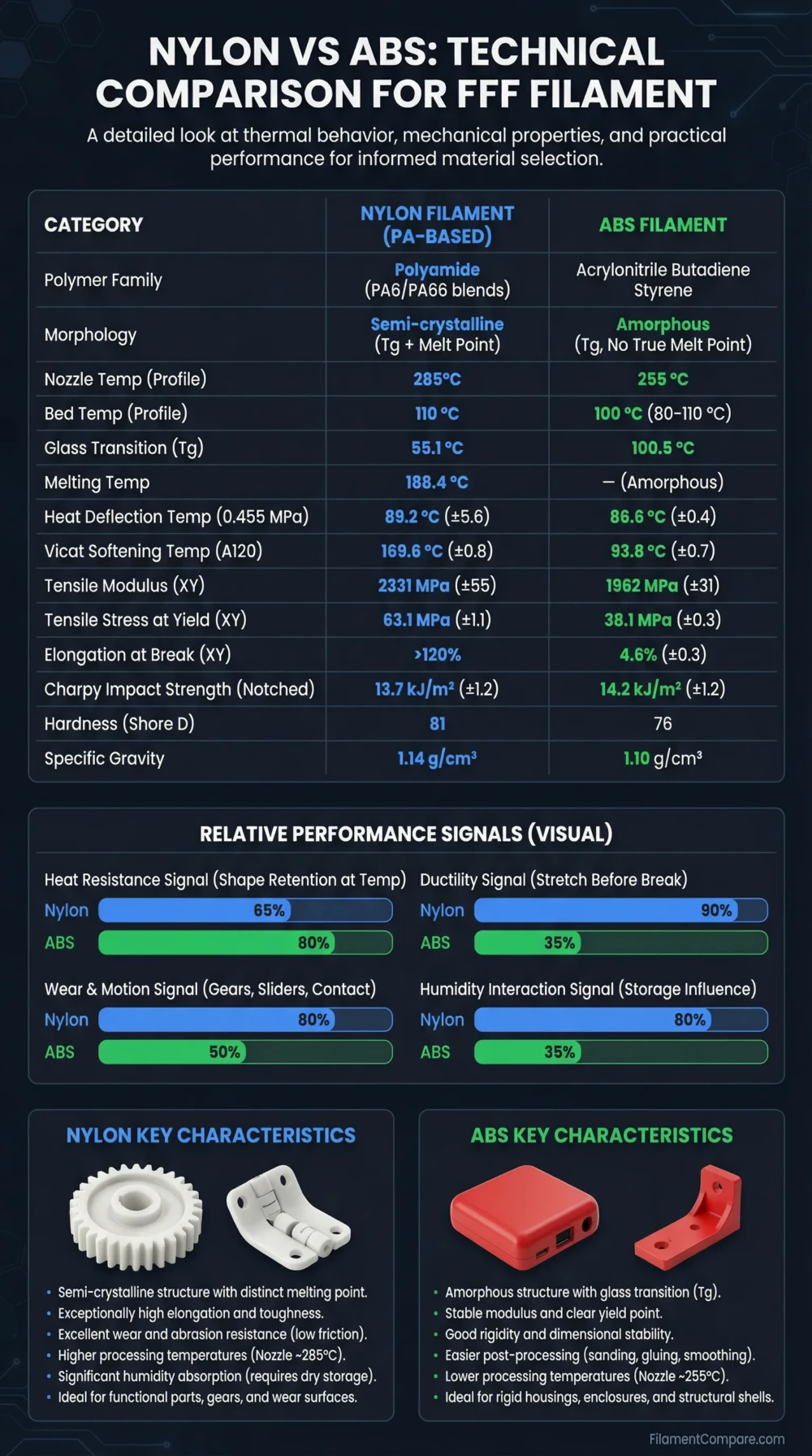
| Category | Nylon Filament (PA-Based) | ABS Filament |
|---|---|---|
| Polymer Family | Polyamide (commonly PA6/PA66-based blends) | Acrylonitrile Butadiene Styrene |
| Morphology (Typical) | Semi-crystalline (Tg + melting point) | Amorphous (Tg, no true melting point) |
| Recommended Nozzle Temp (Example Profile) | 285 °C | 255 °C |
| Recommended Bed Temp (Example Profile) | 110 °C | 100 °C (often 80–110 °C) |
| Glass Transition, Tg (DSC) | 55.1 °C | 100.5 °C |
| Melting Temperature (DSC) | 188.4 °C | — (amorphous) |
| Heat Deflection Temperature (0.455 MPa) | 89.2 °C (±5.6) | 86.6 °C (±0.4) |
| Vicat Softening Temp (A120) | 169.6 °C (±0.8) | 93.8 °C (±0.7) |
| Tensile (Young’s) Modulus (XY Printed) | 2331 MPa (±55) | 1962 MPa (±31) |
| Tensile Stress at Yield (XY Printed) | 63.1 MPa (±1.1) | 38.1 MPa (±0.3) |
| Elongation at Break (XY Printed) | >120% | 4.6% (±0.3) |
| Charpy Impact Strength (23 °C, Notched) | 13.7 kJ/m² (±1.2) | 14.2 kJ/m² (±1.2) |
| Hardness (Shore D) | 81 | 76 |
| Specific Gravity | 1.14 g/cm³ | 1.10 g/cm³ |
| Melt Mass-Flow Rate (MFR) | 6.2 g/10 min (250 °C, 1.2 kg) | 41 g/10 min (260 °C, 5 kg) |
Numbers shown are manufacturer test results and profile examples; exact values vary by brand, printer, profile, and print orientation.
- Where These Values Come From
- Temperature Windows and Profile Context
- ABS Profile Temperatures
- Nylon Profile Temperatures
- Material Identity and Polymer Structure
- Thermal Behavior Under Load
- Mechanical Profile: Stiffness, Strength, and Ductility
- Nylon Mechanical Signature
- ABS Mechanical Signature
- Relative Material Signals (Visual)
- Surface, Feel, and Post-Processing Traits
- ABS Surface Behavior
- Nylon Surface Behavior
- Chemistry and Environment Compatibility
- Terms You’ll See on Filament Datasheets
This comparison focuses on Nylon filament and ABS filament as FFF/FDM materials—two polymers often included in broader discussions of engineering-grade 3D printing filaments. You’ll see thermal behavior, mechanical properties, and the practical meaning of the numbers—so picking Nylon or ABS feels like a clear technical decision, not guesswork.
Where These Values Come From
The ABS mechanical and thermal figures in the table are taken from a manufacturer technical data sheet measured on 3D-printed samples (including print-orientation reporting). ✅Source
The Nylon numbers are from the matching manufacturer technical data sheet, also based on 3D-printed test specimens with stated standards and conditions. ✅Source
Temperature Windows and Profile Context
ABS Profile Temperatures
- Nozzle: listed at 255 °C in an example material profile
- Bed: listed at 100 °C, with a noted 80–110 °C range depending on the part
- Meaning: a steady heat budget supports consistent layer fusion and dimensional stability
Nylon Profile Temperatures
- Nozzle: listed at 285 °C in an example material profile
- Bed: listed at 110 °C
- Meaning: higher melt processing tends to favor tough functional parts and wear-focused designs
The ABS profile temperatures above are taken from a material guidance page that lists recommended nozzle and bed values for ABS. ✅Source
The Nylon profile temperatures above come from a polyamide material page that lists recommended nozzle and bed values for Nylon. ✅Source
Material Identity and Polymer Structure
- ABS as an amorphous polymer
- ABS filament behaves around its glass transition (Tg) rather than a sharp melt point. That’s why you see “amorphous” under melting temperature in the table.
- Nylon as a semi-crystalline polymer
- Nylon filament shows both a Tg and a melting temperature. That dual behavior is tied to crystalline regions forming as the polymer solidifies.
- Why it matters for parts
- The transition points influence how a printed part feels under load as temperatures rise: stiffness shifts, creep resistance changes, and the “working window” becomes easier to predict when you know Tg and melt behavior.
Thermal Behavior Under Load
Heat deflection temperature (HDT) is a loaded test. That’s why it can feel more “real life” than raw Tg when comparing Nylon and ABS in functional assemblies. ✅Source
- Tg influences how the polymer transitions from glassy to rubbery behavior.
- HDT indicates deformation risk under a specified load and heating rate.
- Vicat tracks surface softening under a defined needle load and ramp rate.
- Printer + profile can shift the practical feel of these values through layer bonding and internal stresses.
Glass transition (DSC) is measured via differential scanning calorimetry methods defined in the ISO 11357 series, which is the same family of methods referenced for Tg reporting in many polymer datasheets. ✅Source
Mechanical Profile: Stiffness, Strength, and Ductility
Nylon Mechanical Signature
- High elongation in XY printed samples (table shows >120%)
- Strong yield behavior (table shows 63.1 MPa in XY)
- Practical feel: parts can stay tough and forgiving in mechanical motion
ABS Mechanical Signature
- Stable modulus in XY (table shows 1962 MPa)
- Clear yield reporting in XY (table shows 38.1 MPa)
- Practical feel: commonly selected for rigid housings and shape-holding parts
Relative Material Signals (Visual)
These bars are a relative visual (not a lab measurement). They help you read Nylon and ABS as material “personalities” across common design requirements, while you still use the table values for the hard numbers.
Heat Resistance Signal (how confidently the part keeps shape as temps rise)
Ductility Signal (how willing the material is to stretch before breaking)
Wear and Motion Signal (gears, sliders, bushings, contact surfaces)
Humidity Interaction Signal (how much storage conditions can influence consistency)
Surface, Feel, and Post-Processing Traits
ABS Surface Behavior
ABS filament is often described as friendly to sanding, gluing, and controlled surface smoothing. It also tends to deliver a solid, housing-like feel when printed as thicker shells.
Nylon Surface Behavior
Nylon filament commonly prints with a slightly waxy or technical surface feel, and it’s known for low friction in moving contact. When design needs include flexibility, Nylon’s surface character often fits the job naturally.
Chemistry and Environment Compatibility
- Nylon is frequently selected for parts where abrasion resistance and sliding contact matter.
- ABS is widely used for enclosures, fixtures, and structural shells where rigidity is a main goal.
- Both Nylon filament and ABS filament benefit from matching the material choice to the service temperature and the type of load (static, impact, repeated bending).
Terms You’ll See on Filament Datasheets
- Tensile Modulus
- A stiffness indicator (how much a part resists stretching). In printed parts, it’s also influenced by raster direction and layer bonding.
- Elongation at Break
- How much a specimen stretches before it breaks. This is where Nylon often looks very different from ABS in XY test data.
- MFR (Melt Mass-Flow Rate)
- A flow indicator measured under specified temperature and load. Treat it as a process window hint, not a direct “strength” number.
