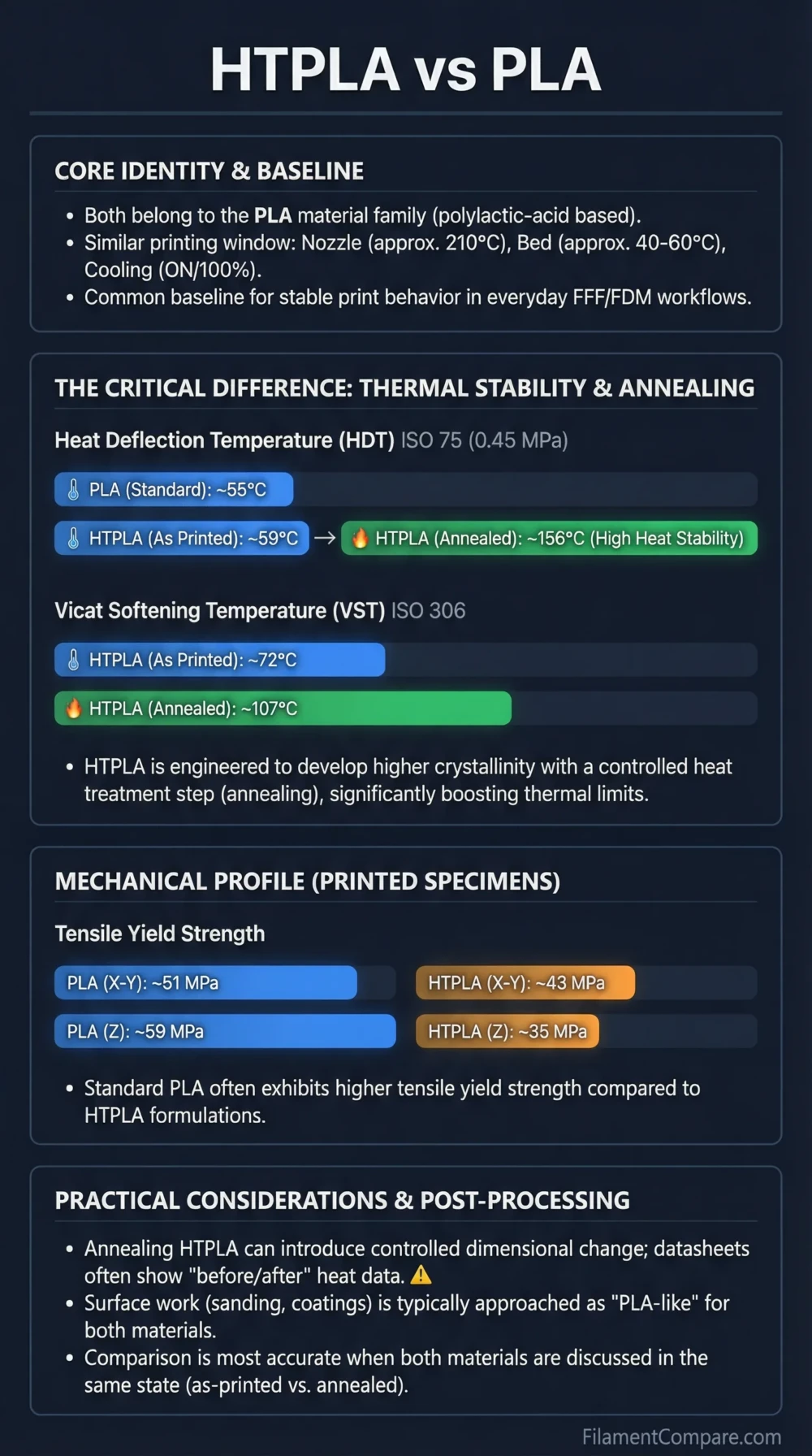
| Attribute | PLA Filament | HTPLA Filament |
|---|---|---|
| Material Family | PLA (polylactic-acid based, standard grade) | HTPLA (PLA-based formulation designed for higher heat stability after heat treatment) |
| Reference Datasheet Used For Numeric Rows | Prusament PLA ✅Source | |
| Reference Datasheet Used For Numeric Rows | Polymaker HT-PLA ✅Source | |
| Typical Nozzle Temperature Window (Manufacturer-Reported) | 210 ± 10°C | 210–230°C |
| Typical Bed Temperature Window (Manufacturer-Reported) | 40–60°C | 25–60°C |
| Cooling Fan (Manufacturer-Reported) | 100% | ON |
| Print Speed (Manufacturer-Reported Upper Range) | Up To 200 mm/s | Up To 300 mm/s |
| Heat Deflection Temperature (HDT) ISO 75, 0.45 MPa | 55°C | 58.6°C (As Printed) 156.2°C (Annealed) |
| Heat Deflection Temperature (HDT) ISO 75, 1.8 MPa | 55°C | 61.4°C (As Printed) 155.2°C (Annealed) |
| Vicat Softening Temperature (VST) ISO 306 | Not Reported In Example Datasheet | 71.7°C (As Printed) 107.2°C (Annealed) |
| Density | 1.24 g/cm³ | 1.21 g/cm³ |
| Tensile Yield Strength (Printed Specimens) | 51 MPa (X–Y) 59 MPa (Z) | 42.86 MPa (X–Y) 35.15 MPa (Z) |
| Tensile Modulus (Printed Specimens) | 3190 MPa (X–Y) 3440 MPa (Z) | 3287 MPa (X–Y) 2421 MPa (Z) |
| Heat Treatment Data Availability | Depends On Brand (some publish annealed data, some do not) | Common (many HTPLA sheets show as-printed and annealed properties) |
| Example Annealing Condition Mentioned | Not Reported In Example Datasheet | 30 Minutes @ 80–90°C |
| Example Drying Condition Mentioned | Not Reported In Example Datasheet | 6 Hours @ 60°C |
Note On The Numbers: The table uses two example technical datasheets to keep the comparison auditable and repeatable. Real-world HDT, strength, and dimensional behavior can shift with printer setup, part geometry, and brand formulation.
- PLA Identity In Practice
- HTPLA Identity In Practice
- What These Two Filaments Really Are
- Key Terms You Will See In Datasheets
- Thermal Behavior Under Load
- Vicat Softening and What It Adds
- Mechanical Profile in Printed Parts
- Print Behavior in FFF/FDM
- Commonly Noted Differences You Can Measure
- Dimensional Stability and Heat Treatment Effects
- Post-Processing Compatibility
- Where Heat Treatment Changes The Conversation
- Testing Standards Behind The Numbers
Both HTPLA and PLA are in the PLA family, so they can feel similar at the printer. The split shows up when you look at heat performance, the role of crystallinity, and whether the material has published annealed vs as-printed data. This page sticks to measurable properties and standard test language so the comparison stays clean and useful.
PLA Identity In Practice
- Stable Print Behavior in many everyday FFF/FDM workflows.
- Thermal Limits often tracked using HDT-style testing language.
- Common Baseline for comparing other filament families.
HTPLA Identity In Practice
- PLA-Based, usually tuned to develop higher crystallinity with heat treatment.
- Published Annealed Data is often part of the product story.
- Heat-Focused positioning, especially for parts that see warm environments.
What These Two Filaments Really Are
PLA filament is typically presented as a general-purpose material with a broad presence in FFF/FDM printing. HTPLA filament is best understood as a PLA-derived category where the formulation is built around higher temperature stability after a heat step, often reported as annealed properties. For a broader overview of how PLA formulations differ—including PLA+, HT-PLA, and other variants—see the Ultimate PLA Filament Guide. A simple way to read “HTPLA” is: PLA that’s engineered to respond well to controlled crystallization.
The phrase High Temperature PLA is not a single chemical standard. Brands may adjust crystallization behavior using different approaches (for example, nucleation-friendly formulations). That is why the most reliable comparison method is to look for test-method labels and reported conditions in datasheets, rather than assuming every spool behaves the same way.
Key Terms You Will See In Datasheets
- HDT (Heat Deflection Temperature)
- A standardized way to report the temperature where a plastic specimen reaches a defined deflection under a defined load; useful for relative comparisons across materials.
- Vicat Softening Temperature (VST)
- A standardized temperature point related to softening behavior under a defined penetration load; often used alongside HDT to describe heat response.
- Annealed vs As Printed
- As printed values describe the printed state. Annealed values describe the material after a controlled heat step intended to increase crystallinity.
- X–Y vs Z
- Orientation notes in printed specimen testing; values can differ based on layer direction and specimen build orientation.
Thermal Behavior Under Load
HDT is often the first number people look for when they care about warm environments. The key detail is that the method is about deflection under load at a defined heating rate, not “maximum service temperature.” That framing is built directly into the ISO method description.✅Source
In filament marketing, HTPLA usually aims to show a strong separation between as-printed and annealed heat response. Standard PLA is frequently presented with a single set of thermal numbers (or sometimes none), while many HTPLA products highlight a second column for heat-treated performance. That difference in published data is often more informative than a generic label.
If you see ASTM D648 mentioned, that is another established route for reporting deflection temperature under a flexural load. It’s commonly used as a reference point when comparing plastics with HDT-style language across industries, not just 3D printing.✅Source
Vicat Softening and What It Adds
Vicat is a different lens than HDT. Where HDT focuses on a bending-style deflection under load, Vicat focuses on a controlled penetration/softening response. Seeing both can give a more rounded view of how PLA and HTPLA behave as temperatures rise.✅Source
Mechanical Profile in Printed Parts
Most practical comparisons lean on tensile strength and tensile modulus because those numbers show up in many filament datasheets. When you see results split by X–Y and Z, it’s a reminder that printed parts have directionality. The core tensile test vocabulary is standardized in ISO tensile testing documents used across plastics characterization.✅Source
How To Read “X–Y” and “Z” Without Overthinking It: X–Y often reflects behavior along the printed roads, while Z highlights layer-to-layer behavior. Neither is “the real number” by itself; they describe different stress paths inside a printed part.
Print Behavior in FFF/FDM
Because HTPLA stays inside the PLA family, the practical printing window can look familiar: nozzle temperatures in a PLA-like range, bed temperatures that are often moderate, and active cooling as a common baseline. For a widely used reference description of PLA print characteristics and general handling context, Prusa’s material guide is a solid orientation point.✅Source
Commonly Noted Differences You Can Measure
- Heat Response Reporting: HTPLA products often publish annealed and as-printed thermal data side-by-side.
- Heat Treatment Sensitivity: annealing can introduce controlled dimensional change, so published “after heat” data matters.
- Orientation Data: more sheets for HTPLA emphasize X–Y vs Z numbers as part of performance context.
Dimensional Stability and Heat Treatment Effects
The big technical lever behind HTPLA is crystallinity. Increasing crystallinity can shift how PLA holds stiffness at elevated temperatures, which is exactly why many HTPLA products publish “after heat treatment” numbers. Research literature on PLA shows annealing and recrystallization changing crystalline structure and related behavior under temperature exposure, which supports why the annealed column exists in HTPLA datasheets.✅Source
Relative Performance Snapshot (Typical Pattern, Not A Spec)
Reading tip: The duplicated labels are intentional: the first bar indicates PLA, the second indicates HTPLA.
Post-Processing Compatibility
In surface work, PLA and HTPLA often sit in the same practical neighborhood: sanding and coatings are typically approached as “PLA-like.” The key difference is that HTPLA products frequently frame post-print heat exposure as a measurable performance step, so surface plans sometimes account for whether the part is in an as-printed state or a heat-treated state.
Where Heat Treatment Changes The Conversation
- Dimensional Shift can be part of the material story, not a surprise. HTPLA sheets often show this indirectly through “before/after” property columns.
- Thermal Benchmarks like HDT and Vicat become central, since they connect to shape retention under warmth.
- Data Selection matters: comparing two filaments is more accurate when both are discussed in the same state (as printed vs annealed).
Testing Standards Behind The Numbers
Why Standards Show Up In Filament Datasheets: They make comparisons more meaningful. If two datasheets cite the same method family, you’re more likely to be comparing like-with-like rather than marketing language.
- ISO 75 defines deflection temperature under load and is often cited as an HDT-style test in plastics.
- ASTM D648 is an ASTM standard for measuring deflection temperature under flexural load and is commonly listed in polymer datasheets.
- ISO 306 sets the method for reporting Vicat softening temperature.
- ISO 527 is the main ISO standard series for tensile properties in plastics datasheets.
