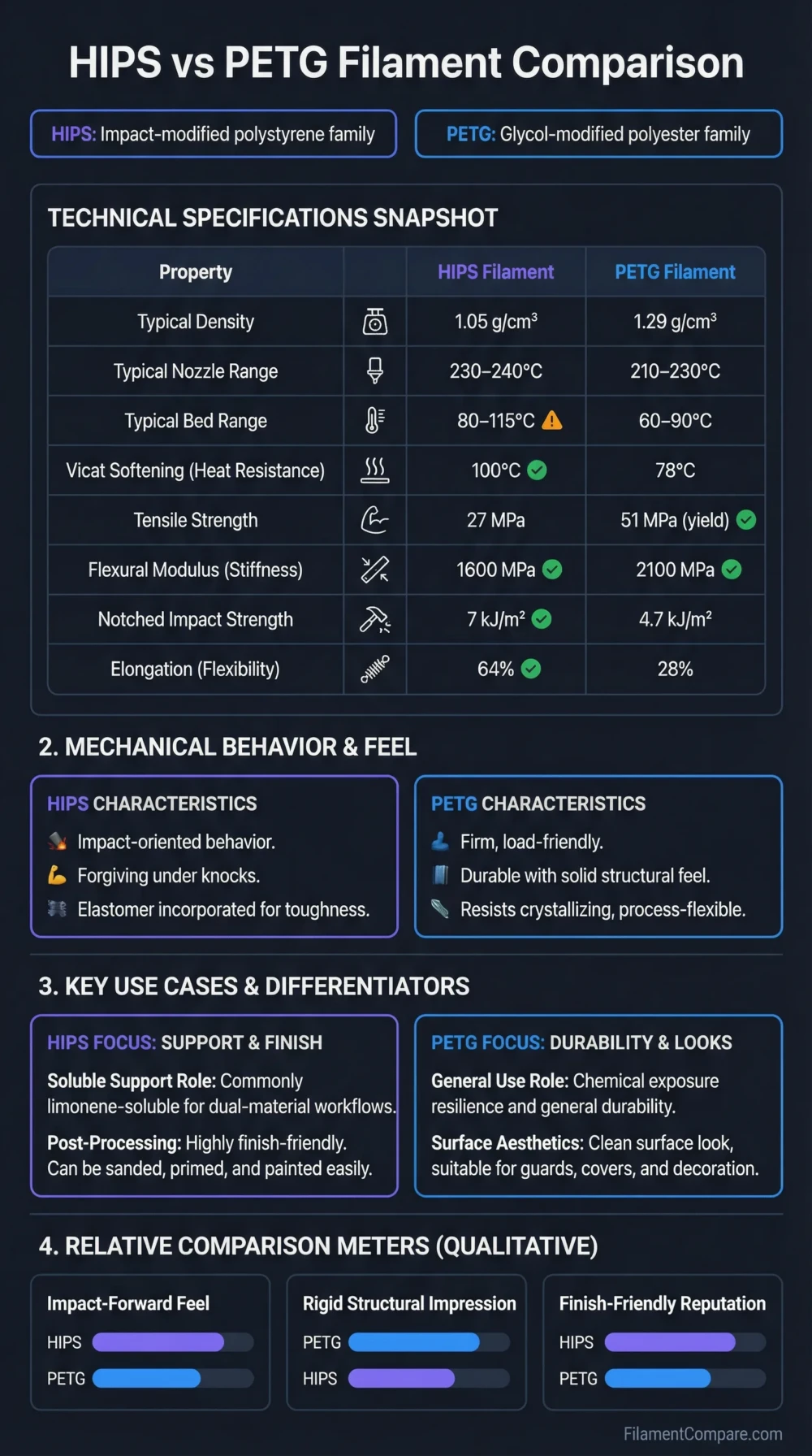
| Property | HIPS Filament | PETG Filament |
|---|---|---|
| Typical Density | 1.05 g/cm³ | 1.29 g/cm³ |
| Typical Nozzle Range | 230–240°C | 210–230°C |
| Typical Bed Range | 80–115°C | 60–90°C |
| Vicat Softening | 100°C | 78°C |
| Tensile Strength | 27 MPa | 51 MPa (yield) |
| Flexural Modulus | 1600 MPa | 2100 MPa |
| Notched Impact Strength | 7 kJ/m² (Izod, notched) | 4.7 kJ/m² (notched) |
| Elongation | 64% | 28% (nominal at break) |
| Flow Index Listed | MFI 5.5 mL/10 min (ISO 1133, 200°C / 5 kg) | MFR 6 g/10 min (ISO 1133) |
| Support-Style Solubility Note | Commonly described as limonene-soluble | Not typically used as a dissolvable support |
PETG reference sheet used for the table values (includes density, Vicat, print window, and mechanical figures)✅Source
- Material Identity and Polymer Structure
- PETG Polymer Notes
- HIPS Polymer Notes
- Thermal Behavior and Service Temperature Context
- PETG Thermal Markers From a Datasheet Example
- How Tg Is Commonly Defined in Plastics Testing
- Mechanical Behavior That Shows Up in Real Parts
- Support Material Compatibility and Dissolution Angle
- HIPS as a Soluble Support Concept
- Surface Finish and Post-Processing Character
- HIPS Finishing Options
- PETG Finish and Decoration Notes
- Relative Comparison Meters for Fast Scanning
- Common Questions People Have When Comparing These Two
HIPS reference sheet used for the table values (includes density, Vicat, print window, mechanical figures, and limonene note)✅Source
Important context: filament brand, color, and printer profile can shift real-world behavior. The table stays strict to the specific published reference sheets above.
When people compare HIPS filament and PETG filament, they’re usually trying to understand behavior, not marketing names. Both are thermoplastics for FFF/FDM and are often discussed alongside other engineering-grade 3D printing filaments, yet they “feel” different in a printer and in a finished part. This page keeps it spec-first and use-case aware, without drifting into step-by-step instructions.
- HIPS: Impact-modified polystyrene family
- PETG: Glycol-modified polyester family
- Both: Common consumer & pro printing material
- Both: Datasheets vary by grade & brand
Material Identity and Polymer Structure
PETG Polymer Notes
PETG is widely described as a glycol-modified PET copolyester. In practice, that “glycol-modified” piece is closely tied to how many PETG grades resist crystallizing and stay more clear and process-flexible than conventional crystallizable PET in many applications.✅Source
HIPS Polymer Notes
HIPS stands for High Impact Polystyrene. Many industrial descriptions emphasize that an elastomer is incorporated into polystyrene during production to achieve the recognizable impact-resistant behavior associated with HIPS grades.✅Source
Thermal Behavior and Service Temperature Context
Thermal numbers can look similar across materials, yet they come from specific test methods and sample conditions. When you compare HDT, Vicat, and Tg, keep the method label close to the value.
PETG Thermal Markers From a Datasheet Example
One widely cited way to describe PETG filament is by its glass transition temperature and heat deflection figures. A PETG technical data sheet example lists Tg as 77.4°C (DSC method) and HDT as 76.2°C (specified method). These numbers are not “universal PETG,” but they are useful as a reference point for what some engineered PETG profiles target.✅Source
How Tg Is Commonly Defined in Plastics Testing
Glass transition temperature is often determined with differential scanning calorimetry in plastics work. A dedicated DSC standard describes methods for determining Tg in amorphous and partially crystalline plastics, which is why you’ll frequently see “ISO 11357” referenced next to Tg values on technical sheets.✅Source
Mechanical Behavior That Shows Up in Real Parts
- Stiffness vs Toughness
- PETG filament often appears as a firm, load-friendly option in datasheets, while HIPS filament is positioned around impact-oriented behavior. The exact balance is grade-dependent, so datasheet context matters.
- Layer Orientation Sensitivity
- FFF parts are layered, so properties can shift between in-plane strength and interlayer strength. This is a material reality, not a defect, and it affects both PETG and HIPS.
- Impact Response Feel
- HIPS is built around impact modification, so many users describe its handling as forgiving under knocks, while PETG is commonly described as durable with a more solid structural feel.
- PETG filament frequently appears in specs where chemical exposure and general durability are relevant, while still keeping a clean surface look.
- HIPS filament is often chosen in contexts where impact handling and post-finish friendliness matter, especially when parts will be sanded or painted.
- Both materials are used for functional prototyping and production-like mockups, but their “feel” in hand can be distinct.
Support Material Compatibility and Dissolution Angle
HIPS as a Soluble Support Concept
A common reason HIPS filament shows up in comparisons is its reputation as a soluble support option in dual-material workflows. Some 3D printing material guides describe HIPS as soluble in limonene, which is why it’s frequently mentioned alongside multi-material printing discussions and clean support removal concepts.✅Source
Good to know: “Soluble support” is not a single universal promise. It depends on material pairing, solvent choice, and filament formulation. That’s why reputable sources usually frame it as a common use, not a guarantee.
Surface Finish and Post-Processing Character
HIPS Finishing Options
Some manufacturer education pages highlight HIPS filament for finishing-friendly traits. It’s often described as a material that can be sanded, primed, and painted (including acrylic paints) after printing, which is why it’s frequently discussed around props, models, and visual parts where the finish is part of the project’s identity.✅Source
PETG Finish and Decoration Notes
Many PETG product pages emphasize how the material can support decoration work such as painting or printing on the surface in broader plastics applications. This is useful context when you’re thinking about PETG filament parts that will be used as covers, guards, or display-like pieces where appearance and durability share the stage.✅Source
Relative Comparison Meters for Fast Scanning
These meters are qualitative and meant for fast scanning. They summarize common positioning of HIPS filament and PETG filament across typical use discussions, while keeping datasheets as the final authority for any specific grade.
Impact-Forward Feel HIPS vs PETG
Rigid Structural Impression PETG vs HIPS
Finish-Friendly Reputation HIPS vs PETG
Common Questions People Have When Comparing These Two
- Are the numbers universal? No. The same material name can cover multiple grades. PETG filament and HIPS filament are families, not one single recipe.
- Why do printing ranges overlap? Both materials sit in an overlapping processing neighborhood, but their flow, surface behavior, and use positioning can still be quite different.
- Does “soluble support” define HIPS? It’s a well-known angle, yet HIPS is also used as a general material. Many users talk about it for finishing and impact-oriented use cases too.
