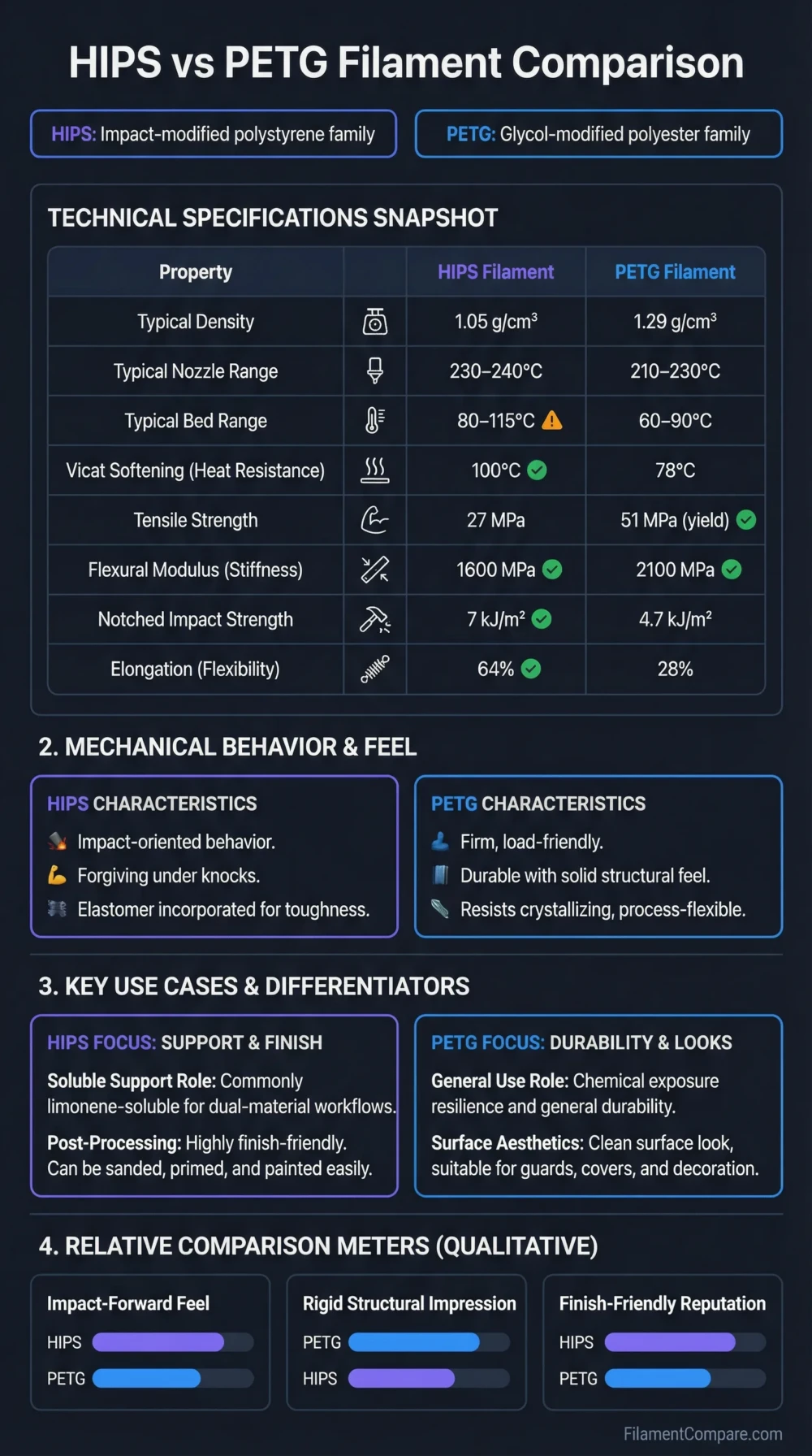
HIPS is easier to sand, lighter in feel, and useful as a dissolvable support material, while PETG is usually the better choice for durable standalone parts with stronger layer bonding and easier day-to-day printing. HIPS behaves closer to ABS in printer requirements, so it benefits from a hot bed, controlled airflow, and an enclosure. PETG is the more practical all-round filament for brackets, fixtures, containers, and outdoor-leaning parts, but HIPS can be the better fit when surface finishing or limonene-soluble support behavior matters.
Choose PETG if you need a reliable functional filament with good toughness, layer adhesion, moderate heat resistance, and lower tuning effort. Choose HIPS if you want easier sanding, a matte ABS-like finish, lightweight visual parts, or soluble supports for compatible multi-material printing.
Best for Everyday Functional Parts
PETG is usually the safer pick because it combines toughness, layer adhesion, and easier printing.
Better for Sanding and Finishing
HIPS sands more cleanly and can produce smooth painted models after basic post-processing.
Better for Beginner Use
PETG needs tuning, but it is normally less enclosure-dependent than HIPS.
Better as Soluble Support
HIPS can dissolve in limonene, which makes it useful as a support material in selected dual-extrusion setups.
Better Layer Adhesion
PETG usually bonds layers strongly, making it useful for clips, brackets, and loaded printed parts.
Better for Enclosure-Free Printing
PETG is generally easier to print on open-frame machines than HIPS, especially for medium-size parts.
Better for Lightweight Models
HIPS has a low-density polystyrene base and works well for display models, prototypes, and sanded parts.
Better Outdoor Fit
PETG is usually more suitable for mild outdoor use, although UV-stabilized grades or ASA may be better for long exposure.
| Category | HIPS | PETG | Better Choice |
|---|---|---|---|
| Material Family | High-impact polystyrene | Glycol-modified polyester | Use-case based |
| Print Difficulty | Moderate; enclosure recommended for stable results | Easy to moderate; stringing and bed grip need tuning | PETG |
| Typical Nozzle Temperature | Usually around 220–255°C, brand-dependent[a] | Usually around 230–250°C, brand-dependent[b] | Similar range |
| Typical Bed Temperature | Usually around 100–110°C | Usually around 70–90°C | PETG |
| Enclosure Requirement | Helpful and often recommended | Usually optional for small and medium prints | PETG |
| Heat Resistance | Good for a styrenic filament; grade-dependent | Moderate; better than PLA but not a high-temperature engineering material | Close, grade-dependent |
| Toughness | Impact-modified and less brittle than plain polystyrene | Good toughness with strong layer bonding | PETG |
| Stiffness | Moderately stiff, easy to sand | Slightly more flexible than PLA, with good ductility | Depends on part design |
| Layer Adhesion | Decent when printed hot and enclosed | Usually strong | PETG |
| Moisture Sensitivity | Lower than PETG in normal storage | Can absorb moisture and become stringy or bubbly | HIPS |
| Surface Finish | Matte, sandable, paint-friendly | Glossy to semi-glossy, can show stringing | HIPS for finishing |
| Support Material Role | Limonene-soluble support for selected materials and workflows | Usually a model material, not a dissolvable support | HIPS |
| Typical Uses | Support structures, display models, sanded prototypes, ABS-like parts | Brackets, fixtures, clips, containers, printer parts, functional prototypes | Different roles |
| Main Limitation | More warping risk and enclosure need | Stringing, strong bed adhesion, moisture sensitivity | Different limits |
The HIPS and PETG comparisons here combine manufacturer datasheets, material guides, and common FDM printing behavior; real results change with brand, color, additives, moisture level, part geometry, and slicer settings.
HIPS Material Profile
- Polymer type: High-impact polystyrene, usually rubber-modified for improved impact behavior.
- Print difficulty: Moderate; more stable with an enclosure and controlled cooling.
- Nozzle range: Typically about 220–255°C.
- Bed range: Typically about 100–110°C.
- Enclosure: Recommended, especially for large parts.
- Drying need: Usually less demanding than PETG, but dry storage is still useful.
- Typical behavior: Matte surface, good sanding response, possible warping on large flat prints.
- Best use cases: Soluble supports, prototypes, lightweight models, painted display parts, ABS-like workflows.
PETG Material Profile
- Polymer type: Glycol-modified polyethylene terephthalate copolymer.
- Print difficulty: Easy to moderate; easier than HIPS for many open-frame printers.
- Nozzle range: Commonly around 230–250°C.
- Bed range: Commonly around 70–90°C.
- Enclosure: Usually optional for small and medium prints.
- Drying need: More important than HIPS; wet PETG often strings, pops, or leaves rough surfaces.
- Typical behavior: Tough, slightly glossy, strong layer adhesion, can stick too strongly to some build surfaces.
- Best use cases: Functional brackets, clips, jigs, fixtures, containers, printer parts, mild outdoor components.
Relative Printing Performance
These bars are relative print-use indicators rather than fixed laboratory ratings. Brand formulation, color, additives, wet filament, nozzle temperature, part orientation, and slicer profile can move the result in either direction.
Printability and Tuning Behavior
PETG is usually easier to run on a common desktop printer. It likes a clean build surface, moderate part cooling, and enough nozzle temperature to bond layers without over-softening the print. The main tuning issues are stringing, small surface zits, and overly strong bed adhesion.
HIPS asks more from the printer environment. A hot bed is normal, and an enclosure helps keep the part from cooling unevenly. Without that thermal stability, corners can lift and large flat prints may warp. This does not make HIPS unreliable, but it does make it more sensitive to room airflow and bed temperature than PETG.
Build plate note: PETG can bond too firmly to smooth PEI or glass if the surface is not prepared correctly. HIPS usually needs stronger thermal control, while PETG often needs surface-release management.
Mechanical Behavior and Part Strength
For most functional printed parts, PETG has the advantage. Its layer adhesion is usually strong, and the material has enough ductility to bend slightly before breaking. That makes it useful for brackets, mounts, clips, light-duty fixtures, printer parts, and mechanical prototypes.
HIPS is impact-modified compared with standard polystyrene, so it is not the same as brittle packaging-style polystyrene. Still, in FDM printing, it is usually chosen more for support behavior, finish, and ABS-like processing than for maximum functional part strength. It can work for housings and prototypes, especially when printed hot and enclosed, but PETG is normally the more forgiving mechanical choice.
Heat Resistance and Shape Retention
HIPS and PETG both sit in a moderate heat-resistance range, but neither should be treated like polycarbonate, nylon, PPS, or other high-temperature engineering materials. Some HIPS datasheets list glass transition near 100°C and HDT around 80°C under stated test conditions[c]. PETG grades often list heat resistance around the 70–80°C area depending on test method and printer settings; UltiMaker’s PETG documentation, for example, lists temperature resistance up to 76°C[d].
In real printed parts, shape retention depends heavily on geometry. Thin walls, black filament, high load, and enclosed warm spaces can reduce the safe margin. PETG is often better for practical functional use, while HIPS can be attractive where sanding, support removal, or a matte prototype surface matters more than load-bearing strength.
Surface Finish, Sanding, and Post-Processing
HIPS is usually the better finishing material. It cuts, sands, and primes more easily than PETG, which can feel gummy under sanding and may leave smeared edges if worked too aggressively. For painted props, housings, visual prototypes, and models that need manual smoothing, HIPS has a clear workflow advantage.
PETG often prints with a glossier surface. It can look clean when tuned well, but stringing and small blobs are more common than with PLA. PETG is less convenient when the goal is a sanded, painted surface. It is better when the printed part will stay as a functional object rather than a post-processed display model.
Moisture, Storage, and Drying
PETG needs more attention to spool storage. Wet PETG can hiss, pop, string heavily, and leave a rougher surface. Some manufacturer guidance recommends drying PETG with warm forced air before printing when moisture is suspected[e].
HIPS is generally less moisture-sensitive in day-to-day use, but dry storage is still a good habit. A sealed bag or dry box protects both materials from dust and humidity. For PETG, that storage habit has a larger effect on print quality.
Support Material Role and Dual-Extrusion Use
HIPS has one role PETG does not replace well: soluble support. HIPS can dissolve in limonene, making it useful for support structures in selected dual-extrusion workflows. This is most often discussed with ABS-family printing, but compatibility depends on the model material, hotend setup, purge behavior, and how strongly the two materials bond at the interface.
PETG is usually not selected as a dissolvable support. It is a model material. It can sometimes be paired with other materials as a breakaway-style interface in experimental workflows, but it is not a direct substitute for HIPS when the target is chemical support removal.
| Use Case | More Suitable Material | Reason |
|---|---|---|
| Beginner functional prints | PETG | Lower enclosure need and better all-round reliability for durable parts. |
| Large enclosed-printer prototypes | HIPS or PETG | HIPS works well with thermal control; PETG is easier if warping risk must stay low. |
| Sanded display models | HIPS | More pleasant sanding and priming behavior. |
| Functional brackets | PETG | Better layer adhesion and toughness for common printed brackets. |
| Soluble support structures | HIPS | Limonene solubility gives it a support-material role that PETG does not match. |
| Containers and organizers | PETG | Tough, less brittle behavior and better resistance to daily handling. |
| Painted housings | HIPS | Matte finish and sanding response help before primer and paint. |
| Mild outdoor parts | PETG | Usually a better fit than HIPS, though ASA or UV-stabilized grades may be better for long exposure. |
| Open-frame printer use | PETG | Less dependent on enclosure conditions. |
| Parts needing low stringing | HIPS when tuned well | PETG can string more, especially when wet or printed too hot. |
Choose HIPS When
- You need a limonene-soluble support material for a compatible dual-extrusion workflow.
- You want a matte surface that sands and primes cleanly.
- You are printing visual prototypes, models, or housings that will be painted.
- Your printer has a hot bed and an enclosure.
- You want an ABS-like workflow without using ABS for every part.
HIPS Is Less Suitable When
- You are printing on an open-frame machine in a cool or drafty room.
- The part has a large flat footprint and warping would ruin the geometry.
- You need the simplest functional material for brackets or fixtures.
- You do not want to manage limonene handling for support removal.
Choose PETG When
- You want tough, practical parts with good layer adhesion.
- You print on a typical desktop printer without a heated chamber.
- You need functional prototypes, clips, brackets, jigs, or containers.
- You want better moisture-sealed storage habits but not a high-warp material.
- You need a filament that balances ease of printing with better durability than PLA.
PETG Is Less Suitable When
- You need a sanded and painted surface with minimal effort.
- Your build surface is prone to PETG over-adhesion.
- The spool has absorbed moisture and you cannot dry it before printing.
- You need soluble support behavior rather than a standalone model filament.
Choose PETG for most functional FDM parts: brackets, clips, mounts, organizers, jigs, fixtures, and general-purpose durable prints. Choose HIPS when the job centers on soluble supports, sanding, painting, or ABS-like enclosed-printer workflows. Neither material replaces the other; PETG is the stronger general-purpose model filament, while HIPS has a more specialized role in finishing and support workflows.
Common HIPS and PETG Questions
Is HIPS stronger than PETG?
Usually no for practical FDM parts. HIPS has useful impact-modified behavior, but PETG normally gives better layer adhesion and more forgiving toughness for brackets, clips, and fixtures.
Can HIPS be used as a normal model filament?
Yes. HIPS can print standalone parts, especially visual prototypes and sanded models. It is not only a support material, but support use is one of its strongest reasons to choose it.
Does PETG need an enclosure?
Usually not for small and medium parts. An enclosure can help with consistency, but PETG is commonly printed on open-frame printers. HIPS benefits more from an enclosure.
Is HIPS easier to post-process than PETG?
Yes. HIPS is generally easier to sand, prime, and paint. PETG can be finished, but sanding can feel less clean and may require more patience.
Which one is better for outdoor prints?
PETG is usually the better of the two for mild outdoor use, but long-term sun exposure is still formulation-dependent. For stronger UV needs, ASA or UV-stabilized materials are often a better fit.
Resources Used
- [a] HIPS – Prusa Knowledge Base — Used for HIPS print temperature guidance, bed temperature behavior, support-material notes, and general HIPS printing context.
- [b] PETG – Prusa Knowledge Base — Used for PETG print temperature guidance, bed settings, beginner suitability, and common PETG printing behavior.
- [c] HIPS Technical Data Sheet (TDS) — Used for HIPS thermal reference values such as glass transition and heat deflection under stated test methods.
- [d] Ultimaker PETG Technical data sheet — Used for PETG material description, thermal resistance reference, and application context for functional printed parts.
- [e] Technical Data Sheet — Used for PETG moisture and drying guidance, especially how wet filament can affect print quality.
