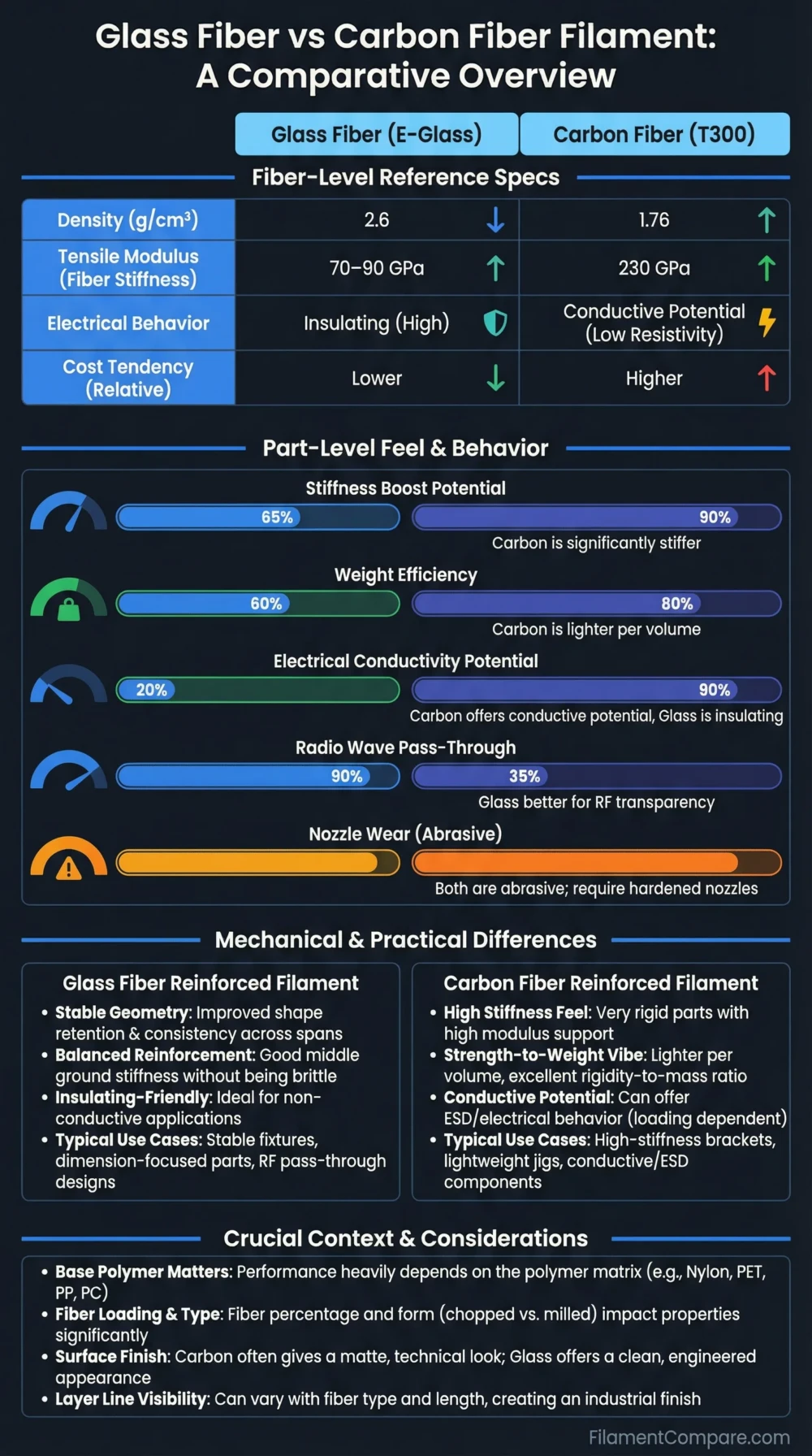
| Spec / Behavior | Glass Fiber (E-Glass) ✅Source | Carbon Fiber (T300) ✅Source |
|---|---|---|
| Density | 2.6 g/cm³ | 1.76 g/cm³ |
| Tensile Modulus (fiber stiffness) | 70–90 GPa | 230 GPa |
| Tensile Strength | 3.4 GPa | 3,530 MPa |
| Typical Fiber Diameter | 5–24 µm | 7 µm |
| Electrical Behavior | Insulating (commonly used for electrical insulation contexts) | Conductive potential (Electric Resistivity: 1.7 × 10⁻³ Ω·cm) |
| Thermal / Dimensional Note | Softening point: 850°C | CTE: -0.41 × 10⁻⁶/°C |
| What This Often Translates to in Filament | Balanced reinforcement, dimensional stability, insulating-friendly builds | High stiffness feel, strength-to-weight, conductive/ESD potential |
Important Context: Glass fiber filament and carbon fiber filament are polymer blends with chopped or milled fibers inside. The table above is the fiber-only picture. In real prints, results depend heavily on base polymer, fiber loading, and fiber length.
- Relative Comparison Meters (Part-Level Feel)
- What “Fiber-Reinforced Filament” Actually Means
- Mechanical Behavior in Printed Parts
- Glass Fiber Reinforced Filament
- Carbon Fiber Reinforced Filament
- Electrical and RF Behavior
- A Practical Note About Conductivity
- Fiber Loading Examples You’ll See in Real Filaments
- Nozzle Wear and Hardware Compatibility
- Surface Finish and Visual Character
- Where Each One Commonly Fits
- A Real-World Composite Example
- Datasheet Terms That Matter
Glass Fiber vs Carbon Fiber is really a comparison of two reinforcement styles used inside composite filaments. Both can make prints feel more rigid and more dimensionally steady, but they do it with slightly different “personalities” at the part level.
Relative Comparison Meters (Part-Level Feel)
Stiffness Boost Potential (relative)
Weight Efficiency (relative)
Electrical Conductivity Potential (relative)
Radio Wave Pass-Through (relative)
Cost Tendency (relative)
What “Fiber-Reinforced Filament” Actually Means
Glass fiber filament and carbon fiber filament are usually made by mixing short fibers into a base polymer. You’ll see the biggest swings when the manufacturer controls fiber length, fiber coating (often called sizing), and fiber percentage so the fibers bond well inside the matrix. ✅Source
- Chopped fibers: often treated and cut into short lengths, giving reinforcement that can align in extrusion flow.
- Milled fibers: finer “powder-like” short fibers that behave more like fillers, changing feel and surface in a different way.
- Orientation: FFF naturally encourages fibers to align along extrusion paths, so direction matters for stiffness and strength.
Mechanical Behavior in Printed Parts
Glass Fiber Reinforced Filament
- Stable geometry: glass fibers can improve shape retention and keep parts feeling more consistent across longer spans.
- Balanced reinforcement: a common “middle ground” feel—stiffness goes up without turning the part into a single-note material.
- Insulating-friendly: glass itself is typically electrically insulating, useful when conductivity is not the goal.
Carbon Fiber Reinforced Filament
- High stiffness feel: carbon fiber’s high modulus often translates into very rigid printed parts when the base polymer supports it, a reinforcement behavior discussed in broader carbon fiber filament guides that examine how fiber content and polymer choice influence real printed parts.
- Strength-to-weight vibe: carbon fiber is lighter per volume than glass fiber, which helps when you care about mass and rigidity together.
- Conductive potential: depending on loading and formulation, carbon-filled composites can offer electrical/ESD behavior.
At the “filament” level, the base polymer still does a lot of work. A nylon composite and a PET composite can feel totally different even if both contain carbon fibers or glass fibers. The fiber choice is the reinforcement flavor; the polymer is the foundation.
Electrical and RF Behavior
Carbon fiber can bring electrical conductivity potential because the fiber itself can be conductive. That’s why some carbon composites are used where ESD behavior is part of the target. Glass fiber is usually tied to insulating behavior, and it’s also commonly associated with radio wave pass-through in composite discussions. ✅Source
A Practical Note About Conductivity
Conductive potential in a printed part depends on fiber loading, fiber connectivity, and how the polymer isolates fibers. It’s possible for a composite to have carbon fiber inside and still behave mostly like an insulator at the part level if the conductive network isn’t continuous.
Fiber Loading Examples You’ll See in Real Filaments
- PET CF15: a PET-based filament described as reinforced with 15% carbon fiber.
- PP GF30: a PP-based filament described as containing 30% glass fibers designed for filament making and 3D printing.
- PC GF30: a PC-based filament described as filled with 30% glass fibers.
Those percentages matter because they influence stiffness, surface feel, and how “composite-like” the filament behaves in a printed part. ✅Source
Nozzle Wear and Hardware Compatibility
Fiber-reinforced composites are often described as abrasive because the embedded fibers can wear standard nozzles over time. Many setups pair these materials with hardened nozzles to keep nozzle geometry stable during longer production runs. ✅Source
Friendly Reminder: Glass fiber filament and carbon fiber filament can both be “composites,” but they aren’t all the same. A milled-fiber blend can behave differently than a chopped-fiber blend, even if the label looks similar.
Surface Finish and Visual Character
- Carbon fiber composites often lean toward a matte, technical look because the fibers can soften the shine of the base polymer.
- Glass fiber composites are frequently associated with a clean, engineered look, and the final appearance depends strongly on the base polymer color.
- Layer line visibility can change with fiber type and fiber length; both can produce an “industrial finish” that many users like for functional parts.
Where Each One Commonly Fits
- Glass Fiber Reinforced Filament
- Often associated with stable fixtures, dimension-focused parts, and designs where RF pass-through is valued in composite discussions.
- Why It’s Used
- Reinforcement with a balanced profile, keeping parts feeling structured and predictable.
- Carbon Fiber Reinforced Filament
- Often associated with high-stiffness brackets, lightweight jigs, and builds where conductive/ESD potential may matter.
- Why It’s Used
- High modulus fiber behavior can deliver that extra rigid feel when combined with the right polymer.
A Real-World Composite Example
Some materials are described as micro carbon fiber filled nylon, which is a clear sign the carbon is used as a reinforcing filler inside a nylon matrix. That kind of description helps you predict a part that feels stiffer and more dimensionally stable than plain nylon, while still staying in the “engineering polymer” family. ✅Source
Datasheet Terms That Matter
- Fiber Loading (% by weight): higher loading usually means a stronger “composite signature” in feel and stiffness.
- Chopped vs Milled: chopped fibers can act more like reinforcement strands; milled fibers act more like fine fillers.
- Tensile vs Flexural: tensile speaks to pulling force behavior; flexural speaks to bending stiffness.
- Anisotropy: properties can shift by direction, because fibers can align with extrusion flow paths.
