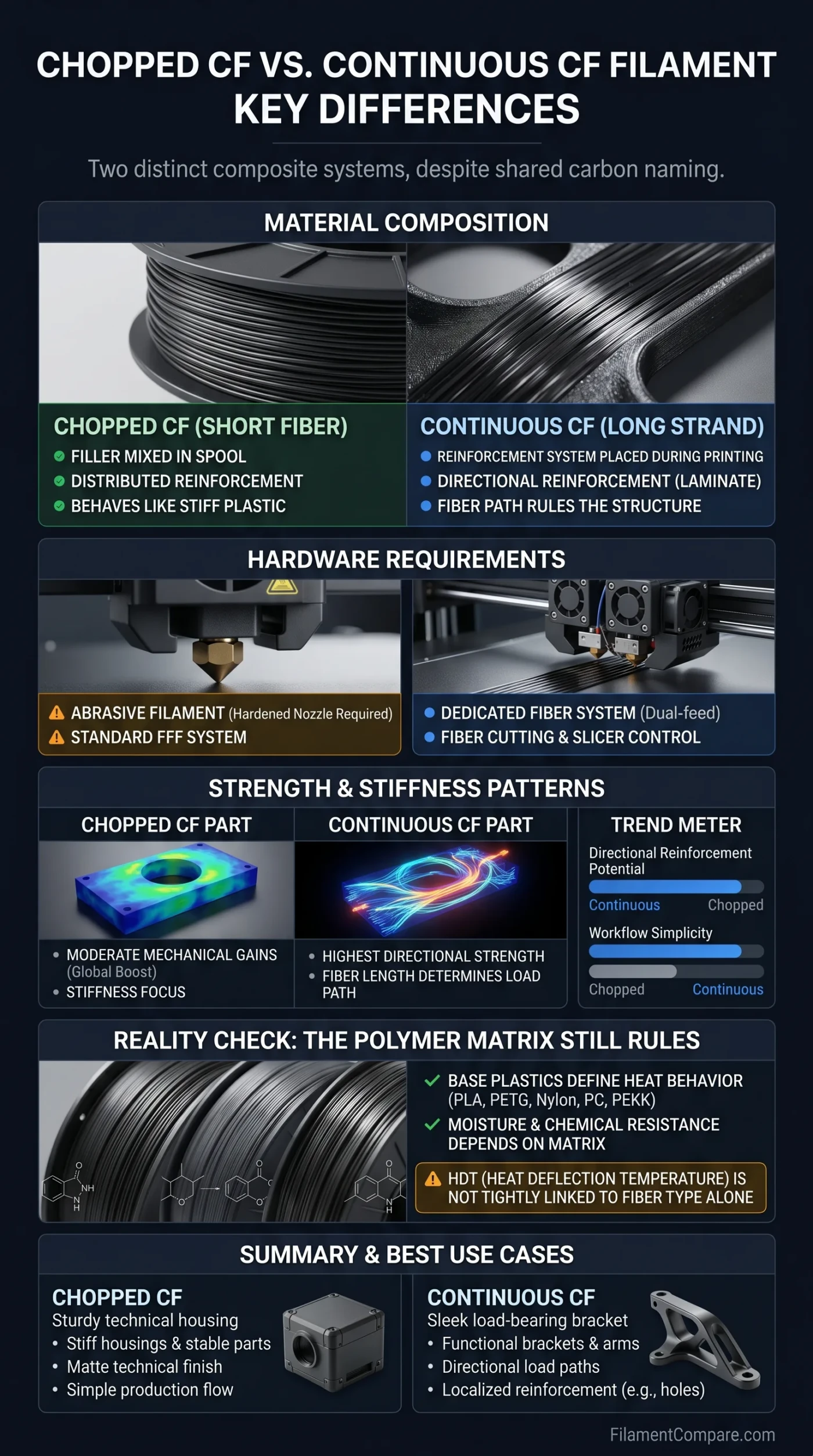
Chopped CF and continuous CF filament can look similar in a product category, yet they behave like two different composite systems. Chopped carbon fiber is mixed through a thermoplastic filament, while continuous carbon fiber is placed as long reinforcement strands inside selected layers of a printed part. The difference is not only fiber amount. It changes load direction, printer hardware, part design, and how datasheet numbers should be read.
| Comparison Area | Chopped CF Filament | Continuous CF Filament |
|---|---|---|
| Fiber Form | Short carbon fibers are cut into small pieces and blended into a polymer filament such as PLA, PETG, PA, PC, or a proprietary nylon blend. | Long carbon fiber strands are laid into the part, usually through a dedicated fiber path and a compatible base material. |
| Main Reinforcement Style | Distributed reinforcement through the whole extruded bead. The fiber helps stiffness, surface texture, and dimensional behavior across the printed material. | Directional reinforcement. The fiber carries load most strongly along the path where it is placed, much like a printed composite laminate. |
| Typical Printer Requirement | Often works on material-extrusion printers that can handle abrasive filaments, usually with a hardened nozzle and suitable temperatures. | Usually needs a continuous-fiber-capable system with a second fiber feed, fiber cutting/control, and slicer support for fiber routing. |
| Representative Datasheet Scale | Markforged Onyx, a chopped carbon fiber filled nylon, lists tensile modulus at 2.4 GPa, tensile stress at yield at 40 MPa, flexural strength at 71 MPa, flexural modulus at 3.0 GPa, HDT at 145°C, and density at 1.2 g/cm³. | Markforged continuous carbon fiber test plaques list tensile strength at 800 MPa, tensile modulus at 60 GPa, flexural strength at 540 MPa, flexural modulus at 51 GPa, compressive strength at 420 MPa, HDT at 105°C, and density at 1.2 g/cm³. |
| Strength Pattern | Strength and stiffness gains are more spread through the printed bead, but the short fibers do not form a long, uninterrupted load path. | Strength can rise sharply in the fiber direction, especially with unidirectional or well-routed reinforcement. Cross-direction behavior still depends on the polymer and layer bonding. |
| Heat Behavior | Mostly controlled by the base polymer. A chopped CF nylon may handle heat very differently from chopped CF PLA or chopped CF PETG. | Also controlled by the matrix and test method. Continuous fiber does not automatically mean a higher heat-deflection number in every datasheet. |
| Design Freedom | Simple geometry workflow. The whole part is printed from the same filled material, so reinforcement follows the normal extrusion paths. | Fiber can be placed in selected layers, rings, ribs, or load paths. This gives more control, but part behavior becomes more dependent on fiber layout. |
| Common Use Pattern | Stiffer brackets, housings, fixtures, printer parts, jigs, visual prototypes with a matte technical surface, and parts needing cleaner dimensional behavior. | Load-bearing fixtures, end-use tooling, thin stiff arms, functional brackets, and parts where the main forces can be aligned with continuous fiber paths. |
| Main Tradeoff | More accessible and simpler to print, with moderate mechanical gains compared with the base polymer. | Higher directional reinforcement potential, with more specialized hardware, slicing, and part-orientation decisions. |
This comparison uses Markforged Onyx and Markforged Continuous Carbon Fiber datasheet values with ASTM/ISO terminology references; it describes tested trends for Chopped CF vs Continuous CF filament, while real part results can shift with matrix polymer, fiber routing, drying, geometry, and print settings.
- Chopped CF: short-fiber filled thermoplastic
- Continuous CF: long-strand reinforcement
- Main difference: load path
- Heat behavior: matrix-dependent
- Hardware: hardened nozzle vs dedicated fiber system
Why the Two Filaments Are Not the Same Material Class
The simplest way to separate them is this: chopped CF filament is a filled plastic, while continuous CF filament is a reinforcement system. Chopped fiber is already mixed into the spool. Continuous fiber is placed into the part during printing, often alongside a base thermoplastic. Same carbon family. Different mechanics.
This matters because a printed part does not fail only because of the material name on the spool. It fails through bead bonding, layer interfaces, raster direction, voids, fiber alignment, and load direction. A chopped CF part and a continuous CF part may share the phrase “carbon fiber,” yet the internal structure can be completely different.
ISO/ASTM terminology for additive manufacturing describes the process around building 3D geometry by successive addition of material, which is useful here because both families are usually discussed inside material extrusion and composite printing, not as conventional molded carbon-fiber laminate plates.[b]
Plain Material Difference
Chopped CF behaves like a thermoplastic that has been stiffened with short carbon fibers. Continuous CF behaves more like a printed composite where the fiber route becomes part of the structure. One is mixed everywhere. The other is placed where the part needs reinforcement.
What Chopped CF Filament Means
Chopped CF filament starts with a base polymer. Carbon fibers are cut into short lengths and blended into that polymer before the filament is extruded. The final spool still feeds like filament, but the material inside the nozzle is now a fiber-filled composite rather than a plain plastic.
The base polymer still matters a lot. Chopped CF PLA, chopped CF PETG, chopped CF nylon, chopped CF polycarbonate, and chopped CF PEKK are not interchangeable. The carbon fiber adds stiffness and can reduce shrinkage, but the polymer sets much of the heat behavior, moisture response, chemical behavior, and layer bonding style.
Short Fiber Distribution
In chopped CF filament, the short fibers tend to follow the extrusion flow through the nozzle. That gives the printed bead a degree of directionality, but it is not the same as a long strand running through the part. The fiber pieces help the bead resist bending and deformation, while the polymer matrix still carries much of the connection between layers.
This is why chopped CF filament is often described as stiffer rather than simply stronger. A part may feel more rigid, hold shape well, and show a clean matte surface. That does not mean every impact, snap-fit, or thin tab will behave like a woven carbon-fiber panel. It will not.
Common Polymer Bases
- PLA-CF: easy printing behavior, low warp, neat surface, and moderate thermal range.
- PETG-CF: practical chemical resistance, more toughness than PLA in many cases, and a slightly more flexible feel.
- PA-CF or Nylon-CF: strong engineering use, but moisture handling and drying behavior matter.
- PC-CF: higher temperature range than many hobby materials, with a more demanding printing profile.
- PEEK-CF or PEKK-CF: high-temperature engineering materials that need specialized printers and controlled conditions.
What Continuous CF Filament Means
Continuous CF filament uses long carbon fiber strands rather than chopped pieces. In many systems, the printer feeds a base thermoplastic and a continuous fiber reinforcement separately. The fiber is then laid into selected layers, rings, or internal paths. It is not just “stronger filament.” It is a different printed structure.
Continuous carbon fiber gives its largest benefit when the fiber path matches the load path. A tensile load along the fiber direction is very different from a load across layers, across beads, or through a thin wall with little reinforcement. Direction rules the result.
Fiber Placement
Continuous fiber can be placed around holes, along edges, inside beams, or through sections expected to carry bending loads. This is why continuous CF often appears in tooling, fixtures, brackets, and parts that need high stiffness with low mass. The designer is not only choosing a filament. The designer is choosing a fiber architecture.
Current composite additive-manufacturing literature also treats continuous fiber as a route to higher mechanical performance because the fiber can form a more direct load path than dispersed short fibers.[c] The short version: long strands carry load better when the force is aligned with them.
Strength and Stiffness: Fiber Length Changes the Load Path
The main mechanical difference is the length of the reinforcing fiber. Chopped fibers are many small reinforcements locked into the polymer. Continuous fibers are long, connected reinforcements. That single difference changes the whole stress path inside the part.
Relative Directional Reinforcement Potential Trend Only
Workflow Simplicity Trend Only
Tensile Behavior
Tensile strength measures how a specimen behaves when pulled. Chopped CF can improve stiffness and sometimes tensile performance compared with the unfilled base polymer, but the short fibers cannot bridge the whole test length as a single load-carrying strand. Continuous CF can carry far more load along the fiber direction, provided the test specimen and the printed part are built to use that direction.
ASTM D638 is commonly used for tensile properties of plastics, including reinforced plastics in standard specimen forms; it also notes that tensile properties depend on specimen preparation, speed, and test environment.[d] For printed composites, that reminder is useful. The specimen is not just material. It is material plus process.
Flexural Behavior
Flexural performance is often the more useful number for brackets, arms, and fixtures because many printed parts bend rather than pull straight apart. Continuous CF can be very strong in bending when fibers are placed near the outside surfaces of a bending section. Chopped CF gives a more general stiffness lift across the printed material, especially when compared with the same polymer without fiber.
ASTM D790 covers flexural properties of unreinforced and reinforced plastics using a beam loaded in bending, and it also warns that highly orthotropic laminates need careful interpretation because fiber stacking can change the apparent result.[e] That sentence explains a lot about continuous CF prints. The layup matters.
Impact and Strain Behavior
Carbon fiber increases stiffness, but stiffness and impact behavior are not the same property. A chopped CF material may feel rigid and dimensionally stable; a continuous CF part may carry high load along the fiber path. Impact response still depends on polymer toughness, layer bonding, fiber content, and geometry. Thin corners tell the truth.
Some carbon-filled filaments can become less flexible than their unfilled base polymer. That is not a flaw. It is the expected behavior of a stiffer filled material. For living hinges, snap tabs, or parts that need high elongation, the base polymer and strain-at-break number deserve close reading.
Heat Behavior Depends on the Polymer Matrix
Heat resistance is one of the easiest areas to misread. Carbon fiber does not melt like the polymer, but the printed part is still a polymer composite. The base matrix softens, creeps, absorbs heat, and controls the service-temperature window.
This is why a chopped CF nylon can show a higher heat-deflection number than a continuous CF composite in a specific datasheet. It sounds surprising at first, but it makes sense once the test method, matrix, fiber layout, and load level are known. Heat resistance is not the same as tensile strength.
ASTM D648 covers deflection temperature of plastics under flexural load and states that the data should not be used to predict elevated-temperature behavior unless time, temperature, loading, and fiber stress are similar to the test conditions.[f] That is a careful way to read every HDT value in carbon fiber filament datasheets.
Useful reading point: a high tensile or flexural number does not automatically mean higher heat resistance. For both chopped CF and continuous CF, the matrix polymer remains a major part of the thermal story.
Hardware, Nozzle Wear, and Printing Workflow
Chopped CF filament is usually the easier route for standard material-extrusion users, but it is still abrasive. Carbon fiber-filled filament can wear brass nozzles, which changes extrusion diameter and print consistency over time. A worn nozzle can quietly turn a good filament into a poor-looking part.
Prusa Research states that carbon fibers are highly abrasive and may damage a brass nozzle, which is why hardened steel nozzles are required for its PC Blend Carbon Fiber filament.[g] The same general idea applies across many chopped carbon-filled filaments: the printer must be ready for abrasion.
Chopped CF Hardware Pattern
- Nozzle: hardened steel, tungsten carbide, ruby-tipped, or another wear-resistant option depending on the printer ecosystem.
- Extruder: stable filament grip helps because filled filaments can be less forgiving than plain PLA or PETG.
- Nozzle diameter: many users prefer larger nozzles for filled materials because fiber-filled melts can be more clog-prone in very small openings.
- Bed and enclosure: requirements come mostly from the base polymer, not only from the carbon fiber.
Continuous CF Hardware Pattern
Continuous CF printing normally needs more than a hardened nozzle. It needs a system that can feed, place, and cut long fiber strands while also printing the matrix material. The slicer must understand fiber paths. The printer must control where those paths begin and end. It is a process choice, not just a spool choice.
This also changes file preparation. With chopped CF, most of the design work is still normal FFF design. With continuous CF, fiber regions, shell placement, load direction, and local reinforcement zones become part of the part definition.
Datasheet Numbers Need Context
Datasheets are useful, but carbon fiber composite numbers are easy to over-read. A chopped CF datasheet value often describes a printed or molded plastic-composite specimen. A continuous CF value may describe a fiber-reinforced plaque, a unidirectional layout, or a test specimen built to show fiber-direction performance. Those are not the same comparison.
| Property | What It Measures | Why It Matters in CF Filament |
|---|---|---|
| Tensile Strength | Resistance to being pulled apart under controlled test conditions. | Continuous CF can show very high values along the fiber direction; chopped CF depends more on the filled polymer bead and layer quality. |
| Tensile Modulus | Stiffness during stretching in the elastic region. | A high modulus usually means less stretch under load. Carbon fiber strongly affects this number. |
| Flexural Strength | Resistance to bending failure in a beam-style test. | Useful for brackets, arms, tool holders, fixtures, and flat sections that bend under load. |
| Flexural Modulus | Stiffness in bending. | Often where carbon-filled materials feel most different from plain polymers. |
| Heat Deflection Temperature | Temperature at which a loaded specimen reaches a defined deflection. | Useful for comparing materials under similar test conditions, but not a full service-temperature guarantee. |
| Density | Mass per unit volume. | Carbon fiber composites are often chosen for stiffness-to-weight behavior, but density alone does not tell the whole part weight story. |
ASTM D3039/D3039M is used for in-plane tensile properties of polymer matrix composite materials reinforced by high-modulus fibers, and it lists properties such as ultimate tensile strength, tensile strain, chord modulus, and Poisson’s ratio.[h] That is closer to how continuous fiber laminates are often evaluated.
Research on FDM polymer composites also points to process variables such as layer thickness, infill pattern, raster angle, fiber orientation, void formation, surface roughness, and fiber-matrix bonding as part of the mechanical result.[i] The printed part is a material plus a manufacturing history.
Part Design Behavior
Chopped CF and continuous CF change part behavior in different ways. Chopped CF improves the printed material more evenly through the part. Continuous CF lets reinforcement be concentrated where it can do more structural work. One is broad. One is targeted.
Where Chopped CF Usually Fits
- Dimensionally stable parts: covers, housings, brackets, machine guards, fixtures, and non-flexing printer parts.
- Matte technical surfaces: carbon-filled filaments often hide layer lines better than glossy unfilled materials.
- Moderate stiffness upgrades: useful when plain PETG, PLA, or nylon feels too flexible for the shape.
- Simple production flow: the print path stays close to normal FFF slicing, with attention to abrasive-material hardware.
Where Continuous CF Usually Fits
- Directional load paths: parts where the main tension or bending stress can be aligned with fiber placement.
- Thin stiff structures: arms, ribs, reinforced panels, and lightweight brackets.
- Functional tooling: jigs and fixtures that need high stiffness without moving to machined metal.
- Localized reinforcement: rings around holes, high-stress zones, and long straight load paths inside the part.
Fiber Orientation and Anisotropy
Anisotropy means a material behaves differently in different directions. All FFF parts have some anisotropy because beads and layers are stacked. Carbon fiber can make this more visible, especially when the fibers are aligned.
In chopped CF filament, the fibers are short and usually align partly with the extrusion direction. In continuous CF printing, the long strand can make the fiber direction much stronger and stiffer than the cross direction. Orientation becomes part of the material.
Simple Direction Example
A continuous CF beam with fibers running along its length can resist bending far better than the same beam with little or no fiber in that direction. A chopped CF beam gains stiffness through the filled polymer, but it does not gain one long carbon path from end to end.
Surface Finish, Weight, and Electrical Behavior
Chopped CF filaments often produce a satin or matte surface because the carbon-filled polymer scatters light differently than a clear or glossy base plastic. This can make layer lines look softer. Continuous CF parts may also use a carbon-filled base material, but the visible finish depends on the outer shell material, fiber placement, and printer process.
Weight is more nuanced than many product names suggest. Carbon fiber has a low density compared with many metals, but the printed part is still a composite of polymer, fiber, voids, walls, and infill. A continuous CF part can be very efficient when the fiber replaces bulky plastic geometry, yet density numbers alone do not describe that efficiency.
Electrical behavior also needs care. Some carbon-filled materials are conductive or static-dissipative enough for certain uses, while others are not specified for electrical control. CF in the name is not an ESD rating. For electronics fixtures or static-sensitive work, the actual surface resistance data is the number to check.
Moisture, Drying, and Matrix Effects
Carbon fiber does not erase the behavior of the base polymer. A nylon-based chopped CF filament can still absorb moisture. A high-temperature CF material can still need controlled storage. A continuous CF part can still be limited by the matrix around the fiber.
This is one of the most useful ways to read a carbon fiber filament listing: first identify the polymer family, then identify the fiber form. “PA-CF” and “PC-CF” may both contain carbon fiber, but their printing temperatures, moisture behavior, and heat performance can be very different.
Material Selection Matrix
| Part Requirement | Chopped CF Filament | Continuous CF Filament |
|---|---|---|
| General stiffness increase | Strong fit because the whole printed material is fiber filled. | Useful when the part also has a clear load path worth reinforcing. |
| Highest directional stiffness | Moderate fit. Short fibers help, but they do not form a continuous path. | Strong fit when fibers can be routed along the main load direction. |
| Simple printer workflow | Strong fit with abrasive-material hardware and suitable print settings. | More specialized because the printer and slicer must support continuous fiber placement. |
| Fine surface appearance | Often strong because chopped CF can give a clean matte finish. | Depends on the outer matrix material and whether fiber affects surface features. |
| Small thin snap features | Depends on the base polymer and strain behavior. | Depends heavily on fiber routing; continuous fiber may not help tiny features if it cannot be placed there. |
| High heat environment | Depends on polymer base: PLA-CF, PETG-CF, PA-CF, PC-CF, and PEKK-CF differ widely. | Also matrix-dependent. Continuous fiber improves load transfer, but the polymer still sets much of the heat window. |
| Localized reinforcement near holes | Possible through geometry, walls, and infill choices. | Strong fit when the system allows fiber rings or routed reinforcement around high-stress zones. |
Common Interpretation Notes
“Carbon Fiber” Does Not Mean One Material
A product name can hide a lot of detail. PLA-CF, PETG-CF, PA-CF, PC-CF, PEEK-CF, and continuous CF reinforced nylon are all different materials. The fiber is only one part of the composite.
Continuous CF Is Not Automatically Better in Every Shape
Continuous CF has a high directional reinforcement potential, but geometry decides how much of that potential is used. Very small parts, thin isolated features, highly curved paths, or loads that cut across layers may not use the long fiber as efficiently as a straight beam or planned bracket.
Chopped CF Is Not Just for Looks
Chopped CF is sometimes chosen for its matte finish, but its technical role is real. It can raise stiffness, reduce the rubbery feel of some polymers, and improve dimensional behavior. The size of that benefit depends on the base polymer, fiber loading, print settings, and part geometry.
Heat and Strength Should Be Read Separately
A material can be stiff and still have a modest heat window. Another material can show a higher HDT but lower tensile strength. These are separate measurements. One number cannot replace the datasheet.
Terms That Make the Comparison Clear
- Matrix
- The polymer that surrounds and holds the carbon fibers. In filament printing, this may be PLA, PETG, PA, PC, PEKK, PEEK, or a proprietary blend.
- Chopped Fiber
- Short carbon fiber segments mixed into a thermoplastic filament before printing.
- Continuous Fiber
- A long fiber strand placed into the printed part so it can carry load along its length.
- Raster Direction
- The direction of the printed extrusion path. It affects both chopped CF and continuous CF parts.
- Anisotropy
- Different mechanical behavior in different directions. FFF parts and fiber composites both show this behavior.
- HDT
- Heat deflection temperature, a test-based value showing when a loaded specimen reaches a defined deflection under specified conditions.
- Fiber Volume Fraction
- The amount of fiber in a composite by volume. More fiber can raise stiffness, but placement, bonding, and void content still matter.
Resources Used
- [a] Markforged Composites Material Datasheet
- [b] ISO/ASTM 52900:2021 — Additive Manufacturing — General Principles — Fundamentals and Vocabulary
- [c] npj Advanced Manufacturing — Recent Advances in Design Optimization and Additive Manufacturing of Composites
- [d] ASTM D638-22 — Standard Test Method for Tensile Properties of Plastics
- [e] ASTM D790-25 — Standard Test Methods for Flexural Properties of Unreinforced and Reinforced Plastics and Electrical Insulating Materials
- [f] ASTM D648-18 — Standard Test Method for Deflection Temperature of Plastics Under Flexural Load
- [g] Prusa Research — Prusament PC Blend Carbon Fiber Filament
- [h] ASTM D3039/D3039M-17R25 — Standard Test Method for Tensile Properties of Polymer Matrix Composite Materials
- [i] Polymers — FDM-Based 3D Printing of Polymer and Associated Composite: A Review on Mechanical Properties, Defects and Treatments
