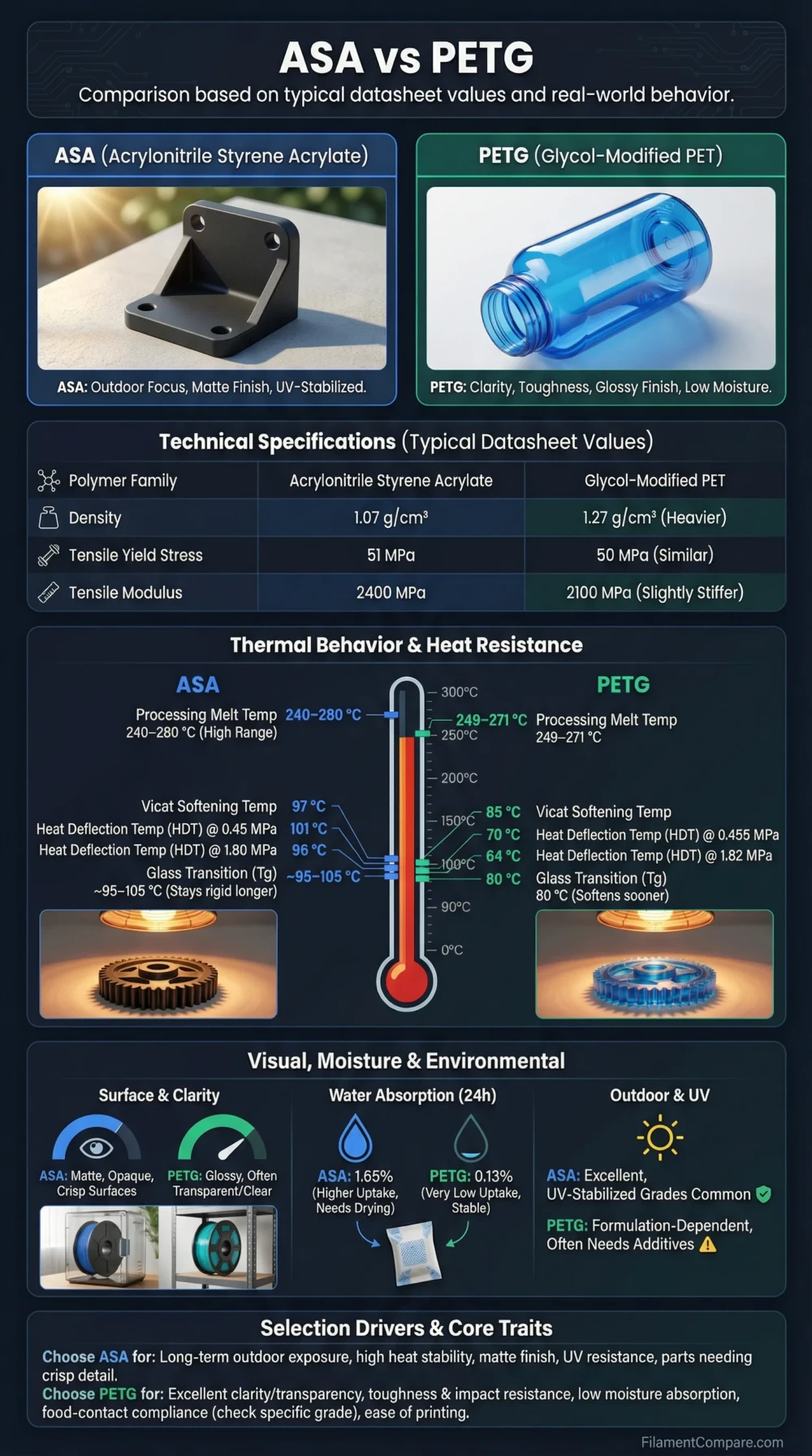
| Spec / Behavior | ASA (Typical Datasheet Values) | PETG (Typical Datasheet Values) |
|---|---|---|
| Polymer Family | Acrylonitrile Styrene Acrylate (ASA) | Glycol-Modified PET (PETG copolyester) |
| Typical Density | 1.07 g/cm³ | 1.27 g/cm³ |
| Glass Transition (Tg) | ~95–105 °C (common ASA range) | 80 °C |
| Heat Deflection / Deflection Temp | 96 °C (@ 1.80 MPa) / 101 °C (@ 0.45 MPa) | 64 °C (@ 1.82 MPa) / 70 °C (@ 0.455 MPa) |
| Vicat Softening Temp | 97 °C | 85 °C |
| Tensile Modulus | 2400 MPa | 2100 MPa |
| Tensile Yield Stress | 51 MPa | 50 MPa |
| Notched Impact (23 °C) | 12 kJ/m² (Charpy, ISO 179/1eA) | 6.2 kJ/m² (Izod, ISO 180) |
| Water Absorption (24 h) | 1.65% (similar to ISO 62) | 0.13% (ISO 62) |
| Typical Processing Melt Temp | 240–280 °C | 249–271 °C |
| Outdoor / Weather Focus | UV-Stabilized grades are common | Formulation-Dependent (varies by brand/additives) |
| Visual Style | Typically opaque with crisp surfaces | Often glossy; clear/transparent grades are common |
ASA numeric values above are from a published material datasheet for Luran® S 757G and are measured on standardized specimens.✅Source
- Key Terms Used In Datasheets
- Material Identity and Core Traits
- Thermal Behavior and Warm-Environment Stiffness
- ASA Thermal Snapshot
- PETG Thermal Snapshot
- Strength, Stiffness, and Impact Profile
- Surface, Detail, and Visual Finish
- Moisture Behavior and Chemical Contact
- Outdoor Exposure and Weather-Focused Grades
- Common Selection Drivers People Compare
PETG numeric values above are from a published technical data sheet for Eastar™ 6763 copolyester and are also based on standard test methods.✅Source
If your goal is a clean filament comparison that stays close to real numbers, ASA filament and PETG filament separate most clearly in heat-related specs, moisture uptake, and optical style. Below you’ll see what those datasheet metrics usually mean in practice, plus where each material tends to show its character in real prints.
Signal Bars (Based on Typical Datasheet Numbers)
Bars are a relative visual of the table values: higher HDT/Tg pushes “Heat Headroom” up, while higher 24 h water absorption pushes “Water Uptake” up.
Key Terms Used In Datasheets
- Glass Transition (Tg)
- The temperature region where an amorphous polymer shifts from a more rigid, glassy feel toward a more rubbery response. For ASA and PETG, Tg often hints at when stiffness starts to fade under warm conditions.
- Deflection Temperature / HDT (DTUL)
- A lab test temperature measured under a defined load. It’s not “maximum service temperature,” but it is a strong comparator between materials when the test methods are listed.
- Vicat Softening Temperature
- A softening metric under a defined needle load and heating rate. It’s often used alongside HDT to talk about warm-environment stiffness.
- Water Absorption (24 h)
- A short immersion measurement that helps explain why some parts feel more dimensionally “steady” after humidity exposure. It’s a handy contrast between ASA and PETG.
Material Identity and Core Traits
ASA sits in the styrenic family (often discussed near ABS), and it’s frequently grouped with other high-performance filaments used for engineering prints. Many grades are designed for long-term outdoor exposure with stable color and surface behavior. In the datasheet language, you’ll often see phrases like high surface quality and UV-stabilized used as core identity markers.✅Source
PETG is a copolyester (PET modified with glycol). That small chemistry shift is why clarity and toughness show up so often in product descriptions, and why low water absorption can be a standout number in the property table.✅Source
Thermal Behavior and Warm-Environment Stiffness
ASA Thermal Snapshot
- Deflection temp: 96 °C (@ 1.80 MPa) and 101 °C (@ 0.45 MPa)
- Vicat: 97 °C
- Processing melt temp: 240–280 °C
These numbers explain why ASA is often paired with parts expected to stay shape-stable in warmer air and sun-warmed enclosures.✅Source
PETG Thermal Snapshot
- Glass transition (Tg): 80 °C
- Deflection temp: 70 °C (@ 0.455 MPa) and 64 °C (@ 1.82 MPa)
- Vicat: 85 °C
- Processing melt temp: 249–271 °C
PETG tends to feel confident in everyday warm environments, and the Tg number is a handy reference point for when stiffness begins to drift under sustained heat.✅Source
Context Note: Datasheet temperatures are measured on standard test specimens. Printed parts can show different results because of layer orientation, infill, and geometry. It’s still a solid way to compare ASA vs PETG on the same playing field.
Strength, Stiffness, and Impact Profile
On paper, ASA and PETG can look surprisingly close in core load numbers: tensile yield is 51 MPa for ASA and 50 MPa for PETG, with modulus around 2400 MPa vs 2100 MPa. That small gap often shows up as a slightly “crisper” feel in fixtures and brackets when everything else is held constant.✅Source
PETG is also known for combining strength with noticeable elongation in standardized tests (for Eastar™ 6763, injection-molded elongation at break is listed at 100% via ISO 527). In real prints, that “give” often translates into parts that tolerate bumps and flex cycles in a friendly way, especially in thicker sections.✅Source
Surface, Detail, and Visual Finish
Many ASA formulations put a premium on surface quality and color fastness, which is exactly why ASA shows up in outdoor housings and panels where the surface is part of the product. If you care about a clean, technical look that stays consistent across seasons, that design intent matters as much as raw strength numbers.✅Source
When the brief includes transparency or a glossy “polyester” sheen, PETG is usually the first name on the shortlist. In Eastar™ 6763 film data, haze is listed at 0.8% and transparency at 85%, which fits the real-world expectation of PETG as a clear-capable material family.✅Source
Moisture Behavior and Chemical Contact
The biggest numeric spread in many ASA vs PETG tables is water absorption. One published ASA datasheet lists 1.65% water absorption (24 h, similar to ISO 62), while a PETG copolyester sheet lists 0.13% for 24 h immersion. That difference helps explain why PETG often feels steady in humid storage and why ASA is frequently paired with controlled conditioning in industrial processing.✅Source
For chemical exposure, what matters is which chemical, which concentration, and how long. Eastman’s long-interval immersion summary for copolyesters includes 1-year data at 23 °C for multiple fluids, showing that some everyday liquids can produce very small property shifts while stronger reagents can move the needle more. That’s why “chemical resistance” is best treated as a matrix, not a single label.✅Source
Outdoor Exposure and Weather-Focused Grades
ASA is widely associated with UV-aware designs. In a typical ASA datasheet, you’ll see the idea stated plainly: superior long-term performance when exposed to UV irradiation plus a focus on surface quality and color stability. For outdoor brackets, enclosures, and sun-facing parts, that intent is a real differentiator.✅Source
PETG is also used outdoors in many projects, and its moderate heat profile (Tg around 80 °C in the referenced sheet) provides a clear boundary for warm environments. With PETG, the real-world outdoor story is often shaped by colorants, additives, and part geometry just as much as the base resin family.✅Source
Common Selection Drivers People Compare
When specs are close, the decision often comes down to a few repeatable drivers. These are the ones that show up again and again in datasheets and real print logs for ASA and PETG:
- Heat Metrics: Tg + HDT + Vicat in one view, especially if the part lives near warm air or sun-heated surfaces.
- Moisture Uptake: 24 h water absorption as a quick hint for conditioning sensitivity and storage behavior.
- Surface Intent: whether the material family is marketed around outdoor surface stability (ASA) or clear-capable toughness (PETG).
- Density: important for weight-sensitive builds, with PETG often coming in heavier per volume.
