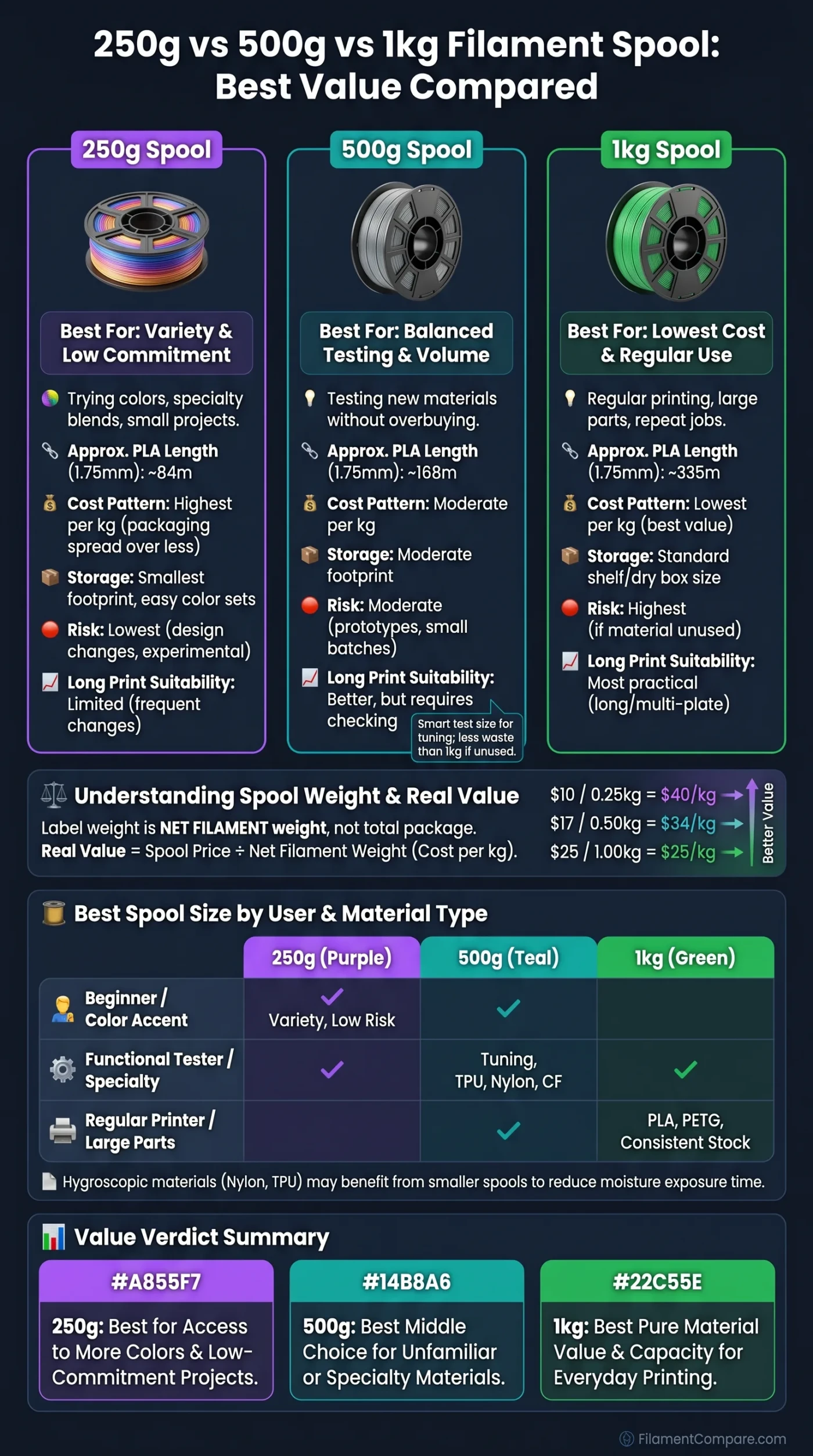
Spool size changes the real cost of filament more than it first appears. A 250g spool gives color variety and low commitment, a 500g spool balances testing with usable volume, and a 1kg spool usually gives the lowest cost per printed gram for everyday PLA, PETG, ABS, ASA, TPU, and many filled materials.
| Comparison Point | 250g Spool | 500g Spool | 1kg Spool |
|---|---|---|---|
| Best Value Role | Best for trying colors, specialty blends, and small projects | Best middle size for testing a material without buying too much | Best value for regular printing and repeat parts |
| Approx. PLA Length, 1.75mm | About 84 m, based on 1.24 g/cm³ PLA density [a] | About 168 m, based on the same diameter and density | About 335 m, which is the common reference size for PLA planning |
| Typical Cost per kg Pattern | Usually highest per kg because packaging, handling, and spool cost are spread over less material | Moderate per kg; often fair for engineering samples or school use | Usually lowest per kg among normal consumer spool sizes |
| Storage Space | Smallest and easiest to store in color sets | Moderate storage footprint | Standard shelf, dry box, and filament dryer size |
| Project Risk | Best when the design may change or the color is experimental | Good for prototypes, small batches, and low-use materials | Best when the material will be used often |
| Long Print Suitability | Limited; a large print may need a spool change | Better, but still needs checking for large parts | Most practical for long prints, multiple plates, and repeat jobs |
| AMS / Dry Box Fit | May need adapters depending on spool diameter and width | Usually easier than mini spools, but still check dimensions | Most common format; many accessories are designed around 1kg spools |
| Waste Control | Good for rare colors because less unused filament remains | Good when a material is useful but not daily-use | Good when the whole spool is likely to be printed before long storage |
This comparison treats 250g, 500g, and 1kg filament spools as size categories, using manufacturer datasheets and official product data; actual value shifts with material type, color, shipping, refill format, spool weight, and local pricing.
The practical winner is simple: 1kg spools usually give the best price per kilogram. Yet value is not only price. If half of a large spool sits open for months, absorbs moisture, or takes shelf space while a rarely used color waits for a single decorative part, the cheaper kilogram can become less useful than a smaller roll.
- Best unit price: 1kg
- Best color variety: 250g
- Best test size: 500g
- Best standard compatibility: 1kg
- Best low-commitment buy: 250g
What Spool Size Actually Means
A filament spool label usually describes the net filament weight, not the total package weight. A 1kg spool means about one kilogram of printable material, while the plastic or cardboard reel, bag, desiccant, and box are extra weight.
This matters when comparing deals. A listing that looks heavier because of shipping weight may not include more usable filament. The number to compare is net filament weight.
Approximate Filament Length by Spool Size
For 1.75mm PLA, a density of 1.24 g/cm³ is widely used in technical datasheets, including Prusament PLA. Using that value, 250g, 500g, and 1kg spools translate into very different print capacity.
| PLA Spool Size | Approx. Filament Length | What It Means in Practice |
|---|---|---|
| 250g | About 84 meters | Enough for small models, color accents, test parts, miniatures, samples, and repair pieces |
| 500g | About 168 meters | Enough for several small prints or one moderate project with less leftover risk |
| 1kg | About 335 meters | Enough for longer print runs, multiple build plates, cosplay parts, organizers, fixtures, and repeated prototypes |
These are planning numbers, not a promise for every filament. PETG, ASA, TPU, nylon, carbon-fiber blends, wood-filled PLA, metal-filled PLA, and glass-filled materials can use different densities, so the same weight may give a different length.
250g Spools: Best for Color Choice and Low Commitment
A 250g filament spool makes sense when the goal is variety. Mini spool bundles often include many colors in a compact set; SUNLU, for example, lists 250g mini spools in multi-roll packs and describes them as one-quarter the size of a standard 1kg spool [b].
The value here is not the lowest price per kilogram. It is access to more colors with less unused material. For signs, toys, school projects, color-coded prototypes, small decorative parts, and display models, 250g can be the more sensible spend.
Where 250g Spools Make the Most Sense
- Testing an unfamiliar filament brand before buying a larger roll
- Buying several colors for multi-color prints without filling a shelf with full spools
- Printing accent colors that may only be used for logos, labels, eyes, buttons, or inserts
- Keeping moisture-sensitive materials in smaller amounts when use is occasional
- Classroom, beginner, or sample-pack printing where variety matters more than bulk value
The trade-off is capacity. An 84-meter PLA estimate sounds useful, but slicer estimates can move fast on dense parts, high infill, supports, brims, purge blocks, and failed first attempts. Small spools feel generous until a large model starts eating material.
Hidden Cost Pattern of 250g Spools
Small spools carry a higher share of packaging, winding, handling, retail listing, and shipping cost per gram. This is why a 250g roll is often not one-quarter of the price of a 1kg roll. The buyer pays for choice and convenience, not only plastic.
500g Spools: The Balanced Middle Size
A 500g filament spool is the most balanced size when a material is useful but not yet trusted for regular printing. It gives enough filament for realistic testing, while still limiting the risk of owning too much of a color, finish, or blend that may only fit one project.
This size is especially practical for engineering materials and specialty looks: matte PLA, silk PLA, translucent PETG, flexible TPU, wood-filled PLA, glow filament, support material, nylon blends, and carbon-fiber-filled materials. Half a kilogram gives room for calibration cubes, temperature towers, functional samples, and a real part. Not just a tiny swatch.
500g is often the smarter test size when the filament needs tuning. A 250g spool can disappear during calibration, while 1kg may be more than needed for a material that will only be used a few times.
When 500g Beats Both Smaller and Larger Spools
- New brand testing: enough filament to judge winding quality, color match, diameter consistency, and surface finish.
- Occasional functional use: enough for brackets, holders, mounts, jigs, and small batches.
- Moisture control: less open material than a 1kg roll when using hygroscopic filaments.
- Print farm sampling: useful for checking whether a material deserves a larger purchase.
- Education and workshops: easier to assign colors or materials across several users.
The main limitation is availability. Many common consumer filaments are sold mostly as 1kg rolls, while 500g options appear more often in sample packs, specialty materials, branded ecosystems, or regional stores.
1kg Spools: The Standard Best Value Size
The 1kg filament spool is the standard format for good reason. It fits many spool holders, dry boxes, filament dryers, AMS-style systems, shelves, and retail categories. Official product listings from major brands commonly present PLA in 1kg format, such as Bambu Lab PLA Basic at 1kg and Hatchbox PLA at 1kg [c].
For everyday PLA, PETG, ASA, ABS, TPU, and many engineering blends, 1kg usually gives the best normal-size value. The packaging cost is spread over more material, and the buyer is less likely to pause a long print because a mini spool ran out.
Where 1kg Spools Are Hard to Beat
- Regular PLA and PETG printing
- Large organizers, bins, cosplay pieces, helmets, props, and printer parts
- Repeat prototypes where the same color and material are used often
- Print farm work that depends on predictable stock
- Functional parts that may need several revisions before the final version
- Multi-plate projects where stopping for spool changes is inconvenient
The 1kg size is not automatically the best buy for every material. A rarely used flexible filament, an unusual color, or a decorative composite may sit for a long time. For moisture-sensitive materials, storage discipline matters more as spool size grows.
Real Value Is Cost per Printed Gram
The cleanest comparison is price divided by net filament weight. A 250g spool at $10 equals $40/kg. A 500g spool at $17 equals $34/kg. A 1kg spool at $25 equals $25/kg. Same material family, very different value.
| Spool Size | Example Spool Price | Calculation | Effective Cost per kg |
|---|---|---|---|
| 250g | $10 | $10 ÷ 0.25 kg | $40/kg |
| 500g | $17 | $17 ÷ 0.50 kg | $34/kg |
| 1kg | $25 | $25 ÷ 1.00 kg | $25/kg |
This is why 1kg is the usual answer for value. The exception comes when the extra 500g or 750g is not likely to be used. Filament that never becomes a printed part has a poor value, even if the unit price looked good.
Value Formula
- Cost per kg
- Spool price ÷ net filament weight in kilograms
- Cost per printed part
- Part filament use × cost per gram, plus expected support, purge, brim, and failed-print allowance
- Useful value
- Low cost per kg only counts when the spool will be used before it degrades, tangles, gets damaged, or becomes unwanted stock
Spool Weight, Reel Size, and Compatibility
Spool size is not only about how much filament is wound on the reel. The outer diameter, width, hub hole, flange shape, spool material, and side-wall design can affect compatibility with spool holders, dry boxes, enclosures, and automatic material systems.
Polymaker’s published spool dimensions show how much format can vary even inside one brand: some 0.5kg and 1kg cardboard spools share a 200mm outer diameter but may differ in width and spool weight, depending on product line and spool design [d].
| Compatibility Area | Why It Matters | Most Predictable Size |
|---|---|---|
| Spool Holder | Very small spools may sit too low or need a narrower axle; wide spools may rub side walls | 1kg |
| Dry Box | Dry boxes are often built around standard spool diameter and width | 1kg |
| Filament Dryer | Many consumer dryers are designed around spools up to about 1kg | 1kg |
| AMS-Style Systems | Spool diameter, width, edge shape, and weight can affect feeding behavior | 1kg, when dimensions match the system |
| Storage Bins | Mini spools save space, but mixed spool sizes can be harder to organize cleanly | Depends on storage layout |
For printers with open spool holders, this may not matter much. For enclosed printers, multi-material systems, and dry-box feeding, dimensions matter. Check before buying a bundle.
Material Type Changes the Best Spool Size
PLA is easy to recommend in 1kg because it is widely used, affordable, and common for prototypes, models, fixtures, and general printing. A basic PLA product page from Bambu Lab lists PLA Basic as a 1kg filament with 1.75mm diameter tolerance of ±0.03mm, which reflects the common consumer format [e].
Other materials need a more careful choice. TPU prints slower, nylon needs better moisture control, filled filaments can be project-specific, and support materials may be used only in thin interface layers. For these, smaller spools can be financially cleaner.
| Filament Type | Best Typical Size | Reason |
|---|---|---|
| Basic PLA | 1kg | Used often, easy to store, strong price-per-kg value |
| PETG | 1kg | Common for functional parts; regular users usually finish the roll |
| TPU | 500g or 1kg | Great when needed, but slower printing can make a full spool last longer |
| Nylon / PA | 500g or 1kg | Good for functional work, but storage and drying matter more |
| Carbon-Fiber Blends | 500g or 1kg | Useful for technical parts; 500g is safer for testing printer setup and nozzle wear |
| Silk / Rainbow / Specialty PLA | 250g or 500g | Often chosen for appearance, not daily printing |
| Support Material | 250g or 500g | Used in smaller amounts unless printing dual-material parts often |
Color Variety vs Bulk Value
Color is where smaller spools become attractive. A single 1kg black PLA spool may be the practical value winner, but a set of 250g spools can supply white, black, grey, red, blue, green, orange, and transparent tones without buying eight kilograms of filament.
For visual printing, color availability can be real value. The best spool size is the one that matches how the filament will be used: one kilogram for the color used every week, smaller rolls for colors used only as accents.
Relative Value Pattern by Spool Size
The meter above reflects typical cost-per-kg behavior for common filament, not every sale or every brand. A discounted 500g spool may beat an expensive 1kg specialty spool. Always calculate.
Moisture, Shelf Life, and Open-Spool Value
Moisture changes the value equation. A full 1kg spool is excellent when it is used regularly, but the same roll may need drying if it sits open in a humid room. PLA is more forgiving than nylon, but storage still affects print quality.
Smaller spools can help when the material is used slowly. A 250g or 500g spool can be opened, printed, and finished sooner, which reduces the time the filament spends exposed to room air. Simple.
For hygroscopic materials, usage rate matters. If a 1kg spool of nylon or TPU will sit open for months, a smaller roll may be the better practical value even when the per-kg price is higher.
Shipping and Packaging Can Shift the Winner
Shipping can make small spools look less attractive. A 250g roll may have nearly the same handling cost as a 1kg roll, especially when ordered alone. Multi-spool bundles reduce that problem because shipping and packaging are shared across several rolls.
Refill systems can also change the math. Some brands sell filament refills without a full disposable spool, and that can reduce waste and sometimes lower the material cost. Hatchbox, for example, lists reloadable-spool PLA refill products and describes them as a cost-saving refill system [f].
Which Size Is Best for Each Buyer Type?
| User Pattern | Best Spool Size | Why |
|---|---|---|
| Beginner testing several colors | 250g | Lower upfront cost per color and less leftover material |
| Beginner printing one main material | 1kg PLA | Best standard value and enough material for learning mistakes |
| Functional part maker | 1kg PETG or PLA+ | Repeat parts and revisions use material quickly |
| Trying TPU, nylon, or CF blend | 500g | Enough for tuning without committing to a full kilogram |
| Print farm or heavy user | 1kg or larger | Consistent stock matters more than color variety |
| Miniature, model, and color-detail printing | 250g or 500g | Many colors can matter more than lowest unit cost |
| Long single-piece printing | 1kg | Lower chance of a mid-print spool change |
How to Compare Filament Deals Correctly
A fair comparison uses the same material family, same diameter, same brand tier, and the same shipping basis. Comparing a premium matte PLA 250g roll against a basic economy PLA 1kg spool does not show the value of spool size alone.
- Check the net filament weight, not total package weight.
- Divide the price by 0.25, 0.5, or 1.0 to get cost per kg.
- Include shipping, tax, and bundle discounts.
- Check whether the roll includes a spool or is a refill.
- Confirm diameter, tolerance, material type, color, and spool dimensions.
- Estimate whether the full roll will be used within a reasonable storage period.
Best Value Verdict: 250g vs 500g vs 1kg
For pure material value, the 1kg spool is usually the best buy. It offers the lowest common cost per kilogram, the easiest accessory compatibility, and the best capacity for long prints.
The 500g spool is the best middle choice when the filament is unfamiliar, specialty, moisture-sensitive, or not likely to become a daily-use material. It has enough volume to test honestly.
The 250g spool is best when color variety, small storage, low commitment, and reduced leftover material matter more than the cheapest kilogram. It is not the cheapest way to buy plastic, but it can be the cleanest way to buy exactly what a project needs.
Resources Used
- [a] Prusa Polymers, Prusament PLA Technical Data Sheet, density 1.24 g/cm³. Source
- [b] SUNLU, 250g mini spool bundle product page. Source
- [c] Hatchbox, 1kg PLA filament product listing. Source
- [d] Polymaker, published spool dimensions for multiple filament spool sizes. Source
- [e] Bambu Lab, PLA Basic product page with 1kg size and 1.75mm diameter tolerance. Source
- [f] Hatchbox, reloadable PLA refill product listing. Source
