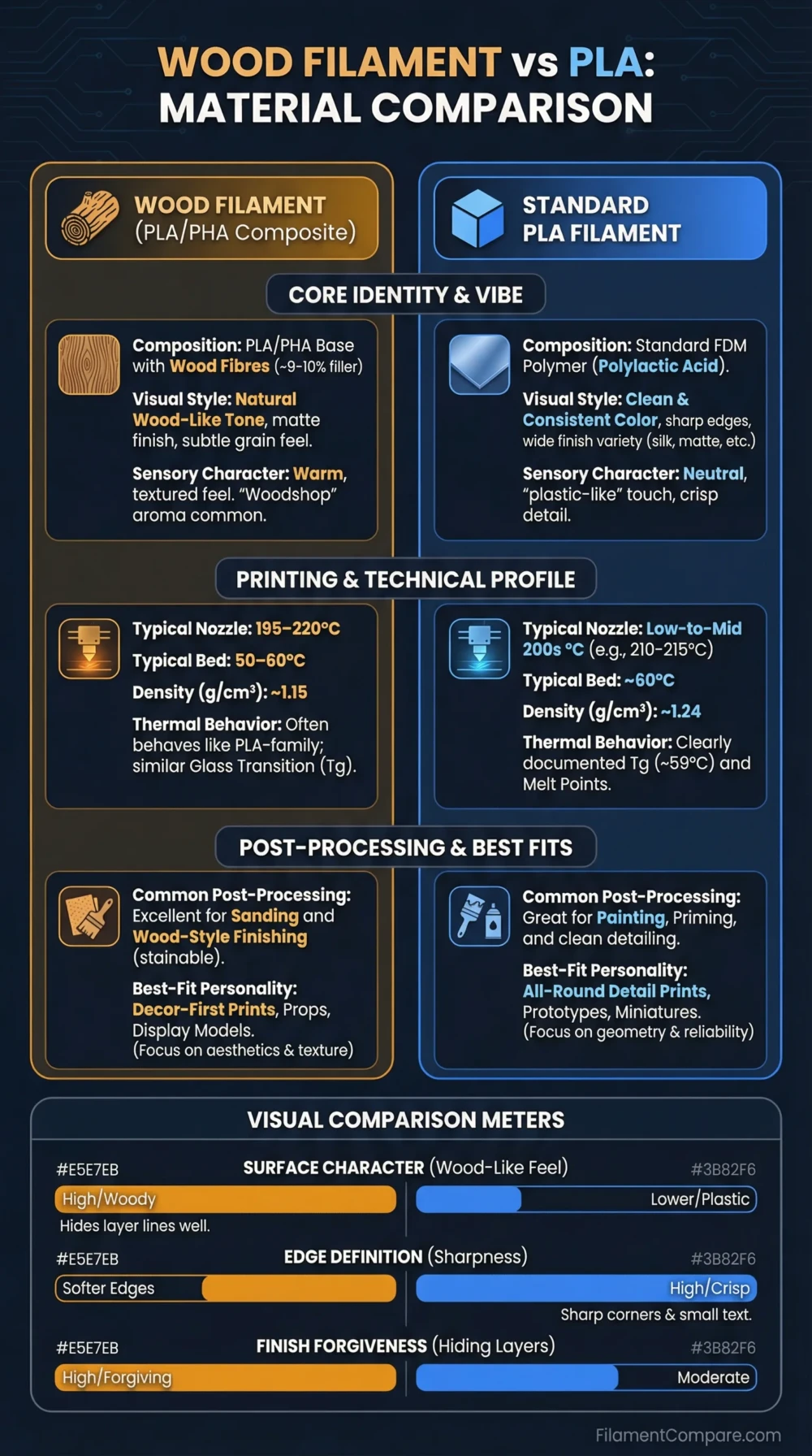
| Category | Wood Filament (Wood-Filled PLA/PHA Composite) | Standard PLA Filament |
|---|---|---|
| Core Material | PLA/PHA blend with fine wood fibres mixed in | PLA (polylactic acid) as a standard FDM polymer |
| Visual Style | Natural wood-like tone, subtle grain feel, matte finish is common | Clean and consistent color, sharp edges, broad finish variety (matte/silk/etc.) |
| Sensory Character | Woodshop vibe is typical: warm look, gentle texture, wood-like aroma in many blends | Neutral feel and appearance; “plastic-like” touch with crisp detail |
| Density (g/cm³) | 1.15 (example: one widely used wood composite blend) | 1.24✅Source |
| Thermal Softening Reference | Often behaves close to PLA-family blends; exact value depends on formulation | Glass transition ~59.1°C (one documented PLA) |
| Melting Point Reference | >155°C (example composite data sheet) | Melting temperature ~151.8°C (one documented PLA) |
| Typical Nozzle And Bed Window | 195–220°C nozzle, 50–60°C bed is commonly listed for wood composites | 215°C first layer, 210°C other layers, 60°C bed✅Source |
| Manufacturer Range Example | Nozzle 195–220°C, Bed 50–60°C, plus measured composite properties in one TDS✅Source | Ranges vary by brand; many profiles stay in a low-to-mid 200s °C zone for nozzle temperature |
| Stiffness Snapshot (Tensile Modulus) | ~2479 MPa (example: printed specimens in one composite TDS) | ~3250 MPa (example: printed specimens in one PLA TDS) |
| Surface After Printing | Soft matte feel is common; layer lines can look “wood-like” | Sharp and clean; strong edge definition and predictable finish |
| Common Post-Processing Identity | Often paired with sanding and wood-style finishing depending on the blend | Often paired with painting, priming, and clean detailing |
| Best-Fit Personality | Decor-first prints: warm aesthetics and “natural” vibe | All-round detail prints: reliable geometry, clean surfaces, wide compatibility |
Wood filament usually means a PLA-based composite that includes real wood fibres. PLA is the classic baseline plastic for FDM printers. This page stays focused on material behavior, numbers, and what changes when the “wood” part enters the mix.
- Material Makeup And Feel
- Wood Filament Identity
- PLA Identity
- Look, Texture, And Sensory Character
- Thermal Behavior And What The Numbers Usually Mean
- Strength, Stiffness, And Composite Effects
- Visual Comparison Meters
- Where The Choice Shows Up First
- Good Fits By Project Type
- Wood Filament Often Matches
- PLA Often Matches
- Common Questions People Ask
Wood filament and PLA can feel surprisingly close because many wood blends are built on a PLA/PHA base. The difference shows up in texture, surface character, and how the filament behaves during flow. This comparison keeps the spotlight on what changes and what stays familiar.
Material Makeup And Feel
Wood Filament Identity
Wood filament is a composite filament: a PLA-family matrix plus wood fibres or wood powder. Many commercial options describe it directly as PLA/PHA + wood fibres, aiming for a natural look and a “wood-adjacent” touch.✅Source
- Matrix: typically PLA-based, sometimes with PHA modifiers
- Filler: wood particles designed to add visual warmth
- Goal: wood-like texture, soft matte appearance, and a crafted vibe
PLA Identity
PLA is the familiar baseline: a clean-flowing, detail-friendly polymer that shows up in countless filament lines. Many technical sheets for PLA filaments document thermal and mechanical values using printed specimens, which makes comparison more grounded than generic “it feels like…” talk. For a broader overview of how different PLA formulations behave in 3D printing—including PLA+, HT-PLA, Meta PLA, and other variants—see the Ultimate PLA Filament Guide.
- Predictable finish with consistent color
- Sharp geometry and fine text readability
- Wide ecosystem: profiles, presets, and community usage are extensive
Look, Texture, And Sensory Character
Wood filament is often chosen for visual warmth. The fibres can break up shine and create a soft matte look that reads “wood-like” even at normal layer heights. PLA leans toward clean precision, where edges stay crisp and the surface looks consistent across wide color ranges.
Some filled products are described as stainable like wood, which is part of their “real material” appeal for decor pieces and props. That property depends on the exact blend, yet it is clearly documented for certain wood-filled lines.✅Source
Thermal Behavior And What The Numbers Usually Mean
- Glass Transition (Tg)
- Tg is where a material shifts from “rigid” to a more rubbery feel. PLA-family materials often sit around the mid-to-high 50s °C in published sheets.
- Heat Deflection Temperature (HDT)
- HDT is a test-based reference under load. It’s a useful comparison anchor when parts experience warm environments.
- Melting Range
- Many PLA grades show a defined melt in the 150–180°C area depending on the grade and crystallinity.
A NatureWorks grade designed for 3D-printing monofilament lists glass transition 55–60°C, a peak melt 165–180°C, and notes that post-annealing 80–130°C can promote crystallization and raise heat performance in printed parts.✅Source
Strength, Stiffness, And Composite Effects
When wood fibres enter a PLA-family base, the part can pick up a different stiffness feel and a more textured surface. Published studies on commercial wood-PLA filament also quantify the filler share used in testing, which helps set expectations for what “wood-filled” means in real percentages.
One peer-reviewed study on a purchased wood-PLA filament reports a wood filler level of 9% (calculated from densities) and describes ~10% as a typical range used in these natural-fibre reinforced PLA composites in practice.✅Source
Visual Comparison Meters
Surface Character (how “wood-like” it reads)
Edge Definition (sharp corners and small text)
Finish Forgiveness (how much the surface hides layer lines)
Where The Choice Shows Up First
- Surface vibe: wood composite often reads warm and matte; PLA reads clean and consistent.
- Detail style: wood blends can look more organic; PLA leans toward crisp geometry.
- Part identity: decor, props, and “crafted” objects often match wood filament; general models, prototypes, and precise shapes often match PLA.
- Thermal expectations: both often live in the PLA-family zone; published PLA-grade sheets give clear Tg and melt references.
Good Fits By Project Type
Wood Filament Often Matches
- Decor pieces where texture matters as much as shape
- Props needing a natural finish without painting everything
- Display models where a matte surface looks premium
- Gift items that aim for a crafted feel
PLA Often Matches
- Detailed miniatures and small text labels
- Prototypes that need dimensional clarity
- General-purpose models with predictable surface quality
- Multi-color projects where consistency across shades matters
Common Questions People Ask
- Is wood filament “real wood”? It’s a PLA-family plastic with real wood fibres blended in, so it behaves like a composite rather than a carved timber part.
- Does wood filament print in the same temperature zone as PLA? Many blends stay close. Published examples list 195–220°C nozzle windows and a 50–60°C bed range for a wood composite.
- Does PLA have published thermal references? Yes. Several PLA technical sheets document Tg, melting temperature, and test-based HDT values for printed specimens.
- Will wood filament always look the same? Natural fibres can create a subtle variation that many users like, especially for decor prints.
