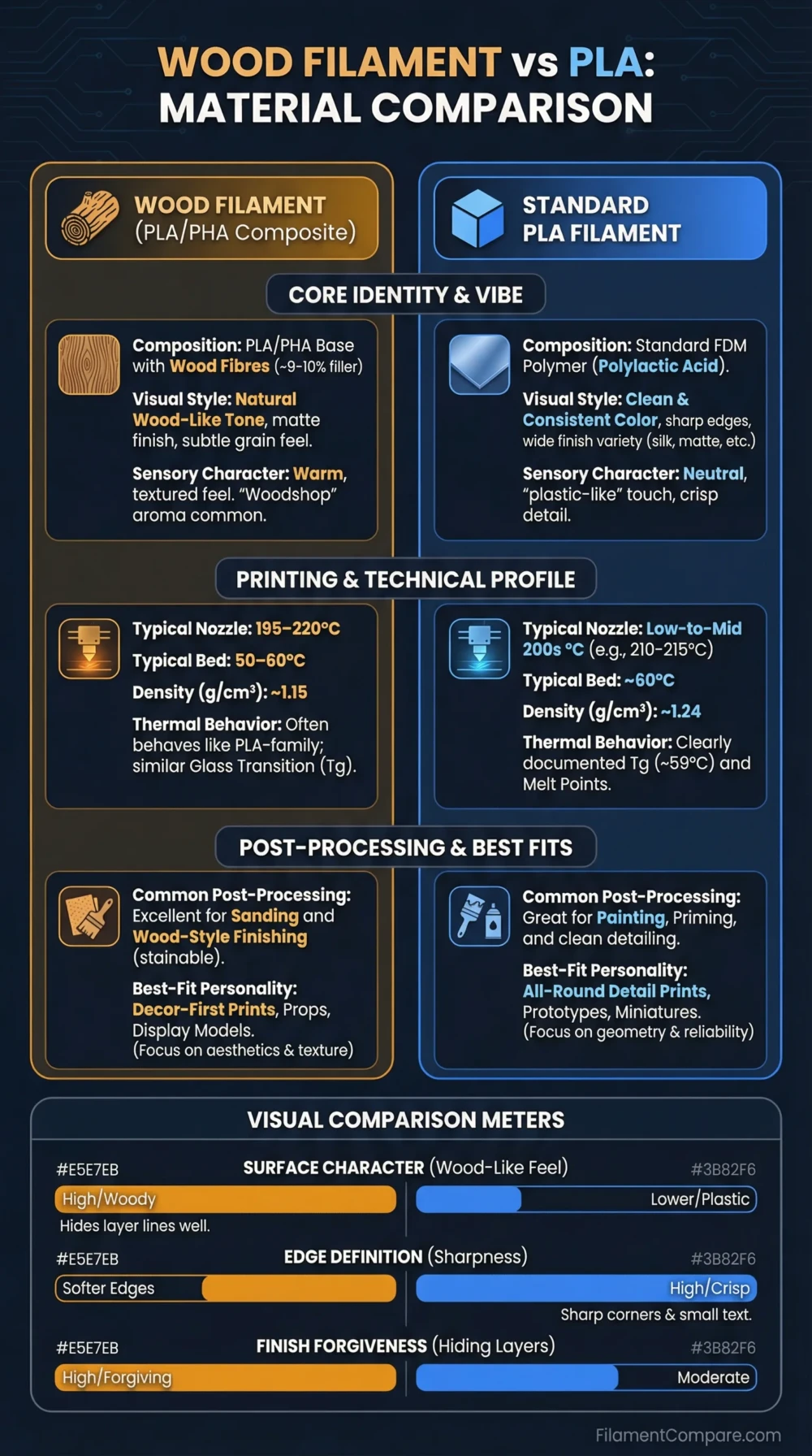
Wood filament is chosen for a wood-like surface and easier staining, while standard PLA is chosen for cleaner detail, steadier extrusion, and more predictable dimensions. Most products sold as wood filament are PLA- or PLA/PHA-based composites containing fine wood particles rather than printable solid wood. Their basic thermal limits therefore remain close to the PLA family, but the filler changes nozzle behavior, texture, finishing, and mechanical consistency.
The Practical Choice
Choose wood filament for decorative prints, architectural models, signs, planters, props, and objects that should accept sanding or wood stain. Choose standard PLA for miniatures, fitted parts, prototypes, multi-color work, fine lettering, and prints where a low-risk nozzle workflow matters more than a natural texture.
There is no useful overall winner. Wood filament is an appearance-led composite; PLA is the more dependable general-purpose option.
Best for First Prints
PLA — fewer clog variables and easier profile tuning.
Best Wood-Like Finish
Wood filament — genuine filled grades create a matte, fibrous surface.
Better Fine Detail
PLA — more suitable for small text, sharp edges, and miniature features.
Better for Staining
Wood filament — many particle-filled grades can be sanded and stained.
Better Tight Tolerances
PLA — more consistent flow helps with fitted lids and measured clearances.
Better Organic Props
Wood filament — texture can make grain-like models look less plastic.
Better Mechanical Baseline
PLA — use a published grade datasheet when strength matters.
Better Material-Changer Fit
PLA — standard filament is usually less brittle and easier to feed through long paths.
| Decision Area | Wood Filament | Standard PLA | Better Choice |
|---|---|---|---|
| Material family | Usually PLA or PLA/PHA with wood flour, fibers, or particles | Polylactic acid filament; additives vary by grade | Different purpose |
| Primary reason to buy | Natural-looking color, texture, scent, and finishing response | Easy printing, detail, low warping, and broad availability | Use-case based |
| Print difficulty | Easy to moderate; formulation and particle size matter | Usually easy | PLA |
| Typical nozzle temperature | About 190–220°C for many PLA-based grades; follow the spool profile | About 190–220°C for many standard grades; broader brand ranges exist | Similar range |
| Typical bed temperature | Usually 40–60°C, product-dependent | Optional to about 60°C, printer- and surface-dependent | Similar |
| Preferred nozzle | 0.6 mm is a safer starting point for many filled grades; some verified products support 0.4 mm | 0.4 mm is the common general-purpose size | PLA |
| Enclosure | Usually not required | Usually not required | Tie |
| Clog risk | Higher because particles can bridge inside a small nozzle or heat zone | Lower with a clean, correctly tuned hot end | PLA |
| Warping | Usually low for PLA-based wood composites | Usually low | Tie |
| Fine surface detail | Texture can soften very small features | Better for crisp lettering, miniature edges, and thin walls | PLA |
| Mechanical consistency | More grade-dependent; filler loading and particle distribution matter | More predictable within a known grade and profile | PLA |
| Heat resistance | Usually PLA-like rather than wood-like | Low unless a heat-modified grade or validated annealing process is used | Neither gains an advantage |
| Moisture behavior | Storage needs vary; wood-filled blends may show bubbles or rough flow when damp | Store dry; occasional drying may restore surface quality | PLA is simpler |
| Post-processing | Often easier to sand, stain, carve lightly, or paint | Can be wet-sanded and painted, but does not take wood stain the same way | Wood filament |
| Outdoor use | Not automatically weather-resistant; filler does not turn PLA into exterior timber | Limited for long UV and heat exposure | Consider ASA or a validated outdoor grade |
| Typical uses | Decor, sculptures, signs, props, architectural models, planters | Prototypes, organizers, miniatures, models, jigs with light duty | Different purpose |
| Main limitation | Clogging, variable strength, and weaker tiny features | Low heat tolerance and a visibly plastic finish | Part-dependent |
This comparison uses official Woodfill and PLA datasheets plus manufacturer printing guidance; it describes broad Wood Filament and PLA trends, while actual results can shift with brand, wood loading, pigment, additives, moisture, nozzle size, orientation, and slicer settings.
Material Profiles
Wood Filament Profile
- Polymer type: usually PLA or PLA/PHA carrying fine wood particles
- Print difficulty: easy to moderate
- Nozzle range: commonly around 190–220°C (brand-dependent)
- Bed range: commonly around 40–60°C
- Enclosure: normally unnecessary
- Drying need: formulation-specific; check the maker’s instructions
- Typical behavior: low warp, matte extrusion, greater clog sensitivity
- Best use cases: decor, props, signs, sculptures, and stainable models
Standard PLA Profile
- Polymer type: PLA with colorants and possible processing additives
- Print difficulty: usually easy
- Nozzle range: commonly around 190–220°C (use the product profile)
- Bed range: unheated to about 60°C
- Enclosure: normally unnecessary
- Drying need: occasional, especially after open storage
- Typical behavior: sharp detail, low warp, stable flow, stiff parts
- Best use cases: prototypes, miniatures, organizers, displays, and fitted models
Relative Printing Performance
Wood Filament
Standard PLA
The meters are relative workshop indicators rather than fixed laboratory ratings. Brand chemistry, filler content, color, absorbed moisture, print direction, wall count, layer height, cooling, and temperature can move the practical result.
What the Wood Filler Changes
Wood filament does not behave like a miniature board cut from timber. The continuous phase is still a thermoplastic, while the wood component sits inside that polymer as flour, fibers, or small particles. The printed part may look, smell, and sand more like wood, yet its heat response, layer structure, and long-term loading behavior remain those of an extruded composite.
The term wood filament also covers products with very different recipes. One may use a PLA/PHA blend with pine fibers, another may use PLA with a lower filler loading, and a wood-colored PLA may contain little or no material that responds to stain like real fibers. Product naming alone is not enough; the material page should identify the base polymer and filler.
Filler interrupts the otherwise continuous polymer flow. That can create a pleasantly irregular surface and hide layer lines, but it can also reduce the strength of thin pins, clips, snap tabs, and narrow lettering. For a decorative vase this trade is often useful. For a calibrated latch, standard PLA is usually the safer starting material.
Nozzle Choice, Flow, and Clogging
A 0.6 mm nozzle gives particles more room to pass and is a sensible default when the manufacturer does not state otherwise. Prusa’s composite guidance notes a higher clog risk and recommends at least a 0.6 mm nozzle for many wood-filled materials with larger particles[a]. This is a category rule, not an absolute requirement.
Some modern formulations are built for a standard 0.4 mm brass nozzle. Prusament Woodfill, for example, lists 195 ±10°C at the nozzle and 60 ±10°C at the bed, and its maker specifically supports a 0.4 mm nozzle for that product[b]. That exception should not be transferred to an unknown spool with coarser particles.
Flow Settings That Matter More with Wood Fill
- Start with the maker’s nozzle size, temperature, and speed range.
- Avoid excessive retraction until the material has completed a clean test print.
- Keep the filament moving during long pauses; heat-soaked particles can collect in the melt zone.
- Use a purge after changing from a filled material to a fine nozzle.
- Reduce speed when the extruder clicks, under-extrudes, or produces intermittent thin lines.
- Check that the nozzle is not partially blocked before raising flow or temperature.
A hardened nozzle is not automatically required for every wood-filled PLA. Many wood grades are far less abrasive than carbon fiber, glass fiber, glow pigment, or metal-filled composites. Still, the product instructions take priority because wood species, particle treatment, and extra pigments can alter wear.
Detail, Grain, and Surface Finishing
Standard PLA preserves modeled geometry more faithfully. A sharp serif, narrow groove, tiny eye socket, or threaded detail is less likely to be softened by visible particles. It also works well with smaller nozzles when a print needs fine layer lines.
Wood filament is more useful when the surface itself is part of the design. Its matte, slightly irregular extrusion can make bowls, carved-style signs, terrain, sculpture, and architectural components feel less synthetic. Layer lines do not disappear, but they can blend into the texture instead of reflecting light as evenly as smooth PLA.
Genuine particle-filled grades often respond better to sanding and stain. ColorFabb identifies its woodFill as PLA/PHA with fine pinewood fibers and lists a 195–220°C nozzle range, a 50–60°C bed range, and a 55°C glass-transition value for that formulation[c]. Those values describe one commercial material, not every spool carrying a wood label.
Strength, Layer Bonding, and Warm Environments
Wood particles do not automatically reinforce a PLA print. In many decorative formulations they are added for appearance and touch, not for load-bearing performance. Particle size, loading, polymer chemistry, nozzle temperature, raster direction, and porosity all affect the result. A part can feel stiff yet break earlier at a thin section or across layers.
A useful datasheet comparison shows why product-level evidence matters. ColorFabb’s WoodFill sheet reports a 3D-printed tensile modulus of about 2,479 MPa and tensile strength of about 28.36 MPa for its stated XY specimen and settings[d]. UltiMaker reports an XY tensile modulus of 3,250 ±119 MPa and yield stress of 52.5 ±0.9 MPa for its own PLA test system[e]. These figures are not a controlled head-to-head test, so they should illustrate grade variation rather than serve as a universal strength ratio.
Heat is not a reason to move from ordinary PLA to ordinary wood-filled PLA. The filler may change stiffness or thermal transfer, but a PLA-based matrix still softens in warm service. Prusa describes standard PLA as easy to print and low-warp, while warning that it deforms above roughly 60°C and has limited UV resistance[f]. A wood-filled grade should not be assumed suitable for a hot car, radiator-adjacent part, dishwasher cycle, or sun-heated exterior mount.
Moisture, Storage, and Spool Handling
Both materials benefit from sealed storage with desiccant. Damp PLA can produce popping, wisps, bubbles, rough walls, and reduced surface quality. Wood-filled filament may make those symptoms harder to diagnose because its normal texture is already less uniform.
Do not apply one drying schedule to every wood composite. The base polymer, filler amount, spool construction, and maker’s limits can differ. One verified product may print directly from normal storage, while another may require controlled drying after exposure. Excessive heat can deform the filament on the spool or alter additives.
Wood Filament Storage
- Seal after use.
- Keep loose dust away from the feed path.
- Check brittleness before loading a long tube.
- Dry only to the maker’s stated time and temperature.
PLA Storage
- Seal after use.
- Watch for popping and rough walls.
- Dry when print quality declines after open storage.
- Keep the spool below temperatures that can warp the filament.
Where Each Material Works Better
| Use Case | More Suitable Material | Reason |
|---|---|---|
| First printer calibration | PLA | Fewer particle-flow variables make temperature, retraction, and first-layer tuning easier. |
| Miniatures and small lettering | PLA | Cleaner small features and better compatibility with fine nozzles. |
| Architectural timber model | Wood filament | Matte texture and natural color suit beams, cladding, and scale furniture. |
| Decorative sign for staining | Wood filament | A verified fiber-filled grade can accept sanding and stain more naturally. |
| Tight-fit organizer or lid | PLA | Steadier flow supports more repeatable clearances. |
| Cosplay staff or wooden prop shell | Wood filament | The surface reduces the amount of paint needed to suggest wood. |
| Functional mounting bracket | PLA | Standard PLA provides a more predictable baseline, though tougher materials may be better for load or impact. |
| Indoor planter or vase cover | Wood filament | Appearance is the main requirement; use a liner when water containment matters. |
| Multi-color material changer print | PLA | Standard PLA is normally easier through long feed paths and repeated unload cycles. |
| Large organic sculpture | Wood filament | Texture can disguise layer reflections and suit broad curved surfaces. |
| Long-term outdoor fixture | Neither by default | Consider ASA or a documented UV-stabilized grade after checking heat and weather exposure. |
| Warm car-interior component | Neither by default | Interior temperatures may exceed the comfortable range of ordinary PLA-based materials. |
| Thin snap-fit tab | PLA | Wood particles can make narrow flexing features more failure-sensitive; another tougher polymer may be preferable. |
| Object intended for sanding and stain | Wood filament | This is one of the composite’s clearest advantages when real fibers are present. |
Where Each Material Fits and Where It Has Limits
Choose Wood Filament When
- The part is mainly decorative.
- A matte, fibrous surface is more valuable than sharp micro-detail.
- The model will be sanded, stained, painted, or lightly carved.
- A larger nozzle is available when the product calls for one.
- Small surface variation supports the intended appearance.
Wood Filament Is Less Suitable When
- The part contains thin clips, pins, or snap tabs.
- A long Bowden path or material changer bends the filament repeatedly.
- Very small text, threads, or a fine nozzle are required.
- The application needs a published mechanical or thermal rating.
- A stoppage would be costly and an untested spool is being used.
Choose PLA When
- The printer is being calibrated or used by a beginner.
- Dimensional repeatability and detail are the priorities.
- The part is a model, prototype, organizer, or light-duty fixture.
- Fast material changes and a standard 0.4 mm nozzle are preferred.
- The finish will be painted rather than stained.
PLA Is Less Suitable When
- The print must resemble unfinished or stained timber.
- The part will sit in high heat or direct sun for long periods.
- Repeated impact, flexing, or sustained loading is expected.
- A soft-touch, fibrous, or naturally varied surface is wanted.
- The application requires outdoor or food-contact claims without grade-level validation.
Material Selection Matrix
Best Choice by Priority
Choose Wood Filament if the visual target is a wood-like, stainable, low-gloss surface and the part does not rely on tiny flexing features or validated engineering strength.
Choose PLA if the print needs cleaner detail, easier nozzle handling, tighter dimensions, simpler profiles, or repeatable everyday production.
Choose another material if the part faces high heat, continuous UV, repeated impact, heavy load, creep, or a regulated safety requirement. Wood filament and PLA overlap in printing temperature, but they solve different design problems and neither replaces an engineering-grade material.
Common Wood Filament and PLA Questions
Is wood filament made from real wood?
Many wood filaments contain real wood flour or fibers dispersed in PLA or a PLA blend. Some wood-colored filaments focus only on appearance, so check the composition before expecting a material to sand or stain like a filled grade.
Is wood filament stronger than PLA?
Not as a general rule. Filler may change stiffness and feel, but decorative wood grades often have lower or more variable tensile and layer performance than an unfilled PLA grade. Use product datasheets and a printed test coupon for load-bearing work.
Can wood filament use a 0.4 mm nozzle?
Some formulations can. A 0.6 mm nozzle remains a lower-clog starting point for many wood-filled products, while specific finely filled grades are approved by their makers for 0.4 mm. The spool instructions decide.
Does wood filament need a hardened nozzle?
Often not, but the filler recipe matters. Plain wood particles are usually less abrasive than carbon or glass fiber, yet blended pigments or other particles can change nozzle wear. Follow the manufacturer’s hardware note.
Can wood filament be stained?
Many genuine wood-filled grades can be sanded and stained, though color uptake varies with filler content and surface preparation. Test the stain on a small print because oil-, water-, and solvent-based products may produce different tones.
Does wood PLA resist heat better than standard PLA?
Usually not enough to change the application category. A PLA-based wood composite should still be treated as a low-heat material unless its own datasheet reports a tested heat value for the printed grade.
Technical References
- [a] Composite materials (with metal or wood particles) | Prusa Knowledge Base (Used to verify that wood-filled products are commonly polymer composites, carry a higher clog risk, and often benefit from a 0.6 mm nozzle when larger particles are present.)
- [b] Prusament Woodfill | Prusament (Used for the product-specific 0.4 mm nozzle support, 195 ±10°C nozzle setting, 60 ±10°C bed setting, finishing advice, and 60°C temperature-resistance listing.)
- [c] woodFill – Real Wood Fiber 3D Printing Filament | colorFabb (Used for the PLA/PHA and fine pinewood-fiber description, 195–220°C nozzle advice, 50–60°C heated-bed advice, and listed 55°C glass-transition value.)
- [d] Technical datasheet WoodFill | colorFabb (Used for the representative 3D-printed tensile modulus and tensile-strength values and their stated ISO 527 test context.)
- [e] PLA 3D printing material | UltiMaker (Used for the manufacturer’s printed PLA modulus and yield-stress data; these figures apply to UltiMaker’s test system.)
- [f] PLA | Prusa Knowledge Base (Used for standard PLA print-temperature guidance, low-warp behavior, detailed-print use, and the warnings about heat and UV exposure.)
