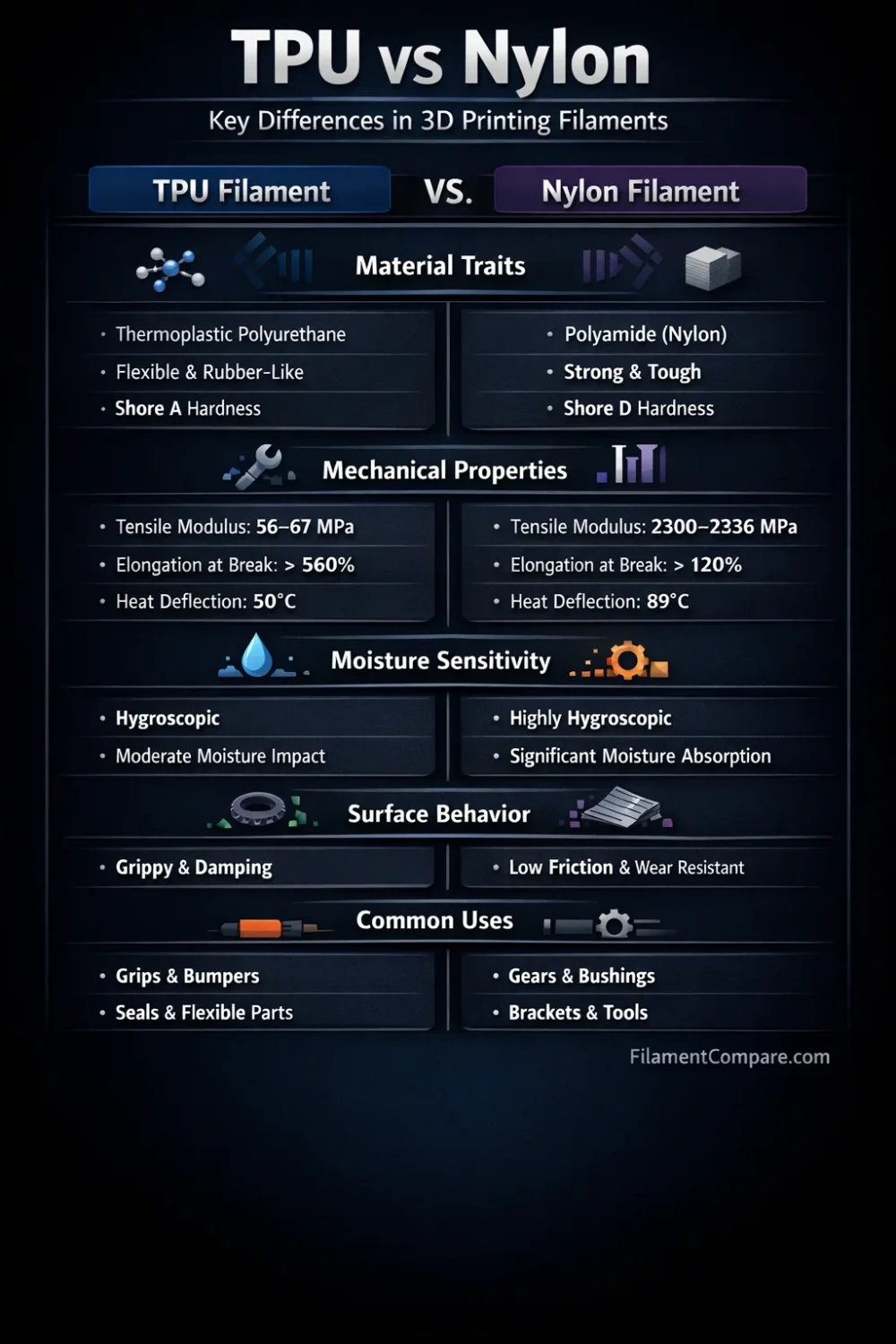
| Attribute | TPU Filament | Nylon Filament |
|---|---|---|
| Material Family | Thermoplastic Polyurethane (TPU); elastomeric | Polyamide (Nylon); engineering thermoplastic |
| Feel Under Load | Flexible, springy recovery, “rubber-like” response | Strong, slightly flexible, “tough plastic” response |
| Hardness Reference | Common filament grades sit around Shore A (example: ~96A for a 95A-class filament) | Often described with Shore D (example: ~81D for a common nylon filament) |
| Tensile Modulus (3D Printed Samples) | About 56–67 MPa (orientation-dependent) | About 2300–2336 MPa (orientation-dependent) |
| Tensile Stress at Break (3D Printed Samples) | About 6–38 MPa (orientation-dependent) | About 23–42 MPa (orientation-dependent) |
| Elongation at Break (3D Printed Samples) | Up to >560% (very high in-plane) | Up to >120% (high in-plane) |
| Heat Deflection (HDT, Printed Samples) | Around 50 °C | Around 89 °C |
| Melting Temperature (DSC) | Around 217 °C | Around 188 °C |
| Moisture Interaction (Trend) | Hygroscopic, usually manageable with dry handling | More hygroscopic, properties can shift with moisture content |
| Friction / Sliding | Grippy surface, good damping | Low friction feel, good for sliding contact |
| Typical Use Identity | Flexible functional parts, seals, grips, impact absorption | Tough engineering parts, wear components, fixtures, tools |
This TPU vs Nylon comparison combines manufacturer datasheets with a small set of trusted technical references, so it reflects standard trends rather than guaranteeing identical results on every printer and setup.
- Material Identity and Chemistry
- TPU Filament
- Nylon Filament
- Performance Shape: What You Feel in Real Parts
- Mechanical Properties and What They Mean
- TPU Example Values (95A-Class Filament)
- Nylon Example Values (Common Engineering Nylon Filament)
- Thermal Behavior and Service Feel
- Moisture Interaction and Dimensional Expectations
- Wear, Friction, and Surface Behavior
- TPU Family Example (Resin Datasheet Metrics)
- Chemical Interaction and Everyday Exposure
- Geometry Sensitivity and Dimensional Behavior
- Where Each Filament Usually Shows Up
- What Usually Decides the Choice
- Terms You’ll See on Spec Sheets
TPU filament and Nylon filament can both land you in the “serious, functional” zone of engineering 3D printing materials, yet they get there in totally different ways. TPU behaves like a controllable elastomer: it bends, compresses, and snaps back. Nylon behaves like a tough engineering plastic: it carries loads, resists wear, and handles repeated stress with a confident, durable feel.
Material Identity and Chemistry
TPU Filament
Thermoplastic polyurethane sits in the middle ground between rubber and rigid plastic. In filament form, that usually means a Shore A hardness rating and a noticeably elastic response when you flex a printed part. Many TPU filaments are designed for strong layer bonding, so parts often feel unified rather than “layer-stacked,” especially in thicker cross-sections.
Nylon Filament
Nylon is a polyamide family, and different nylons (PA6, PA66, PA12, copolyamides) can behave a bit differently. In 3D printing, nylon is loved for the mix of strength-to-weight, durability, and a slightly compliant toughness that helps parts survive real handling and repeated use.
Performance Shape: What You Feel in Real Parts
Relative Profile (visual trend bars, not lab grades)
Mechanical Properties and What They Mean
When people say TPU is flexible and Nylon is strong, they’re usually describing two different mechanical “centers of gravity.” TPU’s printed modulus sits in the tens of MPa, while nylon’s sits in the thousands of MPa. That gap shows up instantly in how parts handle bending, clamps, and snap loads.
TPU Example Values (95A-Class Filament)
- Tensile modulus: ~67 MPa (XY), ~56 MPa (Z)
- Tensile stress at break: ~23.7 MPa (XY), with orientation swings
- Elongation at break: reported up to >560% in-plane
- Hardness: ~96 Shore A (plus a Shore D reference on some sheets)
- HDT (0.455 MPa, printed): ~50 °C
- Melting temperature (DSC): ~216.8 °C
Data anchor: [Source-1✅]
Those same sheets also highlight something practical: orientation matters. TPU can be incredibly stretchy along the printed roads, while the “up” direction focuses more on interlayer strength. The material stays the same, the load path changes, and the numbers follow.
Nylon Example Values (Common Engineering Nylon Filament)
- Tensile modulus: ~2331 MPa (XY), ~2300 MPa (Z)
- Tensile stress at yield: ~63–65 MPa in-plane
- Tensile stress at break: ~40–42 MPa in-plane, ~23 MPa in Z
- Elongation at break: reported up to >120% in-plane
- Hardness: ~81 Shore D
- Glass transition: ~55 °C; melting ~188.4 °C
Data anchor: [Source-2✅]
Thermal Behavior and Service Feel
Temperature isn’t only about “can it print.” It shows up later as part stiffness, softening, and long-term shape. A nylon part often stays confidently rigid across everyday warm environments, while a TPU part stays elastic and comfortable in the hand—even when it’s the same geometry.
TPU processing window (general guidance): nozzle temperatures around 220–240 °C and bed temperatures around 40–60 °C are commonly referenced for TPU printing, with brand profiles and hardness shifting the exact targets.[Source-3✅]
Nylon’s thermal story often includes a clear glass transition and a melt point that anchors common print temperatures well above the polymer’s melting region. That “print hot, perform tough” vibe is a big part of why nylon shows up in wear-prone parts.
Nylon processing window (general guidance): nylon is often printed around 230–260 °C with a build plate commonly cited in the 40–70 °C range, with printer hardware and profiles influencing the exact values.[Source-4✅]
Moisture Interaction and Dimensional Expectations
Both materials can be hygroscopic, meaning they can interact with humidity. The difference is scale and impact: nylon’s moisture uptake can be a meaningful part of its real-world behavior, while TPU typically shows a more moderate shift. That matters for fit, feel, and repeatability across seasons and storage conditions.
- Nylon Moisture Absorption (Example PA6 Reference)
- One PA6 technical sheet reports ~2.1–2.7% equilibrium moisture at 23 °C / 50% RH and ~7.2–7.8% saturation in water at 23 °C (method noted as similar to ISO 62). Different nylon families and filled/unfilled grades can shift these numbers, yet the “moisture-aware” pattern stays consistent.[Source-5✅]
- What That Can Change
- Moisture can shift stiffness, surface feel, and dimensional tightness in nylon parts. TPU’s flexible nature often hides small dimensional shifts, yet moisture can still influence surface finish and consistency.
Wear, Friction, and Surface Behavior
If you care about sliding contact, nylon is often described with a low-friction personality. TPU leans into grip and damping, which can feel premium in hand-contact parts and protective interfaces.
TPU Family Example (Resin Datasheet Metrics)
A TPU resin technical data sheet can show the “elastomer toolbox” clearly: ultimate elongation can be extremely high, abrasion metrics are often reported directly, and tear strength can be a standout. One example sheet lists 800% ultimate elongation, 30 mm³ abrasion loss (ISO 4649), and 80 kN/m tear strength (ISO 34-1B), giving a sense of why TPU prints often feel resilient in repeated contact.
In pure “touch” terms, TPU usually reads as softer and more forgiving, especially at thin walls. Nylon often reads as sleek and engineered, and the surface tends to feel less tacky and more glide-friendly.
Chemical Interaction and Everyday Exposure
Both materials can handle plenty of real-life contact scenarios, yet they shine in different directions. Many TPU filaments are presented as oil and chemical resistant for common industrial environments, while nylon is often highlighted for chemical resistance plus low friction in moving interfaces. When “chemical exposure” is part of the story, the most accurate view usually comes from the exact filament’s safety and technical sheet.
Geometry Sensitivity and Dimensional Behavior
TPU is forgiving in parts that are designed to flex; the geometry can absorb small variation because deformation is part of the job. Nylon rewards stable, well-supported shapes and often feels especially trustworthy in load-bearing designs where stiffness and wear resistance are core requirements.
A calm rule of thumb: TPU’s performance is often dominated by wall thickness and contact area, while nylon’s performance is often dominated by load direction and moisture state.
Where Each Filament Usually Shows Up
These aren’t rules, just common patterns people recognize when matching TPU filament and Nylon filament to real parts. Think of it as “what the material naturally likes to do.”
- TPU is frequently chosen for grips, bumpers, sleeves, protective skins, vibration damping parts, compliant hinges, seals, and soft-touch interfaces.
- Nylon is frequently chosen for brackets, tools, fixtures, sliding guides, bushings, wear pads, functional prototypes, and durable assemblies that benefit from low friction.
What Usually Decides the Choice
- Need elastic deformation: parts that must compress, flex, and rebound often align with TPU’s core personality.
- Need structural stiffness and wear resistance: parts that carry shape under load often align with nylon’s engineering feel.
- Moisture sensitivity tolerance: nylon’s behavior can shift more with humidity; TPU usually shifts less, yet both benefit from dry handling.
- Surface interaction goal: a “grippy” touch points toward TPU; a “sliding” touch points toward nylon.
- Thermal expectations: nylon often holds stiffness deeper into warm conditions; TPU stays flexible and can soften earlier depending on grade.
Terms You’ll See on Spec Sheets
- Shore A vs Shore D
- Shore A is commonly used for elastomers (many TPU filaments). Shore D is commonly used for harder plastics (many nylon filaments). They’re not interchangeable scales; they’re different tools for different hardness ranges.
- HDT (Heat Deflection Temperature)
- A practical indicator of how a material responds under load when warmed. In printed parts, nylon often posts a higher HDT than TPU for common filament grades.
- Glass Transition (Tg)
- The temperature region where a polymer shifts from glassy to rubbery behavior. Nylon often has a clearly stated Tg on sheets; TPU sheets may omit Tg or present it differently depending on formulation.
- Hygroscopic
- Means the material can absorb moisture from air. With nylon, moisture can meaningfully affect stiffness and fit. With TPU, moisture can still affect print consistency and surface quality, just typically with a different intensity.
