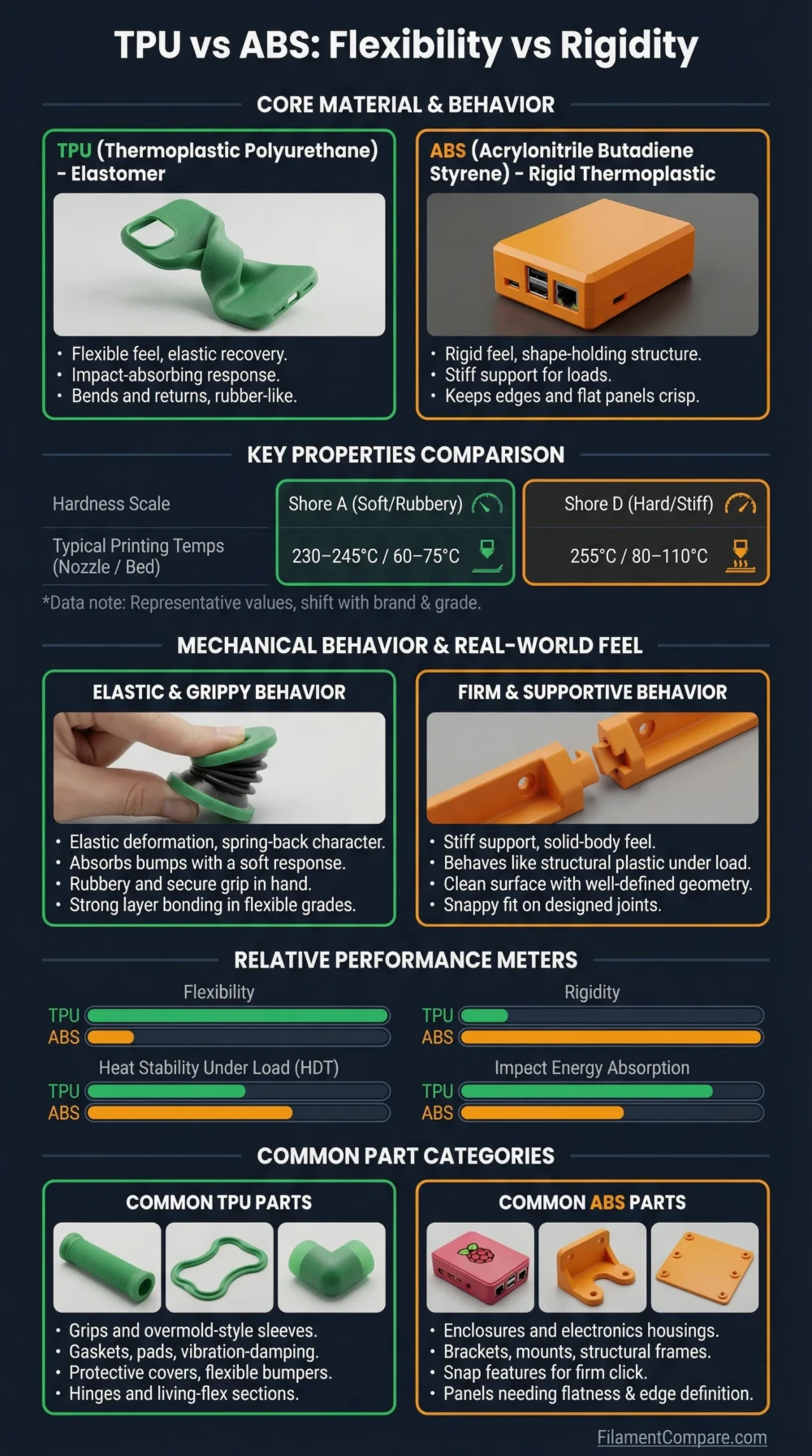
| Category | TPU Filament | ABS Filament |
|---|---|---|
| Material Family | Thermoplastic Polyurethane (elastomeric thermoplastic) | Acrylonitrile Butadiene Styrene (amorphous thermoplastic) |
| Core Behavior | Flexible feel, elastic recovery, and impact-absorbing response for parts that bend and return. | Rigid feel, shape-holding structure, and stiff support for parts that need to stay firm under load. |
| Typical Printing Temperatures (Nozzle / Bed) | 230–245 °C / 60–75 °C ✅Source | 255 °C / 80–110 °C ✅Source |
| Example Datasheet Numbers (3D-Printed Samples) |
|
|
Data note: The table uses representative numbers from one public datasheet per material. Real-world values shift with brand, hardness grade, and part geometry.
- Material Basics That Shape Performance
- Mechanical Behavior Under Real Loads
- TPU: Elastic, Grippy, Stress-Friendly
- ABS: Firm, Supportive, Shape-Forward
- Relative Feel in Typical FFF Parts
- Thermal Profile and Dimensional Response
- What “Softening” Looks Like in Each Material
- Surface Finish, Touch, and Wear Personality
- Common Part Categories for Each Filament
- TPU Parts You See Often
- ABS Parts You See Often
- Decision Points That Usually Matter
When you compare TPU filament and ABS filament, it mainly comes down to flexibility versus rigidity—and how that changes part behavior under real loads.
- Flexibility
- Stiffness
- Heat Response
- Impact Feel
- Surface Touch
- Wear Behavior
Material Basics That Shape Performance
TPU is a thermoplastic elastomer family, commonly grouped with other flexible filament types, so it can bend, compress, and spring back with a very rubber-like response. ABS is a rigid thermoplastic, so it tends to hold angles, edges, and flat panels with a more structural feel.
- Shore Hardness
- Shore A is common for TPU softness; Shore D is common for ABS stiffness. Higher numbers mean a harder feel on that scale.
- HDT (Heat Deflection Temperature)
- A lab measure of when a material starts to deflect under a set load as temperature rises. Useful for comparing heat stability under load.
- Vicat Softening
- A lab measure related to softening under a defined probe and load. It gives another view of heat response.
Mechanical Behavior Under Real Loads
TPU: Elastic, Grippy, Stress-Friendly
TPU is known for elastic deformation, so parts can flex repeatedly with a spring-back character.
- Compression and bending: absorbs bumps with a soft response
- Impact feel: tends to spread force over time for a smoother hit
- Grip and touch: often feels rubbery and secure in the hand
- Layer bonding: commonly described as strong in flexible grades
ABS: Firm, Supportive, Shape-Forward
ABS delivers stiff support and a solid-body feel for parts that should stay put.
- Rigidity: keeps edges and flat faces crisp
- Load handling: behaves like a structural plastic in common enclosures and housings
- Surface finish: tends to look clean with well-defined geometry
- Assembly feel: often gives a snappy fit on designed joints
Orientation matters: With FFF/FDM, strength changes by layer direction. TPU often “gives” before it breaks, while ABS tends to feel more stiff and direct in the same geometry.
Relative Feel in Typical FFF Parts
Flexibility
Rigidity
Heat Stability Under Load
Impact Energy Absorption
Thermal Profile and Dimensional Response
ABS is commonly chosen when heat exposure and shape retention matter, because it tends to keep a firm feel at higher temperatures than many flexible grades. TPU stays supple and comfortable in hand, but it usually softens under load sooner in warm environments.
If the part must remain dimensionally stable while carrying force, HDT is a helpful lens. If the part needs to remain comfortable and elastic, hardness grade and wall geometry tend to shape the real feel more than any single number.
What “Softening” Looks Like in Each Material
- TPU often transitions from springy to more gummy as temperature rises, especially in thin sections and loaded hinges.
- ABS generally keeps a stiffer frame longer, which supports snap geometry, brackets, and housings.
- Both materials can be tuned by infill, wall thickness, and part design to change the real-world feel.
Surface Finish, Touch, and Wear Personality
TPU typically reads as soft-touch and slightly matte, which can make functional parts feel premium and grippy. ABS usually reads as clean and rigid with a more plastic-like tap and a crisp edge definition.
On wear, TPU often shines in abrasion-style contact where flex helps, while ABS tends to shine in shape-holding contact where a hard shell keeps surfaces aligned. In both, the outer walls are the story.
Common Part Categories for Each Filament
TPU Parts You See Often
- Grips and overmold-style sleeves
- Gaskets, pads, and vibration-damping pieces
- Protective covers and flexible corner bumpers
- Hinges and living-flex sections in one piece
- Wear-contact guides where a soft glide helps
ABS Parts You See Often
- Enclosures and electronics housings
- Brackets, mounts, and structural frames
- Snap features designed for a firm click
- Tooling helpers and fixture-style parts
- Panels that need flatness and edge definition
Decision Points That Usually Matter
- Flex required: If the part must bend and return, TPU is the natural family. If the part must stay firm, ABS is a common match.
- Heat exposure: For parts that should remain stiff in warmer use, ABS is often the more stable feel. For parts meant to stay comfortable and elastic, TPU keeps its character.
- Touch and grip: If the surface should feel grippy and forgiving, TPU tends to deliver. If the surface should feel clean and crisp, ABS fits the vibe.
- Geometry style: Thin beams and living bends usually favor TPU, while rigid ribs, bosses, and tight edges often favor ABS.
