| Spec / Topic | Recycled PLA (rPLA) ✅Source | Virgin PLA ✅Source |
|---|---|---|
| Polymer Family | Polylactic Acid (PLA) | Polylactic Acid (PLA) |
| Material History | Reprocessed PLA stream | Fresh PLA resin stream |
| Filament Diameter | 1.75 ± 0.05 mm | 1.75 ± 0.02 mm (± 0.03 mm for PLA Blend) |
| Recommended Nozzle Temp | 210 ± 10 °C | 210 ± 10 °C |
| Recommended Bed Temp | 40–60 °C | 40–60 °C |
| MFR (2.16 kg; 210 °C) | 9–11 g/10 min | 9–11 g/10 min |
| Density | 1.24 g/cm³ | 1.24 g/cm³ |
| Tensile Yield Strength (Filament) | 54 ± 1 MPa | 57 ± 1 MPa |
| Interlayer Adhesion | 21 ± 2 MPa | 17 ± 3 MPa |
| Moisture Absorption (24 h) | 0.3% | 0.13% |
| HDT (0.45 MPa) | 55 °C | 55 °C |
| HDT (1.80 MPa) | 53 °C | 55 °C |
Reading Tip: A single datasheet is a controlled snapshot of one formulation, printed on one setup. Use the numbers to compare trends and test methods, not to predict every spool on the market.
- Material Identity and Traceability
- Recycled PLA (rPLA)
- Virgin PLA
- Polymer Aging During Reprocessing
- Thermal Window and Real-World Limits
- What Standard Test Labels Mean in Filament Datasheets
- rPLA and Virgin PLA in Daily Printing
- Moisture and Processing Discipline
- What Changes First When PLA Is Wet
- Selection Patterns People Use for rPLA and Virgin PLA
- Recycled PLA (rPLA) Is Commonly Chosen For
- Virgin PLA Is Commonly Preferred For
- One Visual Walkthrough on Recycled vs Virgin Filament
Both Recycled PLA (rPLA) and Virgin PLA print as PLA filament, but they arrive at your spool through different material histories. With rPLA, the polymer has already been melted and re-extruded; with virgin PLA, the resin starts fresh. That difference shapes batch behavior, traceability, and how “consistent” PLA feels in daily printing. For a broader overview of PLA formulations—including variants like PLA+, Meta PLA, and other PLA-based filaments—see the Ultimate PLA Filament Guide.
Material Identity and Traceability
Recycled PLA (rPLA)
- Feedstock: PLA scrap that is sorted, re-melted, and extruded again.
- Common Sources: post-industrial (clean production offcuts) or post-consumer (used prints), depending on the brand.
- Key Variable: how well the stream is kept “PLA-only” and how tightly it is filtered and homogenized.
Virgin PLA
- Feedstock: newly produced PLA resin that is compounded and extruded into filament.
- Common Goal: stable melt behavior and repeatable color across many batches.
- Key Variable: the chosen grade (molecular weight, additives) and how tight the process control is.
In research settings, reprocessing PLA from 3D printing waste into new filament is often studied by keeping the input streams separate and measuring how properties shift after extrusion, confirming that origin and sorting are central to real-world rPLA quality.✅Source
Polymer Aging During Reprocessing
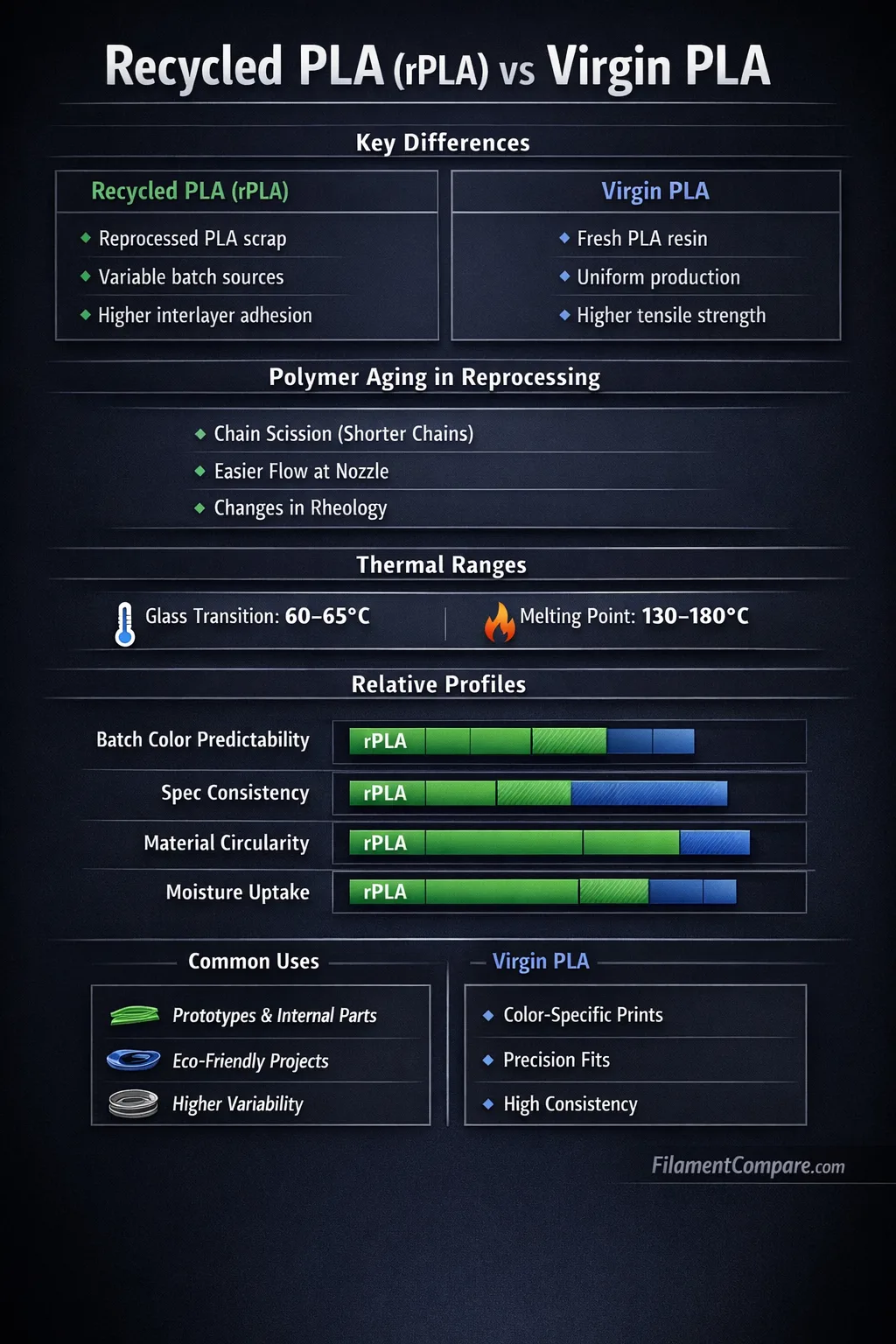
When PLA is melted multiple times, small amounts of heat, shear, and moisture can encourage chain scission (shorter polymer chains). That shift typically shows up as easier flow at the nozzle and changes in rheology, which is why some recycling workflows use stabilization approaches like chain extenders in controlled compounding.✅Source
Practical Meaning: Two spools can both be labeled PLA and still feel different because molecular weight and additive packages influence how the melt behaves in FFF/FDM.
Thermal Window and Real-World Limits
PLA’s useful temperature window is often discussed through glass transition (where it softens) and melting (where it flows). Reported PLA ranges vary by stereochemistry and grade, but Tg is commonly around 60–65°C and melting spans a wider range that often falls near 130–180°C across different PLA structures and crystallinities.✅Source
Compostability claims are not the same thing as “disappears anywhere.” Standards like ISO 17088 define requirements used for industrial composting labeling and evaluation, including disintegration and biodegradation criteria under managed conditions.✅Source
What Standard Test Labels Mean in Filament Datasheets
- MFR / MVR
- Melt mass-flow and melt volume-flow rates describe how easily a polymer flows under a defined temperature and load. Higher flow typically indicates a more fluid melt for the same test setup.✅Source
- Why It Matters
- In FFF printing, flow behavior influences extrusion stability, response to speed changes, and how the filament behaves with small features.
- Tensile Properties
- ISO 527-1 sets general principles for measuring tensile behavior (stress–strain) in plastics under defined conditions, enabling comparable reporting across materials and labs.✅Source
- Why It Matters
- For printed parts, tensile numbers are most useful when you also know print direction, infill strategy, and layer settings—because anisotropy is part of FFF reality.
rPLA and Virgin PLA in Daily Printing
Relative Profile Batch Color Predictability
Relative Profile Spec Consistency Across Batches
Relative Profile Material Circularity
Relative Profile Moisture Uptake (Example)
Color and Appearance: Some rPLA filament lines intentionally keep the feedstock “as-is,” which can make each batch’s shade unique while staying within PLA chemistry. One well-documented example is a recycled PLA product made without added pigments, where batch-to-batch color varies by design.✅Source
Moisture and Processing Discipline
Dry handling matters for virgin PLA and rPLA alike because water can drive hydrolysis during melting, changing melt behavior. Resin producers often describe dried-air or drying practices as part of maintaining stable processing for PLA grades in industrial contexts.✅Source
What Changes First When PLA Is Wet
- Flow Stability can shift, especially on thin walls and fast infill.
- Surface finish may show more micro-bubbles or a slightly different sheen.
- Stringing behavior can drift because viscosity is not exactly the same.
Selection Patterns People Use for rPLA and Virgin PLA
Recycled PLA (rPLA) Is Commonly Chosen For
- High-volume prints where consistent PLA behavior matters more than strict color matching.
- Internal parts and prototypes where material circularity is a key value.
- Workflows that can tolerate mild variation in appearance while keeping PLA-like handling.
Virgin PLA Is Commonly Preferred For
- Color-critical sets that need the same shade across many spools.
- Tight-fit assemblies where predictable diameter tolerance supports repeatability.
- Print libraries where profile reuse across batches is a core requirement.
One Visual Walkthrough on Recycled vs Virgin Filament
This kind of side-by-side demo is most useful when you watch for flow consistency, surface finish, and how temperature sensitivity shows up across multiple prints—not just a single sample.
