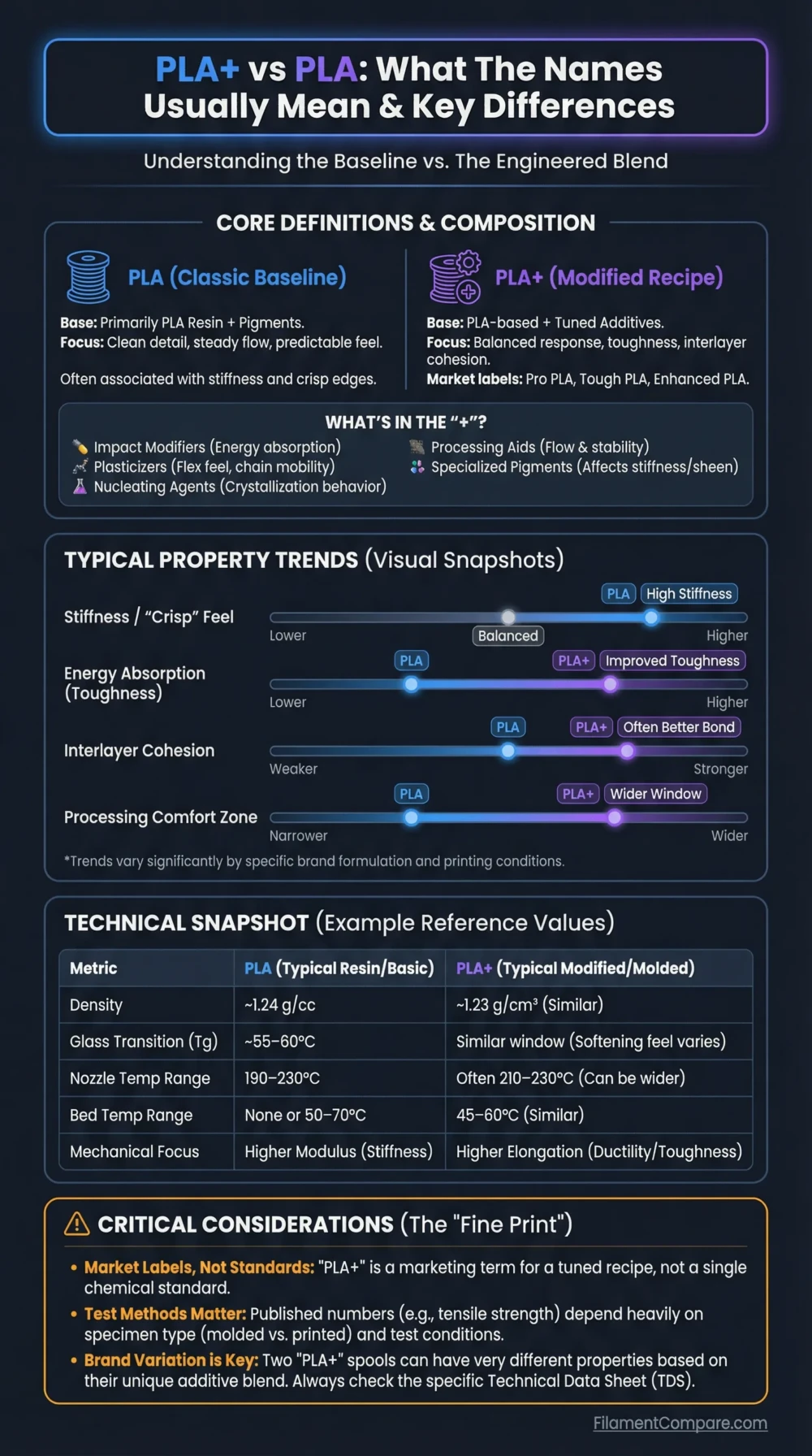
| Attribute | PLA ✅Source | PLA+ ✅Source |
|---|---|---|
| What the Name Usually Signals | PLA is polylactic acid as a base polymer family; filament recipes still vary by brand. | PLA+ is typically modified PLA (additives / blends) sold as PLA Plus, Pro PLA, or Tough PLA. |
| Base Material | Primarily PLA resin with pigments and print-focused additives. | Primarily PLA-based with a stronger emphasis on toughness-leaning modifiers and layer-bond support (varies by brand). |
| Density | Typical resin specific gravity around 1.24 g/cc (grade-dependent). | Typical value listed: 1.23 g/cm³. |
| Glass Transition (Tg) | Listed range: 55–60°C. | Not listed in the cited sheet; many PLA+ products sit in a similar PLA-family Tg window. |
| Melting / Melt Peak | Listed melt peak range: 145–160°C (grade-dependent crystallinity). | Not listed in the cited sheet; PLA+ is still PLA-based, so melting behavior is typically within a PLA-like region but can shift with modifiers. |
| Nozzle Temperature Range | Listed printing range: 190–230°C. | Listed extruder range: 210–230°C (also shows a broader 190–230°C “recommended parameters” line). |
| Build Plate Temperature | Listed: none or 50–70°C (application-dependent). | Listed: 45–60°C (also shows a 45°C line under “recommended parameters”). |
| Tensile / Flexural Snapshot | Example listed (resin test bars): ~60 MPa yield strength and ~3.6 GPa tensile modulus (method and specimen type matter). | Typical values listed (injection-molded test bars): 63 MPa tensile strength, 74 MPa flexural strength, 1973 MPa flexural modulus, 20% elongation at break. |
| Heat Deflection Temperature | Example listed (resin test bars): ~55°C at 0.45 MPa (grade and crystallinity change this). | Typical value listed: 53°C. |
| What This Table Is (and Isn’t) | These values are reference points from specific documents and test conditions. Filament brands can differ in additives, pigments, and processing, so comparison is most reliable when the same testing style is used. | |
PLA+ and PLA sit in the same PLA-family universe, but they often feel different in real prints. PLA is the familiar baseline; PLA Plus usually means “PLA with a tuned recipe.” The interesting part is not the plus sign itself—it’s the additives, the blend strategy, and the test numbers a brand chooses to publish.
- PLA+ vs PLA: What The Names Usually Mean
- PLA As A Filament Category
- PLA+ As A Recipe Direction
- What Typically Changes Inside PLA+ Formulations
- Thermal Behavior: Glass Transition And Softening Window
- Mechanical Profile: Stiffness, Strength, And Energy Absorption
- PLA “Feel” In Many Prints
- PLA+ “Feel” In Many Prints
- Surface Finish And Detail Rendering
- Dimensional Behavior In Longer Prints
- How Published Numbers Are Usually Measured
- Temperature Labels On Spools: What They Usually Represent
- Common Alternate Names
- Practical Comparison Without Guesswork
- PLA: classic PLA-family baseline
- PLA+: modified PLA recipe (brand-defined)
- Numbers: only comparable with matching test methods
- Thermal: Tg/softening drives “heat feel”
- Mechanical: stiffness vs energy absorption balance
PLA+ vs PLA: What The Names Usually Mean
PLA+ is not a single chemical standard. It’s a market label used by many brands for a PLA-based filament that’s been tuned for a particular balance—often toughness, layer bonding, and a wider processing comfort zone. The plus sign is consistent; the recipe behind it is not.
PLA As A Filament Category
PLA filament commonly targets clean detail, steady flow, and a predictable feel across many printers. Even within “plain” PLA, brands can shift surface sheen, stiffness, and thermal response with pigments and processing aids, so “PLA” still covers a range. For a broader overview of how PLA variants like PLA+, HT-PLA, and Meta PLA differ in formulation and behavior, see the Ultimate PLA Filament Guide.
PLA+ As A Recipe Direction
PLA+ usually points to modified PLA—often using impact modifiers, plasticizers, or copolymer-style tweaks to change how the material stores and releases energy. Many brands also use names like Tough PLA or Pro PLA to signal the same idea: PLA base with a more engineered balance.
What Typically Changes Inside PLA+ Formulations
When a spool is labeled PLA+, the “plus” is usually about additives and blend design. In the filament world, additive choices can shift interlayer cohesion, ductile response, and surface feel without turning the material into a different polymer family. ✅Source
- Impact Modifiers
- Elastomer-like phases or toughening agents that aim to increase energy absorption while keeping a PLA base.
- Plasticizers
- Small molecules or oligomers that can change chain mobility, affecting flex feel and sometimes layer fusion.
- Nucleating Agents
- Additives that encourage crystallization behavior, which can shift thermal response and part feel (grade-dependent).
- Processing Aids
- Flow and stability helpers that can influence extrusion consistency and surface finish.
- Pigments And Fillers
- Colorants and micro-additives that can nudge stiffness, gloss, and even perceived “snap,” depending on loading.
Thermal Behavior: Glass Transition And Softening Window
Glass transition is where PLA-family materials start to feel noticeably softer as temperature rises. Many PLA grades show this transition in the ~45–65°C band, and a representative thermal analysis reports a midpoint around 63°C for polylactic acid under specific DSC conditions. ✅Source
Because PLA+ is still PLA-based, many PLA+ products live in a similar thermal neighborhood, yet modifiers can shift how “softening” feels in practice. Two spools can both be PLA+ and still show different responses because crystallinity, additive selection, and pigment load change the curve.
Thermal numbers are meaningful only when the test method and specimen type are known. A resin datasheet, an injection-molded bar, and a printed part can all show different absolute values—even if the label still says PLA or PLA+.
Mechanical Profile: Stiffness, Strength, And Energy Absorption
PLA “Feel” In Many Prints
PLA is widely associated with a stiff, clean-edged response and a crisp surface when printed well. That stiffness often shows up as strong dimensional “hold,” especially on decorative geometry where sharp detail matters.
PLA+ “Feel” In Many Prints
PLA+ is often sold as a more engineered blend that aims for a balanced mechanical response—especially around energy absorption and interlayer cohesion. The exact outcome depends on the brand’s formula, but the marketing intent is usually consistent.
Typical Trend Visual (varies by brand and print conditions)
Surface Finish And Detail Rendering
Surface finish is strongly tied to flow stability, cooling behavior, and the filament’s pigment package. Many PLA lines are tuned for clean edges and uniform sheen. Many PLA+ lines aim for a similar “clean” result while also targeting a more balanced mechanical response. Neither label guarantees a specific gloss level—brands often differentiate products by pigment and additive choices.
Dimensional Behavior In Longer Prints
For PLA and PLA+, “dimensional behavior” in a print is a mix of thermal contraction, layer cooling, and the part’s geometry. A spool with a tighter diameter tolerance and stable melt flow typically produces more consistent extrusion volume. The label (PLA or PLA+) matters less here than the manufacturing control behind the filament.
How Published Numbers Are Usually Measured
When brands publish tensile strength, modulus, or elongation, the test method matters. A common reference is ASTM’s tensile plastics standard, which specifies specimen shapes and controlled test conditions, making results more interpretable across labs. ✅Source
- Specimen Type: many datasheets use injection-molded or standardized bars; printed parts can behave differently.
- Test Speed And Conditioning: changes in strain rate and humidity/temperature can shift results.
- Orientation And Layering: a printed tensile bar includes toolpath effects; a molded bar does not.
- Unit And Standard Matching: impact values are especially sensitive to notch geometry and standard choice.
Temperature Labels On Spools: What They Usually Represent
Temperature ranges on PLA and PLA+ spools are typically manufacturer-specific working windows rather than universal material constants. Those ranges reflect a brand’s chosen viscosity target, pigment system, and intended print behavior. This is why two PLA+ spools can list different numbers and still both be “real” PLA+.
Common Alternate Names
- PLA+ / PLA Plus
- Pro PLA
- Tough PLA
- Enhanced PLA / Modified PLA
Practical Comparison Without Guesswork
A clean way to compare PLA and PLA+ is to focus on published and repeatable signals: the temperature label, the mechanical test method, and whether numbers come from molded bars or printed parts. When those three align, the comparison becomes meaningful. When they don’t, the label alone can’t carry the full story.
Good comparisons keep the same standard, same specimen style, and same units. That’s where PLA vs PLA+ turns from a label debate into real, checkable data.
