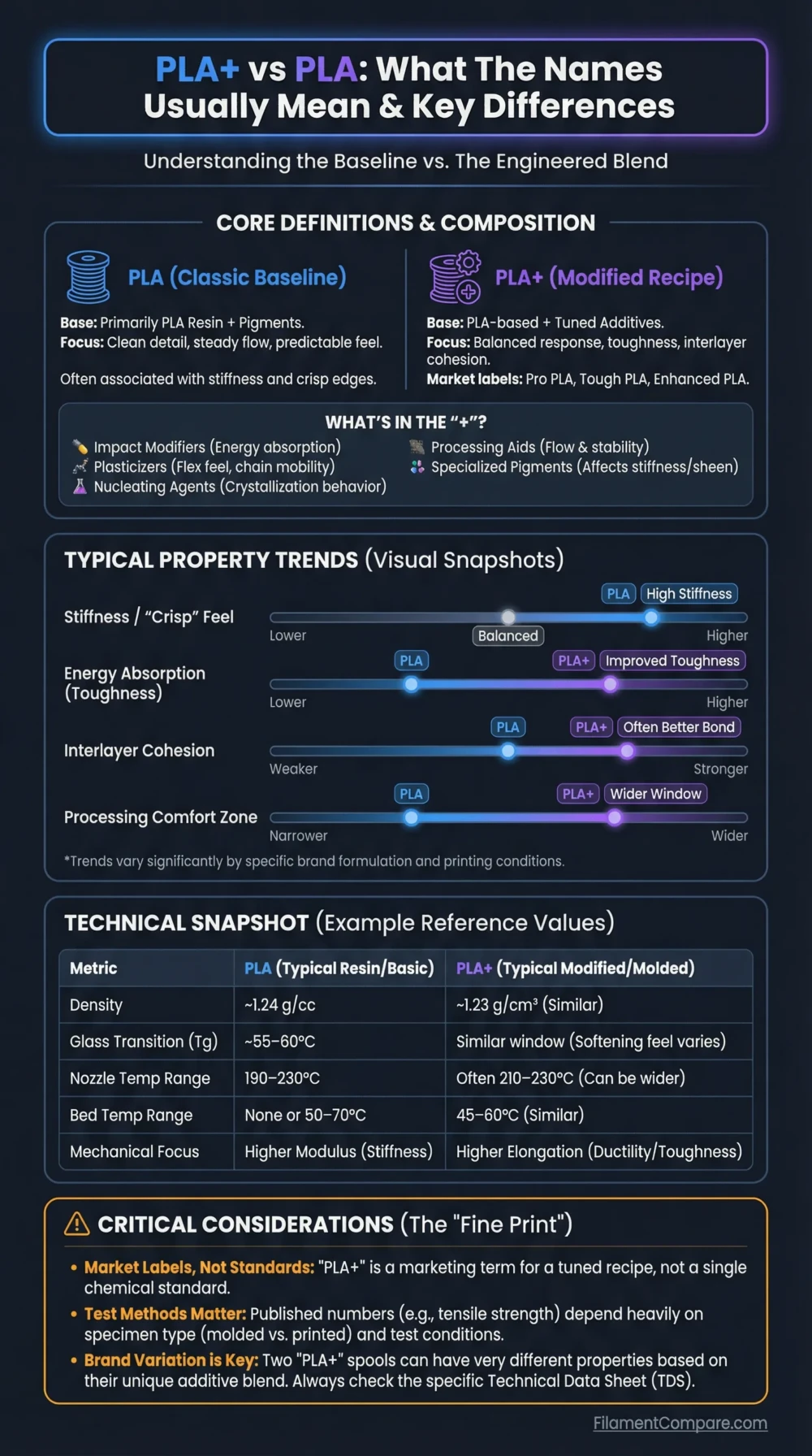
PLA is usually the simpler choice for crisp visual prints, while PLA+ is commonly formulated to reduce brittleness and improve impact behavior. The plus sign does not define one universal recipe, so the real comparison is between a known standard PLA and a documented PLA+ product. For most printers, both remain low-warp materials that work without an enclosure.
The Practical Choice
Choose PLA for display models, miniatures, dimensionally tidy prototypes, broad color selection, and low-cost routine printing. Choose PLA+ for handled parts, props, clips, housings, and prints that may be dropped or flexed occasionally—provided the manufacturer publishes useful technical data for that exact product.
Best for First Prints
PLA usually needs the least profile adjustment and offers a wide working window.
Better for Drop-Prone Parts
PLA+ is often tuned for higher impact resistance and less brittle failure.
Better for Fine Visual Detail
PLA is a dependable choice for sharp corners, lettering, and small decorative features.
Better for Clips and Tabs
PLA+ is usually the safer starting point when a part must bend slightly during assembly.
Better for Verified Properties
Either can be the better option; select the product with a current datasheet and printed-part test values.
Better Heat Tolerance
Neither by name alone. Many PLA+ grades remain in the same thermal class as ordinary PLA.
Better for Large Flat Prints
PLA has very low shrinkage and is widely profiled for open-frame printers.
Better for Frequently Handled Props
PLA+ often tolerates knocks and edge impacts better than a brittle standard PLA.
| Decision Point | PLA | PLA+ | Practical Edge |
|---|---|---|---|
| Material Family | PLA-based thermoplastic filament | Modified PLA-based filament; additives and blend design vary by manufacturer | Product-specific |
| Print Difficulty | Very low | Low, though some grades need more temperature or flow tuning | PLA |
| Typical Nozzle Temperature | Usually about 185–230°C | Often about 190–230°C; some products start higher | Check spool profile |
| Typical Bed Temperature | Often 25–60°C | Often 30–65°C | Similar hardware |
| Enclosure Requirement | Usually not needed | Usually not needed | Tie |
| Heat Resistance | Low unless a heat-focused grade is annealed as directed | Often similar to PLA unless the datasheet states otherwise | Grade-dependent |
| Impact Behavior | Can fracture sharply under impact | Commonly formulated for greater toughness and less brittle failure | PLA+ |
| Stiffness | Usually high and useful for rigid models or jigs | Varies; toughening can retain or reduce stiffness depending on formulation | PLA for predictable rigidity |
| Layer Adhesion | Good with correct temperature and cooling | Often improved, but orientation and settings still control Z-strength | PLA+ when documented |
| Moisture Behavior | Low to moderate sensitivity; wet filament can still cause surface defects | Brand-dependent; do not assume the modifier makes it moisture-proof | Store both dry |
| Surface Finish | Crisp, predictable, and available in many specialty appearances | Usually smooth; flow and gloss vary more by formula | PLA for visual range |
| Outdoor Suitability | Limited for long exposure to heat and UV | Usually still limited unless specifically UV-stabilized | Consider ASA or a verified outdoor grade |
| Typical Uses | Models, miniatures, prototypes, organizers, dimensional checks | Props, brackets, housings, clips, handled prototypes | Use-case based |
| Main Limitation | Brittle failure and low thermal headroom | No shared industry recipe; performance varies sharply by brand and variant | Read the datasheet |
| Better Choice | Visual accuracy, price, ease, color choice | Impact tolerance and functional handling | Neither replaces the other |
This PLA versus PLA+ comparison combines manufacturer datasheets with established printer-material documentation; it describes common patterns rather than fixed results because brand, color, additives, moisture, orientation, and slicer settings can change the printed part.
Material Profiles
PLA Material Profile
- Polymer type: PLA-based thermoplastic polyester filament
- Print difficulty: Very low
- Nozzle range: Commonly 185–230°C
- Bed range: Commonly 25–60°C
- Enclosure: Not normally required
- Drying need: Occasional, based on storage and symptoms
- Typical behavior: Stiff, crisp, low-warp, comparatively brittle
- Best uses: Models, prototypes, miniatures, visual parts, jigs
PLA+ Material Profile
- Polymer type: Modified PLA formulation or PLA-rich blend
- Print difficulty: Low
- Nozzle range: Commonly 190–230°C, product-dependent
- Bed range: Commonly 30–65°C
- Enclosure: Usually unnecessary
- Drying need: Follow the product sheet; recommendations differ
- Typical behavior: Less brittle, smoother failure, formulation-dependent stiffness
- Best uses: Props, clips, housings, brackets, handled parts
Relative Printing-Use Scores
PLA
PLA+
The meter values are comparative printing-use indicators, not laboratory ratings. A different brand, pigment, modifier package, moisture level, part orientation, line width, cooling strategy, or test method can move the result in either direction.
What the Plus Sign Actually Changes
PLA+ is best treated as a manufacturer-defined product category, not a single material with one fixed property sheet. One company may use an impact modifier, another may change the PLA resin grade, and a third may optimize flow for faster printing. “PLA Pro,” “Tough PLA,” and “PLA+” may overlap in purpose, but the names alone do not prove identical chemistry or performance.
The safest buying method is to compare three items on the exact product page: printed-part impact data, X–Y and Z tensile values, and heat-deflection or glass-transition information. A spool described only as “stronger” gives too little information because tensile strength, stiffness, impact resistance, elongation, and layer adhesion describe different failure modes.
Impact, Stiffness, and Layer Direction
Standard PLA is commonly valued for rigidity. That makes it useful for display models, alignment fixtures, brackets that do not receive shocks, and parts where a crisp shape matters more than surviving a drop. The same stiffness can make thin tabs or sharp internal corners more likely to crack when bent.
A well-documented PLA+ can move the balance toward impact tolerance. Polymaker’s published PolyLite PLA Pro data, for example, lists a lower X–Y Young’s modulus than its standard PolyLite PLA while reporting much higher notched Charpy impact strength under the manufacturer’s stated specimen conditions[a]. That example shows why “tougher” and “stiffer” should not be treated as synonyms.
Print orientation remains part of the material decision. A part loaded across layer lines can fail long before an X–Y test value suggests, and more walls often matter more than a higher infill percentage for clips, brackets, and enclosures. PLA+ may improve the margin, but it does not remove FFF anisotropy (the difference between strength along layers and strength through them).
Heat Resistance Is Usually a Separate Upgrade
The name PLA+ does not guarantee extra thermal headroom. In eSUN’s current PLA+ sheet, the reported heat-distortion temperature is 53°C at 0.45 MPa, which matches the 53°C value shown in the company’s older standard PLA sheet[b]. This same-brand example is not a rule for every product, but it demonstrates why the plus sign should not be read as “high heat.”
Parts near sunny windows, warm motors, lighting equipment, dashboards, or hot water need a verified temperature margin. Moderate room warmth is one thing; a closed vehicle in summer can be far more demanding. For those uses, compare a named high-heat PLA, PETG, ASA, polycarbonate, or another suitable material rather than relying on generic PLA+ branding.
Annealing can improve heat behavior for certain crystallization-ready PLA grades. NatureWorks states that its Ingeo 3D850 resin can be post-annealed at 80–130°C to promote crystallization and raise heat-deflection performance[c]. This is a controlled material-and-process route, not evidence that every PLA or PLA+ spool should be heated the same way (dimensions should be checked after any annealing trial).
Print Settings and Surface Results
Both materials are compatible with ordinary FFF hardware, a standard brass nozzle, active part cooling, and an open printer in most cases. Prusa’s material guide places general PLA within a broad 185–235°C nozzle range and a 50–60°C bed range, illustrating how wide the normal PLA processing window can be across products and machines[d].
PLA+ should begin with its manufacturer profile rather than an automatic temperature increase. Current official examples do not all agree: eSUN’s PLA+ sheet recommends 210–230°C, while Polymaker lists 190–220°C for PolyLite PLA Pro[e]. A temperature tower, flow calibration, pressure-advance test, and retraction check are more useful than applying one internet setting to every PLA+ spool.
When Corners Look Soft
Reduce nozzle temperature in small steps, confirm flow calibration, and keep part cooling high after the first layers.
When Layers Split
Raise nozzle temperature slightly, reduce excessive fan speed, add walls, and rotate the part so the main load stays within the layer plane.
When Stringing Appears
Dry the spool if needed, then tune retraction, travel speed, nozzle temperature, and pressure advance for that exact formulation.
Moisture, Storage, and Variant Traps
PLA is less moisture-sensitive than nylon or water-soluble support filament, but it is not unaffected. Prusa notes that absorbed humidity can produce surface defects, blobs, bubbling, stringing, and weaker layer adhesion, and it lists a controlled PLA drying reference of 45°C for six hours for its own materials[f]. Always follow the spool maker’s limit because cardboard cores, plastic spools, and modifiers can require different treatment.
Do not extend the PLA versus PLA+ result to every visual variant. Silk, matte, wood-filled, recycled, carbon-filled, glow, high-speed, and lightweight foaming products can alter stiffness, layer bonding, abrasion, flow, or density. Compare a specialty PLA with its own datasheet, not with the behavior of a plain-color standard spool.
| Use Case | More Suitable Starting Point | Reason |
|---|---|---|
| First calibration prints | PLA | Broad profiles, low warp, and easy visual diagnosis |
| Miniatures and display models | PLA | Crisp detail, many colors, and predictable cooling behavior |
| Snap-fit clip | Documented PLA+ | Often better tolerance of short bending and impact loads |
| Wall-mounted tool holder | PLA+ or PLA after load testing | PLA+ may handle knocks better; geometry and layer direction still dominate |
| Dimensional checking jig | PLA | High stiffness and low shrinkage suit room-temperature checking |
| Frequently handled cosplay prop | PLA+ | Reduced brittle cracking is useful around edges, seams, and drops |
| Large flat decorative panel | PLA | Low warping and familiar bed-adhesion profiles |
| Electronics enclosure on a desk | PLA+ | Better impact tolerance can help during assembly and daily handling |
| Part near a warm motor | Neither by default | Select a material with verified service-temperature data and enough safety margin |
| Permanent outdoor fixture | Neither by default | Generic PLA and PLA+ are not dependable substitutes for verified UV- and weather-suited grades |
| Food-contact container | Neither by default | Filament certification, printer contamination, nozzle material, layer lines, cleaning, and local rules all matter |
| Batch of low-cost visual prototypes | PLA | The PLA+ premium adds little when parts will not be stressed |
Where Each Material Fits Better
Choose PLA When
- The part is mainly visual or used for dimensional review.
- Fine text, sharp corners, or miniature detail has priority.
- The print will stay indoors at ordinary room temperatures.
- Low material cost and a wide color range matter.
- You want the easiest profile for a new printer or nozzle.
- The part needs rigidity more than impact absorption.
PLA Is Less Suitable When
- Thin tabs must flex repeatedly.
- The part may be dropped on a hard floor.
- The environment may approach PLA’s softening range.
- Long outdoor exposure is expected.
Choose PLA+ When
- The exact product has published impact or layer-strength data.
- The part will be handled, transported, assembled, or bumped.
- A clip, latch, housing, or prop needs less brittle behavior.
- You want PLA-like printing without moving to a higher-warp material.
- A small material premium is acceptable for added toughness.
- You are willing to tune flow and temperature for that formulation.
PLA+ Is Less Suitable When
- The product has no useful datasheet or clear print profile.
- You are buying it only because “plus” sounds heat resistant.
- Maximum stiffness is more important than impact tolerance.
- A verified outdoor, chemical, or high-temperature material is required.
Material Selection Matrix
Best Choice by Priority
- Choose PLA if the job is a visual model, miniature, low-cost prototype, rigid jig, or large low-warp print used at room temperature.
- Choose PLA+ if the part will be handled, dropped, clipped into place, transported, or exposed to light impact—and the exact filament has a credible datasheet.
- Choose another material if heat, long outdoor exposure, repeated flexing, chemical contact, or certified end-use performance controls the design.
There is no reliable overall winner. PLA is usually more predictable as a visual and rigid prototyping material, while PLA+ is often more forgiving under impact. The deciding question is not whether a spool has a plus sign; it is whether the documented property change matches the part’s real load.
PLA+ vs PLA Questions
Is PLA+ always stronger than PLA?
No. Some PLA+ products have higher impact resistance or better elongation, while standard PLA may remain stiffer or even show higher tensile values in a different test. Compare the same test method, specimen orientation, and conditioning.
Can PLA+ use a normal PLA slicer profile?
A standard PLA profile is a reasonable starting point only when the spool maker gives no dedicated profile. Match the published nozzle and bed ranges first, then calibrate temperature, flow, pressure advance, and retraction.
Does PLA+ survive more heat than PLA?
Not automatically. Many PLA+ grades stay close to ordinary PLA in heat-deflection behavior. Use a named high-heat grade or another polymer when temperature is part of the design requirement.
Is PLA+ less brittle?
That is a common design goal, and many documented products do show better impact performance. The size of the improvement varies, so thin clips and safety-related parts still need real testing.
Is PLA+ food-safe?
The name does not establish food-contact suitability. A compliant raw material does not automatically make a printed object suitable because pigments, additives, nozzle composition, printer contamination, porous layer lines, cleaning method, and local requirements also apply. Prusa likewise advises against assuming ordinary filament prints are suitable for direct food contact[g].
Can PLA and PLA+ be used in the same multi-color print?
Often yes when their temperature windows overlap, but bonding between two formulations can differ from bonding within one filament. Test the interface before using the combination in a loaded part.
Technical References
- [a] PolyLite™ PLA Pro (Used for the printed-specimen modulus, tensile, impact, and recommended printing-condition example. The manufacturer also states that real results depend on part design and print conditions.)
- [b] PLA+ Technical Data Sheet and PLA Technical Data Sheet (Used for the same-brand heat-distortion comparison and the current PLA+ print and drying recommendations. These are product-specific values, not universal PLA-class limits.)
- [c] Ingeo Biopolymer 3D850 Technical Data Sheet (Used for the grade-specific annealing range and the explanation that crystallization can raise heat-deflection performance.)
- [d] Filament Material Guide (Used for the broad PLA nozzle and bed temperature reference and the general open-printer hardware context.)
- [e] Technical Data Sheet (This Polymaker document was used alongside the eSUN PLA+ sheet to show that official PLA+ and PLA Pro temperature windows differ by formulation.)
- [f] Drying Filament (Used for moisture symptoms, dry-storage guidance, and Prusa’s controlled drying reference for its PLA materials.)
- [g] PLA (Used for the caution against treating ordinary filament prints as automatically suitable for direct food contact.)
