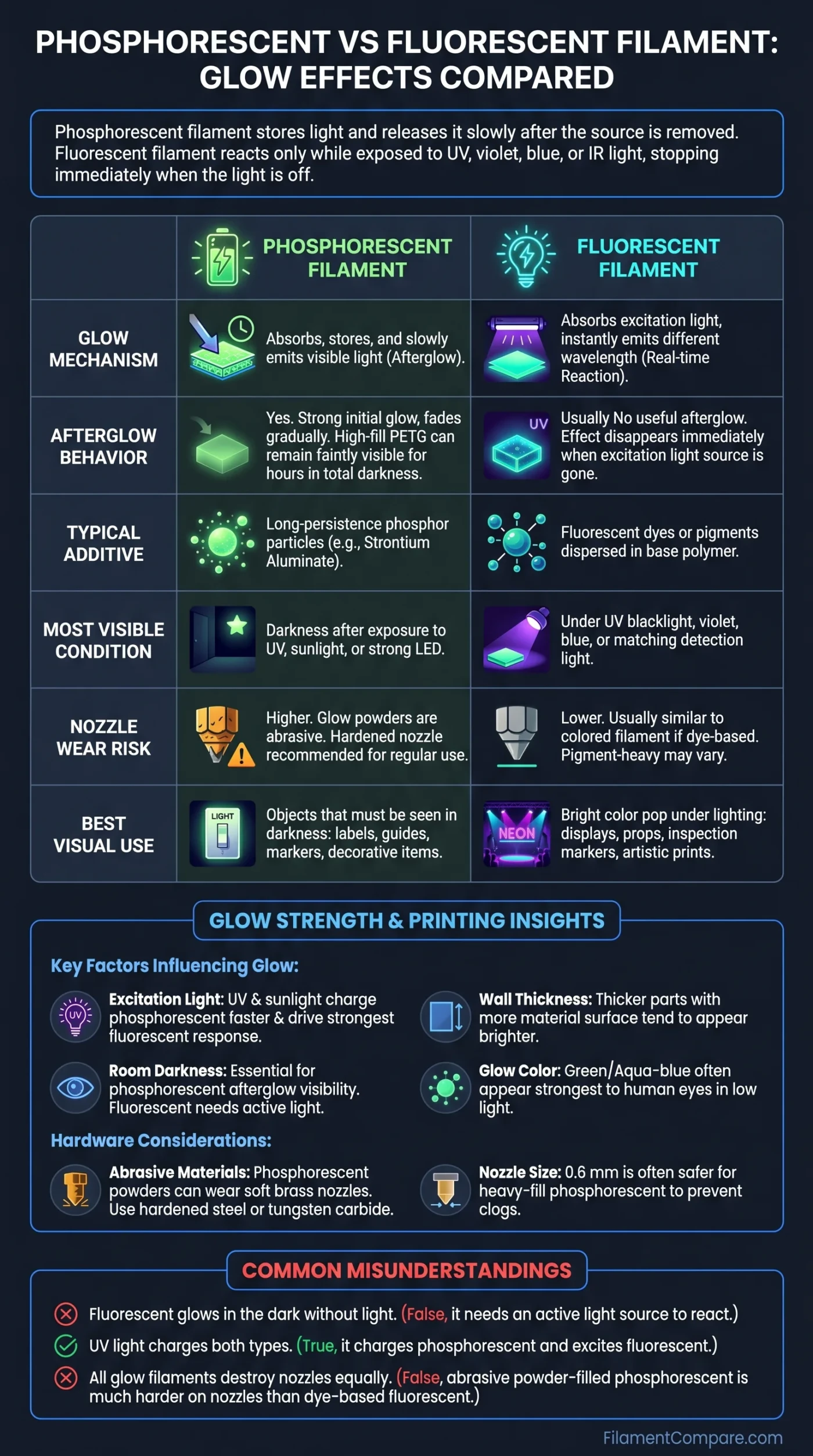
Phosphorescent and fluorescent filament can both create glowing 3D prints, but they do it in different ways. Phosphorescent filament stores light energy and releases it slowly after the light source is removed. Fluorescent filament reacts while it is being hit by UV, violet, blue, or infrared light, then usually stops glowing almost immediately when that excitation light is gone.
| Comparison Point | Phosphorescent Filament | Fluorescent Filament |
|---|---|---|
| Glow Mechanism | Absorbs light, stores part of that energy, then emits visible light after charging. This is the classic glow-in-the-dark effect. | Absorbs one wavelength and emits another while the excitation source is active. This is the classic UV-reactive or light-reactive effect. |
| Afterglow | Yes. The glow may be strong for the first minutes, then fade gradually. Some high-fill PETG glow materials can remain faintly visible for several hours in full darkness.[a] | Usually no useful afterglow. The visual effect depends on ongoing UV, blue, violet, or IR excitation. |
| Typical Additive | Common modern formulations use strontium aluminate or similar long-persistence phosphor particles. | Usually uses fluorescent dyes or pigments dispersed through PLA, PETG, resin, or specialty materials. |
| Most Visible Lighting Condition | Darkness after exposure to sunlight, UV light, or a strong LED source. | Under UV blacklight, violet light, blue light, or a matching detection wavelength. |
| Common Base Polymers | PLA and PETG are common; TPU and ABS-like variants also exist from some brands. | PLA is common for visible fluorescent colors; technical versions can include PETG, ABS, TPU, or near-infrared fluorescent filaments. |
| Nozzle Wear | Often higher. Glow powders can be abrasive, so a hardened nozzle is preferred, especially for regular use.[b] | Usually closer to normal colored filament when the effect comes from dye. Pigment-heavy or filled formulations may vary. |
| Nozzle Diameter | 0.4 mm can work for some brands, but 0.6 mm is often safer for heavy glow-powder formulas. | 0.4 mm is usually fine unless the manufacturer lists larger particles or special print requirements. |
| Visual Strength | Best for objects that must be seen after lights go out: labels, guides, handles, decorative stars, low-light markers. | Best for bright color pop under lighting: displays, props, artistic prints, inspection markers, optical tracking, and hidden tags. |
| Color Range | Green and blue-green usually look brightest. Other glow colors exist, but they often appear dimmer. | Wide visible color range: neon yellow, green, orange, pink, blue, and specialty invisible-to-visible or IR-responsive effects. |
| Main Limitation | Glow fades over time and the additive can affect nozzle wear, surface finish, and layer detail. | Needs the right light source to show the effect; without that light, it may look like a normal bright color. |
This comparison treats phosphorescent filament and fluorescent filament as effect families, using manufacturer material pages, datasheets, and optical references; real results depend on pigment loading, base polymer, color, nozzle size, lighting strength, and print geometry.
- Glow-in-the-dark effect
- UV-reactive color
- Strontium aluminate
- Fluorescent dye
- Afterglow decay
- Hardened nozzle
How the Glow Effect Works
Both materials sit under the wider idea of photoluminescence, where a material absorbs light and emits light back. The split is simple in print behavior: phosphorescent filament keeps glowing after charging, while fluorescent filament needs a live excitation source to keep shining.[c]
That difference matters more than the color name on the spool. A green phosphorescent PLA may look pale in daylight but glow clearly in darkness after charging. A neon green fluorescent PLA may look bright in daylight and intense under UV, yet it will not behave like a stored-energy glow material once the lamp is off.
Phosphorescent Filament: Stored Light, Slow Release
Phosphorescent filament is usually what makers mean by glow-in-the-dark filament. The plastic contains fine phosphor particles. These particles absorb energy from light, then release it slowly as visible glow. Green and aqua-blue shades are common because those emissions are easier for human eyes to notice in low light.
The useful effect has two phases. First, the print glows strongly after charging. Then the brightness drops. Fast. After that, a weaker glow may remain visible in very dark conditions. High-pigment PETG glow materials can be visible for several hours after charging, although the most noticeable part is still the early glow period.[d]
Fluorescent Filament: Reactive Color While Light Is Present
Fluorescent filament behaves differently. It reacts to incoming light and emits another wavelength almost immediately. Under UV blacklight, many fluorescent filaments look far brighter than they do under normal indoor lighting. Remove the UV light, and the effect drops away. No stored glow. That is the point.
This makes fluorescent filament useful when the print is part of a controlled lighting setup. It can create high-contrast visible marks, neon display pieces, color-coded parts, inspection markers, or optical features. Research groups have also used fluorescent 3D printing filament for embedded tracking markers that respond to a matching light and camera setup.[e]
Glow Strength, Charging, and Fade Behavior
Glow strength is not only about the filament label. It depends on pigment chemistry, particle size, pigment loading, wall thickness, light exposure, surface color, and the user’s eyes. A thick printed part with enough glow pigment usually appears stronger than a thin shell printed with low-infill walls.
| Factor | Effect on Phosphorescent Filament | Effect on Fluorescent Filament |
|---|---|---|
| UV Light | Charges many glow pigments quickly and can create a strong early glow. | Usually creates the strongest visible fluorescent response. |
| Sunlight | Good charging source because it includes broad-spectrum light. | Can make fluorescent colors look vivid, depending on dye and color. |
| Warm Indoor Bulbs | May charge slowly, especially with weaker bulbs. | Often gives less reaction than UV or violet light. |
| Wall Thickness | More glowing material near the surface can improve perceived brightness. | More visible surface area improves color impact under excitation. |
| Room Darkness | Needs darkness for the afterglow to be easy to see. | Can be visible in lit spaces if the excitation source is strong enough. |
For phosphorescent prints, the brightest-looking result often comes from short, strong charging with UV or sunlight, followed by viewing in a dark room. For fluorescent prints, the lamp remains part of the final look. The print and the lighting are a pair.
Why Green Glow Usually Looks Stronger
Many phosphorescent filaments are green or blue-green because common long-persistence phosphors emit strongly in that region, and the human eye is very sensitive to greenish light in dim conditions. Other colors can be attractive, especially for themed prints, but they may appear softer at the same pigment loading.
Printability and Hardware Wear
Most phosphorescent and fluorescent filaments print like their base polymer in broad terms. A PLA-based glow filament still behaves broadly like PLA. A PETG-based glow filament still needs PETG-style temperatures. The effect additive changes the details.
Phosphorescent Filament Print Behavior
Phosphorescent filament often contains mineral-like glow powder. Some modern high-brightness materials use strontium aluminate, which can make the filament more abrasive than plain PLA or plain PETG. Regular printing with this type of filament is better matched with hardened steel, tungsten carbide, ruby, or diamond-tip nozzles rather than soft brass.
Heavy glow-powder formulas can also prefer larger nozzle paths. A 0.6 mm nozzle gives particles more room and can reduce the chance of restriction compared with very small nozzle openings. Layer lines may look slightly more textured, especially when pigment loading is high.
Fluorescent Filament Print Behavior
Fluorescent filament is often easier on hardware when the color effect comes from dye rather than hard particles. Many neon PLA filaments print close to normal PLA settings. Still, the label matters. A fluorescent filament can be matte, silk, translucent, filled, flexible, or specialty optical material, and each version may need different temperatures, speeds, or drying habits.
For clean color response, surface quality matters. Smooth walls reflect light evenly, while rough walls scatter it. Thin details can glow brightly under UV, but broad surfaces often show the fluorescent effect more clearly from a distance.
Typical Printing Ranges
The safest values always come from the spool’s own datasheet. These ranges are useful for understanding the difference between effect type and base material, not for replacing manufacturer settings.
| Filament Type | Common Nozzle Range | Common Bed Range | Nozzle Choice | Printing Notes |
|---|---|---|---|---|
| Phosphorescent PLA | About 190–220 °C | About 45–65 °C | Hardened nozzle recommended for frequent use | Good for decorative glow parts, labels, and low-light markers. Avoid very small nozzles when the filament feels particle-heavy. |
| Phosphorescent PETG | About 230–270 °C, depending on brand | About 70–90 °C | Hardened nozzle strongly preferred for high-fill glow formulas | Better heat tolerance than PLA-based glow materials when the base polymer is PETG. Some high-fill PETG glow filaments list 0.6 mm nozzles. |
| Fluorescent PLA | About 190–220 °C | About 45–65 °C | Standard brass often works when no hard filler is present | Good for UV-reactive signs, color accents, props, toys, and display parts. |
| Fluorescent PETG | About 230–250 °C | About 70–85 °C | Depends on additive package | Useful when a fluorescent visual effect needs more toughness and heat tolerance than PLA can offer. |
| Specialty Fluorescent Filament | Manufacturer-specific | Manufacturer-specific | Manufacturer-specific | Near-infrared fluorescent materials, tracking filaments, and optical marker filaments need matching lights, filters, or cameras. |
Mechanical Properties and Layer Strength
The glow effect does not define the whole material. The base polymer still carries most of the mechanical behavior. PLA glow filament is usually chosen for easy printing and rigid parts. PETG glow filament offers more ductility and heat tolerance. TPU glow filament, when available, targets flexible parts.
Additives can change performance. A high load of phosphorescent powder can slightly reduce the amount of continuous polymer in the printed strand, which may affect surface feel, layer bonding, and impact behavior. This is not a flaw. It is a material tradeoff.
When Strength Matters More Than Glow
For brackets, tool holders, outdoor clips, and parts that receive regular load, the better comparison is not just phosphorescent vs fluorescent. It is PLA vs PETG vs ASA vs nylon, then the glow additive. A fluorescent PETG can be more practical than phosphorescent PLA if the part needs more temperature resistance and less stored glow.
When Visual Effect Matters More Than Strength
For props, signs, models, gaming pieces, art parts, key tags, ornaments, and low-light decorative objects, the effect can be the main reason to choose the material. Here, phosphorescent filament gives the print its own after-dark presence. Fluorescent filament gives it a sharper stage-light or UV-light reaction.
Useful material distinction: phosphorescent filament is usually judged by afterglow duration and brightness decay. Fluorescent filament is judged by color intensity under a specific light source. Testing both under the same room light can make the comparison misleading.
Surface Finish and Color Appearance
Phosphorescent filament often looks pale, creamy, translucent, or lightly tinted in normal light. This helps light enter the material and reach the glow particles. A darker opaque base can reduce the stored glow effect because less light reaches the particles and less emitted light escapes.
Fluorescent filament can look bold even before UV exposure. Neon yellow, green, orange, and pink filaments are common because the dye response supports a bright visible surface. Under blacklight, the print can appear far more intense than a regular colored PLA part.
Layer Height and Wall Count
Lower layer heights can produce a smoother surface, which helps both effects look cleaner. More walls can make a phosphorescent print appear stronger because there is more glowing material near the surface. Very sparse infill may still work for display pieces, but thin outer shells limit stored glow volume.
Translucency
Translucency helps phosphorescent materials because light can travel into the part and back out. For fluorescent materials, translucency can create a glowing-edge look under UV. Opaque neon filament gives a more solid, poster-like color. Both can look good. They just look different.
Best Uses for Phosphorescent Filament
Phosphorescent filament is strongest when the print must remain visible after the room gets dark. It is not only decorative; it can make small objects easier to find.
- Low-light labels: switch plates, cable tags, drawer markers, tool labels, and storage indicators.
- Navigation accents: small arrows, stair-edge markers, door-handle rings, and night-use guides.
- Decorative models: stars, moons, fantasy props, miniatures, wall art, and display pieces.
- Everyday objects: keychains, zipper pulls, remote-control markers, and small desk items.
- Multi-material accents: glowing inlays inside normal PLA or PETG parts for controlled visibility.
The best phosphorescent designs avoid relying on tiny glow areas. A small dot can be visible in darkness, but a larger glowing surface reads faster. Shape matters.
Best Uses for Fluorescent Filament
Fluorescent filament works well when there is a planned light source. It is also useful where bright color coding matters in normal light.
- UV-reactive props: stage pieces, cosplay details, display lettering, and themed models.
- High-visibility color coding: jigs, fixtures, workshop labels, safety-colored prototypes, and classroom models.
- Art and design prints: neon sculptures, translucent lampshade details, and layered color effects.
- Inspection markers: printed references that stand out under UV or filtered light.
- Tracking features: specialty fluorescent materials can support optical marker systems when paired with the right camera and filter.
For fluorescent prints, the light source is part of the material choice. A filament that looks strong under 365 nm UV may not look identical under 395 nm UV, and near-infrared fluorescent filament needs a matching imaging setup rather than the human eye alone.
Phosphorescent vs Fluorescent Filament by Project Type
| Project Type | Better Fit | Reason |
|---|---|---|
| Glow-in-the-dark wall stars | Phosphorescent filament | The print needs to remain visible after the room lights are off. |
| Blacklight display sign | Fluorescent filament | The effect is strongest while UV light is present. |
| Door lock finder | Phosphorescent filament | A charged glow ring can help locate the lock in darkness. |
| Workshop color labels | Fluorescent filament | Bright daylight color and UV response both help visibility. |
| Night-use key tag | Phosphorescent filament | The print can emit its own visible glow after charging. |
| Cosplay under stage UV | Fluorescent filament | The UV lighting can keep the color effect active. |
| Multi-material functional handle with low-light accent | Phosphorescent PETG or glow insert | The main part can remain strong while the accent improves low-light visibility. |
| Camera-readable hidden marker | Specialty fluorescent filament | Fluorescent response can be paired with optical filters or cameras. |
Charging and Lighting: What Changes the Result
A phosphorescent print charged under weak indoor lighting may look underwhelming. The same print charged under sunlight or UV can look much stronger. The difference is not magic; it is energy input. The pigment needs light exposure before it can release light in darkness.
Fluorescent filament does not need charging in the same way. It needs the right light at the right moment. A UV-reactive orange filament can look normal under a soft desk lamp, then appear intense under a blacklight. Turn the blacklight off, and the extra effect goes away.
365 nm vs 395 nm UV
Many hobby blacklights are around 395 nm, while some stronger inspection lamps are around 365 nm. Both can excite many fluorescent and phosphorescent materials, but the visual result can differ. 365 nm light is less visibly purple to human eyes, so the emitted color can look cleaner. 395 nm lamps are common and affordable, but they add more visible violet light to the scene.
Distance from the Light
Light intensity drops quickly with distance. A phosphorescent print held close to a UV lamp for a short charge may glow more than the same part sitting across the room. A fluorescent print also loses punch when the excitation light is too far away.
Nozzle, Extruder, and Maintenance Considerations
Phosphorescent filament deserves more hardware attention than ordinary decorative PLA. The glow particles can act like fine abrasive grit inside the nozzle path. A brass nozzle may still print a small test piece, but repeated printing can enlarge the nozzle opening and soften detail.
For steady use, a hardened nozzle is a better match. Some high-fill glow materials also mention wear on guide tubes and drive components, especially in long filament paths. A simple setup with a short, smooth filament path often feeds more consistently.
Practical Nozzle Pairings
- Occasional small PLA glow print: brass can work, but wear is possible.
- Regular phosphorescent printing: hardened steel or another wear-resistant nozzle is the safer choice.
- High-powder PETG glow filament: 0.6 mm hardened nozzle is often a better match than a small nozzle.
- Fluorescent dye-based PLA: standard brass is often acceptable when the filament is not filled with abrasive particles.
- Specialty fluorescent materials: follow the datasheet first, especially for optical or engineering filaments.
Drying, Storage, and Print Consistency
The glow additive is not the only moisture concern. The base polymer controls most drying needs. PLA is usually forgiving. PETG can string more when damp. Nylon or TPU versions need more care. A glow PETG that has absorbed moisture may show stringing, popping, rough texture, or weaker detail.
Storage is simple: sealed bag, desiccant, and less dust. Dust matters more with specialty filaments because particles, moisture, and worn nozzles can all look like “bad filament” when the real issue is the whole material path.
Color Accuracy and Multi-Color Printing
Phosphorescent filament can look different in daylight, under UV, and in darkness. A green glow material may look off-white or pale green on the shelf, bright green just after charging, then softer green as it fades. Product photos often show the strongest moment, not the whole fade curve.
Fluorescent filament can also shift by lighting. Under neutral daylight it may look neon. Under warm indoor light it may look less intense. Under UV it may become vivid enough to overpower nearby ordinary colors.
Mixing with Standard Filament
Multi-material printing can make both effects more useful. A normal PETG handle with a phosphorescent insert gives strength and low-light visibility. A matte black PLA sign with fluorescent lettering gives contrast under UV. The effect material does not need to be the whole print.
Safety and Use Environment
Modern glow-effect filaments are intended for normal 3D printing use, not for food contact by default. The safer assumption is simple: treat printed parts as decorative, visual, or utility objects unless the filament maker gives food-contact guidance for the exact material, color, and printing process.
Phosphorescent filament is not the same as old radioactive glow paint. Modern hobby glow filaments usually rely on non-radioactive phosphor additives, commonly strontium aluminate in many high-brightness products. The practical safety focus for printing is ventilation, nozzle wear, manufacturer temperature limits, and avoiding use cases the material is not rated for.
Cost and Value
Phosphorescent filament often costs more than basic PLA because glow powder adds material cost and can be harder to process. Very bright, long-afterglow formulations may cost more again. The value depends on whether the print needs real afterglow or just a bright color.
Fluorescent filament is often priced closer to other color-effect filaments, especially when it uses dye-based PLA. Specialty fluorescent materials made for optical detection, near-infrared response, or research-style marker systems can be a different category entirely.
Common Misunderstandings
- “Fluorescent filament glows in the dark.”
- Usually not by itself. It glows while excited by a suitable light source.
- “Phosphorescent filament stays bright all night.”
- The strong glow fades first. A faint afterglow may last longer, especially in total darkness and with high-quality glow pigment.
- “All glow filament destroys nozzles.”
- Wear depends on additive type, pigment loading, nozzle material, and print volume. Phosphorescent powder-filled materials deserve the most care.
- “Brighter daylight color means stronger afterglow.”
- Not always. A neon fluorescent color can look very bright in daylight but have no stored glow effect.
- “UV light is only for fluorescent filament.”
- UV can also charge many phosphorescent filaments faster than weak indoor lighting.
Which One Should You Choose?
Choose phosphorescent filament when the print needs visible afterglow after the light source is gone. It is the better match for night markers, glowing decoration, low-light labels, and printed parts meant to be found in darkness.
Choose fluorescent filament when the print will be viewed under UV, violet, blue, or a matching optical light source. It is the better match for neon display parts, blacklight props, color coding, UV-reactive lettering, and optical marker projects.
For the strongest result, choose by behavior first, then by base polymer. Stored glow means phosphorescent. Live light reaction means fluorescent. After that, pick PLA for easy decorative printing, PETG for more heat-tolerant utility parts, TPU for flexible needs, and specialty materials only when the project truly needs them.
Resources Used
- [a] Prusament PETG Ultraglow material page
- [b] Prusa Knowledge Base: Prusament PETG Ultraglow troubleshooting
- [c] Edinburgh Instruments: luminescence, photoluminescence, fluorescence, and phosphorescence
- [d] Prusa Knowledge Base: glow properties and charging notes
- [e] MIT CSAIL HCI Engineering Group: BrightMarker fluorescent 3D printed markers
